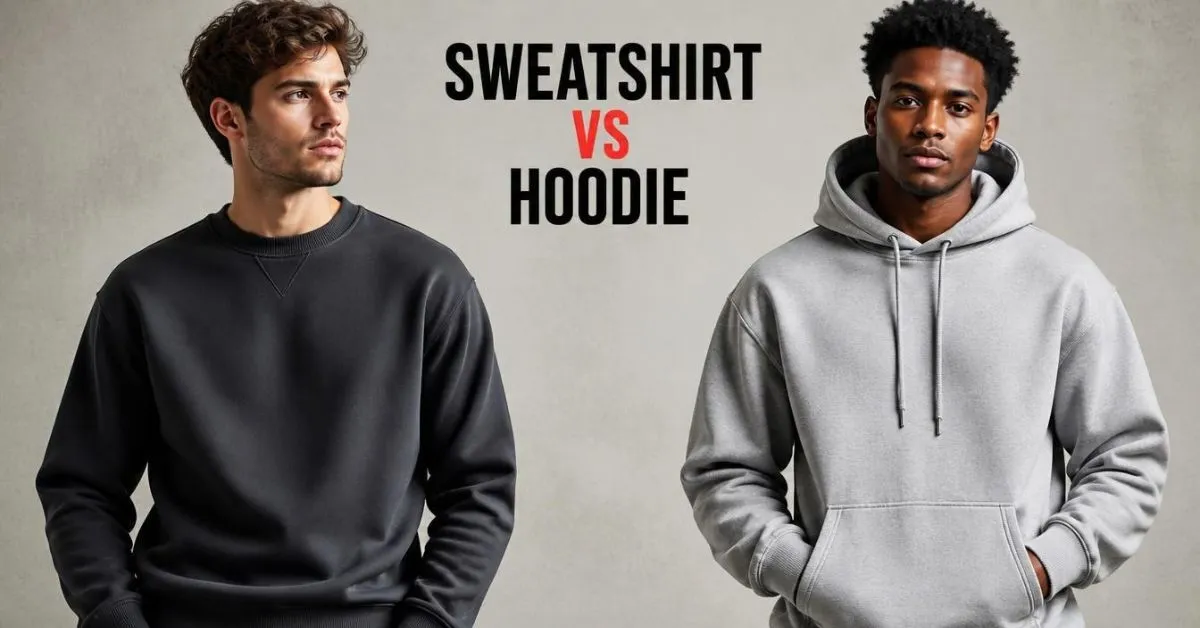
The main difference between a sweatshirt and a hoodie is the hood. A classic sweatshirt, usually a crewneck, has no hood, while a hoodie has an attached hood and often a kangaroo pocket or drawstring.
Both can use similar fabrics, so warmth depends on fabric weight, construction, fit, and whether you need extra head and neck coverage.
Key Takeaways
- A classic sweatshirt usually has a crew neckline and no hood.
- A hoodie has an attached hood and often includes a kangaroo pocket.
- A hoodie is technically a type of hooded sweatshirt.
- A heavier sweatshirt can be warmer than a lightweight hoodie.
- Crewnecks usually layer more easily under jackets and coats.
- Hoodies provide useful head and neck coverage for cool or windy weather.
- The best choice depends on weather, layering, comfort, and personal style.
What Is the Difference Between a Sweatshirt and a Hoodie?
If you are comparing a sweatshirt vs hoodie, the easiest difference to remember is simple:
A sweatshirt usually has no hood. A hoodie has a hood.
A classic sweatshirt typically has a rounded crew neckline, long sleeves, ribbed cuffs, and a ribbed hem. A hoodie has the same general sweatshirt-style body but adds an attached hood. Many hoodies also have a kangaroo pocket and drawstring, although these features are not required.
The two garments can be made from very similar materials. You may find both sweatshirts and hoodies made from cotton, cotton blends, fleece, or French terry.
That means the difference is not simply about thickness or warmth. The biggest structural difference is the hood.
What Is a Sweatshirt?
A sweatshirt is a casual long sleeved garment designed to provide comfort and warmth.
When shoppers use the word “sweatshirt,” they often mean a crewneck sweatshirt.
This style normally has:
- A round crew neckline
- No attached hood
- Long sleeves
- Ribbed cuffs
- A ribbed waistband
- Cotton, fleece, French terry, or blended fabric
- A simple front without a large kangaroo pocket
Some sweatshirts can have different necklines, pockets, or design details, so these features are typical rather than absolute rules.
The crewneck design gives a sweatshirt a clean and simple shape that works well on its own or underneath another layer.
What Is a Hoodie?
A hoodie is a sweatshirt-style garment with an attached hood.
A typical hoodie may include:
- An attached hood
- Drawstrings
- A kangaroo pocket
- Ribbed cuffs
- A ribbed hem
- Fleece or French terry fabric
- Pullover or zip-up construction
A pullover hoodie goes over your head, while a zip-up hoodie opens at the front.
The hood gives the garment an extra function that a standard crewneck does not have: you can pull it over your head when you want more coverage.
Sweatshirt vs Hoodie: Quick Comparison
| Feature | Sweatshirt | Hoodie |
| Hood | Usually no | Yes |
| Common neckline | Crewneck | Hood opening |
| Kangaroo pocket | Usually no | Common |
| Head coverage | No | Yes |
| Neck coverage | Less | More when hood is up |
| Layering | Usually easier | Can add bulk around the neck |
| Style | Clean and classic | Relaxed and casual |
| Construction | Usually pullover | Pullover or zip-up |
| Warmth | Depends on fabric | Depends on fabric + hood coverage |
| Best for | Everyday wear and layering | Casual wear and extra coverage |
This table assumes “sweatshirt” means the classic crewneck style, which is usually what shoppers mean when comparing it directly with a hoodie.
Is a Hoodie a Type of Sweatshirt?
Yes, broadly speaking.
A hoodie can be considered a type of sweatshirt because it has the same general sweatshirt construction and purpose, but it includes a hood.
The terminology can be confusing because everyday shopping language often separates the two.
A useful way to think about it is:
Sweatshirt → broad garment category
Crewneck sweatshirt → hoodless sweatshirt
Hoodie → hooded sweatshirt
That is why someone can ask about a “sweatshirt vs hoodie” even though a hoodie can technically fall under the broader sweatshirt category.
In normal retail conversations, however, the comparison usually means crewneck sweatshirt vs hoodie.
Which Is Warmer: a Sweatshirt or Hoodie?
There is no universal answer.
A hoodie can provide additional warmth around your head and neck when the hood is up. But the fabric, weight, lining, fit, and construction can have a much larger effect on overall warmth.
For example, a heavyweight fleece crewneck can feel warmer through the torso than a lightweight hoodie.
Current apparel guides similarly emphasize that fabric weight and construction should be compared rather than assuming the garment type alone determines warmth.
Why Fabric Weight Matters
When shopping for a sweatshirt or hoodie, look at the actual material specifications.
Important factors include:
- Fabric weight
- Cotton or polyester content
- Fleece vs. French terry
- Brushed vs. unbrushed interior
- Fit
- Lining
- Overall construction
A thicker fabric generally provides more substance, but heavier does not automatically mean better. A very heavy garment can also feel bulky or too warm for indoor use.
If warmth is your main concern, compare similar products rather than assuming every hoodie beats every sweatshirt.
Why the Hood Still Matters
Even when the fabric is similar, a hoodie has one clear advantage: head and neck coverage.
On a cool or windy day, pulling the hood up can make a noticeable difference in comfort.
A sweatshirt cannot provide that same coverage.
So the better question is:
Do you need extra head and neck coverage, or do you mainly need warmth around your body?
If you need head coverage, a hoodie offers an extra layer of functionality.
Sweatshirt vs Hoodie for Layering
Layering is one area where the difference becomes especially noticeable.
A crewneck sweatshirt usually sits more cleanly underneath a jacket because there is no hood gathering behind your neck.
A hoodie can still work underneath a jacket, but the hood adds extra fabric around the neck and upper back. With a fitted jacket or coat, that can create additional bulk.
For example:
Sweatshirt + denim jacket:
Simple and relatively flat around the collar.
Hoodie + denim jacket:
More relaxed, but the hood adds another layer around the neck.
This does not mean a hoodie is bad for layering. It simply means the outer layer needs enough room to accommodate the hood.
If you frequently wear coats or jackets over your mid-layer, a crewneck may be more convenient.
How Sweatshirts & Hoodies Differ in Style and Fit
Both garments come in slim, regular, relaxed, oversized, cropped, and other fits.
The hood is what creates much of the visual difference.
A crewneck sweatshirt usually has a cleaner neckline and simpler silhouette. It can work well with jeans, chinos, joggers, sneakers, or layered outfits.
A hoodie tends to look more relaxed. It is common in casual, athletic, campus, and streetwear-inspired outfits.
Neither style has to be oversized. A fitted hoodie can look very different from an oversized one.
When shopping, pay attention to the actual size chart and fit description rather than assuming every sweatshirt or hoodie has the same shape.
When Should You Wear a Sweatshirt?
A sweatshirt is a practical choice when you want a simple, comfortable layer.
Consider a sweatshirt when:
- You want easy layering.
- You do not need a hood.
- You prefer a clean neckline.
- You are wearing a jacket or coat over it.
- You want a classic casual look.
- You will spend most of your time indoors.
- You want an uninterrupted front for a logo or graphic.
A plain crewneck can also fit more naturally into some smart-casual outfits because it has a simpler silhouette.
When Should You Wear a Hoodie?
A hoodie makes sense when you want comfort plus extra coverage.
Consider a hoodie when:
- You want head and neck coverage.
- The weather is cool or windy.
- You prefer a relaxed casual style.
- You want a convenient front pocket.
- You are going for a sporty or streetwear look.
- You want a pullover or zip-up option.
The hood is especially useful when the weather changes during the day. You can leave it down when you are comfortable and pull it up when you need more coverage.
Crewneck vs Hoodie vs Zip-Up Hoodie
These terms describe different features, so it helps to separate them.
Crewneck Sweatshirt
A crewneck has a rounded neckline and no hood.
It is usually the simplest option and provides a clean front for layering or graphics.
Pullover Hoodie
A pullover hoodie has an attached hood and is pulled over the head.
It often has a kangaroo pocket across the lower front.
Zip-Up Hoodie
A zip-up hoodie has an attached hood and a front zipper.
Instead of pulling the whole garment over your head, you can open the zipper.
A zip-up can be convenient when you want to put the layer on or remove it quickly. It also works well as a casual outer layer.
How to Choose Between a Sweatshirt and Hoodie
Instead of asking which one is universally better, match the garment to your needs.
Choose a sweatshirt if you want:
- Easier layering
- A cleaner neckline
- A classic casual style
- Less bulk around the neck
- A simple everyday layer
Choose a hoodie if you want:
- Head and neck coverage
- A more relaxed appearance
- A kangaroo pocket on many pullover styles
- Extra coverage outdoors
- A casual streetwear or athletic look
If warmth is your priority
Check the actual fabric weight and construction.
Do not choose a hoodie simply because you assume “hoodie” means warmer.
If layering is your priority
A crewneck is often easier beneath fitted jackets and coats because it does not have a hood.
If convenience is your priority
A zip-up hoodie can be useful when you want to take the layer on and off quickly.
If style is your priority
Think about the silhouette you want. A crewneck creates a simpler outline, while a hoodie adds visual weight around the neck and shoulders.
What to Check Before Buying
Whether you choose a sweatshirt or hoodie, look beyond the product name.
Check these details:
1. Fabric:
Look for cotton, polyester, blends, fleece, or French terry.
2. Fabric weight:
A heavier fabric may feel warmer and more substantial, while lighter fabric can be easier for transitional weather.
3. Interior finish:
Brushed fleece generally feels different from loopback or French terry.
4. Fit:
Check whether the garment is slim, regular, relaxed, or oversized.
5. Construction:
Look at cuffs, hem, seams, hood design, and pocket construction.
6. Closure:
If it is a hoodie, determine whether it is a pullover or zip-up.
7. Size chart:
Do not rely only on your usual size. Measurements vary between brands.
This approach gives you a much better idea of what you are actually buying than the words “sweatshirt” or “hoodie” alone.
FAQs:
What is the main difference between a sweatshirt and a hoodie?
The defining difference is the hood. A classic sweatshirt usually has a crew neckline and no hood, while a hoodie has an attached hood. Many hoodies also have a kangaroo pocket and drawstring, but those features are not required.
Is a hoodie a type of sweatshirt?
Yes. A hoodie can broadly be described as a hooded sweatshirt. In everyday shopping language, “sweatshirt” often refers to the hoodless crewneck version, which is why people commonly compare sweatshirts and hoodies as separate styles.
Which is warmer, a hoodie or sweatshirt?
Neither is automatically warmer. A hoodie provides extra head and neck coverage when the hood is up, but fabric weight, lining, material, fit, and construction can have a bigger effect on overall warmth. A heavyweight sweatshirt can be warmer than a lightweight hoodie.
Is a crewneck a sweatshirt?
Yes. A crewneck sweatshirt has a rounded neckline and no hood. “Crewneck” describes the neckline, while “sweatshirt” describes the broader garment type.
Which is better for layering, a hoodie or sweatshirt?
A crewneck sweatshirt generally layers more easily underneath fitted jackets and coats because there is no hood behind the neck. A hoodie can also be layered, but its hood may create additional bulk around the collar.
Can you wear a sweatshirt instead of a hoodie?
Yes. Both can provide a comfortable warm layer. Choose a sweatshirt when you do not need a hood and prefer a simpler silhouette. Choose a hoodie when head and neck coverage or a more relaxed style is useful.
What is the difference between a pullover and a hoodie?
A pullover describes how the garment is worn: it goes over your head. A hoodie describes the presence of a hood. Therefore, a pullover can be a hoodie, sweatshirt, or another type of garment.
What is a zip-up hoodie?
A zip-up hoodie is a hooded garment with a zipper running down the front. Unlike a pullover hoodie, you can open the front completely. This can make it convenient as a casual outer layer.
Conclusion:
The sweatshirt vs hoodie difference comes down mainly to the hood. A classic crewneck sweatshirt gives you a simple neckline, clean silhouette, and easy layering.
A hoodie adds an attached hood and often provides extra head and neck coverage, along with features such as a kangaroo pocket.
For warmth, do not judge by the name alone. Fabric weight, material, lining, fit, and construction matter.
Choose the garment based on how you plan to wear it. If you want a clean layer that works easily under jackets, a crewneck sweatshirt may fit that need. If you want a hood for cool weather and prefer a relaxed casual style, a hoodie may make more sense.
The right choice is ultimately the one that matches your weather, outfit, comfort, and everyday use.

Aiden Robert, an author at ReplyyGenius.com, where I share smart conversation tips, flirty replies, and practical communication ideas to help people reply with confidence.