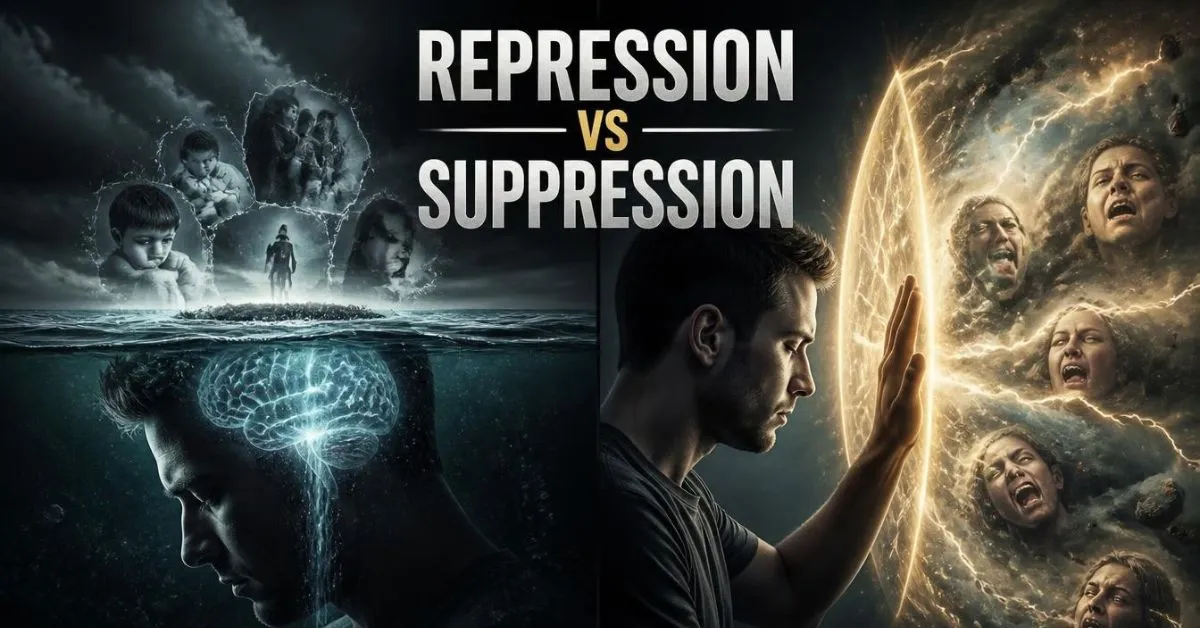
Repression vs suppression mainly differs in awareness. Repression traditionally describes an unconscious process in which unwanted thoughts, feelings, or memories are kept outside conscious awareness.
Suppression is a conscious effort to set aside a thought, feeling, or memory. In simple terms, repression happens without deliberate choice, while suppression involves knowing and choosing to put something aside.
Key Takeaways
- Repression is traditionally unconscious, while suppression is conscious.
- Repression happens without a person deliberately deciding to block something.
- Suppression involves recognizing a thought or feeling and choosing to set it aside.
- Suppression may be temporary, such as putting anger aside during a work meeting.
- The terms are closely related, but psychological research does not use one single definition of repression in every context.
What Is Repression?
Repression is a psychological concept in which unwanted thoughts, feelings, memories, or impulses are kept outside conscious awareness.
In traditional psychodynamic and psychoanalytic theory, repression is considered an unconscious defense mechanism. The person does not intentionally decide to block the thought. Instead, the unwanted material is kept from conscious awareness.
The concept is strongly associated with Sigmund Freud and later psychodynamic theories. However, modern psychological literature does not always define repression in exactly the same way. Some researchers focus on unconscious avoidance, while others use the term more broadly for the tendency to control or avoid threatening information.
That difference matters because it is easy to present repression as a simple, proven process when the scientific literature is more complicated.
Repression in Psychology
A simple way to understand traditional repression is:
You are not consciously choosing to push the thought away.
For example, someone may have a strong emotional reaction to a particular situation without understanding why. A psychodynamic explanation might consider unconscious emotional material as one possible factor.
However, a reaction by itself does not prove that a person has repressed a particular memory or experience.
Example of Repression
Imagine someone who grew up in a home where anger was strongly discouraged.
As an adult, they may have trouble recognizing their own anger. They might insist that they are never angry, while regularly experiencing tension or irritation.
In a traditional psychodynamic interpretation, unconscious defenses could be part of the explanation.
The important point is that the person is not deliberately deciding to hide the emotion.
What Is Suppression?
Suppression is the conscious decision to put an unwanted thought, feeling, memory, or impulse aside.
You know the thought or feeling exists, but you intentionally choose not to focus on it right now.
For example:
“I’m angry about what happened, but I need to finish this meeting first.”
That is a straightforward example of suppression.
Unlike traditional repression, suppression involves awareness and deliberate control. The person knows what they are thinking or feeling but decides to postpone dealing with it.
Research and psychological writing commonly distinguish suppression from repression in this way.
Suppression in Psychology
Suppression can involve thoughts, emotions, or outward emotional expression.
You might suppress:
- Anger during a meeting
- Tears during a public event
- Worry before an exam
- An emotional reaction during an argument
- The urge to respond immediately to criticism
Suppression is not automatically unhealthy.
Sometimes people need to control an immediate reaction so they can focus, stay professional, or deal with a problem at a better time.
The important question is what happens after the emotion has been put aside.
Repression vs Suppression: Key Differences
The easiest way to understand repression vs suppression is to focus on awareness.
| Feature | Repression | Suppression |
| Awareness | Traditionally unconscious | Conscious |
| Intention | Not deliberate | Deliberate |
| Control | Happens outside conscious control | Involves conscious control |
| Main action | Keeps unwanted material outside awareness | Sets unwanted material aside |
| Memory access | May be difficult to access | Usually remains accessible |
| Typical use | Long-term psychological defense | Often temporary or situational |
| Example | Not consciously recognizing an unwanted feeling | Knowing you are angry but waiting to deal with it |
The Difference in One Sentence
Repression is traditionally unconscious; suppression is conscious.
That single distinction answers most searches for repression vs suppression.
Still, it is important to remember that psychological definitions can vary. Research on repression has used the term in several different ways, so the conscious-versus-unconscious distinction is best understood as the traditional and most common comparison, not an absolute rule for every study.
Repression vs Suppression Examples
Real-life examples make the difference much easier to understand.
Example of Repression
A person has strong anxiety around a particular situation but cannot explain the source of the reaction.
A psychodynamic explanation might suggest that an unwanted emotional experience is outside the person’s conscious awareness.
The person is not thinking:
“I need to hide this memory.”
Instead, the process is understood as happening outside deliberate awareness.
Example of Suppression
A person receives an upsetting message from a coworker five minutes before an important presentation.
They think:
“I’m upset, but I’ll deal with this after the presentation.”
They are fully aware of the emotion but intentionally put it aside.
That is suppression.
Another Simple Example
Repression:
“I don’t understand why this situation makes me so uncomfortable.”
Suppression:
“I know this situation makes me uncomfortable, but I’m going to focus on something else for now.”
The first describes the traditional idea of unconscious avoidance. The second describes deliberate avoidance.
Are Repression & Suppression the Same Thing?
No. Repression and suppression are related, but they are not usually treated as the same psychological process.
Both can involve unwanted thoughts, feelings, or memories. The major difference is the person’s relationship to the material.
With traditional repression, the unwanted material is outside conscious awareness.
With suppression, the person is aware of the material and intentionally chooses not to focus on it.
A useful memory trick is:
Repression = pushed away without conscious choice.
Suppression = put aside with conscious choice.
The terms can become confusing because everyday English sometimes uses them more loosely. For example, someone might say they “suppressed their anger” simply because they did not express it. That does not necessarily mean a psychological defense mechanism was involved.
Is Repression Always Unconscious?
In traditional psychoanalytic theory, yes. In modern research, the answer is more complicated.
The classic distinction describes repression as unconscious and suppression as conscious.
However, researchers have used repression in different ways. Some definitions emphasize unconscious avoidance, while others describe patterns of controlling or avoiding threatening information without making unconsciousness the defining feature.
So if you are reading a psychology textbook, research paper, or therapy resource, check how the author defines the term.
For everyday understanding, the simplest distinction remains:
Repression is traditionally unconscious.
Suppression is consciously intentional.
Can Suppression Be Helpful?
Yes. Temporary suppression can sometimes help a person function during a difficult situation.
For example, you might put your anger aside during:
- A work meeting
- An important presentation
- A family emergency
- A difficult conversation
- An exam
- A stressful professional situation
Imagine that a coworker says something upsetting just before you need to speak to a client.
You may think:
“I’m going to deal with this later. Right now, I need to focus.”
That can be a practical form of emotional control.
The concern is chronic or excessive suppression. If someone continually avoids every uncomfortable thought or emotion, they may never address the underlying issue.
Research on thought and emotion suppression has found that deliberately trying to control unwanted thoughts can sometimes produce unwanted effects, including the return of the thought once suppression ends.
So suppression is not automatically good or bad. Its effect depends on why, how, and how often it is used.
What About Repressed Memories?
This is one of the most important areas to discuss carefully.
A repressed memory generally refers to a memory that is unavailable to conscious awareness because of an unconscious psychological process.
However, it would be misleading to assume that every forgotten or difficult memory has been repressed.
Human memory is complex. People can forget information for many reasons, and later memories can also be influenced by suggestion, interpretation, and other factors.
Research has also shown that psychologists have used different definitions of repression, making strong claims about a specific “repressed memory” difficult to establish simply from the fact that someone cannot remember an event.
Therefore, the safest explanation is:
Forgetting something does not automatically prove repression.
If someone is concerned about missing or distressing memories, it is better to explore the issue carefully rather than assume a particular explanation in advance.
Repression vs Suppression in Everyday Language
The two words can also have meanings outside psychology.
Suppression often means actively stopping, limiting, or preventing something.
For example:
- Suppression of a reaction
- Suppression of a sound
- Suppression of information
Repression can also refer to forceful control or restriction, especially in political or social contexts.
For example:
- Political repression
- Repression of a population
- Repression of dissent
So the meaning depends heavily on context.
If the question is specifically about psychology, the conscious-versus-unconscious distinction is usually the most useful starting point.
How to Remember Repression vs Suppression
Use this simple rule:
Repression = “I don’t consciously know I’m pushing it away.”
Suppression = “I know it’s there, but I’m choosing to put it aside.”
Think of suppression as putting something in a drawer because you do not want to deal with it right now.
Think of traditional repression as the material being outside your conscious awareness without you deliberately putting it there.
This shortcut makes the difference much easier to remember.
FAQs:
What is the main difference between repression and suppression?
The main difference is awareness. Repression traditionally refers to an unconscious process that keeps unwanted thoughts, feelings, or memories outside conscious awareness. Suppression is a conscious decision to put an unwanted thought or feeling aside.
Is repression conscious or unconscious?
Traditional psychological theory describes repression as unconscious. A person does not deliberately decide to block the unwanted material. However, research literature uses the term in different ways, so the exact definition can vary by theory or study.
Is suppression a defense mechanism?
Yes. Suppression has traditionally been described as a conscious defense process in which a person deliberately sets aside an unwanted thought or emotion. It can also be discussed as a form of conscious thought or emotion regulation.
Can you repress emotions?
In traditional psychological terminology, yes. Repression can refer to an unconscious process that keeps unwanted emotions outside conscious awareness. However, you cannot determine from a single behavior that a particular emotion has been repressed.
Can you suppress emotions?
Yes. Suppressing an emotion means consciously holding it back or choosing not to express or focus on it. For example, someone may feel angry during a meeting but decide to address the anger later.
Is suppression always bad?
No. Temporarily putting an emotion aside can be useful when you need to stay focused or avoid an immediate reaction. Problems may arise when suppression becomes a repeated way of avoiding emotions without ever addressing them.
Is repression the same as forgetting?
No. Forgetting does not automatically mean repression. Memory can become unavailable for many reasons, and the scientific meaning of repression varies across psychological theories. Therefore, an inability to remember something alone is not proof that it was repressed.
Conclusion:
The simplest way to understand repression vs suppression is to look at awareness.
Repression traditionally describes an unconscious process. The person is not deliberately trying to block the thought, feeling, or memory.
Suppression is conscious. The person knows the thought or feeling exists but intentionally chooses to put it aside, often temporarily.
So, if you remember only one thing, remember this:
Repression happens outside conscious awareness; suppression happens with conscious awareness.
That distinction makes the two terms much easier to understand, while the broader psychological meaning of repression remains more nuanced across different theories and research traditions.

Harry Jack is a content writer at ReplyGenius.com who specializes in practical, natural sounding replies for texts, social media, relationships, and everyday conversations.