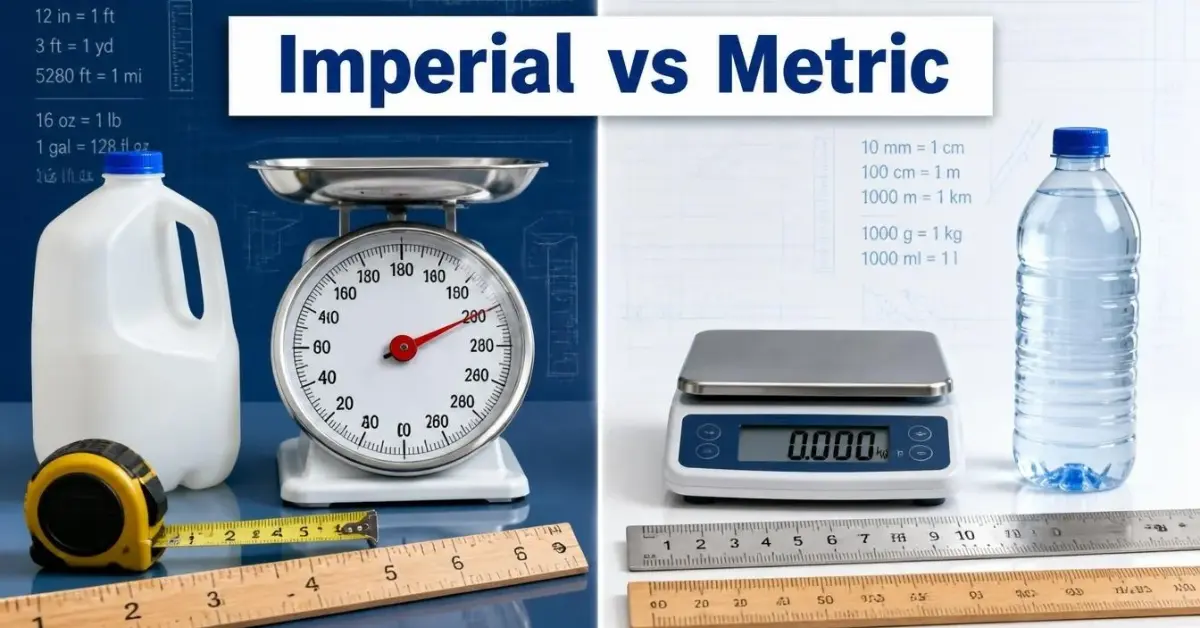
The main difference between Imperial and Metric is how they measure length, weight, volume, and temperature. The imperial system uses units such as inches, feet, pounds, and gallons, while the metric system uses millimeters, meters, grams, kilograms, and liters.
Metric uses a decimal-based structure, making conversions easier.
Key Takeaways
- The imperial system uses inches, feet, miles, pounds, ounces, and gallons.
- The metric system uses millimeters, centimeters, meters, kilometers, grams, kilograms, and liters.
- Metric measurements follow a base-10 structure, so conversions are usually simple.
- Most countries use the metric system for everyday measurements and scientific work.
- The United States mainly uses the U.S. customary system, which differs from the British Imperial System.
What Is The Imperial System?
The imperial system is a traditional system of measurement that developed in Britain. It became the official British measurement system in 1824 and uses different units to measure length, weight, and volume.
People commonly associate this system with inches, feet, yards, miles, ounces, pounds, and gallons. These units are still used in the United Kingdom for certain everyday measurements.
For example, road distances in the UK are commonly shown in miles, while people’s heights may be described in feet and inches.
Unlike the metric system, imperial measurements do not follow one simple decimal pattern. Different units have different relationships. For example, one foot contains 12 inches, while one yard contains 3 feet.
Common Imperial Units
Here are some widely recognized imperial measurements:
| Measurement | Imperial Unit |
| Length | Inch |
| Height | Foot |
| Distance | Mile |
| Weight | Pound |
| Smaller weight | Ounce |
| Liquid volume | Pint |
| Larger volume | Gallon |
| Temperature | Fahrenheit |
These units are useful to recognize when reading British measurements, older documents, product descriptions, or international recipes.
However, American measurements are not always identical to British imperial measurements. This distinction is especially important when measuring liquids.
What Is The Metric System?
The metric system is an international measurement system based on powers of ten. It uses standard units to measure length, mass, volume, and other physical quantities.
Its modern form is known as the International System of Units (SI). Scientists, engineers, businesses, and governments use it because it provides consistent measurement standards across different countries.
The metric system makes calculations easier because its units follow a decimal structure. For example, one meter contains 100 centimeters, and one kilometer contains 1,000 meters.
This pattern allows people to convert between units by multiplying or dividing by powers of ten.
Common Metric Units
The following table shows some common metric measurements:
| Measurement | Metric Unit |
| Small length | Millimeter |
| Length | Centimeter |
| Distance | Meter |
| Long distance | Kilometer |
| Small mass | Gram |
| Larger mass | Kilogram |
| Liquid volume | Milliliter |
| Larger volume | Liter |
| Temperature | Celsius |
For example, a person’s height might be recorded as 170 centimeters instead of 5 feet 7 inches. Similarly, a bottle might contain 1 liter of water instead of a certain number of fluid ounces.
The metric system is especially useful in education, medicine, science, manufacturing, and international trade.
Imperial vs Metric: Key Differences
The biggest difference between imperial vs metric is their structure and the units they use.
The imperial system has different conversion relationships between its units. The metric system follows a consistent base-10 pattern.
Here is a direct comparison:
| Feature | Imperial System | Metric System |
| Origin | Britain | France |
| Length | Inches, feet, miles | Millimeters, meters, kilometers |
| Weight/Mass | Ounces, pounds | Grams, kilograms |
| Volume | Pints, quarts, gallons | Milliliters, liters |
| Temperature | Fahrenheit | Celsius |
| Conversion | Different ratios | Powers of 10 |
| Common use | UK and some traditional applications | Most countries worldwide |
| Scientific use | Limited compared with SI | International standard |
1. Length and Distance
The imperial system measures length using inches, feet, yards, and miles. The metric system uses millimeters, centimeters, meters, and kilometers.
For example:
- 1 inch = 2.54 centimeters
- 1 foot = 0.3048 meters
- 1 mile = approximately 1.609 kilometers
- 1 kilometer = approximately 0.621 miles
A person in the United States might describe a road trip as 100 miles. Someone using metric measurements would describe the same distance as approximately 161 kilometers.
2. Weight and Mass
Imperial measurements commonly use ounces and pounds, while metric measurements use grams and kilograms.
For example:
- 1 ounce = approximately 28.35 grams
- 1 pound = approximately 0.454 kilograms
- 1 kilogram = approximately 2.205 pounds
A 10-pound package weighs approximately 4.54 kilograms.
Technically, grams and kilograms measure mass, while pounds can refer to mass or force depending on the context. In everyday comparisons, people often use the word weight for both.
3. Volume and Liquid Measurements
The imperial system uses fluid ounces, pints, quarts, and gallons. The metric system uses milliliters and liters.
For example:
- 1 U.S. gallon = approximately 3.785 liters
- 1 liter = approximately 0.264 U.S. gallons
- 1 U.S. fluid ounce = approximately 29.57 milliliters
These differences matter when following recipes, purchasing drinks, or measuring liquids.
One important detail is that a British Imperial gallon is larger than a U.S. gallon. A British Imperial gallon equals approximately 4.546 liters, while a U.S. gallon equals approximately 3.785 liters.
4. Temperature
Temperature is another important difference.
The United States commonly uses Fahrenheit, while most countries use Celsius for everyday temperature readings.
For example:
- Water freezes at 32°F or 0°C.
- Water boils at 212°F or 100°C at standard atmospheric pressure.
- A comfortable room temperature might be around 68°F to 72°F, or approximately 20°C to 22°C.
Both scales measure temperature, but they use different reference points and numerical values.
Imperial vs Metric Conversion Chart
Converting between imperial and metric measurements is useful when traveling, cooking, studying, or working with international products.
The following chart provides common approximate conversions.
| Imperial Measurement | Metric Equivalent |
| 1 inch | 2.54 cm |
| 1 foot | 30.48 cm |
| 1 yard | 0.9144 m |
| 1 mile | 1.609 km |
| 1 ounce | 28.35 g |
| 1 pound | 0.454 kg |
| 1 U.S. gallon | 3.785 L |
| 1 U.S. fluid ounce | 29.57 mL |
Length Conversions
To convert inches into centimeters, multiply the number of inches by 2.54.
For example:
10 inches × 2.54 = 25.4 centimeters.
To convert kilometers into miles, multiply the distance by approximately 0.621.
For example:
10 kilometers × 0.621 = 6.21 miles.
Weight and Mass Conversions
To convert pounds into kilograms, multiply the number of pounds by approximately 0.454.
For example:
20 pounds × 0.454 = 9.08 kilograms.
To convert kilograms into pounds, multiply by approximately 2.205.
These calculations help when comparing package weights, food quantities, and other everyday measurements.
Volume Conversions
To convert U.S. gallons into liters, multiply the number of gallons by approximately 3.785.
For example:
2 U.S. gallons × 3.785 = 7.57 liters.
This conversion is useful when comparing fuel capacity, drink containers, and liquid quantities.
Temperature Conversions
Use these formulas to convert between Fahrenheit and Celsius:
Fahrenheit to Celsius:
°C=(°F-32)59
Celsius to Fahrenheit:
°F=(°C95)+32
For example, 68°F equals 20°C.
Understanding these formulas makes it easier to read international weather reports and temperature information.
Why Is The Metric System Easier To Use?
The metric system is often considered easier for calculations because it follows a consistent decimal structure.
Each major unit connects to another through powers of ten. This means people can convert measurements without remembering many unrelated conversion ratios.
For example:
- 1 meter = 100 centimeters
- 1 kilometer = 1,000 meters
- 1 kilogram = 1,000 grams
- 1 liter = 1,000 milliliters
This consistent structure offers several advantages:
1. Simple calculations: Most basic conversions involve multiplying or dividing by 10, 100, or 1,000.
2. Consistent measurements: The same units are recognized across many countries and industries.
3. Scientific accuracy: SI provides internationally agreed measurement standards for scientific and technical work.
4. Easier international communication: Businesses, researchers, and manufacturers can share measurements using common standards.
However, the imperial system remains familiar and practical for people who regularly use it.
Why Does The United States Still Use Imperial Measurements?
The United States continues to use traditional measurements because of its history, established practices, and everyday habits.
Although the metric system is widely used in American science, medicine, manufacturing, and other industries, customary measurements remain common in daily life.
For example, Americans generally use:
- Miles for road distances.
- Feet and inches for height.
- Pounds for body weight.
- Gallons for gasoline.
- Fahrenheit for weather forecasts.
Changing an entire country’s measurement habits requires adjustments to education, product labels, road signs, equipment, and business practices.
The United States has also adopted metric measurements in many professional and technical settings. In fact, federal policy recognizes the metric system as the preferred system for trade and commerce, although U.S. customary measurements remain permitted in many applications.
Is The U.S. Customary System The Same As The Imperial System?
No. The U.S. customary system and the British Imperial System are related, but they are not exactly the same.
Both systems share several familiar units, including inches, feet, yards, and miles. However, their liquid volume measurements differ.
For example:
| Unit | U.S. Customary | British Imperial |
| Fluid ounce | 29.57 mL | 28.41 mL |
| Pint | 473 mL | 568 mL |
| Quart | 946 mL | 1.137 L |
| Gallon | 3.785 L | 4.546 L |
The difference comes from how each system defines and divides liquid volume.
This distinction is important when using British recipes, comparing fuel quantities, or reading product labels from different countries.
For American readers, it is more accurate to call the everyday U.S. system the U.S. customary system rather than the imperial system.
Which Measurement System Is Better?
Neither system is automatically better for every situation. The right choice depends on the purpose and the people using the measurements.
The metric system offers clear advantages in scientific research, international trade, and calculations. Its decimal structure makes conversions easier and supports consistent communication.
The imperial system remains useful in places where people already understand and regularly use its units. In the United States, customary measurements are familiar in construction, road travel, cooking, and everyday conversations.
For international work and scientific calculations, metric is generally the more practical choice. For daily activities in the United States, customary measurements remain common.
Understanding both systems is valuable because people often encounter them together.
FAQs:
1. What Is the Main Difference Between Imperial and Metric?
The main difference is how each system organizes its measurement units. Imperial measurements use units such as inches, feet, pounds, and gallons. Metric measurements use centimeters, meters, grams, kilograms, and liters. Metric follows a base-10 structure, while imperial conversions use different relationships.
2. Is Imperial or Metric Better?
Metric is generally easier for calculations because its units follow powers of ten. It is also the international standard used in science and widely used in international trade. Imperial measurements remain useful in countries and industries where people already understand and use them.
3. Why Does the US Use Imperial Measurements?
The United States continues to use traditional customary measurements because of historical practices, established infrastructure, and public familiarity. Although metric measurements are common in science and many industries, Americans still use miles, feet, pounds, gallons, and Fahrenheit in everyday situations.
4. Which Countries Use the Metric System?
Most countries around the world use the metric system as their primary measurement system. It is widely used in education, science, business, and everyday activities. The United States also uses metric measurements in many professional and technical settings, even though customary units remain common.
5. Can You Use Imperial and Metric Together?
Yes. People often use both systems when traveling, studying, cooking, or working with international products. For example, a product might show its weight in pounds and kilograms. Knowing basic conversion values makes it easier to understand measurements from different systems.
Conclusion:
Understanding Imperial vs Metric makes it easier to compare measurements, convert units, and work with information from different countries. The imperial system uses familiar units such as inches, feet, pounds, and gallons, while the metric system uses centimeters, meters, kilograms, and liters.
Although the metric system offers simpler conversions and is widely used around the world, the U.S. customary system remains common in American daily life. Learning both systems helps you understand measurements more clearly, whether you are traveling, cooking, studying, or comparing products.

Harry Jack is a content writer at ReplyGenius.com who specializes in practical, natural sounding replies for texts, social media, relationships, and everyday conversations.