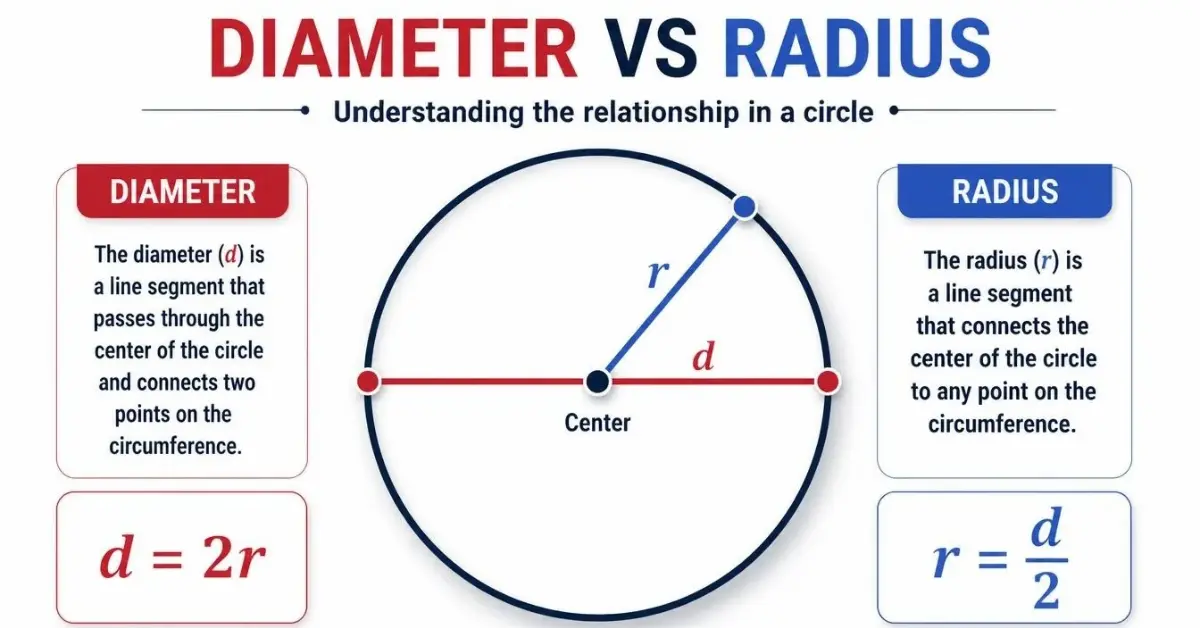
The main difference between Diameter and Radius is how they measure a circle. The radius is the distance from the center to any point on the circle’s edge. The diameter is the distance across the circle through its center.
The diameter is always twice the radius, while the radius is half the diameter.
Key Takeaways
- The radius measures the distance from the center of a circle to its edge.
- The diameter measures the full distance across a circle through its center.
- The diameter is always twice the radius.
- The radius is half the diameter.
- Both measurements help calculate a circle’s circumference and area.
What Is A Radius?
A radius is a straight line segment that connects the center of a circle to any point on its outer edge. It measures how far the circle extends from its center.
The letter r is commonly used to represent the radius in geometry formulas.
Every point on a circle’s boundary has the same distance from its center. This means all radii in the same circle have equal lengths.
For example, imagine a circle with a radius of 5 inches. The distance from its center to any point on its edge is exactly 5 inches.
How to Identify the Radius
You can identify a radius by looking for these features:
- It starts at the center of the circle.
- It ends at a point on the circle’s boundary.
- It covers only half of the distance across the circle through its center.
- All radii in one circle have the same length.
Radius Example
Suppose a circular clock has a radius of 8 inches. This means the distance from the center of the clock to its outer edge is 8 inches.
If you draw another line from the center to a different point on the edge, that line will also measure 8 inches.
Therefore, the radius describes the distance from the middle of a circle to its boundary.
What Is A Diameter?
A diameter is a straight line segment that connects two opposite points on a circle’s boundary and passes directly through its center.
It measures the full distance across the circle. The letter d is commonly used to represent the diameter in geometry.
Unlike the radius, which measures from the center to the edge, the diameter extends from one side of the circle to the other.
For example, if a circle has a radius of 5 inches, its diameter is 10 inches.
How to Identify the Diameter
A diameter has several important features:
- It connects two points on the circle’s boundary.
- It always passes through the center.
- It measures the full width of the circle.
- It consists of two radii placed end to end.
A circle can have many diameters because you can draw a straight line through its center in different directions. However, every diameter in the same circle has the same length.
Diameter Example
Imagine a round table with a diameter of 40 inches.
This means the distance from one edge of the table to the opposite edge, measured through its center, is 40 inches.
The measurement covers the entire width of the table, not just the distance from its center to one side.
Diameter vs Radius: Key Differences
The main difference between diameter and radius is the distance each one measures.
The radius measures from the center to the edge, while the diameter measures across the entire circle through its center.
Here is a simple comparison:
| Feature | Radius | Diameter |
| Definition | Distance from center to edge | Distance across the circle through its center |
| Symbol | r | d |
| Length | Half the diameter | Twice the radius |
| Endpoints | Center and circle boundary | Two points on the circle |
| Measurement | Half of the full width | Full width |
| Formula | r = d ÷ 2 | d = 2 × r |
For example, if a circle has a radius of 6 centimeters, its diameter is 12 centimeters.
Both measurements describe the same circle, but they represent different distances.
What Is The Relationship Between Diameter and Radius?
Diameter and radius have a simple mathematical relationship. The diameter is always twice the radius, and the radius is always half the diameter.
This happens because a diameter passes through the center and contains two equal radii.
For example:
- First radius: 4 inches
- Second radius: 4 inches
- Total diameter: 8 inches
Therefore:
d=2r
You can also reverse the formula to calculate the radius:
r=d2
These two formulas make it easy to convert between the measurements.
Diameter Formula
Use this formula when you know the radius and need to calculate the diameter:
\[ \boxed{d=2r} \]
Here:
- d = diameter
- r = radius
Example:
Suppose a circle has a radius of 7 inches.
Multiply the radius by 2:
d=27
d=14inches
The diameter is 14 inches.
Radius Formula
Use this formula when you know the diameter and need to calculate the radius:
\[ \boxed{r=\frac{d}{2}} \]
Here:
- r = radius
- d = diameter
Example:
Suppose a circle has a diameter of 18 centimeters.
Divide the diameter by 2:
r=182
r=9cm
The radius is 9 centimeters.
How To Calculate Diameter and Radius
Finding the diameter or radius is simple when you know which measurement is available.
How to Find the Diameter
Follow these steps:
- Identify the radius of the circle.
- Multiply the radius by 2.
- Write the answer using the same measurement unit.
Example:
A circular garden has a radius of 12 feet. What is its diameter?
Use the diameter formula:
d=2r
Put 12 in place of r:
d=212
d=24feet
The garden has a diameter of 24 feet.
How to Find the Radius
Follow these steps:
- Identify the diameter of the circle.
- Divide the diameter by 2.
- Write the answer using the same measurement unit.
Example:
A round pizza has a diameter of 16 inches. What is its radius?
Use the radius formula:
r=d2
Put 16 in place of d:
r=162
r=8inches
The pizza has a radius of 8 inches.
How Are Radius and Diameter Used In Circle Formulas?
Radius and diameter are important because they help calculate other measurements of a circle.
Two common calculations are circumference and area.
Circumference Formula
Circumference is the total distance around a circle. It is similar to the perimeter of other shapes.
You can calculate circumference using either the radius or diameter.
Using the radius:
C=2r
Using the diameter:
C=d
Here, C represents circumference, and π (pi) is approximately 3.14159.
For example, if a circle has a diameter of 10 inches:
C=10
C31.42inches
The circumference is approximately 31.42 inches.
Area Formula
The area measures the amount of space inside a circle.
The standard area formula uses the radius:
A=r2
Here:
- A = area
- π = approximately 3.14159
- r = radius
For example, suppose a circle has a radius of 5 inches.
A=52
A=25
A78.54squareinches
The area is approximately 78.54 square inches.
Important: Always use the radius in the standard area formula. If a problem gives you the diameter, divide it by 2 before calculating the area.
Understanding How Diameter and Radius Work Together
Now that you understand the meaning of radius and diameter, it is important to see how these two measurements work together. Both describe the size of the same circle, but they measure different distances.
The radius covers half of the circle’s width, while the diameter covers the entire width through the center. This connection makes it easier to understand circle measurements and solve geometry problems.
Beyond Basic Definitions: Why These Measurements Matter
Understanding the definitions is only the first step. Diameter and radius also play an important role in many mathematical calculations.
For example, you need the radius to calculate the area of a circle, while you can use either radius or diameter to find its circumference. Knowing when to use each measurement helps you avoid calculation errors and get accurate results.
Moving From Formulas to Practical Examples
Once you know the relationship between diameter and radius, you can apply these formulas to everyday objects. Circular items such as wheels, plates, clocks, and tables all have measurable radii and diameters.
These examples show that circle measurements are not limited to textbooks. They are also useful in everyday measurements and practical situations.
Another Important Point: Choosing the Correct Measurement
Before solving a geometry problem, always check whether the given measurement represents the radius or diameter. This small step can make a big difference in your final answer.
If a question provides the diameter but asks for the radius, divide it by two. If it provides the radius and asks for the diameter, multiply it by two. Following this simple rule makes calculations easier and more reliable.
Connecting Circle Measurements to Everyday Geometry
Similarly, radius and diameter help explain other properties of circular shapes. They are closely connected to circumference, area, and chords.
Learning these relationships creates a strong foundation for more advanced geometry topics. Once you understand these basic measurements, working with circles becomes much simpler.
Real-Life Examples of Diameter and Radius
You can find diameter and radius measurements in many everyday objects. These examples make the difference easier to understand.
1. Wall Clock
A round clock has a radius of 6 inches. The distance from its center to the outer edge is 6 inches. Its full diameter is 12 inches.
2. Pizza
A pizza has a diameter of 14 inches. Its radius is 7 inches, measured from the center to the crust.
3. Bicycle Wheel
A bicycle wheel has a radius of 13 inches. Its diameter is 26 inches. The diameter measures the full distance across the wheel through its center.
4. Round Table
A circular table has a diameter of 48 inches. Its radius is 24 inches. You can use these measurements to understand the table’s size and calculate its surface area.
Common Mistakes When Comparing Diameter and Radius
Students sometimes confuse diameter and radius because both describe measurements of the same circle.
Here are common mistakes to avoid:
1. Treating Them as Equal
The diameter and radius are not equal. The diameter is always twice the radius.
2. Measuring Without Including the Center
A diameter must pass through the center of the circle. A line connecting two points on the boundary without passing through the center is called a chord, not a diameter.
3. Using the Wrong Measurement in a Formula
The area formula requires the radius. If you use the diameter instead, your answer will be incorrect.
4. Forgetting to Divide by Two
When finding the radius from the diameter, divide by 2 instead of multiplying.
5. Mixing Measurement Units
Keep the same units when comparing the two measurements. For example, do not combine inches and centimeters without converting them first.
Understanding these mistakes can help you solve geometry problems more accurately.
FAQs:
1. What Is the Main Difference Between Diameter and Radius?
The radius measures the distance from the center of a circle to its outer edge. The diameter measures the full distance across the circle through its center. The diameter is twice the radius, while the radius is half the diameter.
2. Is the Diameter Always Twice the Radius?
Yes. The diameter is always exactly twice the radius of the same circle. This relationship is true for every circle, regardless of its size. The formula is d=2r. For example, a circle with a radius of 4 inches has a diameter of 8 inches.
3. How Do You Find the Radius If You Know the Diameter?
Divide the diameter by 2 to find the radius. For example, if a circle has a diameter of 20 centimeters, divide 20 by 2. The radius is 10 centimeters. The formula is r=d/2.
4. Can a Circle Have Multiple Radii?
Yes. A circle has infinitely many radii because you can draw a line from its center to any point on its boundary. However, all these radii have exactly the same length because every point on the circle is equally distant from its center.
5. Is the Diameter the Longest Chord of a Circle?
Yes. The diameter is the longest possible chord of a circle because it passes through the center. A chord connects two points on a circle’s boundary, but it does not always pass through the center. Every diameter is a chord, but not every chord is a diameter.
6. Do Radius and Diameter Apply to Spheres?
Yes. Both terms also apply to spheres. The radius measures the distance from the center of a sphere to its surface, while the diameter measures the distance across the sphere through its center. The diameter is also twice the radius.
Conclusion:
Understanding Diameter vs Radius makes basic geometry much easier. The radius measures the distance from the center of a circle to its edge, while the diameter measures the full distance across the circle through its center.
The relationship is simple: the diameter is twice the radius, and the radius is half the diameter.
Remember these two formulas:
d=2r
r=d2
Once you understand this relationship, you can calculate either measurement and use it to solve problems involving the circumference and area of circles.