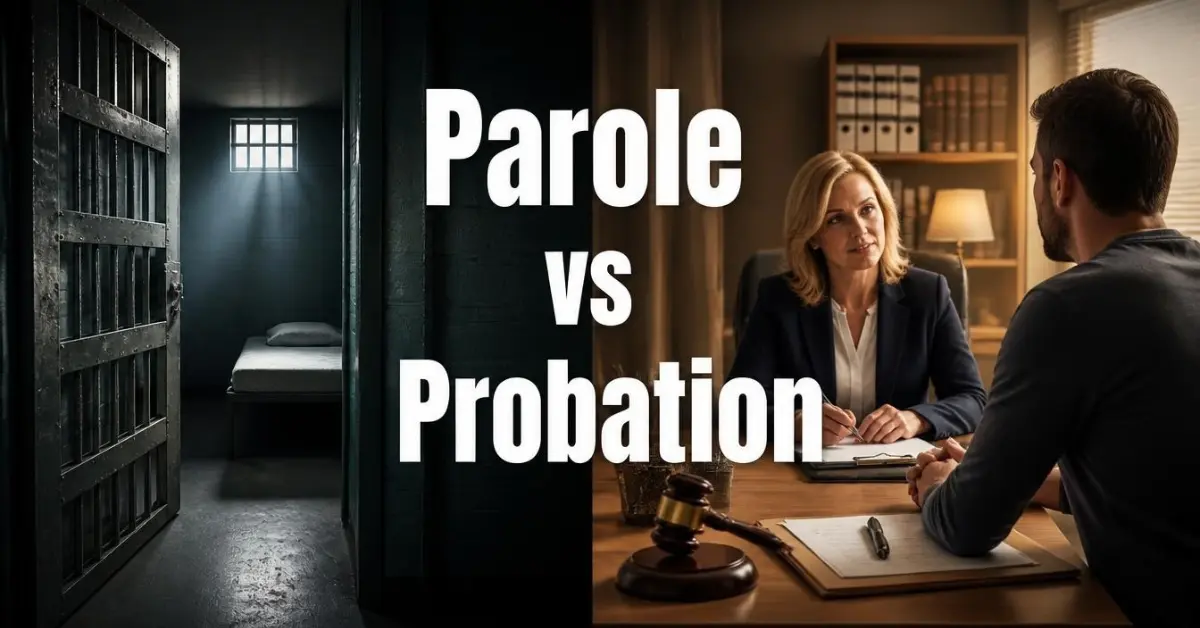
The main difference between Parole vs Probation is when each type of supervision begins. Probation is generally a court-ordered sentence that allows someone to remain in the community instead of serving time in prison.
Parole allows someone to leave prison before completing their sentence and serve the remaining portion under community supervision. Both involve specific rules and conditions.
Key Takeaways
- Probation is generally an alternative to incarceration ordered by a judge.
- Parole is conditional release from prison after serving part of a sentence.
- Judges typically impose probation, while parole decisions are handled by a parole authority when required.
- Both require people to follow supervision conditions.
- Violating either type of supervision can lead to additional penalties or imprisonment.
What Is Probation?
Probation is a court-ordered period of supervision that allows someone convicted of a crime to remain in the community instead of serving a prison sentence.
A judge decides whether probation is appropriate based on the offense, criminal history, applicable laws, and other factors.
During probation, the person must follow specific rules set by the court. A probation officer may monitor their progress and check whether they meet these requirements.
Probation is commonly used for eligible offenses when the court determines that community supervision is appropriate.
According to the U.S. Sentencing Commission, probation is a sentencing option instead of imprisonment, although some sentences may include limited confinement or other restrictions.
How Probation Works
The probation process generally follows these steps:
- Court decision: A judge determines whether probation is appropriate.
- Sentence: The court establishes the probation period and conditions.
- Supervision: A probation officer monitors compliance with the requirements.
- Completion: The person finishes probation after meeting the applicable conditions and completing the required period.
Some jurisdictions also use split sentences, which combine a short period of incarceration with probation.
Common Probation Conditions
People on probation may have to follow several requirements, depending on their cases.
Common conditions include:
- Meeting regularly with a probation officer.
- Maintaining employment or attending school when required.
- Completing community service.
- Attending court-ordered counseling or treatment.
- Avoiding new criminal offenses.
- Following travel restrictions.
- Paying court-ordered fines or restitution.
Not everyone receives the same conditions. The judge determines the requirements based on the applicable law and individual circumstances.
What Is Parole?
Parole is the conditional release of someone from prison before their sentence has been fully completed.
Instead of remaining incarcerated for the entire sentence, an eligible prisoner may be allowed to serve the remaining portion in the community under supervision.
Parole is designed to support the transition from prison to everyday life while maintaining accountability.
Unlike probation, parole follows a period of incarceration. It may be granted by a parole board or another authorized parole authority, depending on the jurisdiction and applicable sentencing rules.
The U.S. Department of Justice explains that parole allows someone to serve part of their sentence under community supervision after spending time in an institution.
How Parole Works
The parole process generally involves these stages:
- Prison sentence: A person receives a sentence that may allow parole under applicable law.
- Eligibility: The person reaches the required parole eligibility point.
- Review: The authorized parole body reviews the case and relevant information.
- Release decision: Parole is granted or denied when a discretionary decision is required.
- Community supervision: An approved person is released under specific conditions.
Eligibility does not guarantee release. The decision depends on the applicable law, sentence, and parole process.
Common Parole Conditions
People released on parole may have to:
- Report regularly to a parole officer.
- Maintain an approved residence.
- Follow employment or other approved activity requirements.
- Avoid new criminal activity.
- Attend required counseling or treatment programs.
- Follow restrictions on travel and certain associations.
- Comply with any additional conditions imposed by the parole authority.
These requirements help monitor the person’s transition back into the community.
Parole vs Probation: Key Differences
Although parole and probation both involve community supervision, they differ in their purpose, timing, and legal process.
Here is a direct comparison:
| Feature | Probation | Parole |
| Meaning | Court-ordered community supervision | Conditional release from prison |
| Timing | Generally instead of incarceration | After serving part of a prison sentence |
| Decision-maker | Judge | Parole board or authorized authority |
| Prison time | Generally avoided | Already served part of the sentence |
| Supervision | Probation officer | Parole officer or supervising officer |
| Main purpose | Supervision instead of incarceration | Supervised return to the community |
| Conditions | Set by the court | Set by the authorized parole authority |
| Violation consequences | Additional penalties or incarceration | Additional restrictions or return to custody |
| Eligibility | Depends on the offense and applicable law | Depends on the sentence and parole laws |
The Bureau of Justice Statistics distinguishes probation as community supervision generally imposed instead of incarceration and parole as conditional release after imprisonment.
The easiest way to remember the difference: Probation generally helps someone avoid prison, while parole allows an eligible prisoner to finish part of their sentence outside prison under supervision.
How Do Parole and Probation Work In Real Life?
Simple examples make the difference easier to understand.
Example of Probation
Imagine someone is convicted of an eligible offense. After reviewing the case, the judge decides that imprisonment is unnecessary and orders three years of probation.
The person remains in the community but must follow court-ordered conditions, report to a probation officer, and avoid further legal trouble.
If the person successfully completes the requirements, probation ends according to the court’s order.
Example of Parole
Now imagine someone receives a six-year prison sentence. After serving part of that sentence, the person becomes eligible for parole under the applicable rules.
An authorized parole board reviews the case and approves conditional release. The person leaves prison but must follow supervision requirements for the remaining period established by law and the sentence.
These examples are simplified. Actual sentencing and release decisions depend on state or federal law.
What Happens If Someone Violates Parole or Probation?
Both parole and probation come with legal responsibilities. Failing to follow the conditions can result in serious consequences.
However, not every violation automatically results in imprisonment.
Probation violations may include:
- Missing required meetings with a probation officer.
- Failing to complete court-ordered programs.
- Committing another offense.
- Violating court-imposed restrictions.
Depending on the circumstances, the court may modify the conditions, extend supervision where legally permitted, impose additional penalties, or revoke probation.
Parole violations may include:
- Failing to report as required.
- Leaving an approved area without permission.
- Violating specific release conditions.
- Committing another offense.
Depending on the jurisdiction and circumstances, the parole authority may impose additional conditions, increase supervision, or revoke parole.
Revocation can result in a return to custody. The exact procedures and consequences depend on applicable laws, the type of violation, and the person’s individual circumstances.
Is Parole The Same As Federal Supervised Release?
No. Parole and supervised release are different legal concepts in the United States.
Federal supervised release is a period of community supervision that a judge imposes as part of a sentence. It generally begins after a person completes the prison portion of that sentence.
Federal parole, on the other hand, was abolished for most federal offenses committed on or after November 1, 1987, under the Sentencing Reform Act of 1984. Certain older cases remain subject to parole rules.
State parole systems are separate, and their laws differ. This distinction matters because people sometimes use the words parole and supervised release interchangeably, even though they are not legally identical.
FAQs:
1. Is parole better than probation?
Neither is automatically better. Probation generally allows someone to avoid incarceration, while parole allows an eligible prisoner to return to the community before completing a sentence. Their effects depend on the person’s circumstances, sentence, supervision requirements, and applicable laws.
2. Can someone go to prison while on probation?
Yes. A person who violates probation may face additional penalties, including incarceration. A judge reviews the alleged violation and determines the appropriate outcome under the applicable law. However, not every probation violation results in prison time.
3. Can someone return to prison while on parole?
Yes. Parole can be revoked if someone violates release conditions or commits another offense. Depending on the circumstances and applicable procedures, the person may be returned to custody to serve some or all of the remaining sentence.
4. How long do parole and probation last?
There is no single nationwide duration for either type of supervision. Probation length depends on the court’s sentence and applicable law. Parole duration depends on the original sentence, release date, and relevant jurisdictional rules.
5. Can someone travel while on parole or probation?
Travel may be restricted under both types of supervision. A person may need approval before leaving an authorized area or traveling outside their state. The exact restrictions depend on the court order, parole conditions, and applicable regulations.
6. Does every state offer parole?
No. State parole systems differ. Some states use discretionary parole boards, while others have changed their sentencing and release systems. Eligibility also depends on the offense, sentence, and state law.
Conclusion
Understanding Parole vs Probation becomes easier when you focus on when each type of supervision begins. Probation generally allows someone to remain in the community instead of serving a prison sentence, while parole provides conditional release after a period of incarceration.
Both systems involve supervision, legal requirements, and possible consequences for violations. However, the rules, eligibility requirements, and procedures vary across jurisdictions.
Anyone dealing with a specific probation or parole case should review the applicable court order and state or federal laws or consult a qualified criminal defense attorney.

Eric Walker, an author at replyygenius.com, where I create clear and helpful content for readers.
I focus on writing useful, engaging, and easy to understand articles that deliver real value.