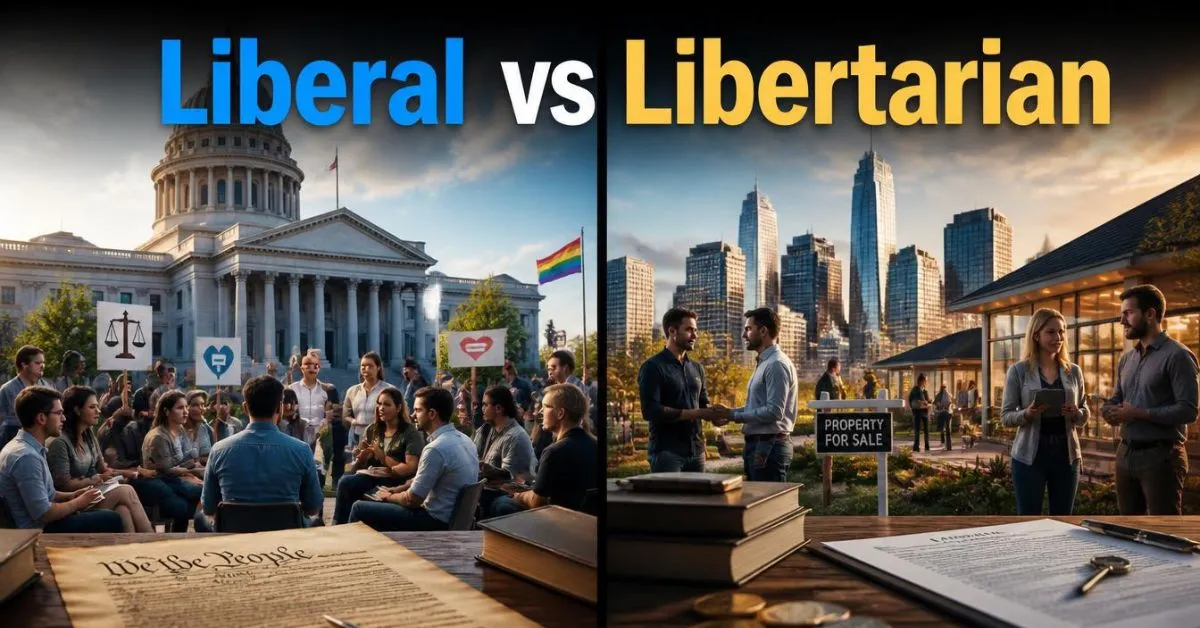
Liberal vs libertarian refers to two related but distinct political traditions. In modern U.S. politics, liberals generally support individual rights along with a more active government role in economic and social policy.
Libertarians put greater emphasis on individual liberty, private property, free markets, and limiting government power. The two can overlap on some civil-liberty issues but differ significantly on economic policy and government intervention.
Key Takeaways
- Liberal is a broad political term with different meanings across time and countries.
- In modern U.S. politics, liberalism generally combines individual rights with support for an active role for government.
- Libertarianism places individual liberty and limits on government coercion at the center of its philosophy.
- Liberals and libertarians may agree on some personal freedoms while disagreeing about taxes, regulation, redistribution, and government programs.
- Classical liberalism helps explain why the two terms are historically connected.
- Political labels are broad, so an individual’s views may not fit perfectly into either category.
What Does Liberal Mean?
The word liberal can mean different things depending on the historical and political context.
At its broadest level, liberalism is a political tradition that gives an important place to individual liberty. But liberalism is not one single theory. The Stanford Encyclopedia of Philosophy describes liberalism as a family of related but sometimes competing views about liberty, political authority, equality, and the proper role of government.
In the United States today, “liberal” commonly refers to a center-left political position. Modern American liberals generally support civil liberties and individual rights while also accepting a significant government role in areas such as economic policy, public programs, regulation, and social policy.
That is different from saying that every liberal supports the same policies.
For example, one liberal may favor a larger government role in health care, while another may prefer a more limited approach. The label describes a broad political tradition rather than a single checklist of beliefs.
This distinction matters because modern American liberalism is not identical to the older meaning of classical liberalism.
What Does Libertarian Mean?
Libertarianism is a political philosophy that puts individual freedom at the center of political life.
The Stanford Encyclopedia of Philosophy describes libertarianism as a family of views in which individual freedom is treated as a paramount political value. Libertarians generally object to coercion and place strong importance on individual rights, private property, voluntary exchange, and freedom of contract.
In practical terms, libertarians generally favor a much more limited role for government than modern American liberals do.
The current Libertarian Party describes its principles around individual liberty, personal responsibility, limited government, free markets, and civil liberties. Its platform also emphasizes property rights and voluntary economic exchange.
However, libertarianism is broader than the Libertarian Party. A person can hold libertarian political views without belonging to that party.
Liberal vs Libertarian: What’s the Difference?
The simplest way to understand the liberal vs libertarian difference is to ask one question:
How much should government do?
Both traditions can value freedom, but they often disagree about how government should protect freedom and address social and economic problems.
View of Government
Modern liberals generally see government as a legitimate tool for addressing public problems.
They may support government action when they believe it can expand opportunity, protect rights, provide public goods, regulate harmful activity, or reduce serious economic and social disadvantages.
Libertarians generally want government power to be much more limited.
The Libertarian Party’s current platform says individuals should be free to make their own choices as long as they do not forcibly interfere with the equal rights of others. It also calls for limiting government interference in voluntary relationships and economic activity.
So, in broad terms:
Liberal: Government can play an active role in solving public problems.
Libertarian: Government should be limited so individuals retain greater control over their own lives.
Economic Policy and Taxes
Economics is one of the clearest areas where the two approaches can differ.
Modern liberals generally accept taxation as a way to fund government programs and public services. They may also support regulations designed to protect workers, consumers, public health, or the environment.
Libertarians generally favor lower taxes and fewer government restrictions on economic activity.
The current Libertarian Party platform strongly supports free markets and private property and opposes government efforts to redistribute wealth or manage voluntary trade.
The difference can therefore be summarized like this:
| Economic question | Liberal approach | Libertarian approach |
| Taxes | Generally accepts taxation to fund government | Generally favors substantially lower taxation |
| Markets | Supports markets with government rules | Strong preference for free markets |
| Regulation | More accepting of regulation | Generally skeptical of regulation |
| Redistribution | May support redistribution | Generally opposes government redistribution |
| Government programs | Generally supports a larger public role | Generally favors a much smaller role |
These are broad tendencies, not rules that describe every individual.
Personal & Social Freedom
This is an area where liberals and libertarians can sometimes look similar.
Both may support freedom of speech, personal autonomy, civil liberties, and limits on government interference in private life.
But the underlying reasoning can differ.
Libertarianism generally starts from a strong presumption that peaceful adults should be free to make their own choices. The Libertarian Party’s platform explicitly emphasizes personal liberty and individual responsibility.
Modern liberals also generally place significant value on civil rights and personal freedoms, but may be more willing to use government policy when they believe it is needed to protect rights or create fairer social conditions.
That means two people can agree that an individual should have a particular freedom while disagreeing about the government’s role in protecting or supporting that freedom.
Regulation and Government Programs
Another major difference concerns government intervention.
Liberals are generally more open to regulations and public programs when they believe these policies solve social or economic problems.
Libertarians tend to question whether government intervention is necessary in the first place.
For example, a liberal might view a government regulation as a way to prevent harm or protect the public. A libertarian might argue that the same regulation gives government too much power over voluntary choices or private businesses.
The disagreement is therefore not simply about whether a specific rule is good or bad. It can reflect a deeper disagreement about how much authority government should have in the first place.
Liberal vs Libertarian Comparison Table
| Issue | Liberal | Libertarian |
| Main emphasis | Liberty plus social and economic goals | Individual liberty |
| Government | More active role | Limited role |
| Taxes | Supports taxation for public purposes | Generally favors lower taxes |
| Free markets | Supports markets with more regulation | Strongly favors free markets |
| Regulation | More accepting | More skeptical |
| Social programs | Generally supports a larger public role | Generally favors limited government involvement |
| Property rights | Supports property rights with some government limits | Places very strong emphasis on property rights |
| Personal freedom | Generally values civil liberties | Places individual liberty at the center |
| Redistribution | May support it | Generally opposes government redistribution |
| Political identity | Commonly associated with the U.S. left | Separate political tradition |
The table shows broad tendencies rather than universal rules. Liberalism itself contains multiple schools of thought, while libertarianism also contains internal disagreements.
Liberalism, Classical Liberalism & Libertarianism
One reason liberal vs libertarian is confusing is that the word “liberal” has changed meaning over time.
Classical liberalism traditionally emphasized individual rights, limited government, private property, free markets, and freedom of contract.
Some of these ideas strongly overlap with modern libertarianism.
Modern American liberalism developed in a different direction, placing greater emphasis on the government’s ability to address economic inequality, provide public goods, and support social programs.
This does not mean classical liberalism and libertarianism are exactly the same. Nor does it mean modern liberalism has abandoned the idea of individual liberty.
Instead, these traditions disagree about how liberty should be understood and what government can legitimately do.
The Stanford Encyclopedia of Philosophy describes libertarianism as typically a variety of liberal political theory while noting that the classification is contested.
That historical connection explains why liberal and libertarian sound so similar.
Are Libertarians Liberal or Conservative?
The answer depends on what aspect of politics you are discussing.
Libertarians do not fit neatly into the traditional U.S. liberal-conservative spectrum.
On economic issues, libertarians often support positions associated with limited government, free markets, private property, and lower taxation.
On some personal-liberty issues, libertarian positions can differ from traditional conservative positions because libertarians place a strong emphasis on individual choice and limiting government interference.
The Stanford Encyclopedia of Philosophy specifically notes that libertarianism is difficult to place neatly on the contemporary left-right spectrum.
So calling every libertarian either “liberal” or “conservative” can leave out important parts of the ideology.
Can Someone Be Both Liberal & Libertarian?
Yes, depending on how the terms are defined.
A person may agree with modern liberals on certain civil-rights questions while agreeing with libertarians on specific economic or regulatory issues.
Someone may also identify more closely with classical liberalism, which has historical connections to both traditions.
Political labels are not mathematical categories. A person can hold a mixture of views that does not perfectly match any single ideological label.
That is why it is often more useful to ask what someone believes about a specific issue rather than assuming their entire political outlook from one label.
FAQs:
Are liberals and libertarians the same?
No. They share some ideas about individual freedom and civil liberties, but they generally differ over the proper size and role of government. Modern U.S. liberals are generally more accepting of government programs, taxation, and regulation, while libertarians place stronger emphasis on limited government, private property, and free markets.
Is libertarianism a form of liberalism?
Libertarianism is commonly classified as a variety of liberal political theory, although that classification is debated. Both traditions have strong connections to individual liberty, but libertarianism gives especially strong weight to limits on coercion, private property, and voluntary exchange.
Do libertarians believe in government?
Yes. Libertarianism does not necessarily mean having no government. Many libertarian approaches support a limited government focused on protecting individual rights, property, and voluntary agreements. The exact functions considered legitimate can vary among libertarians.
What is classical liberalism?
Classical liberalism is a tradition emphasizing individual rights, liberty, limited government, property rights, and economic freedom. Some of its ideas overlap strongly with libertarianism, which helps explain the historical relationship between the two terms.
What is the biggest difference between liberal and libertarian?
The biggest difference is often their view of government’s proper role. Modern American liberals generally accept a broader government role in social and economic policy, while libertarians generally seek much stronger limits on government power and greater individual control over private and economic choices.
Conclusion:
The liberal vs libertarian distinction is easier to understand when you separate shared values from different views of government.
Both traditions can place a high value on individual liberty. The major difference is often what they believe government should do to protect that liberty and address social and economic problems.
Modern U.S. liberals generally accept a more active government role, including taxation, regulation, and public programs. Libertarians generally emphasize limited government, private property, free markets, voluntary exchange, and personal responsibility.
The terms are related, but they are not interchangeable. Understanding the specific issue behind a political label gives a clearer picture than relying on the label alone.

Eric Walker, an author at replyygenius.com, where I create clear and helpful content for readers.
I focus on writing useful, engaging, and easy to understand articles that deliver real value.