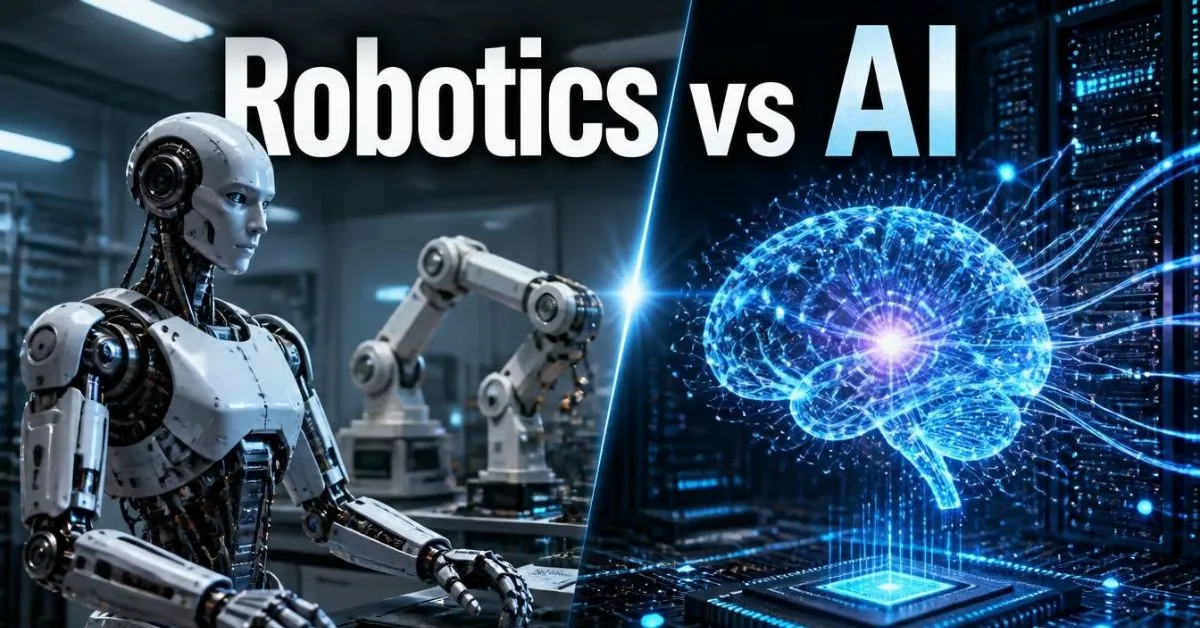
Robotics and AI are different but closely connected fields. Robotics focuses on building and controlling physical machines that can sense and act in the real world.
AI focuses on software systems that can perform tasks such as recognizing patterns, learning from data, making predictions, and supporting decisions. A robot can work without AI, while AI can work without a robot.
Key Takeaways
- Robotics focuses on physical machines and their actions.
- AI focuses on intelligent computational tasks.
- A robot does not automatically use AI.
- AI does not need a physical body.
- Robotics, AI, and automation can overlap but are not the same.
- AI can make robots more adaptable to changing environments.
What Is the Difference Between Robotics and AI?
The easiest way to understand robotics vs AI is to ask what problem each field is trying to solve.
Robotics is focused on physical action. It involves designing machines that can sense their environment, process information, move, and perform physical tasks.
Artificial intelligence is focused on intelligent behavior. AI systems can analyze data, recognize patterns, make predictions, understand language, generate content, or support decisions.
The two fields overlap, but they are not interchangeable. Stanford describes robotics as a field combining engineering and computer science to create machines capable of physical tasks. AI can be integrated into those machines to help them perceive, decide, and adapt.
A simple example makes the difference clear:
A factory robot that repeats the same programmed movement = robotics.
A computer model that identifies objects in photographs = AI.
A robot that uses computer vision to identify objects and decide what to pick up = robotics + AI.
What Is Robotics?
Robotics is the field concerned with designing, building, programming, and controlling robots.
A robot can contain several different systems, including:
- Sensors
- Motors
- Actuators
- Cameras
- Controllers
- Mechanical components
- Software
- Communication systems
These components allow robots to interact with the physical world.
For example, an industrial robotic arm can move parts between different locations on a production line. A warehouse robot can transport goods. A robotic system can also be designed for inspection, agriculture, healthcare, or exploration.
Importantly, robotics does not automatically mean AI.
A robot can simply follow a predefined sequence of instructions.
How Robotics Works
A basic robotic system can be understood as:
Sense → Process → Act
The robot receives information through sensors, processes that information through its control system, and then performs an action.
More advanced robots may add AI to this process.
For example:
Camera → AI vision model → Object recognized → Robot decides movement → Arm moves
That combination is where robotics and AI become closely connected.
Examples of Robotics
Common examples include:
- Industrial robotic arms
- Warehouse robots
- Drones
- Robotic vacuum cleaners
- Surgical robotic systems
- Agricultural robots
- Space robots
- Autonomous vehicles
NIST also identifies robotics and autonomous systems as important areas involving physical machines, sensing, control, and increasingly advanced AI techniques.
What Is Artificial Intelligence?
Artificial intelligence is a broad field involving computer systems that perform tasks associated with intelligent behavior.
AI can be used to:
- Recognize images
- Understand language
- Analyze data
- Detect patterns
- Make predictions
- Generate text or images
- Recommend products
- Support decisions
AI does not require a physical machine.
A chatbot, recommendation system, image-recognition tool, or fraud-detection system can all use AI without being robots.
NIST defines AI systems in terms of capabilities such as making predictions, recommendations, or decisions that influence virtual or physical environments.
How AI Works
A simplified AI process looks like:
Data → AI model → Output
For example, an image-recognition model receives an image and produces a prediction about what the image contains.
Machine learning is one major approach used in modern AI. It allows systems to learn patterns from data instead of relying only on manually written rules.
Examples of AI
Examples include:
- Chatbots
- Search systems
- Recommendation engines
- Image recognition
- Speech recognition
- Translation tools
- Fraud detection
- Generative AI
- Predictive systems
None of these applications needs a physical robot.
Robotics vs AI: Key Differences
| Feature | Robotics | AI |
| Main focus | Physical machines | Intelligent software and systems |
| Physical body | Usually required | Not required |
| Hardware | Very important | Optional |
| Sensors | Commonly important | May be used |
| Motors/actuators | Commonly used | Not required |
| Data | Used for control and perception | Often central to model development |
| Machine learning | Optional | Common technique |
| Physical action | Core function | Not required |
| Example | Robotic arm | Chatbot |
| Can work independently? | Yes | Yes |
The important point is that robotics describes a physical system and AI describes intelligent computational capabilities. Modern systems can combine both.
Robotics vs AI vs Automation
This is one of the most useful distinctions to understand.
Automation means using technology to perform a task with limited or no human intervention.
Robotics involves physical machines that can perform actions in the physical world.
AI involves computational systems that can perform capabilities such as prediction, recognition, reasoning, or decision-making.
For example:
| Technology | Simple Example |
| Automation | A system automatically sends an email after a form is submitted |
| Robotics | A machine moves a product from one position to another |
| AI | A model predicts whether a transaction may be fraudulent |
| AI + Robotics | A robot identifies an object and decides how to pick it up |
Automation does not always require AI. AI does not always involve automation. Robotics is also not synonymous with either one. NIST describes traditional automation as increasingly being combined with AI and advanced sensing to create more adaptive systems.
Can Robotics Work Without AI?
Yes.
A robot can operate using predefined instructions.
Imagine a factory arm programmed to:
- Move to position A.
- Pick up a component.
- Move to position B.
- Place the component.
- Repeat the process.
If the environment and task are predictable, the robot may not need machine learning or another AI technique.
This is why saying “all robots are AI” is incorrect.
Robotics can use traditional control systems, programmed logic, sensors, and mechanical systems without requiring AI.
Can AI Work Without Robotics?
Yes.
In fact, many AI applications have no physical robot at all.
Consider:
- A chatbot answering questions
- An AI tool generating text
- Software detecting spam
- An algorithm recommending videos
- A model analyzing medical images
- A system predicting customer demand
These are software-based AI applications.
The AI can receive information, process it, and produce an output without controlling a physical machine.
How AI and Robotics Work Together
The real overlap between the two fields happens when AI is placed inside a robotic system.
Stanford explains that AI can help robots perceive their surroundings, make decisions, and adapt to situations that are not fully covered by explicit programming.
AI in Robot Perception
A robot can use cameras and other sensors to collect information.
AI-based computer vision can then help identify:
- Objects
- People
- Obstacles
- Product defects
- Changes in the environment
AI in Robot Decision-Making
After collecting information, an AI system can help determine what should happen next.
For example, a warehouse robot may need to select a route around an obstacle instead of simply following one fixed path.
NIST describes autonomous systems as combining robotics or automation capabilities with advanced algorithms, including AI, to select and execute different actions with less human intervention.
AI in Robot Movement
AI can also support planning and control.
For example, an AI-enabled robot may need to determine how to reach an object, grasp it, and move it without hitting nearby objects.
This is part of the growing area often called embodied AI, where AI capabilities are connected to systems that interact with the physical world. NIST is researching how these approaches can be tested and applied in real robotic systems.
Real-World Applications of Robotics and AI
Manufacturing
Robotics is widely used for physical production tasks such as assembly, handling, and inspection.
AI can add capabilities such as computer vision, adaptive decision-making, and analysis of manufacturing data.
NIST’s 2026 smart-manufacturing roadmap identifies AI and machine learning applications involving advanced sensing, autonomous systems, robotics, and logistics.
Healthcare
Robotic systems can assist with physical procedures and controlled movements.
AI can support image analysis, pattern recognition, and other information-processing tasks.
Some systems combine both technologies.
Warehousing
Robots can physically transport goods around warehouses.
AI can help systems interpret sensor information, plan routes, identify objects, or respond to changing conditions.
Agriculture
Robots can perform physical tasks such as monitoring crops or handling materials.
AI and computer vision can help these systems identify objects or conditions in their environment.
Transportation
Autonomous vehicles combine physical hardware, sensors, control systems, and advanced algorithms.
This makes transportation a strong example of how robotics, automation, sensing, and AI can overlap.
Robotics vs AI for Students and Careers
Your choice depends on the type of work you want to do.
Robotics May Interest You If You Like:
- Mechanical engineering
- Electronics
- Sensors
- Motors
- Control systems
- Physical machines
- Hardware
- Programming robots
AI May Interest You If You Like:
- Programming
- Mathematics
- Statistics
- Machine learning
- Data
- Algorithms
- Computer vision
- Natural language processing
What If You Like Both?
You can study both.
Modern robotic systems increasingly combine robotics with AI, especially in areas involving perception, autonomy, and changing environments. NIST’s current robotics research specifically highlights the interaction between advanced AI, sensors, manipulation, and physical robotic systems.
FAQs:
Is robotics part of AI?
No. Robotics and AI are separate but overlapping fields. Robotics focuses on physical machines and their ability to sense and act in the world. AI focuses on computational capabilities such as learning, perception, prediction, and decision-making. A robotics system can use AI, but robotics itself is not simply a subset of AI.
Do all robots use AI?
No. Some robots use fixed programs and traditional control systems. AI becomes useful when robots need capabilities such as visual recognition, adaptive planning, or decision-making in less predictable environments.
Is AI a type of robotics?
No. AI can operate entirely as software. A chatbot, recommendation system, or image-recognition model can use AI without controlling any physical robot.
What is an example of AI without robotics?
A chatbot is a simple example. Other examples include recommendation systems, fraud-detection models, image-recognition software, and generative AI applications.
What is an example of robotics without AI?
A programmed industrial robotic arm is an example. It can repeatedly perform a specific movement using predefined instructions without machine learning.
Can AI and robotics be used together?
Yes. AI can help robots perceive their surroundings, interpret sensor data, plan actions, and adapt to changing situations. The robot supplies the physical capability, while AI can provide additional perception and decision-making capabilities.
Conclusion:
Robotics vs AI highlights two different but closely connected technologies. Robotics focuses on building and controlling physical machines, while AI focuses on learning, analyzing data, and making intelligent decisions.
A robot can operate without advanced AI, while AI can work without a physical machine.
When combined, robotics and AI can create smarter systems that can sense their surroundings, learn from information, and perform tasks with less human input.
From manufacturing and healthcare to transportation and agriculture, both technologies are changing how work gets done. Understanding the difference between Robotics vs AI makes it easier to see how each technology works and where it can be used.

Olivia Smith is a professional author at ReplyGenius.com, where I create clear and engaging content on communication and writing.