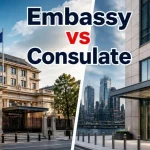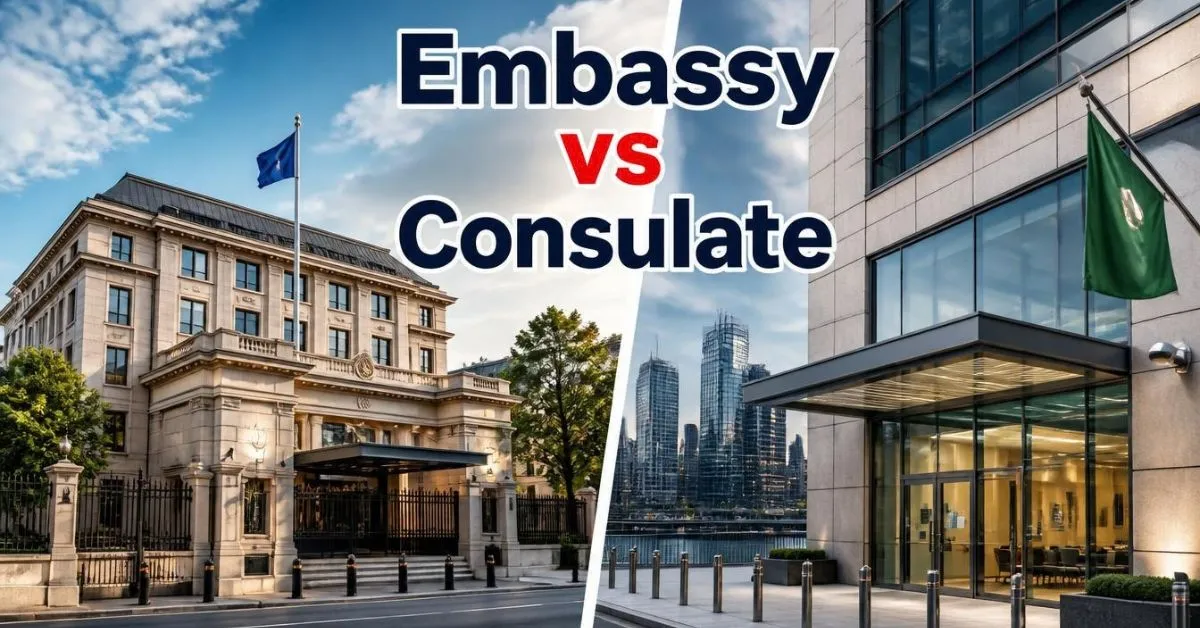
An embassy is a country’s main diplomatic mission in another country, usually located in the capital and led by an ambassador.
A consulate is a regional office that mainly handles services such as visas, passports, documents, and help for citizens abroad. An embassy may also have a consular section, so their services can overlap.
Key Takeaways
- An embassy is usually a country’s main diplomatic mission in another country.
- A consulate usually serves people in a specific city or region.
- Embassies are generally located in the host country’s capital.
- Consulates commonly handle visas, passports, and citizen services.
- An embassy can also provide consular services through its consular section.
- The correct office depends on the service you need and the country’s rules.
What Is an Embassy?
An embassy is the main diplomatic mission that represents one country in another country. It serves as an official channel between the two governments.
Most countries maintain their main embassy in the capital city of the country where they have diplomatic relations. An embassy is normally headed by an ambassador, who represents the sending country.
For example, a foreign country’s embassy in the United States is generally located in Washington, D.C. because that is the U.S. capital and the center of the federal government.
An embassy does more than provide services to travelers. Its broader role involves diplomacy, government relations, economic matters, cultural connections, and other official relationships.
What Does an Embassy Do?
The exact responsibilities can differ by country, but an embassy may:
- Represent its government in the host country
- Maintain diplomatic relations
- Communicate with the host government
- Support political and economic cooperation
- Promote cultural and educational relationships
- Report relevant developments to its government
- Provide or oversee certain consular services
- Assist citizens in serious situations abroad
Under the Vienna Convention on Diplomatic Relations, diplomatic missions have functions that include representing the sending state, negotiating with the receiving government, protecting certain interests, and promoting friendly relations.
So, when comparing embassy vs consulate, think of an embassy primarily as the country’s main diplomatic presence.
What Is a Consulate?
A consulate is a government office that provides consular services in a foreign country.
Unlike an embassy, which is normally based in the capital, a country can have several consulates in different cities. This allows people in different regions to access government services without traveling to the capital.
A consulate may serve a defined geographic area known as a consular district.
What Does a Consulate Do?
Consulates often deal directly with travelers, immigrants, foreign applicants, and citizens living abroad.
Depending on the country and the specific consular post, services may include:
- Processing visa applications
- Providing passport services
- Issuing emergency travel documents
- Helping citizens during emergencies
- Providing certain notarial services
- Registering certain vital events
- Offering information about local procedures
- Supporting commercial and cultural relationships
For example, if a U.S. citizen loses a passport while traveling abroad, the nearest U.S. embassy or consulate may provide assistance and information about replacing travel documents.
The exact service available depends on the country, location, and individual diplomatic post.
Embassy vs Consulate: What’s the Difference?
The easiest way to understand the difference is to compare their main purpose, location, leadership, and services.
| Feature | Embassy | Consulate |
| Main purpose | Diplomatic representation | Consular services |
| Typical location | Capital city | Major cities or regions |
| Main leader | Ambassador | Consul General or consul |
| Government relations | Major responsibility | More limited regional role |
| Visa services | May provide them | Often provides them |
| Passport services | May provide them | Commonly provides them |
| Citizen assistance | Yes | Yes |
| Number in a country | Usually one main embassy | May be several |
| Geographic role | Countrywide diplomatic mission | Specific consular district |
The important point is that these roles are not completely separate.
An embassy can contain a consular section. That section may handle visas, passports, and other consular matters.
Because of this overlap, you should always check the official website of the specific embassy or consulate before making an appointment or visiting.
Embassy vs Consulate: Location Matters
Location is one of the easiest ways to tell the difference.
An embassy is generally located in the capital city because it needs to maintain close contact with the host country’s central government.
Consulates are often located in other major cities.
For example, a country may have:
- One embassy in Washington, D.C.
- A consulate general in New York
- Another consulate general in Los Angeles
- Additional consular offices in other U.S. cities
This arrangement allows the country to provide services to people across different regions.
However, the number and location of diplomatic posts vary from country to country.
Do You Go to an Embassy or Consulate for a Visa?
This is one of the most common questions about embassy vs consulate.
The answer is: it depends on the country, visa type, and where you live.
A consulate may process visa applications for people living within its assigned region. An embassy may also process visas through its consular section.
For example, if you want to visit another country, you should not assume that the embassy in the capital handles every visa application.
Instead, check the country’s official visa instructions and find out:
- Which office handles your visa category?
- Which locations accept applications?
- Whether you need an appointment?
- Which geographic area the office serves?
- What documents and fees are required?
This is especially important because visa procedures can change.
The safest rule is simple: follow the official instructions from the country whose visa you are applying for.
What Is a Consulate General?
A consulate general is a type of consular post.
It performs consular functions but is not an embassy.
You may see names such as:
- Consulate General of Canada
- Consulate General of India
- Consulate General of France
- U.S. Consulate General
The word general refers to the type of consular post. It does not mean that the office is a second embassy.
A consulate general may serve a large geographic area and provide several types of consular services.
Embassy vs Consulate for Passport Problems
If you lose your passport while traveling abroad, your country’s embassy or consulate may be able to help.
The correct office depends on your location and your country’s overseas network.
A consular office may provide information about:
- Replacing a lost or stolen passport
- Emergency travel documents
- Required identification
- Police reports
- Appointment procedures
- Travel restrictions
For U.S. citizens abroad, the U.S. Department of State directs travelers to U.S. embassies and consulates for assistance with certain emergencies.
If your passport is lost or stolen, contact the appropriate U.S. embassy or consulate as soon as possible and follow its instructions.
Embassy vs Consulate for Emergencies
Embassies and consulates can both assist their country’s citizens in certain emergencies.
Examples may include:
- Lost or stolen travel documents
- Arrest or detention
- Serious accidents
- Major emergencies
- Death of a family member abroad
- Large-scale crises
However, consular assistance has limits. A diplomatic post generally cannot override local laws, provide unlimited financial support, or act as a person’s private lawyer.
The specific assistance available depends on the situation and the country’s policies.
Is a Consulate the Same as an Embassy?
No. An embassy is generally the main diplomatic mission in a foreign country, while a consulate is usually a regional post focused on consular services.
However, the two can overlap. An embassy may have a consular section that provides services normally associated with a consulate.
Can a Consulate Issue Visas?
Yes, a consulate can issue or process visas when that country’s rules give the consular post responsibility for the relevant visa category.
However, not every consulate handles every type of visa.
Always check the official website of the relevant diplomatic mission before submitting an application.
Can an Embassy Help With a Lost Passport?
Yes. An embassy may provide passport or emergency travel-document assistance to its citizens abroad.
In some countries, this service may instead be handled by a consulate.
The correct office depends on where the traveler is located and how that country organizes its consular services.
Can One Country Have Multiple Consulates?
Yes.
A country can have several consulates in another country. Large countries such as the United States may have multiple consular posts because one office would not be practical for everyone.
Each post may have its own geographic area and list of services.
Is an Embassy Always in the Capital?
Generally, yes. Embassies are normally located in the capital because their primary function is diplomatic representation and communication with the host government.
There can be unusual diplomatic arrangements, so the best way to locate a particular embassy is to check the official government or diplomatic mission website.
Which One Should You Contact?
The answer depends on what you need.
For diplomatic or government-to-government matters:
The embassy is generally the main diplomatic contact.
For a visa:
Check the official visa instructions to find the embassy or consulate responsible for your application.
For a passport problem abroad:
Contact your country’s embassy or consulate and follow its consular instructions.
For local citizen services:
A consulate may be the appropriate office if one serves your area.
For an emergency abroad:
Contact the nearest appropriate embassy or consulate and use its emergency instructions.
The most important thing is to check the specific diplomatic post, rather than assuming that every embassy or consulate provides the same services.
Embassy vs Consulate: The Simple Difference
The simplest way to remember the difference is:
Embassy = main diplomatic mission.
Consulate = regional office for consular services.
An embassy focuses heavily on relations between governments, while a consulate usually focuses more on practical services for people and citizens abroad.
But there is some overlap. An embassy can have a consular section, and the services offered by each post depend on the country and location.
Conclusion:
If you’re wondering if you need an embassy or consulate, start with the service you need.
For visas, passports, and citizen assistance, check the official website of the relevant country to identify the office responsible for your location and request.
For broader diplomatic relations, the embassy is generally the main mission.
Understanding this difference can save you time and help you contact the right office before making a trip or appointment.

Aiden Robert, an author at ReplyyGenius.com, where I share smart conversation tips, flirty replies, and practical communication ideas to help people reply with confidence.