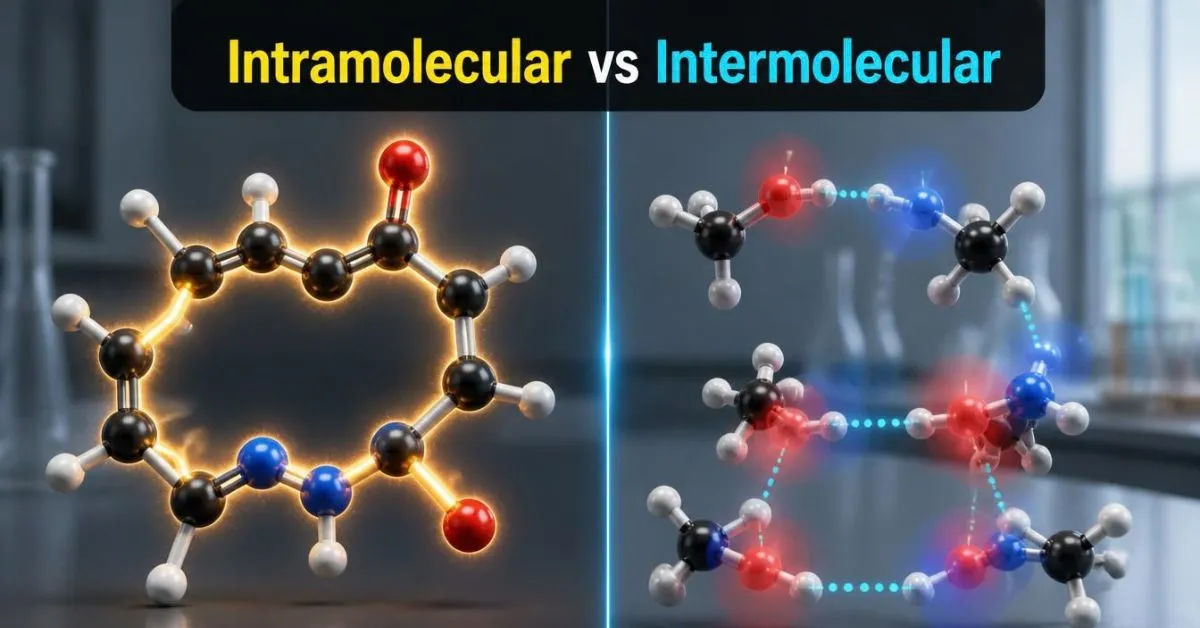
Intramolecular means something occurs within the same molecule, while intermolecular means it occurs between separate molecules or molecular entities.
Intramolecular interactions help hold a molecule together, while intermolecular forces act between particles and affect properties such as boiling point, melting point, and physical state.
Key Takeaways
- Intra means within.
- Inter means between.
- Intramolecular interactions occur within the same molecular entity.
- Intermolecular forces act between separate molecules or particles.
- Common intermolecular forces include London dispersion, dipole-dipole attraction, and hydrogen bonding.
- Both terms can also describe chemical reactions.
What Does Intramolecular vs Intermolecular Mean?
The easiest way to understand intramolecular vs intermolecular is to focus on the prefixes.
Intra- means within.
Inter- means between.
Therefore, something intramolecular happens within the same molecular entity. Something intermolecular involves separate molecular entities. IUPAC defines intramolecular processes as interactions or transfers involving different parts of the same molecular entity.
For example, the O-H covalent bonds inside one water molecule are within that molecule. By contrast, the attraction between one water molecule and another is intermolecular.
A simple way to remember it is:
Intra = inside
Inter = between
This distinction is important in chemistry because the two terms can describe forces, interactions, hydrogen bonds, and reactions.
Intramolecular Forces Explained
Intramolecular interactions occur within a molecule and help hold its atoms or groups together.
A common example is a covalent bond. In an HCl molecule, hydrogen and chlorine are connected by a covalent bond. That bond exists within the molecule.
In organic chemistry, bonds such as carbon-carbon and carbon-hydrogen covalent bonds are also within individual molecules.
These interactions are closely connected to a substance’s chemical structure. Changing the bonding arrangement can produce a different molecule or chemical substance.
Examples of Intramolecular Interactions
Consider a single water molecule:
H-O-H
The bonds connecting the hydrogen atoms to oxygen are intramolecular because the atoms are part of the same molecular entity.
Now consider two water molecules:
H₂O ··· H₂O
The dotted attraction between the two molecules is intermolecular rather than intramolecular.
This simple example shows why the distinction depends on where the interaction occurs.
Why Intramolecular Forces Matter
Intramolecular bonding helps determine the structure and chemical identity of a substance.
For example, breaking a covalent bond can change the molecule itself. This is very different from changing the distance between intact molecules during a physical change.
That difference is important when studying melting, boiling, evaporation, and chemical reactions.
Intermolecular Forces Explained
Intermolecular forces are attractive interactions between separate molecules or particles.
They are especially important in liquids and solids because they help keep particles close together. Intermolecular forces also help explain physical properties such as boiling points and melting behavior.
The three common types discussed in introductory chemistry are:
- London dispersion forces
- Dipole-dipole forces
- Hydrogen bonding
The strength of these interactions varies depending on the molecules involved.
London Dispersion Forces
London dispersion forces result from temporary changes in electron distribution.
They can occur in all atoms and molecules, including nonpolar molecules. For larger molecules, dispersion forces can become more significant because the molecules have more electrons and can have greater polarizability.
For example, methane and other nonpolar molecules experience London dispersion forces.
Although an individual dispersion interaction may be weak, many interactions together can have a noticeable effect on a substance’s physical properties.
Dipole-Dipole Forces
Dipole-dipole forces occur between polar molecules.
A polar molecule has an uneven distribution of charge, giving it partially positive and partially negative regions. Opposite partial charges on nearby molecules can attract each other.
HCl is a common example.
The hydrogen side of one HCl molecule can be attracted to the chlorine side of another HCl molecule. This attraction occurs between molecules, so it is intermolecular.
Hydrogen Bonding
Hydrogen bonding is a particularly strong type of intermolecular attraction commonly discussed when hydrogen is bonded to fluorine, oxygen, or nitrogen.
Water provides the classic example. The hydrogen of one water molecule can interact with the oxygen of another water molecule.
Despite the word “bond,” hydrogen bonding is generally treated as an intermolecular attractive force in this context rather than the same type of covalent bond that holds atoms together inside a molecule.
Intramolecular vs Intermolecular: Key Differences
| Feature | Intramolecular | Intermolecular |
| Basic meaning | Within the same molecule | Between separate molecules |
| Location | Inside one molecular entity | Between molecular entities |
| Common examples | Covalent bonds within molecules | Dispersion, dipole-dipole, hydrogen bonding |
| Main importance | Molecular structure and chemical identity | Physical properties and behavior |
| Example | O-H bond inside H₂O | Attraction between H₂O molecules |
| Related reactions | Reaction within one molecule | Reaction between separate molecules |
One important detail: in introductory chemistry, intramolecular forces often refers broadly to the chemical bonds holding atoms together. Strictly speaking, not every substance containing ionic or metallic bonding is made of discrete molecules, so “intramolecular” is most precise when discussing molecular entities. IUPAC’s definition centers on interactions involving parts of the same molecular entity.
Intramolecular vs Intermolecular Hydrogen Bonding
Hydrogen bonding can be either intramolecular or intermolecular.
An intramolecular hydrogen bond forms between two suitable groups within the same molecule.
An intermolecular hydrogen bond forms between groups belonging to different molecules.
For example, hydrogen bonding between separate water molecules is intermolecular.
This distinction can affect molecular shape and behavior. In some organic molecules, groups within the same molecule can form an internal hydrogen bond instead of interacting with another molecule.
So, when you see the phrase “hydrogen bond,” do not automatically assume it is intermolecular. Look at which atoms or groups are interacting.
How Intermolecular Forces Affect Physical Properties
Intermolecular forces play a major role in the behavior of liquids and solids.
When molecules attract one another, energy is needed to move them farther apart. This helps explain why intermolecular forces influence properties such as:
- Boiling point
- Melting point
- Vapor pressure
- Physical state
- Enthalpy of vaporization
For example, water molecules have strong hydrogen-bonding interactions. These attractions contribute to the amount of energy needed to turn liquid water into vapor.
A useful comparison is HCl. OpenStax notes that about 17 kJ per mole is required to overcome the intermolecular attractions when liquid HCl becomes a gas, while breaking the H-Cl covalent bonds requires about 430 kJ per mole.
This illustrates a common chemistry principle: intermolecular attractions are usually much weaker than the chemical bonds holding atoms together within a molecule.
However, the exact strength depends on the specific interaction and molecular environment.
Intramolecular vs Intermolecular Reactions
The terms intramolecular and intermolecular are also used when discussing chemical reactions.
An intramolecular reaction occurs when reacting groups are located within the same molecule.
An intermolecular reaction involves reacting groups associated with different molecules. OpenStax uses the same distinction when describing reactions in organic chemistry.
For example:
Intramolecular reaction:
Two reactive groups within one molecule react with each other.
Intermolecular reaction:
A reactive group on one molecule reacts with a group on another molecule.
This distinction is especially useful in organic chemistry because a molecule may contain multiple reactive groups that can potentially react internally or with another molecule.
Which Is Stronger: Intramolecular or Intermolecular?
In basic chemistry, intramolecular chemical bonds are generally stronger than ordinary intermolecular attractions.
For example, the covalent H-Cl bond is much stronger than the intermolecular attractions between separate HCl molecules. OpenStax gives approximately 430 kJ/mol for breaking H-Cl covalent bonds compared with about 17 kJ/mol for overcoming the intermolecular attractions during vaporization of liquid HCl.
This is why boiling a molecular substance normally does not break its covalent bonds. Instead, the process separates molecules while leaving their internal chemical bonds intact.
Still, “intramolecular is always stronger” is too broad as a universal statement. Chemistry contains many different types of interactions, and their strengths depend on the specific particles and environment.
For most introductory chemistry questions, however, this rule is useful:
Chemical bonds hold a molecule together. Intermolecular forces help hold separate molecules near one another.
FAQs:
Is hydrogen bonding intramolecular or intermolecular?
It can be either. If the hydrogen bond occurs between groups within the same molecule, it is intramolecular. If it occurs between separate molecules, it is intermolecular. Hydrogen bonding between water molecules is a common example of an intermolecular interaction.
What is an example of an intramolecular force?
A covalent bond between atoms within a molecule is a common example. For instance, the O-H bonds inside a water molecule are intramolecular because they connect atoms within the same molecular entity.
What is an example of an intermolecular force?
Hydrogen bonding between two water molecules is a common example. Dipole-dipole attraction between polar molecules and London dispersion forces are other common intermolecular interactions.
Why are intermolecular forces important?
Intermolecular forces influence many physical properties, including boiling point, melting behavior, vapor pressure, and physical state. They help explain why particles remain close together in liquids and solids.
How can I remember the difference?
Use the prefixes:
Intra = within
Inter = between
If the interaction happens inside one molecule, think intramolecular. If it happens between separate molecules, think intermolecular.
Conclusion:
The main difference between intramolecular vs intermolecular is simple: intramolecular means within, while intermolecular means between.
Intramolecular interactions occur within the same molecular entity and include the chemical bonds that hold atoms together. Intermolecular forces act between separate molecules and include London dispersion forces, dipole-dipole interactions, and hydrogen bonding.
The easiest exam trick is:
Intra = inside.
Inter = between.
Once you remember that difference, it becomes much easier to understand chemical bonding, hydrogen bonding, molecular reactions, boiling points, and other chemistry concepts.

Harry Jack is a content writer at ReplyGenius.com who specializes in practical, natural sounding replies for texts, social media, relationships, and everyday conversations.