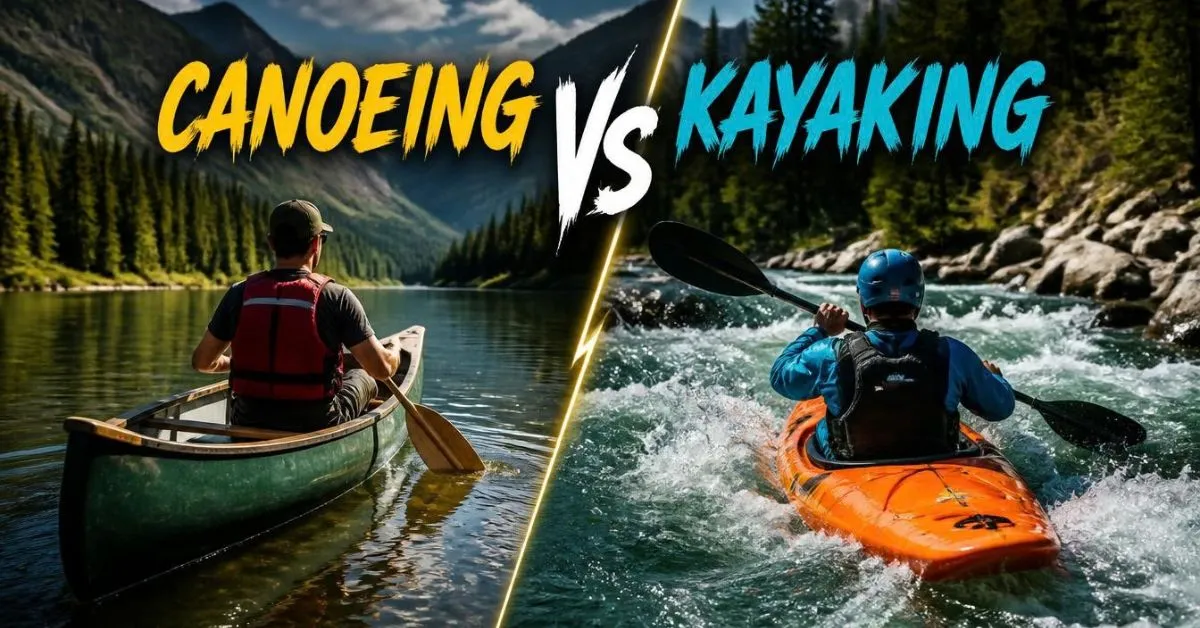
Canoeing and kayaking are both paddle sports, but the boats and paddles are different. A canoe is typically an open boat paddled with a single-bladed paddle, while a kayak usually has a low seat and is paddled with a double-bladed paddle.
Canoes offer more open space for people and gear, while kayaks are often convenient for solo paddling and maneuverability.
Key Takeaways
- Canoes usually use a single-bladed paddle.
- Kayaks usually use a double-bladed paddle.
- Canoeists may sit or kneel, while kayakers usually sit with their legs forward.
- Canoes generally provide more open space for passengers and gear.
- Kayaks come in many designs, including sit-inside, sit-on-top, touring, fishing, and whitewater models.
- Neither is always better. The right choice depends on where you paddle and what you want to do.
Canoeing vs Kayaking: What’s the Difference?
At first glance, a canoe and kayak can look very similar. Both are small human-powered boats, both use paddles, and both can be used on lakes, rivers, and other waterways.
The main differences are the paddle, seating position, and boat design.
A traditional canoe is generally open and uses a single-bladed paddle. The paddler may sit on a raised seat or kneel inside the boat.
A kayak usually places the paddler lower in the boat and uses a double-bladed paddle. Traditional sit-inside kayaks have a cockpit around the paddler, while sit-on-top kayaks have an open deck.
The International Canoe Federation also distinguishes canoe and kayak disciplines by paddle type and paddler position.
Canoeing
Canoeing usually involves an open canoe with a single-bladed paddle.
You can paddle from a seated position or kneel, depending on the canoe and paddling style. Canoes are popular for recreational trips, fishing, camping, family outings, and carrying gear.
Their open design gives you plenty of room to move and makes it easier to load bulky items.
Kayaking
Kayaking uses a kayak and a double-bladed paddle.
The paddler normally sits with the legs extended forward. Depending on the model, the kayak may have an enclosed cockpit or an open sit-on-top design.
Kayaks are available for calm lakes, rivers, fishing, touring, sea kayaking, and whitewater. This wide range of designs means two kayaks can feel completely different on the water.
Canoe vs Kayak: Key Differences
| Feature | Canoe | Kayak |
| Typical paddle | Single-bladed | Double-bladed |
| Seating | Sitting or kneeling | Usually seated, legs forward |
| Design | Usually open | Sit-inside or sit-on-top |
| Storage | More open space | Varies by model |
| Typical use | Family trips, camping, fishing | Recreation, touring, fishing, rivers |
| Solo use | Possible | Very common |
| Tandem use | Common | Available on tandem models |
| Entry and exit | Generally open and accessible | Depends on design |
| Maneuverability | Depends on hull and technique | Often very responsive |
| Stability | Depends on hull and load | Depends on hull and design |
These are general differences, not absolute rules. Modern recreational boats come in many shapes, and specialized canoes and kayaks can behave very differently.
Paddle
The paddle is one of the easiest ways to tell them apart.
A canoe paddle normally has one blade. You use it on one side of the canoe and switch sides or use steering strokes to maintain direction.
A kayak paddle has two blades, one at each end. You alternate strokes from side to side.
For many beginners, the kayak paddle feels intuitive because you can keep paddling on alternating sides without changing your grip.
Seating Position
Canoeists generally sit higher than kayakers or kneel inside the boat.
Kayakers normally sit lower, with their legs stretched toward the front. Some kayaks also have foot braces that help the paddler maintain contact with the boat.
The seating position changes how each boat feels. A lower seat can make a kayak feel secure and responsive, while the higher, open position of a canoe provides easier access to gear and more freedom to move.
Boat Design
Traditional canoes have an open top and a roomy interior.
Kayaks can have an enclosed cockpit or an open sit-on-top design. Sit-on-top kayaks are common for recreational paddling and fishing because the paddler sits on top rather than inside a cockpit.
This distinction matters when choosing a kayak. A recreational sit-on-top kayak may feel very different from a narrow touring or whitewater kayak.
Stability
Stability depends on more than whether a boat is called a canoe or kayak.
Hull width, hull shape, length, weight distribution, paddler position, and water conditions all affect stability.
Many recreational canoes are designed to feel stable and provide plenty of room. Recreational kayaks can also be highly stable, especially wider models designed for beginners or fishing.
A lower seating position can also affect how a kayak feels when balancing. Paddling experts note that recreational kayaks and canoes can both be stable when matched to the right conditions.
So instead of asking, “Which is always more stable?” ask, “Which specific boat is designed for the water and activity I have in mind?”
Speed and Maneuverability
Kayaks are often efficient for solo paddlers because the double-bladed paddle allows continuous strokes from both sides.
Long, narrow touring kayaks can also be designed to cover distance efficiently.
But there is no universal rule that every kayak is faster than every canoe. Hull shape, length, weight, wind, current, and paddling technique all affect speed.
The same is true for maneuverability. A short recreational kayak may turn very easily, while a long touring kayak may track straighter. Canoes also vary widely in how quickly they turn.
Storage & Capacity
This is one of the biggest practical differences.
A canoe’s open interior makes it easy to carry camping equipment, coolers, fishing supplies, pets, or other bulky gear.
Kayaks usually have less open interior space, although touring and fishing kayaks can have substantial storage compartments.
If you are planning a multi-day camping trip, the amount and type of gear you need may strongly influence your choice.
Is Kayaking Easier Than Canoeing?
For many beginners, a recreational kayak can be easier to control at first.
The double-bladed paddle lets you alternate strokes from one side to the other, which can make basic forward paddling feel natural.
Canoeing can require more attention to steering, especially when paddling solo. Techniques such as the J-stroke help a canoeist maintain direction without constantly switching sides.
However, “easier” depends on the boat and the person.
Someone who wants an open boat with plenty of room may find a canoe more comfortable. Someone who wants to paddle alone may prefer a recreational kayak.
For beginners, calm water and an appropriate boat matter more than choosing one sport based on a simple difficulty label.
Canoe vs Kayak for Different Activities
For Beginners
A stable recreational kayak can be a simple starting point for someone who wants to paddle alone.
A canoe can also be beginner-friendly, especially with two paddlers on calm water.
If possible, try both before buying. Comfort and confidence are important parts of the learning experience.
For Lakes
Both canoes and kayaks work well on calm lakes.
Choose a canoe if you want more room for people, children, pets, or bulky gear.
Choose a kayak if you prefer a smaller craft and mostly plan to paddle alone.
Always consider wind and weather because conditions on a large lake can change quickly.
For Rivers
Both canoes and kayaks can be used on rivers, but the correct boat depends on the river.
A calm, slow-moving river is very different from a technical whitewater run.
Specialized whitewater kayaks and canoes are designed for moving water and require appropriate skills. A recreational boat designed for a calm lake should not automatically be used in rapids.
For Fishing
Both are popular fishing platforms.
A canoe gives you a spacious open area for tackle, coolers, and other equipment. A fishing kayak can be a compact option for a solo angler.
A sit-on-top fishing kayak can also provide easy access to the deck and storage areas.
Your choice should depend on how much equipment you carry, how far you paddle, and whether you fish alone or with someone else.
For Camping
Canoes are often practical for camping because of their open storage area.
You can load dry bags, tents, food, cooking equipment, and other bulky supplies without working around a narrow cockpit.
Kayaks can also be used for touring and camping, particularly models designed with dedicated storage compartments.
For Families
A canoe can be useful for families because it offers an open interior and can accommodate multiple paddlers depending on the model and capacity.
It is also easier to move around inside a canoe than in many sit-inside kayaks.
Always follow the manufacturer’s capacity limits and use appropriate safety equipment.
For Solo Paddling
Kayaks are commonly chosen for solo paddling.
A single recreational kayak is relatively compact, and the double-bladed paddle makes alternating strokes straightforward.
Solo canoeing is also possible, but positioning and steering require practice.
Canoeing vs Kayaking Pros & Cons
Canoe Pros
- Spacious open design
- Good for carrying bulky gear
- Useful for families and groups
- Easy access to the interior
- Well suited to camping and fishing
Canoe Cons
- Larger models can be heavy
- Wind can affect an open canoe
- Solo steering may take practice
- Transport can require more space
Kayak Pros
- Excellent option for solo paddling
- Double-bladed paddle is efficient for many users
- Many designs are available
- Compact recreational models are easy to transport
- Good options exist for touring, fishing, rivers, and sea use
Kayak Cons
- Many models have less open storage
- Sit-inside models can feel confined to some beginners
- Getting in and out takes practice
- Specialized kayaks may require specialized skills
Canoe or Kayak: Which Should You Choose?
Use your planned activity as the starting point.
Choose a canoe if you:
- Need plenty of open storage.
- Want to paddle with family or friends.
- Plan to carry camping equipment.
- Prefer an open boat.
- Want room for larger gear.
Consider a kayak if you:
- Mostly paddle alone.
- Want a compact boat.
- Prefer a double-bladed paddle.
- Want a boat designed for a specific activity such as touring or fishing.
- Prefer the lower seating position of a kayak.
If you are still unsure, renting both for a short trip can be more useful than choosing based on specifications alone.
Canoeing and Kayaking Safety Tips
If you choose, match the boat and your skills to the water conditions.
Wear a properly fitted personal flotation device (PFD) appropriate for your activity. The American Canoe Association emphasizes life-jacket use as an important part of paddling safety.
Before launching, check the weather and water conditions. Know your route and tell someone where you are going if you are paddling in a remote area.
Beginners should start in conditions suitable for their experience. Strong wind, cold water, waves, currents, and whitewater can quickly turn a simple trip into a serious situation.
If you use a sit-inside kayak, learn appropriate capsize and wet-exit skills before paddling in conditions where a rescue could be difficult.
FAQs:
Is kayaking easier than canoeing?
For many beginners, a recreational kayak is easier to control at first because its double-bladed paddle makes alternating strokes simple. However, the answer depends on the boat, water, and paddler. A canoe can be very easy to use on calm water, especially with two people.
Is a canoe more stable than a kayak?
Not necessarily. Stability depends on the boat’s hull, width, seating position, weight distribution, and water conditions. Many recreational canoes and kayaks are designed for good stability. A specific boat’s design matters more than its category alone.
Which is faster, a canoe or kayak?
It depends on the boats and conditions. A long, narrow kayak may be very efficient for a solo paddler, while a canoe with two skilled paddlers can also travel efficiently. Hull shape, length, weight, wind, current, and technique all affect speed.
Can two people use a kayak?
Yes. Tandem kayaks are designed for two paddlers. However, many recreational kayaks are made for one person, so always check the manufacturer’s capacity and seating configuration.
Can one person paddle a canoe?
Yes. A canoe can be paddled solo, but solo canoeing requires learning how to position yourself and control the boat. Some canoe designs are specifically made for solo paddling, while others are better suited to two paddlers.
Conclusion:
Canoeing vs kayaking comes down to more than the name of the boat.
Canoes typically offer an open design, single-bladed paddles, and plenty of room for people and gear. Kayaks generally use double-bladed paddles and provide a lower seating position, with designs ranging from simple recreational boats to specialized touring, fishing, sea, and whitewater kayaks.
If you want space for family, camping gear, or a relaxed group trip, a canoe may fit your needs. If you want to paddle solo or want a compact boat designed for a specific activity, a kayak may make more sense.
The most important step is to match the boat, water conditions, and your skill level to the trip you actually plan to take.

Eric Walker, an author at replyygenius.com, where I create clear and helpful content for readers.
I focus on writing useful, engaging, and easy to understand articles that deliver real value.