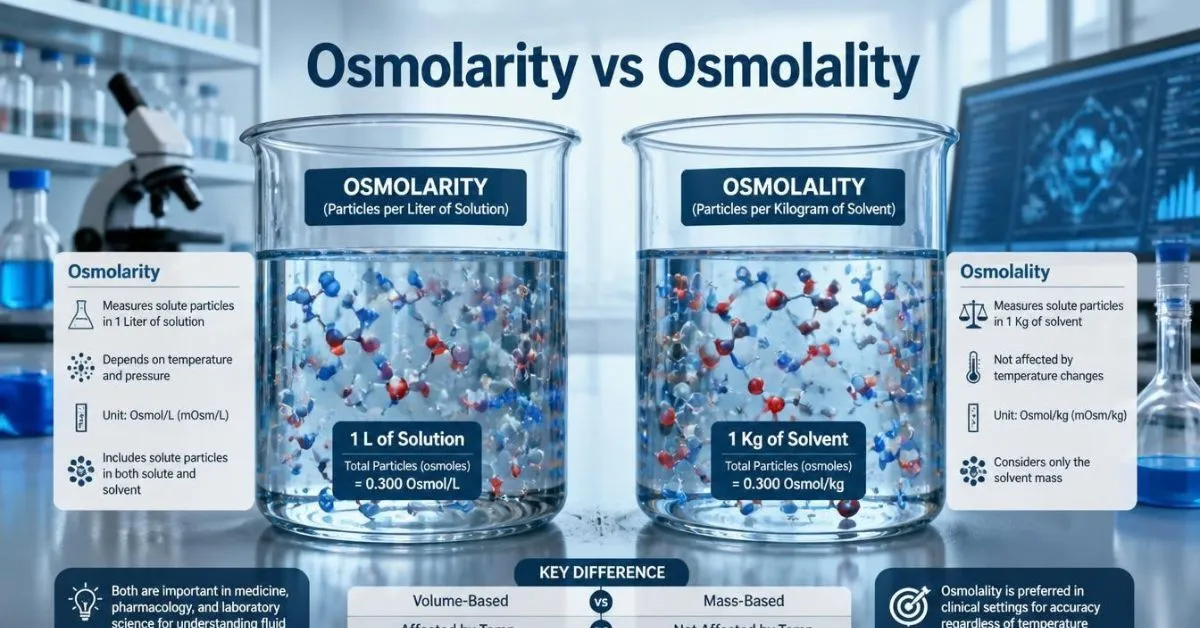
Osmolarity and osmolality both measure the concentration of osmotically active particles, but they use different denominators.
Osmolarity measures osmoles per liter of solution (Osm/L), while osmolality measures osmoles per kilogram of solvent (Osm/kg).
Osmolality is commonly used in clinical laboratories because it is based on mass rather than volume.
Key Takeaways
- Osmolarity = osmoles per liter of solution.
- Osmolality = osmoles per kilogram of solvent.
- Common units are mOsm/L for osmolarity and mOsm/kg for osmolality.
- Their numerical values can be very close in dilute water-based solutions.
- Osmolality is commonly used for clinical laboratory measurements.
- Tonicity is different from both osmolarity and osmolality.
What Is Osmolarity?
Osmolarity is the concentration of osmotically active particles in a solution, expressed per unit volume of the entire solution.
The basic formula is:
Osmolarity = osmoles ÷ liters of solution
The standard unit is Osm/L, although mOsm/L (milliosmoles per liter) is commonly used for physiological and medical measurements.
The key word to remember is liter.
For example, if a solution contains 300 milliosmoles of dissolved particles in one liter of solution, its osmolarity is:
300 mOsm/L
Osmolarity depends on the number of particles present, not simply the number of molecules added. If a substance separates into multiple particles in solution, those particles contribute separately to osmotic concentration.
A Simple Osmolarity Example
Imagine a solution containing 100 milliosmoles of osmotically active particles in 0.5 liters of solution.
Using:
Osmolarity = osmoles ÷ liters
The calculation is:
100 mOsm ÷ 0.5 L = 200 mOsm/L
So, the osmolarity is 200 mOsm/L.
What Is Osmolality?
Osmolality measures the concentration of osmotically active particles based on the mass of the solvent, rather than the volume of the final solution.
The basic formula is:
Osmolality = osmoles ÷ kilograms of solvent
Its standard unit is Osm/kg, while mOsm/kg is commonly used in clinical medicine.
The important distinction is:
- Osmolarity uses liters of solution.
- Osmolality uses kilograms of solvent.
In a water-based solution, the solvent is generally water.
A Simple Osmolality Example
Suppose a solution contains 200 milliosmoles of particles dissolved in 0.5 kg of solvent.
Using:
Osmolality = osmoles ÷ kilograms of solvent
The calculation is:
200 mOsm ÷ 0.5 kg = 400 mOsm/kg
Therefore, the osmolality is 400 mOsm/kg.
Osmolarity vs Osmolality: What’s the Difference?
The easiest way to understand the difference is to focus on the denominator.
| Feature | Osmolarity | Osmolality |
| Measures | Osmotic particle concentration | Osmotic particle concentration |
| Based on | Volume of solution | Mass of solvent |
| Formula | Osmoles ÷ L of solution | Osmoles ÷ kg of solvent |
| Common unit | mOsm/L | mOsm/kg |
| Volume-dependent | Yes | No |
| Temperature-related volume effects | Can matter | Much less relevant |
| Common clinical measurement | Less commonly measured directly | Commonly measured |
The Memory Trick
Use this simple rule:
Osmolarity → Liter
Osmolality → Kilogram
If you remember only one thing from this article, remember that.
Why Are Osmolarity & Osmolality So Similar?
Osmolarity and osmolality are technically different measurements, but their numerical values can be very close in dilute aqueous solutions.
Why?
Because the density of water is close to 1 kg/L under many ordinary conditions. As a result, one liter of a dilute water-based solution and one kilogram of its solvent can produce similar numerical concentration values.
That does not mean the definitions are identical.
The distinction becomes more important when precision matters, when solutions are concentrated, or when physical conditions affect solution volume.
Why Is Osmolality Commonly Used In Medicine?
Clinical laboratories often use osmolality because it is based on mass rather than solution volume.
Volume can change with temperature. Mass does not undergo the same temperature-dependent expansion and contraction.
This makes mass-based measurements useful when precise laboratory measurements are needed.
Serum, plasma, and urine osmolality are commonly discussed in clinical medicine because they provide information about the concentration of dissolved particles and the body’s water balance.
A laboratory can directly measure osmolality using an osmometer. One common laboratory method uses freezing-point depression: dissolved particles lower the freezing point of a solution, and the change can be measured to determine osmolality.
How Is Serum Osmolality Calculated?
Serum osmolality can be measured directly or estimated from common laboratory values.
A commonly used calculated formula in conventional U.S. units is:
Calculated serum osmolality = 2 × Na + glucose/18 + BUN/2.8
Where:
- Na = sodium in mEq/L
- Glucose = glucose in mg/dL
- BUN = blood urea nitrogen in mg/dL
Example
Suppose laboratory results are:
- Sodium = 140 mEq/L
- Glucose = 90 mg/dL
- BUN = 14 mg/dL
The estimated serum osmolality would be:
2 × 140 + 90/18 + 14/2.8
= 280 + 5 + 5
= 290 mOsm/kg
This is a simplified calculation example. Clinical interpretation should use the laboratory’s method, reference interval, and the patient’s overall clinical context.
Measured vs Calculated Osmolality
These two terms are easy to confuse.
Measured Osmolality
Measured osmolality is determined directly by a laboratory instrument called an osmometer.
One common method is based on freezing-point depression.
Calculated Osmolality
Calculated osmolality is estimated using measured substances such as sodium, glucose, and BUN.
The calculated value can then be compared with measured osmolality.
This comparison is useful when evaluating an osmolal gap.
What Is the Osmolal Gap?
The osmolal gap is the difference between measured serum osmolality and calculated serum osmolality.
In simple terms:
Osmolal gap = measured osmolality − calculated osmolality
A difference can occur because measured osmolality accounts for particles that may not be included in the standard calculation.
An increased osmolal gap can occur in several clinical situations, including the presence of certain alcohols or other unmeasured osmoles.
The result should not be interpreted by itself. Healthcare professionals consider the patient’s symptoms, history, other laboratory findings, and the specific calculation used.
Osmolarity vs Osmolality in Blood, Plasma, and Urine
Both concepts can be used when discussing body fluids, but osmolality is especially common in clinical laboratory reporting.
Serum and Plasma
Serum or plasma osmolality helps describe the concentration of dissolved particles in the blood’s fluid component.
It is relevant to evaluation of water and electrolyte balance.
Urine
Urine osmolality provides information about how concentrated or dilute urine is.
It can be useful when evaluating the body’s handling of water and certain disorders involving fluid and electrolyte balance.
The exact interpretation depends on the patient’s situation and other test results.
Osmolarity vs Osmolality vs Tonicity
These three concepts are related, but they are not interchangeable.
Osmolarity
Measures the concentration of osmotically active particles per liter of solution.
Osmolality
Measures the concentration of osmotically active particles per kilogram of solvent.
Tonicity
Describes the effect of effective solutes on water movement across a cell membrane and, therefore, on cell volume.
This distinction is important.
A solution may have a particular osmolarity or osmolality, but its effect on cells depends on which solutes can effectively influence water movement across the relevant membrane.
So:
Osmolarity = concentration per volume
Osmolality = concentration per mass
Tonicity = effect on cell water movement
Osmolarity vs Osmolality: Which One Should You Use?
There is no single answer for every situation.
Use osmolarity when the concentration is being expressed per liter of solution.
Use osmolality when the concentration is being expressed per kilogram of solvent.
In clinical laboratory medicine, osmolality is commonly preferred for direct measurement because it is mass-based and can be measured with an osmometer.
For students, the most important distinction is not choosing one as universally “better.” It is understanding what each measurement actually represents.
Common Mistakes About Osmolarity and Osmolality
Mistake 1: Thinking they are exactly the same
They can have similar numerical values, but their definitions are different.
Mistake 2: Mixing up the units
Remember:
mOsm/L = osmolarity
mOsm/kg = osmolality
Mistake 3: Using solvent and solution as if they mean the same thing
They do not.
The solution includes both solvent and dissolved solutes.
The solvent is the substance that dissolves the solute.
Mistake 4: Confusing moles with osmoles
A mole measures an amount of substance. An osmole relates to the number of osmotically active particles.
A substance that dissociates into several particles can contribute more osmoles than its molar concentration alone might suggest.
Mistake 5: Confusing osmolality with tonicity
Osmolality measures particle concentration by mass of solvent. Tonicity describes the effect of effective solutes on cell water movement.
FAQs:
Is osmolarity the same as osmolality?
No. Osmolarity is based on osmoles per liter of solution, while osmolality is based on osmoles per kilogram of solvent. Their values may be numerically similar in dilute water-based solutions, but the measurements are defined differently.
Which is more accurate: osmolarity or osmolality?
Neither should simply be called more accurate in every situation. They measure concentration using different reference quantities. For clinical laboratory measurement, osmolality is commonly used because it is mass-based and can be directly measured with an osmometer.
What does mOsm/kg mean?
mOsm/kg means milliosmoles per kilogram of solvent. It is a common unit for reporting osmolality, including serum and urine osmolality.
What does mOsm/L mean?
mOsm/L means milliosmoles per liter of solution. It is the common unit for osmolarity.
Why is osmolality preferred in clinical medicine?
Osmolality is commonly used because it is based on the mass of solvent rather than the volume of the solution. Volume can change with temperature, while mass is much less affected by those physical changes.
What is the difference between osmolarity and molarity?
Molarity describes the number of moles of a substance per liter of solution. Osmolarity describes the number of osmotically active particles per liter of solution. Because some substances can dissociate into multiple particles, molarity and osmolarity are not always numerically identical.
What is the difference between osmolality and molality?
Molality measures moles of a substance per kilogram of solvent. Osmolality measures osmoles of particles per kilogram of solvent. The distinction is especially important for substances that dissociate into multiple particles.
Conclusion:
The simplest way to remember osmolarity vs osmolality is to look at the denominator.
Osmolarity = osmoles per liter of solution.
Osmolality = osmoles per kilogram of solvent.
Their values can be close in dilute aqueous solutions, which is why the terms are sometimes confused. However, they are not technically interchangeable.
For clinical laboratory testing, osmolality is commonly used because it is mass-based and can be directly measured with an osmometer.
Understanding the difference also makes related concepts such as serum osmolality, urine concentration, osmolar gaps, molarity, molality, and tonicity much easier to understand.
Quick memory trick: Liter = osmolarity. Kilogram = osmolality.

Eric Walker, an author at replyygenius.com, where I create clear and helpful content for readers.
I focus on writing useful, engaging, and easy to understand articles that deliver real value.