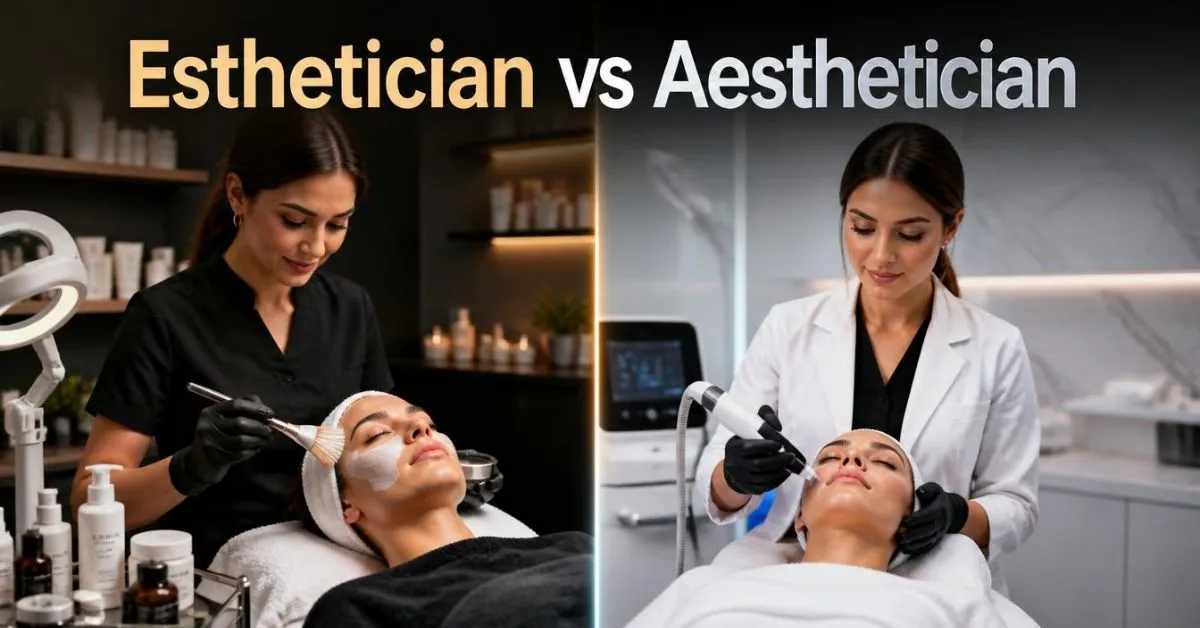
Esthetician and aesthetician can refer to the same skincare profession, but the terms are not always used the same way. In U.S. English, esthetician is the more common spelling.
Some employers use aesthetician for clinical or medical skincare roles, while others use it simply as a spelling variant. Your state license, training, and scope of practice matter more than the spelling.
Key Takeaways
- Esthetician is the more common U.S. spelling.
- Aesthetician is also a valid term and is common in British English.
- The two words can describe the same skincare profession.
- Some U.S. employers use aesthetician for clinical or medical-aesthetics positions.
- The word itself does not determine what treatments someone can legally perform.
- State licensing rules, education, credentials, and scope of practice are the important factors.
Esthetician vs Aesthetician: Are They the Same?
If you are searching for a skincare career, booking a facial, or looking for a beauty professional, you may see both esthetician and aesthetician.
They look almost identical, so it is natural to wonder whether they describe two different careers.
The answer is sometimes yes in workplace usage, but not because of the spelling alone.
Major dictionaries recognize the words as closely related. Cambridge identifies esthetician as the U.S. spelling of aesthetician, while Collins lists aesthetician in American English and gives esthetician as an alternative.
At the same time, some U.S. career and skincare sources use the terms to describe different work settings. Indeed, for example, describes an aesthetician as a clinical or medical skincare professional and an esthetician as someone focused more on cosmetic skincare.
That means you should not rely on the extra “a” to determine someone’s qualifications.
The better question is: What license, training, and scope of practice does the professional actually have?
What Is an Esthetician?
An esthetician is a skincare professional who provides cosmetic and skin-care services within the limits of their training and state regulations.
Depending on the license and location, services may include:
- Facials
- Skin cleansing
- Exfoliation
- Waxing
- Hair removal
- Makeup services
- Skin consultations
- Certain superficial skin treatments
- Product recommendations
Estheticians may work in salons, spas, skincare studios, resorts, and other beauty settings. Some also work in medical-spa or clinical environments, depending on state rules and their qualifications.
For example, California officially regulates estheticians through its Board of Barbering and Cosmetology. The state defines specific esthetician services and education requirements, showing why the legal scope of practice matters more than the spelling of the job title.
The U.S. Bureau of Labor Statistics also identifies skincare specialists as a licensed occupation and notes that requirements vary by state.
What Is an Aesthetician?
Aesthetician is another spelling of the term and can refer to a skincare professional.
In general English usage, it does not automatically mean that someone works in medicine.
Collins, for example, defines aesthetician in American English as a person versed in aesthetics and also lists beautician and cosmetologist among its meanings. It also gives esthetician as an alternative term.
However, the word is sometimes used differently in the U.S. beauty and medical-aesthetics industries.
Some employers use aesthetician, clinical aesthetician, or medical aesthetician for professionals working in clinical environments.
That is where the confusion begins.
The important distinction
The difference is usually not:
esthetician = one license
aesthetician = another license
Instead, the distinction may be:
esthetician/aesthetician = title or spelling
medical or clinical aesthetician = specialized work setting or role
Some current career sources make exactly this distinction, while others treat the two spellings as interchangeable.
Esthetician vs Aesthetician: Quick Comparison
| Factor | Esthetician | Aesthetician |
| Common spelling | U.S. English | Common in British English; also used in the U.S. |
| Basic meaning | Skincare professional | Skincare professional or aesthetics-related specialist |
| Typical services | Facials, skincare, waxing, beauty treatments | Depends on employer, training, and setting |
| Clinical usage | Possible | Sometimes used for clinical/medical skincare |
| Separate universal U.S. license? | No | No |
| Legal scope | Depends on state | Depends on state |
| What matters most | License and training | License and training |
Bottom line: the spelling does not tell you everything about the person’s professional qualifications.
Why Are There Two Spellings?
The difference comes from the words aesthetic and esthetic.
The spelling with “ae” is common in British English and remains widely recognized internationally.
American English often uses simplified spellings in certain words, which is why esthetician is common in the United States.
You can see this same spelling variation in words related to aesthetic/esthetic.
As a result, both forms continue to appear in websites, job advertisements, educational programs, and professional profiles.
That does not mean there are automatically two separate professions.
Does “Aesthetician” Mean Medical?
Not necessarily.
This is one of the most important points to understand.
Some U.S. organizations use aesthetician for a professional working in a medical or clinical environment. For example, Loma Linda University describes a medical aesthetician as someone working within a medical setting and discusses roles involving plastic surgery and patient care.
Other sources use the two spellings more generally.
Therefore, you should look for the full title.
Compare:
- Aesthetician — can be a general skincare title.
- Medical aesthetician — specifically signals a medical or clinical context.
- Clinical aesthetician — usually signals clinical skincare work.
- Esthetician — commonly refers to a licensed skincare professional.
The words medical and clinical provide much more information about the role than the spelling difference alone.
What Does a Medical Aesthetician Do?
A medical aesthetician may work in places such as:
- Dermatology offices
- Plastic surgery practices
- Medical spas
- Clinical skincare centers
- Other healthcare-related environments
Depending on the jurisdiction, employer, and additional training, their work may include specialized skincare support before or after medical procedures.
However, the exact services permitted can vary significantly.
A professional should not be assumed to have permission to perform a medical procedure simply because their job title contains the word aesthetician.
Licensing law and scope of practice determine what someone can legally do.
Is an Esthetician a Medical Professional?
Generally, you should not assume that an esthetician is a medical professional.
An esthetician is a licensed skincare specialist whose permitted services depend on state law.
For example, state rules can define which cosmetic skincare services an esthetician may perform and which services are outside that license’s scope.
This is especially important when a professional works inside a medical spa or doctor’s office.
Working in a medical setting does not automatically give an esthetician permission to perform medical procedures.
The person’s actual credentials and applicable state regulations must be checked.
Does the Spelling Affect Licensing?
Usually, the spelling itself is not what determines licensing.
Licensing is handled by individual states, and each state can establish its own education, examination, registration, and scope-of-practice requirements.
That means someone researching an esthetician career should look at their state’s official licensing authority rather than relying on a general article that says one spelling always means one particular job.
For example, California’s licensing system uses esthetician as a regulated professional title and establishes education and examination requirements.
Florida provides another example of why titles can be confusing. Current career sources explain that Florida uses the Facial Specialist credential while employers may use terms such as esthetician or aesthetician in job descriptions.
So the legal credential can be different from the everyday job title.
Which Spelling Should You Use in the United States?
If you are writing for a U.S. audience, esthetician is generally the safest standard spelling.
It is widely recognized in American skincare and licensing contexts.
However, you should still recognize aesthetician because you may encounter it in:
- Job postings
- Medical-spa websites
- Skincare articles
- Professional profiles
- International content
- Educational programs
If you are searching for jobs, it is smart to use both keywords.
For example, search:
- Esthetician jobs
- Aesthetician jobs
- Medical aesthetician jobs
- Clinical aesthetician jobs
- Licensed esthetician jobs
This prevents you from missing relevant opportunities simply because an employer chose a different spelling.
If You Are Choosing a Skincare Professional
If you are looking for someone to provide skincare services, do not choose based only on whether their title says esthetician or aesthetician.
Instead, check:
- Their license or credential
- Their training
- The exact services they offer
- Their experience with your type of treatment
- Your state’s rules
- Whether the treatment is cosmetic or medical
For medical or potentially invasive procedures, it is especially important to understand who is legally qualified to provide the service.
The title alone is not enough.
If You Are Choosing an Esthetics Career
If you are considering becoming an esthetician or aesthetician, start with your state’s licensing requirements.
Look at:
- Required education hours
- Approved schools
- Examinations
- Application requirements
- Renewal requirements
- Scope of practice
- Additional certifications
- Employer expectations
Then decide what kind of environment interests you.
You might want to work in a:
- Day spa
- Salon
- Resort
- Skincare studio
- Medical spa
- Dermatology practice
- Plastic-surgery setting
The work environment can influence the additional skills and training you need.
Common Mistakes About Esthetician vs Aesthetician
Mistake 1: Thinking one spelling is always medical
There is no universal rule that aesthetician automatically means medical.
Some U.S. employers use it that way, but dictionary usage and industry usage are broader.
Mistake 2: Thinking an esthetician can only work in a spa
Estheticians can work in different environments depending on their credentials and local regulations.
Mistake 3: Assuming a medical spa changes someone’s license
Working in a medical spa does not automatically expand a person’s legal scope of practice.
Mistake 4: Choosing a school based on the title
Look at the actual credential the program prepares you to obtain.
Mistake 5: Searching only one spelling
If you are looking for jobs or training programs, search both esthetician and aesthetician.
FAQs:
Is an aesthetician the same as an esthetician?
Often, yes. The two terms can refer to the same skincare profession, and esthetician is the more common U.S. spelling. However, some U.S. employers use aesthetician for clinical or medical skincare roles. Because industry usage varies, check the professional’s actual license, training, and job duties.
Is esthetician the American spelling?
Esthetician is the common U.S. spelling. Aesthetician is also used in American English and is especially common in British English and some professional contexts. The spelling difference does not automatically create two separate professions.
Is an aesthetician a medical professional?
Not automatically. The word aesthetician by itself does not prove that someone has medical credentials. If you see medical aesthetician or clinical aesthetician, the additional wording indicates a clinical context, but you should still verify the person’s actual qualifications and scope of practice.
Do estheticians and aestheticians need different licenses?
Not simply because of the spelling. U.S. licensing is determined by state law, and the official credential may have a different name from the job title used by an employer. Always check your state’s licensing authority for the current requirements.
Can an esthetician work in a medical spa?
Yes, an esthetician may work in a medical-spa environment where state law and the employer permit it. However, working in a medical spa does not automatically authorize every medical or advanced aesthetic procedure. The person’s license, additional training, and state scope-of-practice rules determine what they can do.
Which spelling should I use for a U.S. audience?
Esthetician is usually the most natural choice for U.S. English. Still, include or recognize aesthetician when appropriate because users, employers, and organizations use both forms.
Conclusion:
The simplest answer to esthetician vs aesthetician is that the two terms are closely related, but their exact use depends on language, industry, employer, and context.
In the United States, esthetician is the more common spelling. Aesthetician is also used and may sometimes describe a clinical or medical-skincare role, but the spelling itself does not establish a different license.
If you are choosing a skincare professional, focus on their license, training, experience, services, and legal scope of practice.
If you are looking for a career, check your state’s official requirements and search job listings using both spellings.
In short, don’t let one extra “a” make the decision for you. The professional’s actual credentials and permitted work are what matter.