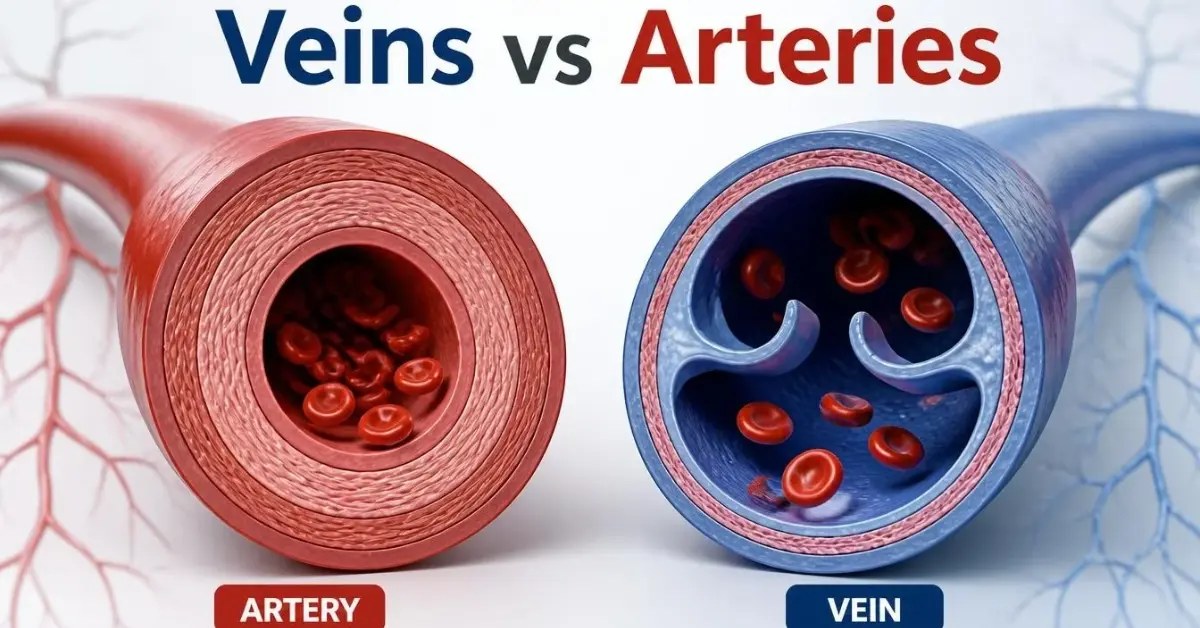
Veins and Arteries are two main types of blood vessels in the body. Arteries carry blood away from the heart, while veins carry blood back to the heart. Arteries have thick, strong walls to handle higher blood pressure.
Veins have thinner walls, lower blood pressure, and often have valves that help stop blood from flowing backward.
Key Takeaways
- Arteries carry blood away from the heart.
- Veins return blood to the heart.
- Arteries have thicker and stronger walls.
- Veins have thinner walls and often contain one-way valves.
- Most arteries carry oxygen-rich blood, while most veins carry oxygen-poor blood.
- Capillaries connect small arteries and veins.
- Blood flow direction, not oxygen level, defines an artery or vein.
What Are Arteries?
Arteries are blood vessels that carry blood away from the heart. Their main job is to deliver blood to your organs, muscles, and other body parts.
When your heart pumps, it sends blood into the arteries under high pressure. The largest artery is called the aorta. It carries blood from the heart and branches into smaller arteries.
These smaller arteries supply blood to the brain, heart, arms, legs, and other organs.
Most arteries carry oxygen-rich blood. This oxygen helps your body cells make the energy they need.
Main Functions of Arteries
Arteries perform several important jobs:
- Carry blood away from the heart.
- Deliver oxygen to body tissues.
- Supply organs with nutrients.
- Help control blood pressure.
- Move blood throughout the body.
For example, the carotid arteries supply blood to the brain. The coronary arteries supply blood to the heart muscle.
Why Do Arteries Have Thick Walls?
Arteries have thick, strong, and elastic walls because they receive blood under high pressure.
Each heartbeat sends a wave of blood into these vessels. Their walls stretch and then return to their normal shape.
This helps keep blood moving through the body.
Arteries and smaller vessels called arterioles can also change their width. This helps control blood flow and blood pressure.
What Are Veins?
Veins are blood vessels that carry blood toward the heart.
After blood delivers oxygen and nutrients to body tissues, it enters small veins called venules. These join to form larger veins that return blood to the heart.
Most veins carry oxygen-poor blood. This blood travels to the right side of the heart before going to the lungs.
The lungs add oxygen to the blood.
The two largest veins are:
- Superior vena cava: Brings blood from the upper body to the heart.
- Inferior vena cava: Brings blood from the lower body to the heart.
Veins complete the journey of blood back to the heart.
Main Functions of Veins
The main functions of veins include:
- Return blood to the heart.
- Carry oxygen-poor blood from body tissues.
- Help maintain normal blood flow.
- Carry blood toward the lungs.
- Hold a large part of the body’s blood supply.
Veins can expand to hold more blood when needed. This makes them important blood storage vessels.
Why Do Veins Have Valves?
Veins have thinner walls and carry blood under lower pressure than arteries.
Returning blood from the legs can be hard because blood must move upward against gravity. Many veins in the legs have small, one-way valves to help with this job.
These valves open to let blood move toward the heart. They close to help stop blood from flowing backward.
Muscle movement also helps push blood through veins. For example, when you walk, your leg muscles squeeze nearby veins and help move blood upward.
Not every vein has valves, but they are common in veins that carry blood back from the limbs.
Veins vs Arteries: Key Differences
The main difference between veins and arteries is the direction of blood flow. However, they also differ in wall thickness, pressure, structure, and valves.
The table below shows their main differences.
| Feature | Arteries | Veins |
|---|---|---|
| Main function | Carry blood away from the heart | Carry blood toward the heart |
| Blood oxygen level | Usually oxygen-rich | Usually oxygen-poor |
| Wall thickness | Thick and muscular | Thin and less muscular |
| Blood pressure | Higher | Lower |
| Valves | Usually absent along their length | Present in many veins |
| Blood flow | Pulses with heartbeats | Usually has no felt pulse |
| Elasticity | More elastic | Less elastic |
| Inner space | Usually smaller | Often wider |
| Main examples | Aorta and carotid artery | Vena cava and jugular vein |
| Main role | Deliver blood to tissues | Return blood to the heart |
Important: Oxygen levels are the usual difference, not the main rule. Blood flow direction tells us whether a vessel is an artery or a vein.
Direction of Blood Flow
Direction is the easiest way to tell arteries and veins apart.
- Arteries carry blood away from the heart.
- Veins carry blood toward the heart.
Think of arteries as the delivery route and veins as the return route.
For example, the aorta carries blood away from the heart. The vena cava brings blood from the body back to the heart. This rule applies even when blood has a different oxygen level.
Wall Thickness & Structure
Arteries and veins have different wall structures because they work under different pressure levels.
Both have three main wall layers:
- Inner layer: A smooth lining that lets blood flow easily.
- Middle layer: Contains muscle and elastic tissue.
- Outer layer: Gives the vessel support and strength.
Artery Walls
Arteries have a thick middle layer with more muscle and elastic tissue. This helps them handle the high pressure created by the heart. Their walls stretch when blood enters and then move back toward their normal shape.
Vein Walls
Veins have thinner walls and less muscle than arteries. Blood moves through veins under lower pressure, so their walls do not need to be as thick. Many veins also have a wider inner space. This allows them to hold more blood.
Blood Pressure
Blood pressure is higher in arteries than in veins.
This happens because arteries receive blood directly from the heart’s pumping action.
As blood moves through smaller arteries and capillaries, its pressure falls.
By the time blood reaches the veins, the pressure is much lower.
This is why arteries need thicker walls than veins.
Valves
Valves are another important difference between arteries and veins. Many veins have one-way valves. These valves help stop blood from flowing backward. They are especially useful in the legs, where blood must travel upward against gravity.
When your leg muscles move, they squeeze nearby veins. This helps push blood toward the heart. The valves help keep it moving in the right direction.
Most arteries do not have valves along their length. However, the heart has valves at the openings of the aorta and pulmonary artery. These heart valves help control blood flow.
Oxygen Levels In Blood
Most arteries carry oxygen-rich blood, while most veins carry oxygen-poor blood.
However, there are two important exceptions.
Pulmonary Arteries
Pulmonary arteries carry oxygen-poor blood from the right side of the heart to the lungs. In the lungs, blood releases carbon dioxide and receives oxygen.
Pulmonary Veins
Pulmonary veins carry oxygen-rich blood from the lungs back to the left side of the heart. The heart then pumps this blood through the aorta to the rest of the body. These examples show why blood flow direction, not oxygen level, defines arteries and veins.
How Do Arteries and Veins Work Together?
Arteries and veins work together to keep blood moving throughout your body.
Arteries deliver blood to body tissues. Veins return blood to the heart. Between them, tiny blood vessels called capillaries allow important substances to move between blood and cells.
The Journey of Blood Through the Body
Here is a simple look at how blood moves through your body.
- The heart pumps blood: The left side of the heart sends oxygen-rich blood into the aorta.
- Arteries carry blood: Smaller arteries and arterioles move blood toward different body tissues.
- Capillaries exchange materials: Oxygen and nutrients move into body cells. Carbon dioxide and other waste enter the blood.
- Veins collect blood: Capillaries drain into small vessels called venules. These join to form veins.
- Blood returns to the heart: Large veins carry oxygen-poor blood to the right side of the heart.
- Blood travels to the lungs: The right side of the heart pumps blood through the pulmonary arteries.
- The lungs add oxygen: Blood releases carbon dioxide and takes in oxygen. Pulmonary veins carry it back to the left side of the heart.
The process then repeats.
What Is the Difference Between Arteries, Veins, & Capillaries?
The circulatory system has three main types of blood vessels: arteries, veins, and capillaries.
Each has a different job.
| Blood Vessel | Main Function | Main Feature |
|---|---|---|
| Arteries | Carry blood away from the heart | Thick, strong walls |
| Veins | Return blood to the heart | Thin walls; many have valves |
| Capillaries | Exchange oxygen, nutrients, and waste | Very thin walls |
Capillaries are the smallest blood vessels in the body.
They connect small arteries called arterioles with small veins called venules.
Their walls are very thin. This allows oxygen and nutrients to move from blood into nearby tissues. Waste products move from the tissues into the blood.
Without capillaries, blood could not exchange the materials that body cells need.
Why Do Veins Look Blue Under the Skin?
You may have noticed blue or green-looking veins on your hands, arms, or legs.However, blood inside your veins is not blue. Blood in both arteries and veins is red.
Veins may look blue or green because of how light interacts with your skin and the tissues below it.The way they look can depend on skin thickness, lighting, and how deep the veins are.
This is a normal visual effect. It does not mean veins contain blue blood.
FAQs:
1. What is the main difference between veins and arteries?
Arteries carry blood away from the heart, while veins carry blood toward the heart. Arteries have thicker walls because they handle higher blood pressure. Veins have thinner walls, and many contain valves that help stop backward blood flow.
2. Do arteries carry oxygen-rich blood?
Most arteries carry oxygen-rich blood from the heart to body tissues. However, pulmonary arteries carry oxygen-poor blood from the right side of the heart to the lungs.
3. Do veins always carry oxygen-poor blood?
No. Most veins carry oxygen-poor blood back to the heart. Pulmonary veins are an exception because they carry oxygen-rich blood from the lungs to the heart.
4. Why are artery walls thicker than vein walls?
Artery walls are thicker because blood enters them under higher pressure. Their strong, muscular, and elastic layers help them handle this pressure and keep blood moving.
5. Which blood vessels have valves?
Many veins have one-way valves that help keep blood moving toward the heart. These valves are especially important in the legs. Most arteries do not have valves along their length, but the heart has valves at the openings of the aorta and pulmonary artery.
6. Which blood vessels carry blood toward the heart?
Veins carry blood toward the heart. The superior and inferior vena cava are two major veins that return blood from the body to the right side of the heart.
7. What connects arteries and veins?
Capillaries connect the smallest arteries, called arterioles, to small veins, called venules. They allow oxygen, nutrients, and waste products to move between blood and body tissues.
8. Are veins and arteries the same color?
Blood in both veins and arteries is red. Blood in arteries is usually brighter red, while blood in veins is darker red. Veins may look blue or green through the skin because of the way light interacts with body tissues.
Conclusion:
Veins and Arteries have different jobs, but both are important for healthy blood flow.
Arteries carry blood away from the heart under higher pressure. Veins bring blood back under lower pressure. Arteries have thick, strong walls, while many veins have valves that help blood move in the right direction.
Capillaries connect these vessels and allow oxygen and nutrients to reach body cells. The easiest way to remember the difference is simple: arteries carry blood away from the heart, and veins carry blood toward it.