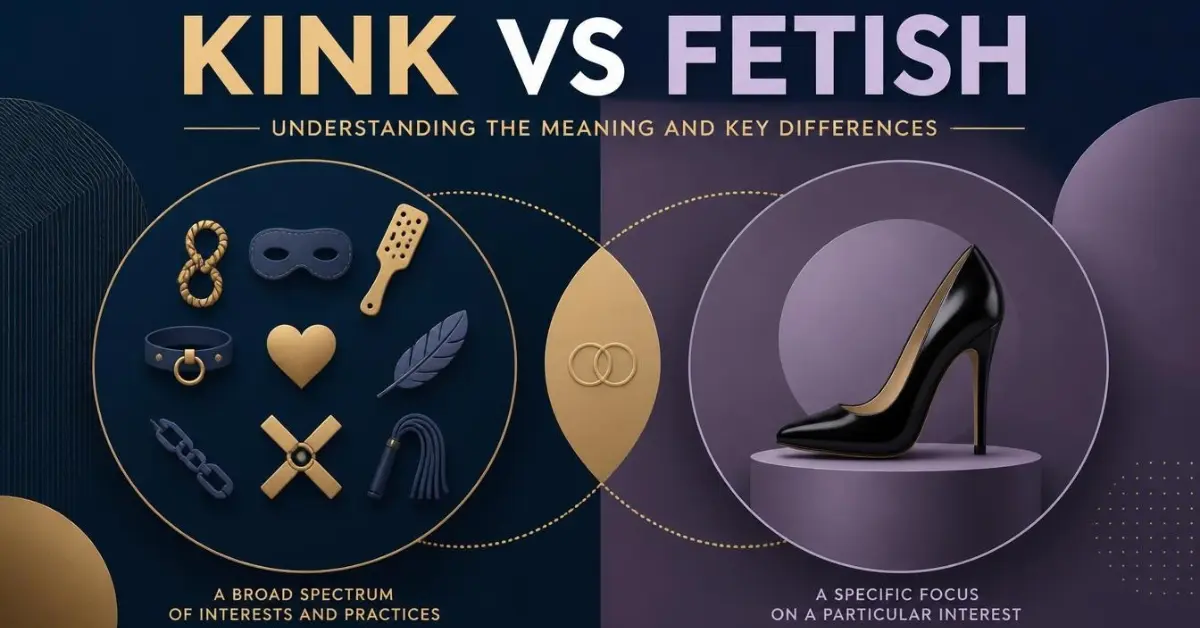
Kink and Fetish are related terms, but they have different meanings. Kink is a broad term for interests that fall outside common ideas of sexuality.
Fetish usually refers to a more specific interest linked to an object, material, or body feature. A fetish may be considered a type of kink, but the terms are not always used in the same way.
Key Takeaways
- Kink is a broad term for less common interests.
- Fetish usually describes a more specific focus.
- The two terms can overlap.
- A fetish does not always have to be essential to a person’s experience.
- Clinical terms have more specific meanings than everyday language.
- An unusual interest does not automatically mean a mental health disorder.
What Does Kink Mean?
Kink is a broad term used to describe interests that differ from common ideas of sexuality.
The word can have different meanings depending on who uses it. Some people use kink to describe a wide range of less common interests. Others use it more narrowly when discussing certain relationship or behavior patterns.
There is no single definition that everyone follows.
The key point is that kink describes a broad group of interests rather than one specific thing.
It is also important to remember that the word kink is not, by itself, a medical or mental health diagnosis.
What Does Fetish Mean?
Fetish has several meanings, but it often describes a strong, specific interest in an object, material, or body feature.
In clinical psychology, the term has a narrower meaning. It can refer to a pattern of sexual interest focused on certain objects or specific body features.
However, not every person gives the same importance to that interest.
For one person, a particular interest may be a small part of their preferences. For another, it may play a much larger role.
The word also has nonsexual meanings. For example, people sometimes use fetish to describe an unusually strong interest in a hobby or object.
This is why context matters when someone uses the word.
Kink vs Fetish: What Is the Difference?
The main difference is the scope of each term.
Kink is generally broader, while fetish usually describes a more specific interest.
The terms can overlap, but they are not exact synonyms.
| Comparison | Kink | Fetish |
|---|---|---|
| Meaning | A broad category of less common interests | A specific type of interest |
| Scope | Wide | Narrower |
| Main focus | Different interests or preferences | A particular object, material, or body feature |
| Usage | Common in general discussions | Used in everyday and clinical discussions |
| Relationship | Can include fetishes | May fall under the wider kink category |
| Clinical meaning | Not a diagnosis by itself | Has a specific clinical meaning in some contexts |
A useful way to remember the difference is this:
Kink is the broader category. Fetish is a more specific term.
However, this is a general guide, not a strict rule followed by everyone.
Everyday Meaning vs. Clinical Terminology
The words kink and fetish are often used in casual conversations. Their meanings can change depending on the speaker and situation.
Clinical terminology is more precise.
Mental health professionals do not diagnose someone simply because they have an unusual interest.
They consider several factors, including:
- Whether the interest causes significant personal distress.
- Whether it affects daily life or important relationships.
- Whether another person is harmed or placed at risk.
- Whether the pattern meets the relevant clinical criteria.
The American Psychiatric Association makes an important distinction between an atypical interest and a paraphilic disorder.
In simple terms, having an unusual interest does not automatically mean someone has a mental health condition.
Are Kink and Fetish The Same Thing?
No. They are related, but they are not exactly the same.
Kink is often used as a general term for a wide range of less common interests. Fetish usually describes a more specific focus.
For example, an interest may be described as a kink in a broad conversation. A more specific interest focused on a particular object or material may be called a fetish.
The exact label can depend on how the person understands and describes their interest.
This is why the two words sometimes overlap in everyday discussions.
Common Misconceptions
Misconception 1: Kink and fetish always mean the same thing.
Not exactly. Kink is generally broader, while fetish usually describes a more specific interest.
Misconception 2: Every fetish must be essential.
This is not always true. The importance of a specific interest can vary from person to person.
Misconception 3: Every unusual interest is a disorder.
No. An unusual interest alone is not enough for a mental health diagnosis.
Misconception 4: The word fetish always has a sexual meaning.
No. It can also describe a strong nonsexual interest or an object with special cultural meaning.
Misconception 5: Everyone defines kink in the same way.
No. The meaning can vary between everyday conversations, specialist discussions, and clinical settings.
FAQs:
What is the main difference between kink and fetish?
Kink is a broad term for less common interests, while fetish usually refers to a more specific focus on an object, material, or body feature. Their meanings can overlap.
Is a fetish a type of kink?
In many everyday discussions, yes. Fetish is often included within the wider category of kink. However, not everyone uses these terms in exactly the same way.
Does having a fetish automatically mean someone has a disorder?
No. An unusual interest does not automatically indicate a mental health condition. A clinical diagnosis requires a wider assessment of the person’s situation and the relevant diagnostic criteria.
Can the word fetish have a nonsexual meaning?
Yes. The word can describe a strong interest in something or an object that has special cultural or symbolic importance.
Why are kink and fetish sometimes used interchangeably?
Both words can describe interests outside common ideas of sexuality. Because their meanings overlap, people sometimes use them as if they mean the same thing. However, their more specific meanings are different.
Is kink a medical term?
No. Kink is mainly a general term. It does not describe a mental health diagnosis by itself.
Conclusion:
Understanding Kink vs Fetish becomes easier when you look at the scope of each term. Kink is generally the broader word, while fetish describes a more specific interest. The two can overlap, and their meanings may change depending on the context.
Most importantly, an unusual interest should not automatically be treated as a mental health problem.
Understanding the difference between everyday language and clinical terminology helps prevent confusion and unfair judgments.

Olivia Smith is a professional author at ReplyGenius.com, where I create clear and engaging content on communication and writing.