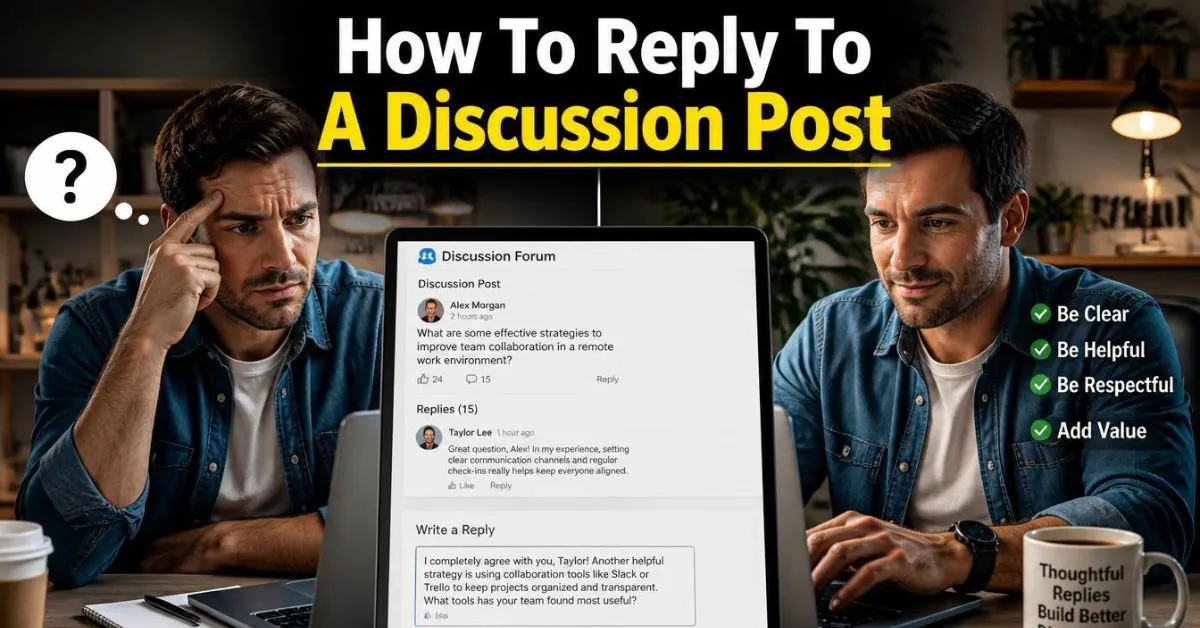
Knowing how to reply to a discussion post can sometimes feel harder than writing your own post. You may understand the topic and agree with someone’s main point, but simply saying “I agree” does not add much to the conversation.
A strong discussion post reply should show that you actually read the original post, understood its main idea, and have something meaningful to contribute. That contribution could be another perspective, a personal observation, a supporting example, a thoughtful question, or a respectful disagreement.
The good news is that your response does not need to be long or overly academic. Whether you’re replying to a classmate, participating in a discussion board, responding in an online community, or joining a group conversation, a clear and specific response can make your contribution much more valuable.
In this guide, you’ll find 50+ natural discussion post reply examples, plus a simple framework you can use to write your own responses without making them sound repetitive, forced, or overly formal.
Quick Answer
To reply to a discussion post, acknowledge one specific point, add your own perspective, and ask a relevant question when it makes sense.
A simple example is:
“I really liked your point about how communication affects teamwork. I agree that being clear can prevent many misunderstandings. I also think active listening is just as important. What do you think is the biggest communication challenge when people have different expectations?”
You don’t need to repeat the entire original post. Focus on one meaningful idea and build on it.
What Makes a Good Discussion Post Reply?
A useful discussion response should do more than prove that you read someone’s post. It should help move the conversation forward.
A strong reply usually does one or more of the following:
- Acknowledges a specific idea
- Explains why you agree or disagree
- Adds a new perspective
- Provides an example
- Connects the topic to another idea
- Shares a relevant experience
- Asks a thoughtful follow-up question
- Encourages further discussion
The goal isn’t to make your response sound complicated. The goal is to make it relevant, specific, and meaningful.
For example:
Weak:
“I agree with your post.”
Stronger:
“I agree with your point about communication. Clear expectations can prevent misunderstandings, especially when people are working toward the same goal.”
The second response gives the original writer something more useful to engage with.
The Acknowledge + Add + Ask Formula
One of the easiest ways to write a thoughtful discussion response is:
Acknowledge + Add + Ask
1. Acknowledge
Mention something specific from the original post.
“Your point about teamwork stood out to me.”
2. Add
Give your own perspective, example, observation, or related idea.
“I think teamwork becomes much easier when everyone understands their responsibilities from the beginning.”
3. Ask
If you want to continue the conversation, ask a question connected to the topic.
“What do you think is the biggest challenge when team members have different expectations?”
Put together:
“Your point about teamwork stood out to me. I think teamwork becomes much easier when everyone understands their responsibilities from the beginning. What do you think is the biggest challenge when team members have different expectations?”
You don’t have to use all three steps every time. Sometimes acknowledge + add is enough. Other times, a relevant question makes the response more engaging.
Best Discussion Post Reply Types at a Glance
| Reply Style | Best For | Tone | Sample Reply |
| Agree + Add | When you share the same view | Thoughtful | “I agree with your point, especially because clear communication can prevent misunderstandings. I would also add that listening is just as important.” |
| Ask a Question | Continuing the discussion | Curious | “That’s an interesting perspective. What do you think would happen if the situation continued for a long time?” |
| Add a New Angle | Introducing another perspective | Constructive | “I hadn’t considered that side of the issue. Another factor that could affect the situation is how people respond to change.” |
| Respectful Disagreement | When your opinion differs | Professional | “I understand your point, although I see this slightly differently. I think the outcome may also depend on the circumstances.” |
| Personal Example | Connecting with experience | Conversational | “Your point reminded me of a similar situation I’ve seen where communication changed the outcome.” |
| Short Reply | Quick discussion responses | Natural | “I agree with your point about preparation. It can make difficult situations much easier to manage.” |
50+ Discussion Post Reply Examples
Agreeing With a Discussion Post
- I agree with your point about the importance of communication. Clear expectations can make collaboration much easier.
- I completely agree that preparation can make challenging situations easier to manage.
- You made a strong point about how small actions can create bigger results over time.
- I agree, especially with your observation about how important teamwork can be.
- Your point about adaptability really stood out to me. Flexibility is often overlooked when people discuss change.
- I agree with your perspective because having a clear understanding of the situation can make decision-making much easier.
- I think you explained that idea really well. Your point about consistency is especially important.
- I agree that communication can have a major impact on the outcome. Misunderstandings often happen when expectations aren’t clearly explained.
- Your argument makes a lot of sense, especially when considering how different people may respond to the same situation.
- I share your view on this topic. I think your point about preparation is particularly relevant.
Agreeing & Adding Something New
- I agree with your point about communication. I would also add that active listening is just as important as clearly expressing your ideas.
- I think you’re right about preparation. Another factor is making sure everyone understands their responsibilities.
- I agree that technology can improve productivity, although I think proper training also plays an important role.
- Your point about consistency makes sense. I also think having realistic goals makes it easier to maintain that consistency.
- I agree with your main idea, and I think the same principle can apply to situations where people have very different expectations.
- You made a good point about teamwork. I would add that trust can also influence how effectively a team works together.
- I agree that experience can shape how people approach challenges. At the same time, I think being open to new ideas can be equally valuable.
- Your point about adapting to change is important. I would also consider how much support people receive during that transition.
- I agree with your observation. Another thing worth considering is how the situation might affect people differently.
- I think your argument is strong. I would add that timing can sometimes be just as important as the decision itself.
Adding a New Perspective
- I like the way you explained this. One thing I would add is that people can respond differently depending on their previous experiences.
- I hadn’t considered that side of the issue before. Another factor that could affect the outcome is the environment people are working in.
- Your point made me think about another possibility. The same approach might produce different results depending on the circumstances.
- I agree that this is an important factor, but I also think individual motivation can influence the outcome.
- Another perspective worth considering is how the situation affects people who have less experience with the issue.
- Your post made me think about the role of timing. Even a good strategy may not work if it is introduced at the wrong moment.
- I think another important consideration is how people communicate their expectations before taking action.
- This is an interesting point. I wonder whether the outcome would be different if the people involved had more resources available.
Respectful Disagreement Replies
- I understand your perspective, although I see the situation a little differently. I think the outcome may depend heavily on the circumstances.
- That’s an interesting point. I would argue that there is another factor worth considering before reaching that conclusion.
- I can see why you reached that conclusion, but I think the issue may be more complicated than it first appears.
- I agree with part of your argument, although I think individual circumstances can significantly change the outcome.
- Your perspective makes sense, but my experience has been somewhat different. I think there may be another explanation to consider.
- I understand your reasoning. However, I think the situation could look different when we consider the other side of the issue.
- I see where you’re coming from. At the same time, I think it’s important to consider how this might affect people with different experiences.
- I respect your point, although I would approach the issue differently because I think the circumstances play a major role.
Follow-Up Question Replies
- What do you think is the biggest challenge when applying this idea in practice?
- How do you think this approach would work in a completely different situation?
- What experience most influenced your perspective on this topic?
- Do you think the same idea would apply to a larger group? Why or why not?
- What do you think would be the best way to address that challenge?
- How might this situation change if the people involved had different priorities?
- Do you think there is a situation where this approach would not work as well?
- What do you think is the most important factor influencing the outcome?
Short Discussion Post Replies
- I agree with your point, especially regarding communication.
- That’s an interesting perspective. I hadn’t considered that angle before.
- You made a strong point about the importance of preparation.
- I agree, and I would also add that consistency plays an important role.
- Your example helped me understand the issue from a different perspective.
- I can see why you reached that conclusion.
- Your point about teamwork really stood out to me.
- I agree with your main idea, although I think another factor is worth considering.
- This made me think about the topic differently.
- I found your explanation especially interesting because it connects to a larger issue.
How to Reply to a Classmate’s Discussion Post
When responding to a classmate, avoid simply repeating their argument. Instead, identify one idea that caught your attention and explain your reaction.
You can use examples like:
- I enjoyed reading your perspective on this topic. Your point about was especially interesting because.
- I agree with your observation about. I had a similar thought while reading the discussion.
- Your example helped me understand the issue from a different perspective.
- I hadn’t considered before reading your post. Do you think?
- I agree with your main point, but I also wonder whether could affect the outcome.
- Your explanation of made me think about another aspect of the topic.
- I found your example particularly useful because it shows how the issue can affect people in real situations.
How to Reply When You Strongly Agree
You can be enthusiastic, but give a reason for your agreement.
Instead of:
“I completely agree!”
Try:
“I completely agree with your point about preparation. Having a clear plan can make a challenging task much more manageable and can also reduce confusion among the people involved.”
This makes your agreement meaningful rather than repetitive.
How to Reply When You Partly Agree
Partial agreement can create a more interesting discussion because you recognize the original point while introducing another consideration.
For example:
“I agree that communication is important, but I also think timing plays a major role. Even a clear message may not be effective if it is delivered at the wrong time.”
This approach allows you to build on the original idea without dismissing it.
How to Disagree Respectfully in a Discussion Post
Disagreement doesn’t have to sound confrontational.
Avoid:
“That is completely wrong.”
Instead, try:
“I understand why you see it that way. I have a slightly different perspective because I think the situation can depend heavily on the circumstances and the people involved.”
A respectful disagreement usually has three parts:
Recognize → Explain → Expand
- Recognize the other person’s idea.
- Explain why your perspective differs.
- Add evidence, reasoning, or another consideration.
This keeps the conversation focused on the idea, rather than the person.
How to Reply When the Original Post Is Very Short
Sometimes the original discussion post doesn’t give you much information to work with.
In that situation, don’t invent an unrelated topic. Respond to the main idea and ask a thoughtful question.
For example:
“That’s an interesting way to look at the topic. I can see why you reached that conclusion. What experience or example most influenced your opinion?”
You can also use:
- “That’s an interesting point. What led you to that conclusion?”
- “I can see why you think that. Do you think the same idea would apply in a different situation?”
- “Your point is interesting. What do you think would be the biggest challenge in applying it?”
How to Personalize Your Discussion Post Reply
The best responses don’t sound like they could have been written for any random post.
Start by identifying something specific.
Step 1: Mention Their Idea
“I found your point about teamwork especially interesting.”
Step 2: Explain Your Reaction
“I think it matters because people sometimes focus on individual performance and overlook how much cooperation affects the final result.”
Step 3: Add Your Own Perspective
“I’ve noticed that even simple tasks become easier when everyone understands their role from the beginning.”
Step 4: Ask a Relevant Question
“Do you think the same approach would work when team members have very different working styles?”
Combined:
“I found your point about teamwork especially interesting. I think it matters because people sometimes focus on individual performance and overlook how much cooperation affects the final result. I’ve noticed that even simple tasks become easier when everyone understands their role from the beginning. Do you think the same approach would work when team members have very different working styles?”
This feels much more personal than a generic response.
How Long Should a Discussion Post Reply Be?
There is no single perfect length for every discussion.
If you’re responding to a classmate, follow the instructor’s requirements first. If no specific word count is provided, focus on quality rather than length.
A useful response can often be a few clear sentences:
- Mention the specific point.
- Explain your reaction.
- Add something meaningful.
- Ask a question if appropriate.
A longer response isn’t automatically better. Repeating the same idea just to reach a word count can make a reply less effective.
Common Mistakes When Replying to a Discussion Post
1. Only Saying “I Agree”
Example:
“I agree with you.”
Why it misses:
It shows agreement but doesn’t explain what you agree with or contribute anything new.
Better:
Mention the specific idea and explain why you agree.
2. Repeating the Entire Original Post
Rewriting everything the other person already said in different words doesn’t move the conversation forward.
Better:
Choose one point and build on it.
3. Making the Reply Too Long
A discussion response does not need to become another full essay.
If you can communicate your idea clearly in a few sentences, unnecessary repetition may make the response weaker.
4. Asking an Unrelated Question
Example:
“What do you think about another completely different topic?”
Why it misses:
The question doesn’t connect naturally to the original discussion.
Better:
Ask about something the writer actually mentioned.
5. Disagreeing Too Aggressively
Example:
“That is completely wrong.”
Why it misses:
It attacks the conclusion instead of creating a useful exchange of ideas.
Better:
Explain your different perspective respectfully and give a reason.
6. Using Too Much Academic Language
Trying to sound extremely formal can make a simple response feel unnatural.
Instead of:
“Your aforementioned conceptual framework demonstrates a multifaceted understanding…”
Say:
“Your explanation helped me understand the issue from another perspective.”
Clear writing is usually more effective than complicated wording.
7. Adding a Question Just for the Sake of It
Not every response needs a question.
If your point already feels complete, end with a thoughtful observation instead of forcing an unrelated question.
FAQs:
What should I say when replying to a discussion post?
Mention one specific point from the post, explain your reaction, and add another idea, example, or relevant question. This makes your response feel engaged rather than generic.
How do I reply to a discussion post without saying “I agree”?
Instead of simply agreeing, explain why you agree and add another thought.
For example:
“I agree with your point about communication because unclear expectations can create problems even when everyone has good intentions. I also think active listening is an important part of the process.”
How long should a discussion post reply be?
The ideal length depends on the discussion requirements. If you’re responding to a classmate, follow any word-count or formatting instructions provided by the instructor. Otherwise, focus on making the response specific and meaningful rather than unnecessarily long.
How do I start a discussion post reply?
Begin by acknowledging a specific idea that caught your attention.
You can write:
“I found your point about…”
or:
“Your example of…”
Then explain your reaction and add something useful.
Can I disagree with someone in a discussion post?
Yes. Respectful disagreement can create a productive conversation. Focus on the idea, explain your reasoning, and avoid language that attacks or dismisses the other person.
How do I make my discussion reply sound natural?
Write as if you’re having a thoughtful conversation rather than trying to use complicated academic language. Refer to something specific in the original post and explain your reaction in your own words.
What is a good way to end a discussion post reply?
If you want to continue the conversation, end with a relevant open-ended question. If your response already feels complete, a thoughtful final observation can work without adding a question.
How do I reply to a classmate’s discussion post?
Mention something specific from their post, explain what you found interesting, and add your own perspective. You can finish with a relevant question if you want to encourage another response.
What if I don’t have much to say about the discussion post?
Look for one specific claim, example, or idea you can respond to. You can explain why it stood out to you, connect it to another idea, or ask the writer to explain it further.
Conclusion:
A strong discussion post reply doesn’t need to be complicated. The goal is to show that you understood the original message and then contribute something meaningful of your own.
The easiest approach is to acknowledge one specific idea, add your perspective, and ask a relevant question when it fits.
You don’t need to agree with everything, write a long paragraph, or use complicated academic language. A thoughtful response that directly engages with the original post is usually more useful than a longer response that simply repeats what was already said.
If you’re replying to a classmate, participating in an online discussion, or responding to a group conversation, focus on making your contribution specific, respectful, and easy to continue.
CTA
Try This Next Time
Before submitting your discussion reply, check three things:
- Did I mention something specific from the original post?
- Did I add my own thought instead of simply repeating theirs?
- Did I ask a relevant question if the conversation would benefit from one?
If the answer is yes, your response is likely doing more than simply saying, “I agree.”

Aiden Robert, an author at ReplyyGenius.com, where I share smart conversation tips, flirty replies, and practical communication ideas to help people reply with confidence.