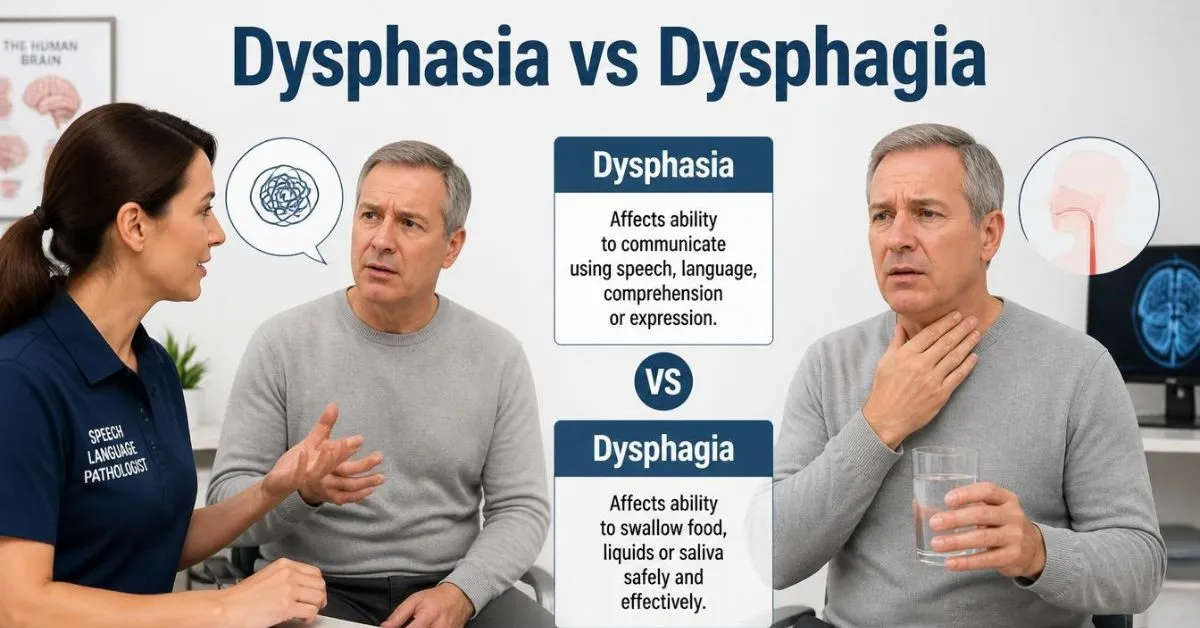
Dysphasia and dysphagia are different conditions. Dysphasia refers to difficulty with language, such as finding words, understanding speech, reading, or writing.
Dysphagia means difficulty swallowing food or liquids. Although the words look and sound similar, dysphasia affects communication, while dysphagia affects swallowing.
Key Takeaways
- Dysphasia involves difficulty with language and communication.
- Dysphagia means difficulty swallowing food, liquids, or saliva.
- Dysphasia is closely related to aphasia, a term commonly used for acquired language impairment.
- Dysphagia can cause coughing, choking, food sticking, or other swallowing problems.
- A person can experience both conditions, particularly after a stroke or other neurological injury.
- New or sudden communication or swallowing problems should be medically evaluated.
Dysphasia vs Dysphagia at a Glance
The simplest way to remember the difference is:
Dysphasia = language problem
Dysphagia = swallowing problem
| Difference | Dysphasia | Dysphagia |
| Main issue | Language and communication | Swallowing |
| What may be affected? | Speaking, understanding, reading, writing | Eating and drinking |
| Common signs | Word-finding difficulty, trouble understanding language | Coughing, choking, food sticking |
| Main body system involved | Brain and language networks | Muscles, nerves, throat, and/or esophagus |
| Related term | Aphasia | Swallowing disorder |
| Can occur after stroke? | Yes | Yes |
| Common specialist | Speech-language pathologist | Speech-language pathologist and other medical specialists |
If you only remember one thing, remember language versus swallowing. That distinction separates the two terms.
What Does Dysphasia Mean?
Dysphasia refers to difficulty using or understanding language. Depending on the person and the affected parts of the brain, it can interfere with speaking, understanding spoken language, reading, or writing.
For example, a person may know exactly what they want to say but struggle to find the correct word. They may substitute another word, pause frequently, or have difficulty putting words together.
Dysphasia is therefore a language-related problem, not a swallowing disorder.
The term is closely associated with aphasia, which is widely used in modern clinical settings to describe acquired language impairment. Terminology can vary between sources and healthcare settings, so the exact wording used by a clinician may differ.
Common Symptoms of Dysphasia
A person with a language impairment may have difficulty:
- Finding the right word
- Understanding conversations
- Naming familiar objects
- Forming sentences
- Following spoken instructions
- Reading text
- Writing words or sentences
- Using words correctly
- Expressing thoughts clearly
The severity can vary. Someone may have mild word-finding difficulty, while another person may have much greater difficulty communicating.
Importantly, language difficulty does not automatically mean that a person has an intellectual disability. A person can know what they want to communicate while having trouble accessing or expressing the language needed to communicate it.
Is Dysphasia The Same as Aphasia?
The terms dysphasia and aphasia can overlap, but their use is not completely consistent across medical sources.
Aphasia is commonly used to describe an acquired language disorder caused by damage to brain areas involved in language. Dysphasia has also been used to describe impaired language, sometimes with the implication of partial impairment.
Because terminology varies, it is better to focus on the actual symptoms and the clinical diagnosis rather than assuming that the two words always represent different levels of severity.
For everyday understanding:
Aphasia/dysphasia → difficulty with language.
This is completely different from dysphagia, which concerns swallowing.
What Does Dysphagia Mean?
Dysphagia means difficulty swallowing.
Swallowing is a complex process involving the mouth, throat, nerves, muscles, and esophagus. Dysphagia can occur when one or more parts of this process do not work properly.
A person with dysphagia may have trouble swallowing solid foods, liquids, pills, or even saliva.
They may describe a feeling that food is stuck in the throat or chest. Some people may cough or choke when eating or drinking.
Common Symptoms of Dysphagia
Possible signs include:
- Difficulty swallowing
- Coughing while eating or drinking
- Choking during meals
- Feeling that food is stuck
- Taking a long time to finish meals
- Difficulty swallowing pills
- Drooling
- Food remaining in the mouth
- A wet or gurgly voice after swallowing
- Avoiding certain foods or drinks
- Unexplained weight loss
- Repeated respiratory problems
Not everyone experiences all of these symptoms.
Some swallowing problems can also involve aspiration, which occurs when food or liquid enters the airway instead of moving safely toward the esophagus. Aspiration may sometimes happen without an obvious cough.
Types of Dysphagia
Dysphagia can be broadly described according to where the swallowing problem occurs.
Oropharyngeal Dysphagia
Oropharyngeal dysphagia involves difficulty initiating or completing the early part of swallowing. Problems may occur as food or liquid moves from the mouth toward the throat.
Possible symptoms include coughing, choking, difficulty initiating a swallow, or changes in the voice after drinking.
Esophageal Dysphagia
Esophageal dysphagia occurs when food or liquid has difficulty moving through the esophagus.
A person may feel as though food becomes stuck in the throat or chest, particularly after swallowing.
The underlying cause determines the appropriate evaluation and treatment.
Dysphasia vs Dysphagia: What Is the Main Difference?
The difference comes down to the function affected.
Dysphasia affects language. Dysphagia affects swallowing.
Consider these two examples:
Example 1:
Someone understands a question but cannot find the word they want to use in their answer.
That points toward a language problem, such as aphasia or dysphasia.
Example 2:
Someone can speak normally but coughs every time they drink water.
That may indicate a swallowing problem, such as dysphagia.
The two problems can sometimes appear in the same person, but they are not the same condition.
Why Do People Confuse Dysphasia and Dysphagia?
The words are confusing because they share several letters and begin with the same prefix.
The most useful distinction is in the endings:
- -phasia → language
- -phagia → swallowing or eating
The prefix dys- generally indicates difficulty or abnormal function.
So you can use this simple memory trick:
Dys + phasia → difficulty with language
Dys + phagia → difficulty with swallowing
This is especially helpful when reading medical information because confusing the two terms can change the meaning of a diagnosis or symptom description.
Can Someone Have Dysphasia and Dysphagia Together?
Yes.
A person can have both language and swallowing difficulties. This can happen when the same underlying neurological condition affects multiple brain functions.
For example, following a stroke, someone may have difficulty finding words during conversation and also have trouble swallowing liquids.
These symptoms represent two different problems:
- Difficulty finding words → language impairment
- Difficulty swallowing liquids → dysphagia
A healthcare professional may assess each problem separately because communication and swallowing require different evaluations.
Stroke is one important example, but it is not the only possible cause of either condition.
Dysphasia vs Dysphagia After a Stroke
Both conditions can occur after a stroke, but they affect different functions.
Aphasia or dysphasia can affect communication. A person may have difficulty speaking, understanding speech, reading, or writing.
Dysphagia can affect swallowing. The person may cough while eating, have difficulty managing food or liquids, or experience other signs of impaired swallowing.
The presence of one does not automatically mean the person has the other.
Because swallowing problems can affect nutrition, hydration, and airway safety, they should be evaluated when suspected.
When Should You Talk to a Doctor?
Persistent difficulty with language or swallowing deserves professional attention.
For language problems, a healthcare provider may recommend assessment by a speech-language pathologist (SLP). The evaluation may examine speaking, understanding, reading, writing, naming, and other communication skills.
For swallowing problems, an SLP or another appropriate healthcare professional may assess how safely and effectively a person swallows. Additional testing may be recommended depending on the suspected cause.
When Symptoms Are Sudden
Sudden difficulty speaking or understanding language can be a sign of a stroke, particularly when it occurs with other sudden neurological symptoms such as facial drooping or weakness in an arm or leg.
Sudden symptoms require emergency medical attention.
Similarly, severe swallowing difficulty accompanied by an inability to breathe or clear the airway is an emergency.
Do not try to diagnose dysphasia or dysphagia from symptoms alone. The underlying cause matters, and different causes require different treatment.
How Are Dysphasia & Dysphagia Diagnosed?
Diagnosis depends on the symptoms and suspected cause.
For language difficulties, a clinician may ask the person to name objects, answer questions, follow instructions, speak, read, or write. A speech-language pathologist can perform a more detailed communication assessment.
For dysphagia, the evaluation may include observing swallowing and examining how the person handles different food or liquid consistencies. In some cases, instrumental tests may be used to examine swallowing more closely.
The goal is not simply to identify the word for the condition. It is to determine what is causing the difficulty and which functions are affected.
How Are Dysphasia & Dysphagia Treated?
Treatment depends on the underlying cause, severity, and individual needs.
For language impairment, speech-language therapy may focus on improving communication skills and developing strategies that help the person communicate more effectively.
For dysphagia, treatment may focus on improving swallowing function, using safe swallowing strategies, or modifying food and liquid consistency when clinically appropriate.
There is no single treatment that works for everyone. A healthcare professional should determine the appropriate approach.
FAQs:
Is dysphasia a speech or swallowing problem?
Dysphasia is a language problem. It can affect speaking, understanding language, reading, or writing. Dysphagia is the term used for a swallowing problem involving food, liquids, or saliva.
Is dysphagia the same as difficulty swallowing?
Yes. Dysphagia means difficulty swallowing. It can involve problems moving food or liquids through the swallowing pathway and may have different causes.
Is dysphasia the same as aphasia?
The terms overlap. Aphasia is commonly used for acquired language impairment, while dysphasia has also been used to describe impaired language. Because terminology varies, the clinical context is important.
Can dysphasia affect reading and writing?
Yes. Language impairment can affect more than spoken communication. Some people may have difficulty reading, writing, naming objects, understanding spoken language, or expressing themselves.
Can dysphagia affect liquids?
Yes. Dysphagia can affect liquids as well as solid foods. Some people may cough or choke when drinking, although symptoms vary from person to person.
Can a person have both dysphasia and dysphagia?
Yes. Both can occur in the same person, including after a stroke or other neurological injury. However, they affect different functions and are evaluated separately.
What is an easy way to remember dysphasia vs dysphagia?
Think language versus swallowing:
Dysphasia → language
Dysphagia → swallowing
That simple distinction can help prevent the two terms from being mixed up.
Conclusion:
The difference between dysphasia vs dysphagia is easier to remember once you focus on what each condition affects.
Dysphasia is associated with difficulty using or understanding language, while dysphagia means difficulty swallowing.
Although the words look almost identical, they describe different problems. A person may experience one or both, especially when a neurological condition affects several functions.
If you notice new or persistent difficulty with communication or swallowing, professional evaluation can help identify the underlying cause and determine appropriate care.

Harry Jack is a content writer at ReplyGenius.com who specializes in practical, natural sounding replies for texts, social media, relationships, and everyday conversations.