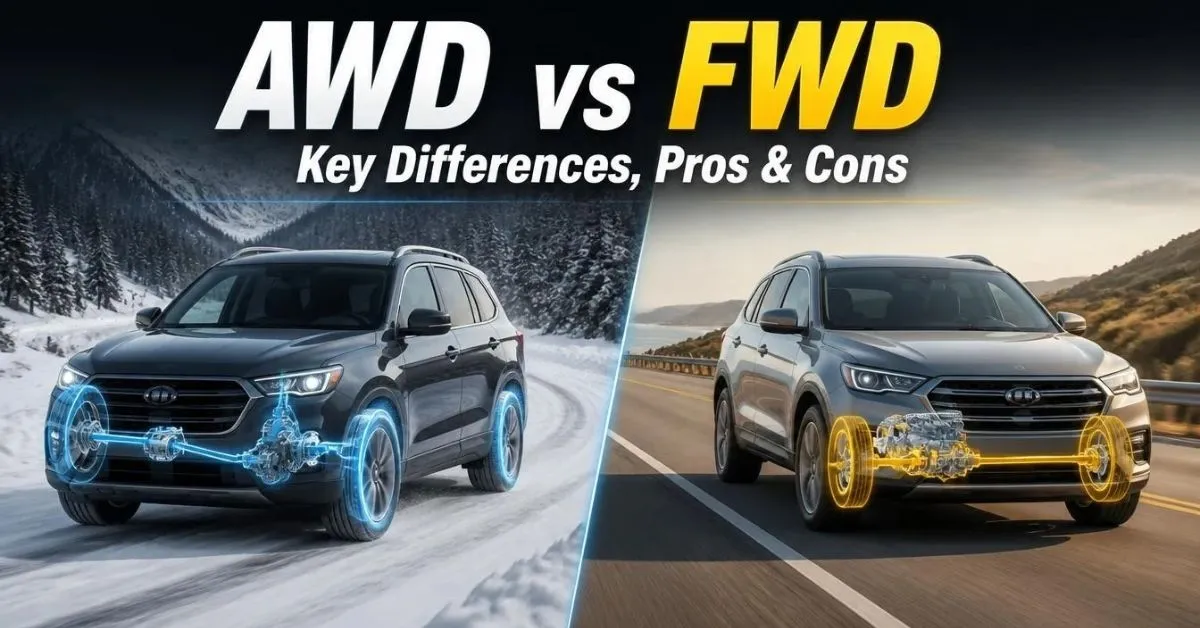
AWD vs FWD compares two ways a car sends power to its wheels. All-wheel drive (AWD) can send power to all four wheels to help the car move on snow, wet roads, and loose ground.
Front-wheel drive (FWD) powers only the front wheels. It often costs less and uses less fuel. The best choice depends on your roads, weather, budget, and driving needs.
Key Takeaways
- AWD can help a car move on snow, slush, and slippery hills.
- FWD often costs less to buy and can offer better gas mileage.
- AWD does not automatically help a car stop faster.
- Good tires are important for both AWD and FWD.
- FWD works well for most daily driving needs.
- AWD may be worth the extra cost if you often drive on slippery roads.
AWD vs FWD: What Is the Difference?
The main difference between AWD and FWD is which wheels receive power from the engine or electric motor.
- AWD: Can send power to both the front and rear wheels.
- FWD: Sends power only to the front wheels.
AWD can help a car move when one or more tires have less grip. FWD has a simpler design and can be more affordable to own.
Here is a quick comparison:
| Feature | AWD | FWD |
| Powered wheels | Front and rear | Front only |
| Snow traction | Often better when moving | Good with suitable tires |
| Wet-road driving | Can help during acceleration | Works well in normal rain |
| Fuel economy | Often lower | Often better |
| Purchase price | Often higher | Often lower |
| System design | More complex | Simpler |
| Maintenance | May cost more | Often simpler |
| Daily driving | Very good | Very good |
| Light off-road use | Depends on the vehicle | More limited |
These are common differences, not fixed rules. The exact car, engine, tires, and AWD design can change the results.
What Is Front-Wheel Drive (FWD)?
Front-wheel drive sends power to the two front wheels. These wheels pull the car forward and also control its direction.
FWD is common in sedans, small cars, hatchbacks, and many SUVs.
Its design places the engine and transmission near the front wheels. This can save space and reduce the number of parts needed to send power to the road.
Pros of FWD
1. Lower purchase price
FWD models often cost less than similar AWD models. This can help buyers stay within their budget.
2. Good fuel economy
FWD systems are often lighter and simpler. This can help a car use less fuel.
3. Useful traction
In many front-engine cars, the engine’s weight rests over the front wheels. This can help those wheels grip the road.
4. Simple design
FWD has fewer drivetrain parts than many AWD systems. This can make the design easier to service.
5. More room inside
Some FWD cars have a compact design that leaves more space for passengers and storage.
Cons of FWD
FWD has limits on very slippery roads.
The front tires must steer the car and send power to the road at the same time. If they lose grip, the car may struggle to move or turn as planned.
FWD can also have trouble climbing steep, icy hills or moving through deep snow.
Still, FWD is a good choice for many drivers. With suitable tires and safe driving, it can handle most normal road trips.
What Is All-Wheel Drive (AWD)?
All-wheel drive sends power to the front and rear wheels. The system can adjust how much power goes to each axle.
This can help the car move when some tires have less grip.
Many modern AWD systems use sensors to track wheel speed and driving conditions. They can change power delivery when needed.
How Does AWD Work?
AWD systems do not all work in the same way.
Some systems send power to both axles most of the time. Others mainly power the front wheels and send power to the rear when extra grip is needed.
Some electric cars use separate motors for the front and rear wheels.
This means that an AWD badge does not tell you exactly how the system works. Check the vehicle’s features and owner’s manual before buying.
Pros of AWD
1. More traction when moving
AWD can send power to more wheels. This may help the car move when some tires start to slip.
2. Better starts on snow
AWD can help a car move from a stop on snowy or slippery roads.
3. Help on steep hills
Extra grip can help when climbing a wet, snowy, or loose hill.
4. More options for rough roads
Some AWD vehicles can handle gravel roads and light trails.
5. Easy to use
Many AWD systems work on their own. The driver does not need to switch them on during normal use.
Cons of AWD
1. Higher purchase price
AWD models often cost more than similar FWD models.
2. Possible fuel costs
Extra weight and moving parts can reduce fuel economy.
3. More drivetrain parts
Some AWD systems have extra parts that may need service or repair.
4. Tire care is important
Some AWD systems have strict rules for tire size and tread depth. Using mismatched tires may cause problems.
5. No safety guarantee
AWD cannot stop every skid or prevent a crash. It also does not replace good tires or safe driving.
AWD can be useful when you often face slippery roads. But it may not be worth the extra cost if you rarely need more traction.
AWD vs FWD in Snow, Rain & Ice
Weather is one of the main reasons people compare AWD and FWD. But snow, rain, and ice create different risks.
Is AWD or FWD Better in Snow?
AWD often has an advantage when starting on snow or climbing a slippery hill. It can send power to more wheels, which may help the car find grip.
FWD can also work well in snow. Good winter tires can make a major difference in how well the car moves, turns, and stops.
Deep snow creates another problem: ground clearance. A car with low ground clearance may get stuck even if it has AWD.
Which should you choose?
- Choose AWD if you often drive on snowy roads or steep winter routes.
- FWD may be enough if your area gets light snow and you use suitable tires.
- Consider winter tires if you often drive in snow or ice, no matter which system you have.
NHTSA recommends using winter tires on all four wheels to help maintain safe handling.
Is AWD or FWD Better in Rain?
Both AWD and FWD can work well in normal rain.
AWD may help reduce wheelspin when you speed up on a wet road. But it cannot stop a car from hydroplaning.
Hydroplaning happens when water builds between the tires and road. The tires can lose contact with the road, making it harder to steer or stop.
To reduce the risk:
- Slow down in heavy rain.
- Keep your tires in good shape.
- Avoid sudden turns or hard braking.
- Leave more space between cars.
AWD does not make it safe to drive faster in wet weather.
Is AWD Better on Ice?
AWD can help a car start moving on ice, but it cannot create grip where the tires have very little traction.
Turning and stopping still depend on tire grip and road conditions.
A car with AWD can still slide on ice. Use suitable winter tires when needed. Drive slowly and avoid sudden turns, hard braking, and fast starts.
Does AWD Help With Braking?
No. AWD does not automatically make a car stop faster.
AWD helps send power to the wheels. Braking depends on the brakes, tires, road surface, and speed.
An AWD car may speed up more easily on snow than a FWD car. This can make drivers feel safer than they really are.
But the car may still slide when it needs to stop.
Remember: AWD helps a car move. Good tires and safe driving help it stop and turn.
AWD vs FWD: Fuel Economy, Cost & Maintenance
The cost of a car includes more than its price at the dealer. Fuel, tires, service, and repairs also matter.
Which Gets Better Gas Mileage?
FWD often gets better gas mileage because its drivetrain can be lighter and simpler.
AWD can use more fuel due to added weight and moving parts. But the gap depends on the vehicle.
For example, the 2026 Nissan Rogue has these EPA ratings:
| Model | City MPG | Highway MPG | Combined MPG |
| Rogue FWD | 29 | 36 | 32 |
| Rogue AWD | 28 | 35 | 31 |
This example shows a small fuel economy difference. Other vehicles may have a larger or smaller gap.
Always compare the official EPA ratings for the exact model year, engine, and trim.
Which Costs Less to Buy?
FWD models often cost less than similar AWD models.
Some cars offer both systems, while others only offer AWD on certain trims.
Before buying, compare the full price of each version. Also check whether AWD requires a higher trim or extra package.
If you drive mostly on clear roads, paying extra for AWD may not give you enough value.
Which Is Cheaper to Maintain?
FWD usually has a simpler drivetrain. This can mean fewer parts that need repair.
AWD systems may have extra parts, such as a rear differential or a unit that sends power between the axles.
These parts can add service needs. However, AWD does not always mean high repair bills.
Repair costs depend on the vehicle, its design, service history, and the type of fault.
Before you buy, check:
- The service schedule.
- The warranty.
- Common repair needs.
- Local repair costs.
- The price of replacement parts.
What About Tire Costs?
Tires are important for both systems.
Some AWD vehicles need all four tires to have very similar tread depth and rolling size. This is because the system may be sensitive to differences in how fast each wheel turns.
If one tire is damaged, you may need to replace more than one tire. Some vehicles may require all four to be replaced together.
This is not a rule for every AWD vehicle.
Check your owner’s manual before replacing a tire. It will explain the allowed tread-depth difference, tire size, and replacement rules.
For both AWD and FWD, use the correct tire size and keep the tires in good condition.
AWD vs 4WD: Are They the Same?
No. AWD and four-wheel drive (4WD) both send power to all four wheels, but their systems can work in different ways.
AWD is common in cars and crossover SUVs. It often works on its own and suits normal roads, snow, and some light off-road use.
4WD is common in trucks and some larger SUVs. Many 4WD systems offer extra tools for rough ground, such as low-range gearing.
| Feature | AWD | 4WD |
| Common use | Roads and light off-road trips | Rough ground and tougher off-road trips |
| Driver control | Often automatic | May have driver-selectable modes |
| Low-range gearing | Usually not available | Available on many systems |
| Best fit | Snow, rain, and mixed roads | Deep snow and demanding terrain |
These are general patterns. Some AWD and 4WD systems share features, so check the vehicle’s manual before driving off-road.
If you face deep snow, rocky trails, or rough ground often, a suitable 4WD vehicle may be a better choice.
Ground clearance, tires, and the exact drive system still matter.
Which Is Better For Your Driving Needs?
The best choice depends on where you live, how you drive, and what you can spend.
| Your needs | Best starting point |
| Daily city driving | FWD |
| Lower purchase price | FWD |
| Better fuel economy | Often FWD |
| Frequent snow and slush | AWD |
| Steep, slippery hills | AWD |
| Highway trips in mild weather | FWD |
| Light snow with good tires | FWD can work well |
| Gravel roads and light trails | AWD, depending on the car |
| Deep snow or tough trails | Consider suitable 4WD |
Choose FWD If You Want to Save Money
FWD is a smart choice if you mostly drive on paved roads and live in an area with mild winters.
It often offers:
- A lower purchase price.
- Good fuel economy.
- A simple drivetrain.
- Enough traction for daily driving.
You may not need AWD if you rarely face snow or slippery hills.
Choose AWD If You Need More Traction
AWD may be worth the extra cost if you often drive on:
- Snowy roads.
- Slushy streets.
- Steep, slippery hills.
- Loose gravel roads.
- Roads with changing weather conditions.
It can help the car move when some tires lose grip.
But check the tires, ground clearance, fuel use, and service costs before buying.
Is AWD Worth the Extra Cost?
AWD is worth considering when the extra traction solves a problem you face often.
Think about how many days each year you drive on snow, ice, or loose roads.
If you rarely face these conditions, FWD may be the better value.
If you drive through snow every winter or travel on slippery hills, AWD may be worth paying more for.
Do not buy AWD only because it sounds safer. Compare the full cost and your real driving needs.
What Should You Check Before Buying?
Use these steps to compare two cars:
- Compare the same model. Check FWD and AWD versions with similar engines and features.
- Check fuel ratings. Use official EPA figures for each version.
- Think about your roads. Consider snow, hills, rain, and unpaved routes.
- Check the tires. Find out what tires come with each model and what winter driving may require.
- Compare long-term costs. Include fuel, service, tires, and possible repairs.
- Check the owner’s manual. Look for tire replacement and maintenance rules.
- Test-drive both if possible. Notice comfort, handling, noise, and how the car feels on your usual roads.
This helps you choose based on real needs instead of paying for features you may not use.
FAQs:
Is AWD better than FWD?
AWD is often better for getting moving on slippery roads. FWD often costs less and can offer better fuel economy. Neither is best for every driver. Your weather, tires, budget, and driving habits should guide your choice.
Is FWD good in snow?
Yes. FWD can handle many snowy roads when it has suitable tires and the driver uses care. Winter tires can improve grip. AWD may help more when starting on snow or climbing slippery hills.
Does AWD use more gas than FWD?
Often, yes. AWD can add weight and drivetrain friction, which may reduce fuel economy. But the difference varies by model. Check official EPA ratings before buying.
Does AWD help with braking?
No. AWD does not automatically shorten braking distance. Tires, brakes, speed, and road grip affect how quickly a car stops. AWD mainly helps with putting power to the road when moving.
Is AWD worth the extra cost?
AWD may be worth it if you often drive in snow, on slippery hills, or on rough roads. If you mainly drive on clear, paved roads, FWD may offer better value. Compare the total cost and the conditions you face.
Can a FWD car drive on a steep hill?
Yes, if the road has enough grip and the car has suitable tires. FWD can climb many hills because the engine’s weight often rests over the front wheels. But steep, icy, or loose hills can be harder to climb.
Is AWD good for off-roading?
AWD can work well on gravel roads and some light trails. But not every AWD car is made for rough terrain. Ground clearance, tires, suspension, and the drive system all matter. For tough trails, a suitable 4WD vehicle may be better.
Which is safer, AWD or FWD?
Neither system is always safer. AWD can help with traction when moving, but it does not remove the risk of skidding or crashing. Good tires, safe speeds, working brakes, and careful driving matter for both.
Conclusion:
The main difference in AWD vs FWD is how power reaches the wheels. AWD can help a car move on slippery roads, while FWD often costs less and uses less fuel.
Choose AWD if you often face snow, slippery hills, or loose roads. Choose FWD if you mostly drive on paved roads and want to keep costs down.
Before you decide, compare the exact cars, their tires, fuel ratings, and service costs. The right choice is the one that fits your real driving needs.