Epinephrine and Norepinephrine are two key chemicals in the body. They help control heart rate, blood pressure, and the body’s response to stress. Both are also used as drugs in hospitals.
But they do not work in the same way. Epinephrine can help during a severe allergic reaction or cardiac arrest. Norepinephrine is often used to treat very low blood pressure, such as in septic shock.
In this guide, I will explain the key differences between epinephrine and norepinephrine. You will learn how they work, when doctors use them, and what side effects they may cause.
Key Takeaways
- Epinephrine is also called adrenaline.
- Norepinephrine is also called noradrenaline.
- Both are part of the body’s stress response.
- Epinephrine acts on alpha and beta receptors.
- Norepinephrine mainly acts on alpha-1 and beta-1 receptors.
- Epinephrine is the first-choice drug for anaphylaxis.
- Epinephrine is used during cardiac arrest.
- Norepinephrine is the first-choice drug for most adults with septic shock.
- Both drugs can cause serious side effects and need medical care.
What Is Epinephrine?
Epinephrine is a natural chemical made by the adrenal glands. These small glands sit above the kidneys.
It is also known as adrenaline. Your body releases it when you feel fear, stress, or danger.
Epinephrine helps your body act fast. It can make your heart beat faster and help air move into your lungs. It also changes blood flow to help your body respond to danger.
Doctors also use epinephrine as a medicine. It can treat severe allergic reactions and help during cardiac arrest.
What Is Norepinephrine?
Norepinephrine is a natural chemical made by the body. It is also called noradrenaline.
It works as both a brain and nerve messenger and a hormone. Nerves release it to send signals to other parts of the body. The adrenal glands can also release a small amount into the blood.
Norepinephrine helps keep blood pressure at a safe level. It does this by making blood vessels tighter.
Doctors also use it as a medicine. It is often given to people with very low blood pressure, especially during septic shock.
Epinephrine vs Norepinephrine: Main Differences
The table below shows how these two drugs differ.
| Feature | Epinephrine | Norepinephrine |
|---|---|---|
| Other name | Adrenaline | Noradrenaline |
| Main role in the body | Hormone | Nerve messenger and hormone |
| Main receptors | Alpha and beta | Mainly alpha-1 and beta-1 |
| Heart rate | Often increases it | May increase or slow it |
| Blood pressure | Can raise it | Usually raises it |
| Blood vessels | Effects depend on the blood vessel and dose | Usually makes them tighter |
| Lungs | Opens the airways | Has little effect on opening the airways |
| Main emergency use | Severe allergic reaction | Very low blood pressure in shock |
| Cardiac arrest | Used during resuscitation | Not the standard drug used during cardiac arrest |
Important: The effects of both drugs can change with the dose and the person’s condition. Their effects are not the same in every patient.
How Do Epinephrine & Norepinephrine Work?
Both drugs work by attaching to special sites on cells. These sites are called receptors.
Think of a receptor as a lock and a drug as a key. When the drug reaches the right receptor, it starts an action in the body.
The main receptors are alpha-1, alpha-2, beta-1, and beta-2.
1. Alpha-1 Receptors
Alpha-1 receptors are found in many blood vessels.
When these receptors are active, blood vessels become tighter. This can raise blood pressure.
Norepinephrine has a strong effect on alpha-1 receptors. Epinephrine also acts on them.
2. Alpha-2 Receptors
Alpha-2 receptors help control the release of some nerve signals.
They are part of the body’s system for controlling stress and blood flow.
Both epinephrine and norepinephrine can act on these receptors.
3. Beta-1 Receptors
Beta-1 receptors are found mainly in the heart.
When these receptors are active, the heart can beat faster and pump with more force.
Both drugs act on beta-1 receptors.
4. Beta-2 Receptors
Beta-2 receptors are found in the lungs and some blood vessels.
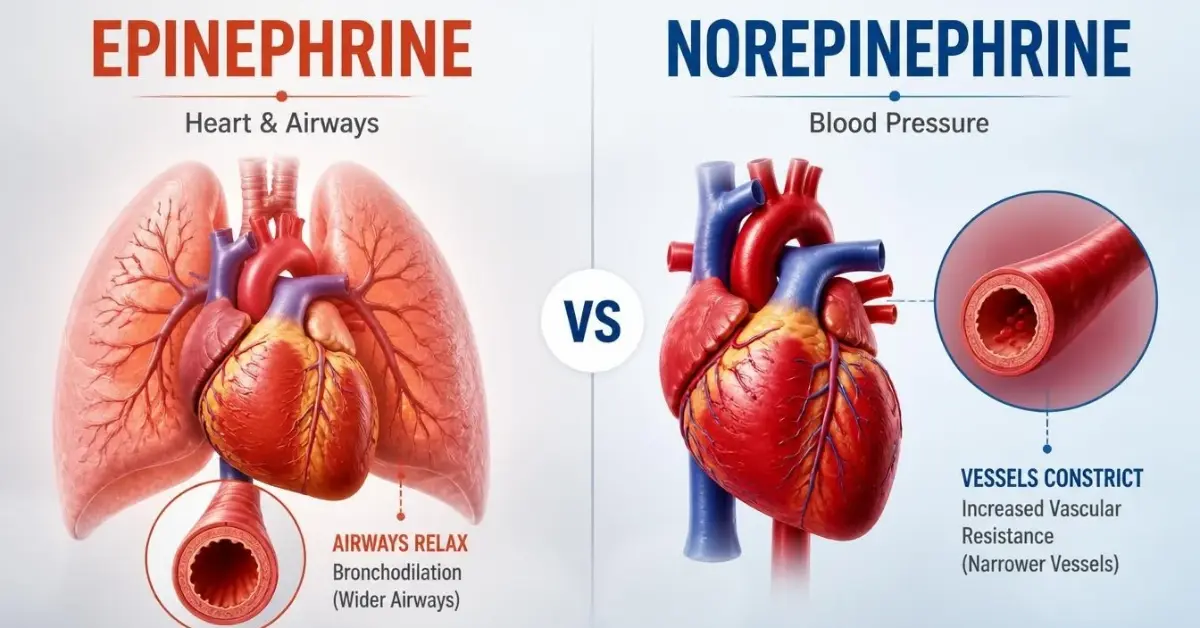
When epinephrine acts on beta-2 receptors in the lungs, the airways open wider. This helps air move in and out.
Epinephrine has a stronger effect on beta-2 receptors than norepinephrine.
Effects on The Heart
Epinephrine can make the heart beat faster and pump harder. This may help during some life-threatening emergencies.
Norepinephrine also acts on the heart. It can increase the force of each beat. But it also makes blood vessels tighter.
When blood pressure rises, the body may slow the heart through a natural response. This is why the heart rate may slow in some people who receive norepinephrine.
So, norepinephrine does not always slow the heart by its direct action. The rise in blood pressure can cause the body to slow the heart as a reflex.
Effects on Blood Pressure
Both drugs can raise blood pressure, but they do so in different ways.
Epinephrine: It can tighten some blood vessels. It can also relax some blood vessels through beta-2 receptors. Its effect depends on the dose and the part of the body.
Norepinephrine: It mainly tightens blood vessels. This raises the pressure of blood moving through the body.
This is one reason doctors often choose norepinephrine when a patient has very low blood pressure.
Effects on The Lungs
Epinephrine can relax the muscles around the airways. This makes the airways wider and helps a person breathe.
This action is useful during a severe allergic reaction. It can also help in some serious breathing emergencies.
Norepinephrine does not open the airways in the same way. Its main action is to tighten blood vessels and raise blood pressure.
Medical Uses of Epinephrine
Doctors use epinephrine in several serious medical emergencies.
1. Severe Allergic Reactions
A severe allergic reaction is called anaphylaxis.
It can cause swelling, trouble breathing, a drop in blood pressure, and other serious signs.
Epinephrine is the first-choice treatment for anaphylaxis. It helps open the airways and supports blood pressure.
A person with signs of anaphylaxis needs urgent medical help. Do not wait to see if the symptoms go away.
2. Cardiac Arrest
Cardiac arrest happens when the heart stops pumping blood in a useful way.
Doctors and emergency teams use epinephrine during adult cardiac arrest as part of resuscitation.
It helps tighten blood vessels and supports blood flow to key organs during CPR.
3. Some Severe Breathing Emergencies
Epinephrine can help open the airways. It may be used in certain serious breathing emergencies.
It is not the routine treatment for every asthma attack. The right treatment depends on the cause and the patient’s condition.
Medical Uses of Norepinephrine
Norepinephrine is often used in hospitals to treat very low blood pressure.
1. Septic Shock
Septic shock is a life-threatening problem caused by a severe response to an infection.
Blood pressure can fall to a very low level. This may stop key organs from getting enough blood.
Norepinephrine is the first-choice drug for most adults with septic shock. It helps tighten blood vessels and raise blood pressure.
The 2026 Surviving Sepsis Campaign guidelines continue to recommend norepinephrine as the first choice for most adults with septic shock.
Doctors may add other drugs if blood pressure does not improve enough.
2. Severe Low Blood Pressure
Norepinephrine may be used when a person’s blood pressure is too low to support the brain, heart, and other organs.
It helps tighten blood vessels and improve blood pressure.
3. Other Types of Shock
Doctors may also use norepinephrine in some other forms of shock.
The choice of drug depends on why the person’s blood pressure is low and how the heart is working.
Cardiac Arrest vs. Shock After Cardiac Arrest
These two conditions are not the same.
During cardiac arrest, the heart is not pumping blood in a useful way. Epinephrine is used during adult resuscitation.
After the heart starts beating again, some patients still have very low blood pressure. This is called post-resuscitation shock.
A 2022 study in Intensive Care Medicine looked at patients with shock after cardiac arrest. It found a link between epinephrine use and a higher risk of death than norepinephrine use.
But this was an observational study. It cannot prove that epinephrine caused the higher risk.
This study does not mean epinephrine should not be used during cardiac arrest. It looked at a different stage of care.
Side Effects of Epinephrine
Epinephrine can cause side effects because it strongly affects the heart and blood vessels.
Possible side effects include:
- Fast heartbeat
- Shaking or tremors
- Anxiety or nervousness
- Headache
- Sweating
- High blood pressure
- Heart rhythm problems
Serious side effects are more likely in some people, especially those with heart problems.
In a life-threatening allergic reaction, the need for quick treatment is very important. Medical help should not be delayed.
Side Effects of Norepinephrine
Norepinephrine can also cause serious side effects.
Possible side effects include:
- High blood pressure
- Slow or irregular heartbeat
- Headache
- Anxiety
- Reduced blood flow to some body parts
- Cold hands and feet
- Tissue damage if the drug leaks outside the vein
Doctors give norepinephrine with close monitoring. They check blood pressure, heart rate, and blood flow during treatment.
How Are Epinephrine & Norepinephrine Made in The Body?
Both drugs belong to a group of chemicals called catecholamines.
The body makes them from an amino acid called tyrosine.
The basic path is:
- Tyrosine
- L-DOPA
- Dopamine
- Norepinephrine
- Epinephrine
In simple terms, the body makes norepinephrine first. It can then turn norepinephrine into epinephrine.
The adrenal glands make and release much of the body’s epinephrine into the blood. Nerve cells also make and release norepinephrine to send signals.
Common Myths About Epinephrine and Norepinephrine
Myth 1: They Are the Same Drug
Fact: They are closely related, but they have different effects and medical uses.
Myth 2: Norepinephrine Always Slows the Heart
Fact: Norepinephrine can act on beta-1 receptors in the heart. But its effect on blood pressure may cause a reflex that slows the heart.
Myth 3: Epinephrine Is Only Used for Allergies
Fact: Doctors also use epinephrine during cardiac arrest and in some other serious emergencies.
Myth 4: Norepinephrine Is Only a Medicine
Fact: The body also makes norepinephrine. It works as a nerve messenger and a hormone.
FAQs:
1. What is the main difference between epinephrine and norepinephrine?
Epinephrine acts on both alpha and beta receptors. It can raise heart rate and open the airways. Norepinephrine mainly tightens blood vessels and raises blood pressure.
2. Is epinephrine the same as adrenaline?
Yes. Epinephrine and adrenaline are two names for the same chemical.
3. Is norepinephrine the same as noradrenaline?
Yes. Norepinephrine and noradrenaline are two names for the same chemical.
4. Which drug raises blood pressure more?
Norepinephrine is often used when doctors need to raise very low blood pressure. It has a strong effect on blood vessels. Epinephrine can also raise blood pressure, but its effects depend on the dose and the body’s response.
5. Why is norepinephrine used in septic shock?
Septic shock can cause blood pressure to fall to a dangerous level. Norepinephrine tightens blood vessels and helps raise blood pressure.
6. Why is epinephrine used for anaphylaxis?
Epinephrine helps open the airways, supports blood pressure, and treats other serious effects of anaphylaxis. It is the first-choice drug for this emergency.
7. Does norepinephrine increase heart rate?
It can increase the force of the heart’s beat through beta-1 receptors. But the rise in blood pressure may cause a reflex that slows the heart rate.
Conclusion:
Epinephrine and Norepinephrine are two important chemicals in the body. Both help the body respond to stress and can raise blood pressure.
But they have different roles.
Epinephrine acts on alpha and beta receptors. It is the first-choice drug for severe allergic reactions and is used during cardiac arrest.
Norepinephrine mainly tightens blood vessels. It is the first-choice drug for most adults with septic shock.
Doctors choose between these drugs based on the patient’s condition. Both need careful use and close medical care.

Harry Jack is a content writer at ReplyGenius.com who specializes in practical, natural sounding replies for texts, social media, relationships, and everyday conversations.