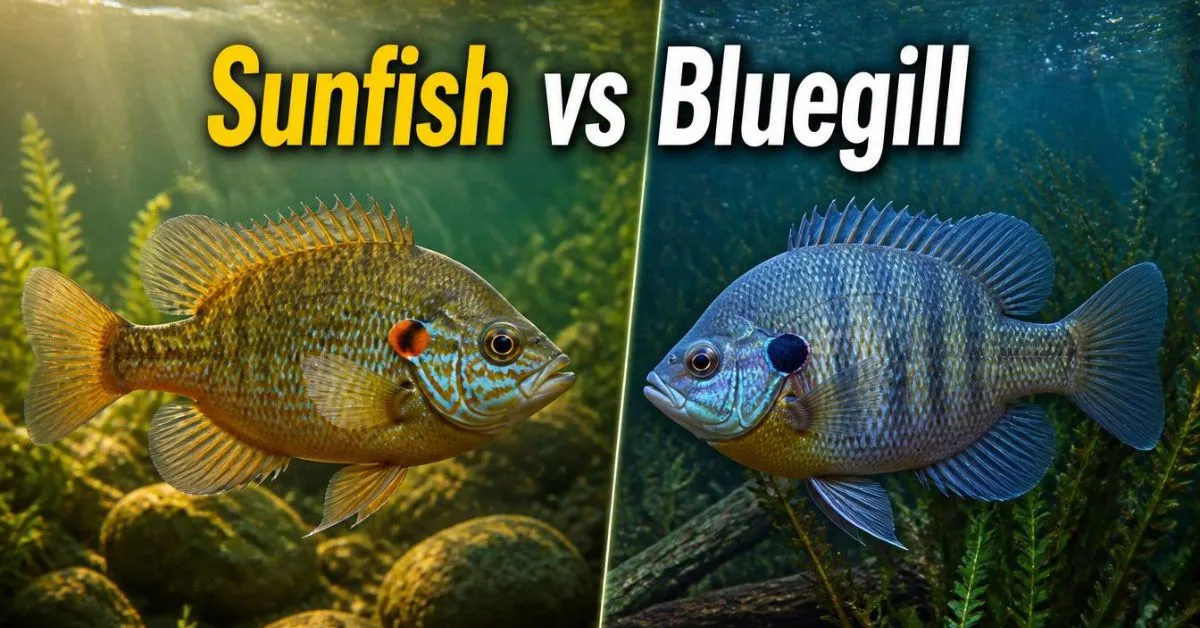
A bluegill is a type of sunfish, so they are not two separate kinds of fish. Sunfish is a broad name used for several freshwater fish, while bluegill is one specific species (Lepomis macrochirus).
Bluegills usually have a deep, flat body, a small mouth, dark vertical bars, a black ear flap, and a dark spot near the rear of the dorsal fin. Other sunfish, such as green sunfish and pumpkinseed, have different combinations of colors, markings, and body features.
Sunfish vs Bluegill: Key Differences
| Feature | Sunfish | Bluegill |
| Meaning | A broad common name for several fish | One specific fish species |
| Scientific name | Varies by species | Lepomis macrochirus |
| Body shape | Varies by species | Deep, oval, and flattened from side to side |
| Color | May be green, brown, orange, yellow, or blue | Often olive or green with blue tones and a yellow-orange belly |
| Markings | Depend on the species | Often has dark vertical bars and a dark spot near the rear of the dorsal fin |
| Mouth | Size varies by species | Usually small |
| Typical size | Depends on the species | Common length is about 7.5 inches, though size varies |
| Habitat | Depends on the species | Common in ponds, lakes, reservoirs, and many slow-moving waters |
| Fishing | Methods depend on the species | Often caught with worms, crickets, small jigs, and flies |
Important: This is not a comparison between two equal categories. Bluegill is one species within the sunfish group. To compare two specific fish fairly, use a species-level comparison, such as bluegill vs green sunfish or bluegill vs pumpkinseed.
What Is a Sunfish?
Sunfish are freshwater fish commonly associated with the family Centrarchidae. The word can be used in different ways. In everyday fishing talk, people often use sunfish for fish such as bluegills, green sunfish, and pumpkinseeds. In scientific classification, the sunfish family is broader and also includes fish such as bass and crappies.
Many sunfish have bodies that are tall and flat from side to side. They often have spiny dorsal fins and live in freshwater lakes, ponds, rivers, and streams. However, their appearance, size, and behavior vary by species.
Common Types of Sunfish
Bluegill: Usually has a small mouth, a dark ear flap, vertical bars, and a dark spot near the rear of the dorsal fin.
Green sunfish: Often has a larger mouth than a bluegill, a green or blue-green body, and short, rounded pectoral fins.
Pumpkinseed: Known for its bright colors and a red or orange mark along the rear edge of its dark ear flap.
Redear sunfish: Has a dark ear flap with a red or orange edge. It often feeds on snails and other hard-shelled animals.
Longear sunfish: Often has a long ear flap and bright blue markings on its body.
These fish may look alike at first. Their colors can also change with age, sex, breeding season, and local conditions. Use several physical features to identify a fish rather than relying on color alone.
What Is a Bluegill?
The bluegill (Lepomis macrochirus) is a freshwater fish in the sunfish family. It is common in many US lakes and ponds and is a popular fish for recreational anglers.
Bluegills have a deep, flattened body and a relatively small mouth. Their sides may look olive, green, copper, or orange, while blue or purple tones often appear near the cheek and gill cover. Their colors can become more intense during the breeding season, especially in males.
How to Identify a Bluegill
Look for these features when identifying a possible bluegill:
- Black ear flap: The flap behind the eye is usually dark and lacks the bright red or orange edge seen on some other sunfish.
- Dark dorsal-fin spot: A dark mark often appears near the rear of the soft-rayed section of the dorsal fin.
- Vertical bars: Dark bars often run down the sides of the body.
- Small mouth: The mouth usually does not extend far past the front of the eye.
- Deep body: The fish looks tall and flat from side to side.
- Pointed pectoral fins: The side fins are often long and pointed.
The dark spot near the dorsal fin is one of the most useful clues, but no single feature is perfect. Bluegills can also breed with other sunfish, creating hybrids with mixed traits. If the fish is difficult to identify, compare several features or consult a local fish identification guide.
For an official visual reference, see the Michigan Department of Natural Resources bluegill guide.
Sunfish vs Bluegill: Size & Appearance
There is no single size or color for all sunfish because the word covers multiple species. Bluegills, by contrast, have a more consistent set of identifying traits.
The U.S. Fish & Wildlife Service lists about 7.5 inches as the common length for bluegills, although some grow much larger. Growth depends on factors such as food, age, water conditions, and population density.
Color can help with identification, but it should not be the only clue. A bluegill may look more blue or orange during breeding season, while another sunfish may show similar colors. Check the ear flap, mouth, fins, body shape, and dorsal-fin marking together.
Sunfish vs Bluegill: Habitat
Sunfish live in many freshwater habitats across North America. The exact conditions they prefer depend on the species.
Where Do Bluegills Live?
Bluegills commonly live in:
- Ponds and lakes
- Reservoirs
- Slow-moving rivers and streams
- Backwaters and sheltered areas
- Weedy shorelines
- Areas near submerged logs, docks, and other cover
They often use shallow areas to feed and spawn. At other times, they may move into deeper water, depending on the season, water temperature, and available food.
Where Do Other Sunfish Live?
Other sunfish can use many of the same habitats, but some favor different conditions. For example, some species are common in small streams, while others do well in lakes and ponds with abundant vegetation.
Habitat alone cannot confirm a fish’s identity. Several sunfish species may live in the same body of water, so physical features are usually more useful for telling them apart.
Sunfish vs Bluegill: Diet
Bluegills eat a range of small food sources, including aquatic insects, insect larvae, zooplankton, and other small invertebrates. Larger bluegills may also eat small fish or other available prey.
Other sunfish often eat similar foods, but their diets vary. Redear sunfish, for example, are known for eating snails and other hard-shelled animals.
A fish’s diet also changes as it grows. Young fish often feed on tiny organisms, while larger fish can eat bigger prey.
Sunfish vs Bluegill: Which Is Better for Fishing?
Bluegills are a popular choice for beginner anglers because they are common in many freshwater areas and can often be caught with simple gear. Other sunfish can also provide enjoyable fishing, but the best method depends on the species and local conditions.
Best Bait for Bluegill
Common choices include:
- Small pieces of worm
- Crickets
- Mealworms
- Small jigs
- Tiny soft-plastic lures
- Small flies and poppers
A small hook with a worm or cricket under a bobber is a simple starting point. Try fishing near weeds, docks, submerged wood, or other cover. If you are not getting bites, change the depth or try a smaller bait.
Tips for Catching Other Sunfish
Small hooks and natural baits can work for several sunfish species. Small lures may also help when fish are active. However, the best bait, depth, and location can differ by species and season.
Always check your local fishing regulations before keeping fish. Size limits, daily limits, seasons, and permitted methods vary by location.
Are Sunfish & Bluegill the Same Fish?
Not exactly. A bluegill is a sunfish, but not every sunfish is a bluegill.
Think of the word sunfish as a group name and bluegill as one member of that group. A pumpkinseed and a green sunfish are also sunfish, but each is a different species.
People sometimes use the names loosely when fishing. If someone says they caught a sunfish, they may mean a bluegill or another similar species. Looking at the fish’s physical features can help you identify which one it is.
FAQs:
Are all bluegills sunfish?
Yes. Bluegills belong to the sunfish family, Centrarchidae. However, other sunfish species are not bluegills.
How can you tell a bluegill from another sunfish?
Look for a dark ear flap, dark vertical bars, a small mouth, and a dark spot near the rear of the dorsal fin. Compare several features because other sunfish can share some of these traits.
Are bluegills bigger than other sunfish?
Not always. Bluegills commonly reach around 7.5 inches, but size varies. Some other sunfish are smaller, while others can grow larger. A fair size comparison requires naming the two species.
Do bluegills and other sunfish live in the same water?
Yes. Different sunfish species can share ponds, lakes, rivers, and reservoirs. They may use different areas or food sources within the same habitat.
Do bluegills taste good?
Many anglers eat bluegills because they have mild, flaky flesh. Whether a fish is safe to eat depends on the water where it was caught. Check local fish-consumption advisories before eating fish from unfamiliar waters.
Is a bluegill the same as a bream?
In some parts of the United States, bream is a common name for bluegill. In other places, it can refer to other sunfish or similar fish. The meaning depends on the region, so it is not always a precise species name.
Is a bluegill a type of perch?
No. Bluegills are sunfish, not true perch. People sometimes use perch as a casual local name for bluegills, but the fish belong to different groups.
Conclusion:
The main difference between sunfish vs bluegill is that sunfish is a broad group name, while bluegill is one specific species. Green sunfish, pumpkinseeds, redear sunfish, and bluegills are related, but each has its own identifying features.
To identify a bluegill, check its dark ear flap, small mouth, vertical bars, pointed pectoral fins, and dark spot near the rear of the dorsal fin. Do not rely on color alone, because color can vary and some fish may be hybrids.
Once you understand the difference between the broad name and the specific species, it becomes much easier to identify freshwater fish and learn more about what you catch.

Olivia Smith is a professional author at ReplyGenius.com, where I create clear and engaging content on communication and writing.