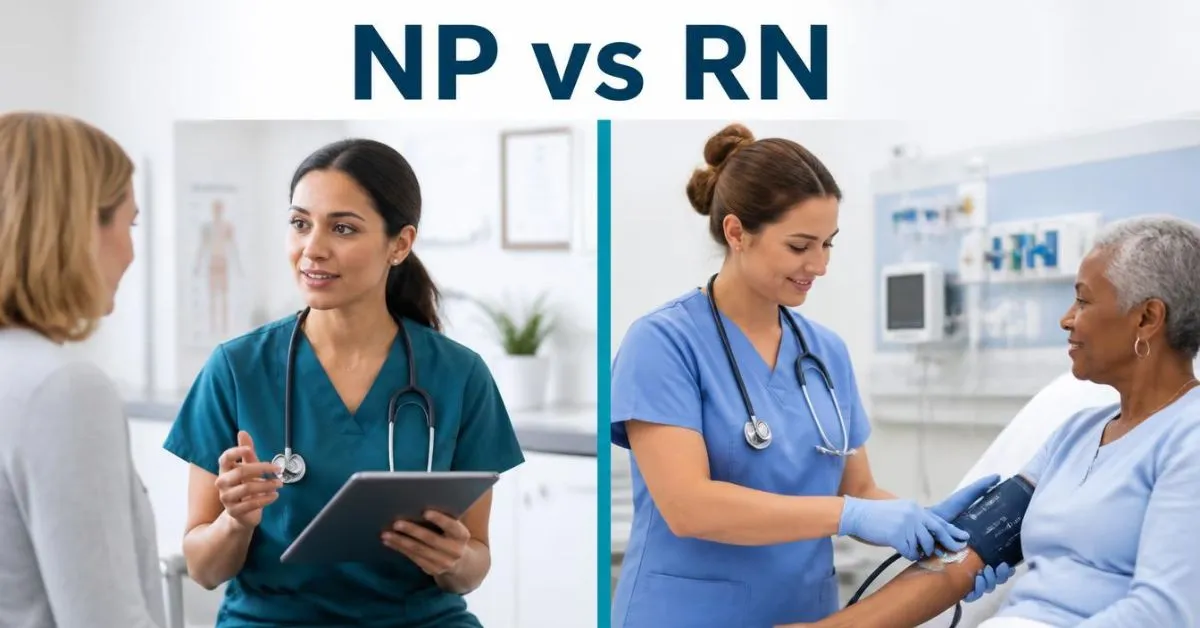
The main difference between an NP and an RN is their education and scope of practice. A registered nurse (RN) provides and coordinates patient care, while a nurse practitioner (NP) has advanced nursing education and can diagnose illnesses, order tests, develop treatment plans, and prescribe medication when state law allows.
NPs need graduate-level education, specialty certification, and state authorization.
Key Takeaways
- RNs focus on patient care, health assessments, medication administration, and care coordination.
- NPs have advanced training and can diagnose and treat patients within their authorized scope.
- RNs can qualify through approved diploma, associate degree, or bachelor’s degree nursing programs.
- NPs generally earn more than RNs, but actual pay depends on location, specialty, experience, and employer.
- Becoming an NP requires additional education, certification, and state authorization.
NP vs RN: What’s the Main Difference?
An RN, or registered nurse, provides direct patient care and helps patients manage their health. RNs monitor symptoms, give prescribed medications, educate patients, and coordinate care with other healthcare professionals.
An NP, or nurse practitioner, is an advanced practice registered nurse (APRN) with graduate-level education and specialized clinical training. NPs can assess patients, diagnose illnesses, order tests, develop treatment plans, and prescribe medication when state law permits.
The biggest difference is the level of clinical responsibility. RNs focus on nursing care and patient support, while NPs have additional training that allows them to manage many clinical decisions.
Both roles are essential to healthcare. The right career depends on your education, interests, and preferred responsibilities.
NP vs RN Comparison Table
| Feature | Registered Nurse (RN) | Nurse Practitioner (NP) |
| Education | Approved diploma, associate degree, or bachelor’s degree | Graduate nursing degree |
| Main role | Patient care and care coordination | Advanced assessment and treatment |
| Diagnosis | Nursing assessments and nursing diagnoses within scope | Medical diagnosis within authorized scope |
| Prescribing | Generally does not prescribe independently | Can prescribe when authorized |
| Licensing | State RN license | RN qualification plus state APRN authorization |
| Certification | NCLEX-RN for initial licensure | National specialty certification generally required |
| Work settings | Hospitals, clinics, schools, home care | Primary care, hospitals, specialty clinics |
| Career progression | Specialty nursing, leadership, education | Advanced clinical practice and specialty care |
| Median annual wage | $97,550 | $132,300 |
Salary figures are U.S. national medians for May 2025, not starting salaries. See the BLS RN profile and NP wage information.
What Does an RN Do?
Registered nurses focus on patient safety, nursing assessments, treatment support, and care coordination. Their duties depend on their workplace and specialty.
Common RN duties include:
- Checking vital signs and monitoring symptoms.
- Giving prescribed medications and treatments.
- Assessing patients and reporting changes in their health.
- Recording patient information and updating nursing care plans.
- Teaching patients how to manage health conditions.
- Helping coordinate treatment with other healthcare professionals.
- Supporting patients before and after medical procedures.
For example, an RN caring for someone after surgery may check vital signs, give ordered medication, monitor the surgical site, and report warning signs to the healthcare team.
RNs use clinical judgment and can identify nursing problems. However, their license does not normally authorize independent medical diagnosis or prescribing.
What Does an NP Do?
Nurse practitioners have advanced training that prepares them to assess, diagnose, and manage health conditions within their specialty and legal scope.
Their duties may include:
- Taking medical histories and performing physical exams.
- Diagnosing illnesses and evaluating symptoms.
- Ordering and interpreting diagnostic tests.
- Creating treatment plans.
- Prescribing medication when authorized.
- Managing conditions such as diabetes and high blood pressure.
- Referring patients to specialists when needed.
For example, a family nurse practitioner may evaluate a patient with a persistent cough, review their medical history, order tests, diagnose the condition, and recommend treatment.
NPs may specialize in family practice, pediatrics, psychiatric mental health, adult-gerontology, and other recognized areas. Their exact duties depend on their training, certification, workplace, and state law.
NP vs RN Education Requirements
Education is one of the biggest differences between these careers.
How to Become an RN
To become a registered nurse in the United States, you generally need to:
- Complete an approved nursing program. Common routes include an associate degree, bachelor’s degree, or approved nursing diploma.
- Complete the required clinical training.
- Apply for licensure through your state board of nursing.
- Meet state eligibility requirements and pass the NCLEX-RN exam.
- Meet any additional state licensing requirements.
A BSN commonly takes about four years of full-time study. Associate degree programs often involve about two years of nursing coursework, while diploma programs vary. Prerequisites and program schedules can increase the total time.
How to Become an NP
To become a nurse practitioner, you generally need to:
- Qualify as an RN.
- Complete graduate nursing education in an NP specialty.
- Complete the required clinical training.
- Pass the appropriate national specialty certification exam.
- Obtain the advanced practice authorization required by your state.
Many NP programs require a BSN, although bridge programs and other pathways are available. A Doctor of Nursing Practice (DNP) is one possible route, but it is not universally required for entry-level NP practice.
The Bureau of Labor Statistics provides further details about advanced practice nursing education and certification.
Which takes longer? Becoming an NP generally takes longer because it requires graduate education after the initial RN pathway. Your timeline depends on your previous education, program format, clinical requirements, and work schedule.
NP vs RN Salary in the United States
Nurse practitioners generally earn more than registered nurses at the national median.
According to the U.S.
Bureau of Labor Statistics, the median annual wages in May 2025 were:
- Registered nurses: $97,550
- Nurse practitioners: $132,300
That is a difference of $34,750 per year between the two national median figures.
A median is the midpoint of reported wages. Half of workers earn more, and half earn less. It does not represent a guaranteed starting salary.
Actual pay depends on several factors:
- State and city.
- Years of experience.
- Specialty and clinical responsibilities.
- Employer and healthcare setting.
- Work schedule and additional compensation.
- Education and professional qualifications.
NPs often earn more because they complete additional education and take on advanced clinical duties. However, a higher salary is not guaranteed in every job.
Before choosing a career, compare local wages, tuition, financial aid, and the time you may spend studying instead of working.
Can NPs Diagnose Patients & Prescribe Medication?
Yes. Nurse practitioners can diagnose and treat health conditions within their authorized scope of practice. They may also order tests and prescribe medication when they meet the applicable legal requirements.
RNs can assess patients, monitor symptoms, identify nursing problems, and provide care within their scope. However, the standard RN role does not generally include independent medical diagnosis or prescribing.
NP practice authority varies by state.
The American Association of Nurse Practitioners describes three broad practice environments:
- Full practice: State law allows NPs to evaluate patients, diagnose conditions, order and interpret tests, and manage treatment under the authority of the nursing regulatory body.
- Reduced practice: State law limits at least one element of NP practice and may require a regulated collaborative agreement or restrict certain activities.
- Restricted practice: State law requires additional supervision, delegation, or team management for at least one element of practice.
These categories describe broad state-level frameworks. Specific rules, especially for prescribing, may involve additional requirements.
Check the AANP State Practice Environment resource and your state board of nursing for current rules.
How Much Does It Cost to Become an NP?
The cost depends on your current education and the graduate program you choose.
Your total expenses may include tuition, university fees, books, clinical supplies, certification fees, travel for clinical placements, and lost income if you reduce your work hours.
A nurse who already has a BSN may follow a different pathway from someone who needs additional undergraduate education first. Public universities, private schools, and bridge programs can also have different costs.
Before enrolling, compare the full program cost rather than tuition alone. Confirm that the program meets the educational and certification requirements for your intended specialty and state.
There is no single cost that applies to every future NP. Use official program tuition information to estimate your own expenses.
NP vs RN: Which Career Should You Choose?
The best choice depends on your goals, preferred responsibilities, and willingness to pursue additional education.
Consider becoming an RN if you want to:
- Enter nursing through an approved initial program.
- Focus on direct patient care and care coordination.
- Explore different specialties before choosing an advanced role.
- Build a career in bedside care, leadership, or nursing education.
Consider becoming an NP if you want to:
- Complete graduate-level nursing education.
- Take on advanced patient assessment and treatment.
- Diagnose conditions and develop treatment plans within your legal scope.
- Pursue a specialized clinical role with greater responsibility.
You can begin as an RN and pursue NP education later. This path lets you gain practical experience before deciding whether advanced practice suits your goals.
Neither career is automatically better. RNs provide essential patient care, while NPs take on additional clinical responsibilities. Choose the pathway that fits your interests, financial situation, and preferred type of work.
FAQs:
Is an NP higher than an RN?
An NP has advanced nursing qualifications and a broader clinical scope in many areas. However, the two roles have different responsibilities rather than a simple workplace ranking. Both contribute to safe, effective patient care.
Is an NP a doctor?
An NP is an advanced practice nurse, not a physician. Some NPs hold doctoral degrees, but a DNP does not make someone a medical doctor. NPs and physicians have different educational pathways, credentials, and professional roles.
Can an RN prescribe medication?
RNs in the standard registered nursing role generally administer medication prescribed by authorized professionals. They do not normally prescribe independently. NPs can prescribe when permitted by state law and their professional authorization.
Do NPs have to work under a doctor?
Not always. Some states allow NPs to practice independently within their authorized scope, while others require collaboration or supervision for certain activities. Requirements vary by state.
Can you go from RN to NP?
Yes. An RN can complete graduate education, obtain national certification in the appropriate specialty, and meet state advanced practice requirements. The time and cost depend on previous education and program structure.
Which career pays more, an NP or an RN?
Nurse practitioners had a higher national median annual wage than registered nurses in May 2025. The BLS reported $132,300 for NPs and $97,550 for RNs. Individual earnings vary by location, experience, specialty, and employer.
Conclusion:
When comparing NP vs RN, focus on education, clinical responsibilities, salary, and state practice rules. RNs provide essential direct patient care, while NPs receive advanced training to diagnose and treat patients within their authorized scope.
If you want to begin nursing and gain hands-on experience, the RN pathway may be a practical starting point. If you want advanced clinical responsibilities and are prepared for additional education, consider becoming an NP.
Compare accredited programs, total education costs, local salary data, and state licensing requirements before deciding. The best career is the one that matches your goals and the kind of patient care you want to provide.