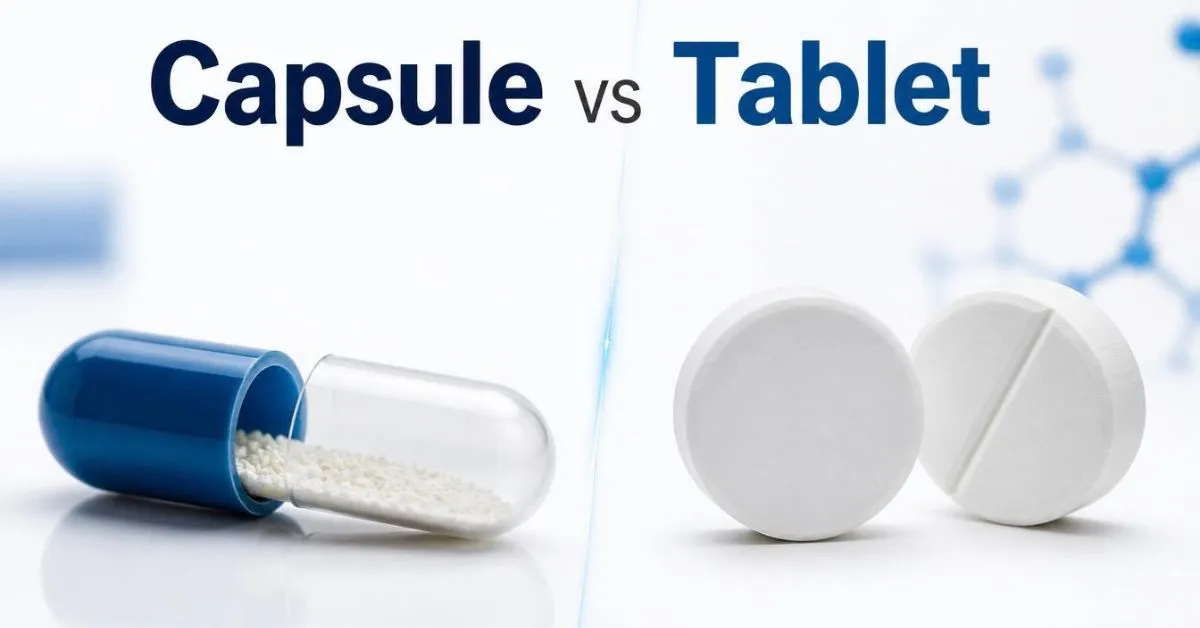
The main difference between a capsule and a tablet is how the medicine is made. A capsule holds medicine inside a shell, while a tablet is made by pressing ingredients into a solid shape.
Both can deliver medicine effectively, but they differ in design, available forms, and how they should be taken. Neither form is always better. The right choice depends on the specific medicine, its release design, your needs, and the instructions on the label.
Capsule vs Tablet: Key Differences
| Feature | Capsule | Tablet |
| How it is made | Medicine sits inside a shell | Ingredients are pressed into a solid form |
| Contents | Powder, granules, pellets, or liquid | Usually compressed powder and other ingredients |
| Taste | Often hides bitter tastes | Taste may be noticeable if uncoated or chewed |
| Swallowing | Smooth shell may feel easier for some people | Shape, size, and coating affect ease of swallowing |
| Absorption | Depends on the medicine and formulation | Depends on the medicine and formulation |
| Cost | May cost more for some products | Often less expensive, but prices vary |
| Splitting or opening | Opening is safe only for certain products | Some can be split; others must stay whole |
| Available forms | Hard-shell and softgel capsules, among others | Coated, chewable, dissolving, and extended-release tablets |
| Best choice | Depends on the drug and personal needs | Depends on the drug and personal needs |
The most important difference is not simply the shape. The formulation controls how the medicine is released and how you should take it. The FDA recognizes many types of tablets and capsules, including delayed-release and extended-release forms.
What Is a Capsule?
A capsule is a medicine or supplement enclosed in a shell. The shell is often made from gelatin or a plant-based material. Inside, it may contain powder, small granules, coated pellets, or liquid.
Capsules are designed to release their contents in a specific way. Some release medicine soon after swallowing, while others are made to delay or control its release.
Types of Capsules
Hard-shell capsules: These usually have two joined parts and contain powder, granules, or pellets.
Softgel capsules: These have a soft, sealed shell and often contain liquid or oil-based ingredients.
Modified-release capsules: These are designed to release medicine over time or under specific conditions. Some contain coated pellets that must not be chewed or crushed.
Benefits of Capsules
- Can hide unpleasant tastes: The shell keeps the contents from directly touching your tongue.
- Offer different formulations: Capsules can contain powders, liquids, or coated pellets.
- May be easier to swallow: Some people prefer their smooth surface.
- Can control medicine release: Certain capsules are designed for delayed or extended release.
Drawbacks of Capsules
- May cost more: The price depends on the medicine, brand, and formulation.
- May have dietary considerations: Some shells contain animal-derived gelatin. Plant-based options are also available.
- Can be affected by storage conditions: Heat and moisture may affect some capsule products.
- Cannot always be opened: Removing the shell may change how a medicine works or how much your body absorbs.
What Is a Tablet?
A tablet is a solid dose of medicine made by compressing active ingredients and other materials into a specific shape. Other ingredients help hold the tablet together, control its release, or improve its taste and stability.
Tablets may be round, oval, or oblong. Some have a coating, while others are designed to dissolve in the mouth, be chewed, or release medicine over time.
Types of Tablets
Standard tablets: These are swallowed and break down in the digestive tract.
Coated tablets: A coating may help mask taste, make swallowing easier, or serve a specific purpose.
Chewable tablets: These are made to be chewed before swallowing.
Orally disintegrating tablets: These break apart in the mouth. They are not the same as chewable tablets, and their instructions may differ.
Enteric-coated tablets: These have a coating designed to resist stomach conditions and release the medicine farther along the digestive tract.
Extended-release tablets: These release medicine over a longer period. They often have special instructions and should not be crushed unless the product information specifically allows it.
Benefits of Tablets
- May cost less: Many tablet products are economical to manufacture.
- Offer many dosage options: Tablets come in different sizes and release designs.
- Can provide controlled release: Some are made to release medicine over time.
- May allow dose splitting: Certain scored tablets can be split when their product instructions permit it.
- Include options for different needs: Chewable and orally disintegrating tablets may help people who struggle with standard pills.
Drawbacks of Tablets
- May be hard to swallow: Large or rough tablets can be uncomfortable for some people.
- May have an unpleasant taste: This can happen if a tablet is uncoated or is chewed when it should be swallowed whole.
- Cannot always be split or crushed: Doing so may change the dose or release pattern.
- May take up more space for some doses: The size depends on the drug and formulation, not just the dosage form.
Capsule vs Tablet: Which Absorbs Faster?
There is no universal winner. A capsule may release its contents faster than a particular tablet, but that does not mean all capsules work faster than all tablets.
The speed and amount of medicine absorbed depend on several factors:
- The active ingredient and its properties
- How the product is formulated
- Whether it is immediate-release, delayed-release, or extended-release
- How the medicine dissolves in digestive fluids
- Food, other medicines, and individual health factors
A capsule containing liquid is not automatically more effective than a tablet with the same active ingredient. Likewise, a tablet may be designed to release medicine quickly or over several hours.
What matters most: Compare the exact products, not just the words capsule and tablet. Follow the directions for your medicine, and ask a pharmacist if you are unsure whether two forms can be substituted.
Capsule vs Tablet: Which Is Easier to Swallow?
Neither form is easier for everyone. Some people find smooth capsules easier to swallow, while others prefer smaller tablets or tablets that dissolve in the mouth.
The pill’s size, shape, coating, and instructions can matter more than its form.
If you have trouble swallowing pills, ask a pharmacist whether your medicine is available as a liquid, chewable tablet, or orally disintegrating tablet. Do not assume that opening a capsule or crushing a tablet is safe.
If you also have trouble swallowing food or drinks, seek medical advice rather than trying pill-swallowing techniques on your own.
Capsule vs Tablet: Which Is Better for Your Stomach?
Neither form is automatically gentler on the stomach. Stomach discomfort depends on the active ingredient, dose, other ingredients, and how the medicine is formulated.
Some tablets have coatings that serve a specific purpose, while some capsules contain ingredients that may not suit everyone. A capsule shell does not guarantee that a medicine will prevent stomach upset.
If a medicine causes nausea, pain, or other side effects, do not switch forms or change the dose on your own. Ask your pharmacist or prescriber whether another formulation is suitable.
Capsule vs Tablet: Which Costs Less?
Tablets are often less expensive for some medicines, but this is not a rule. Prices vary by active ingredient, brand, generic availability, dose, insurance coverage, and pharmacy.
Capsules may cost more for certain products, while other capsule and tablet versions may have similar prices.
To compare costs fairly:
- Check that both products contain the same active ingredient.
- Compare the strength and dose.
- Check whether they have the same release type.
- Compare the price for the same number of doses.
- Ask your pharmacist whether a lower-cost equivalent is suitable.
Do not choose a different formulation based on price alone if it changes how the medicine should be taken.
Can You Open a Capsule or Crush a Tablet?
Only do so when the product instructions or a qualified healthcare professional confirms it is safe. Some capsules can be opened, and some tablets can be split or crushed. Others must remain intact.
Changing a medicine can affect its release, absorption, or safety.
For example:
- Extended-release medicines: Crushing some products can release too much medicine too quickly.
- Enteric-coated tablets: Crushing them may damage the coating and prevent the medicine from reaching the intended part of the digestive tract.
- Capsules containing coated pellets: Some may be opened, but the pellets must not be crushed or chewed.
- Certain capsule medicines: Removing the shell can change how much medicine the body absorbs.
These rules depend on the exact product. Even medicines with the same active ingredient may have different instructions. The NHS Specialist Pharmacy Service explains why each product must be checked before a tablet is crushed or a capsule is opened.
If you cannot swallow your medicine, ask a pharmacist about safe alternatives instead of changing it yourself.
Capsule vs Tablet: Which Should You Choose?
The best choice depends on the medicine and your needs. Use this guide as a starting point, not as a substitute for the product label or professional advice.
| Your need | What to consider |
| You prefer a smooth pill | Ask whether a capsule or smooth-coated tablet is available |
| You dislike bitter tastes | A capsule or coated tablet may help hide the taste |
| You want a lower price | Compare equivalent products and generic options |
| You have trouble swallowing | Ask about liquid, chewable, or orally disintegrating forms |
| You need a specific release pattern | Choose only a formulation approved for your treatment |
| You follow a vegetarian or vegan diet | Check the shell and inactive ingredients |
| You want to split a dose | Confirm that the exact tablet can be split and that your prescriber approves |
The right formulation is the one that delivers the intended dose safely and fits your treatment plan. If your prescribed medicine is working well, do not switch forms without checking first.
FAQs:
Are capsules better than tablets?
No. Capsules may hide unpleasant tastes and may be easier for some people to swallow. Tablets offer many forms and may cost less for some medicines. The best option depends on the specific product and the person’s needs.
Do capsules work faster than tablets?
Not always. Some capsules release their contents quickly, but absorption depends on the active ingredient and the formulation. A capsule is not automatically faster or more effective than a tablet.
Are tablets safer than capsules?
Neither form is always safer. Safety depends on the medicine, dose, release design, inactive ingredients, and how the product is taken. Follow the label and ask a pharmacist about concerns.
Can I take a capsule instead of a tablet with the same medicine?
Not without checking first. Products may differ in strength, release pattern, ingredients, and instructions. A pharmacist can confirm whether the specific products are interchangeable.
Can I open a capsule if I cannot swallow it?
Sometimes, but not always. Some capsules contain medicine that must remain inside the shell or pellets that must not be crushed. Check with a pharmacist before opening any capsule.
Can I split a tablet in half?
Only if the specific tablet is suitable for splitting and the instructions or your healthcare professional allow it. A score line alone does not mean every tablet can be split safely.
Are capsules always made from gelatin?
No. Some use gelatin, while others use plant-based materials. Check the product label if you have dietary restrictions or concerns about an ingredient.
Which is better for children?
It depends on the child’s age, ability to swallow, medicine, and prescribed dose. A liquid, chewable, or other child-appropriate formulation may be available. Ask a pediatrician or pharmacist before changing the form.
Conclusion:
When comparing capsule vs tablet, neither form is best for every person or every medicine. Capsules can help mask unpleasant tastes and come in different formulations. Tablets offer many options, including chewable, coated, and extended-release forms, and may be less expensive for some products.
The most important factors are the active ingredient, the dose, the release design, and how safely you can take the medicine. If you are choosing between two products, compare their labels and ask a pharmacist whether they are suitable alternatives. Never crush a tablet or open a capsule unless you have confirmed that it is safe for that exact medicine.
Health information note: This article is for general education and does not replace advice from a doctor or pharmacist.

Aiden Robert, an author at ReplyyGenius.com, where I share smart conversation tips, flirty replies, and practical communication ideas to help people reply with confidence.