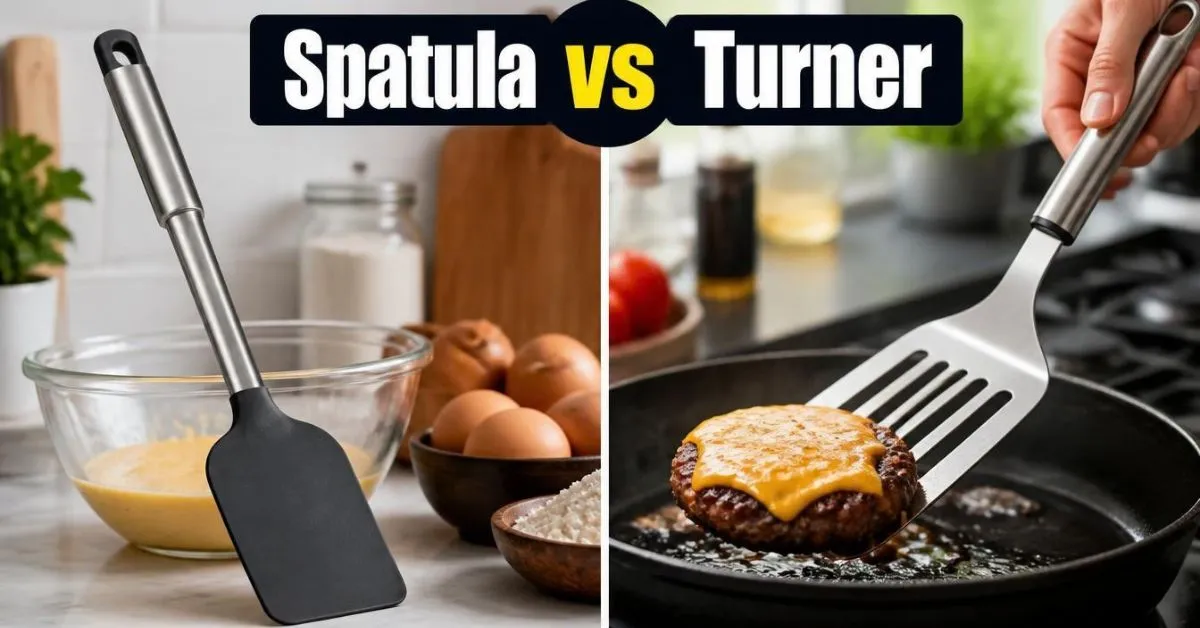
A spatula and a turner are closely related kitchen tools, but they are not always the same thing. Spatula is a broad term for flat utensils used for scraping, mixing, spreading, lifting, or flipping.
A turner is designed mainly to slide under food and turn, lift, or transfer it while cooking. In American English, however, turners are often called spatulas.
Key Takeaways
- Spatula is a broad name for several flat kitchen utensils.
- Turner is mainly designed to flip, lift, and transfer food.
- A turner can be considered a type of spatula in common American usage.
- Silicone spatulas are great for scraping, mixing, folding, and spreading.
- Turners work well for pancakes, eggs, burgers, fish, and other foods.
- A thin fish spatula is actually a specialized type of turner.
- For nonstick cookware, choose a utensil that the pan manufacturer says is safe.
Spatula vs Turner: Quick Comparison
| Feature | Spatula | Turner |
| Main purpose | Scrape, mix, fold, spread, lift | Flip, turn, lift, transfer |
| Common design | Flexible or flat head | Flat, thin, often angled head |
| Common materials | Silicone, rubber, plastic, metal | Stainless steel, nylon, silicone |
| Best for | Batter, sauces, frosting, mixing | Eggs, pancakes, burgers, fish |
| Blade flexibility | Often flexible | Can be flexible or rigid |
| Slotted versions | Less common for mixing spatulas | Very common |
| Baking | Excellent | Limited |
| Flipping food | Depends on design | Primary purpose |
The important distinction is function, not just the name. The words overlap, especially in American kitchens. HelloFresh and other cooking sources use “spatula” as a broad term that can include turners, while describing turners specifically as tools for flipping and transferring food.
What Is a Spatula?
A spatula is a flat kitchen utensil used for different tasks, depending on its design.
The classic silicone or rubber spatula has a flexible head. It can scrape food from a bowl, fold ingredients together, stir thick mixtures, or spread frosting.
For example, you might use a spatula to:
- Scrape brownie batter from a mixing bowl
- Fold whipped egg whites into a mixture
- Stir a thick sauce
- Remove peanut butter from a jar
- Spread frosting over a cake
- Scrape food from the sides of a pan
The word can also describe flat tools used for lifting and flipping food. This is one reason the term spatula vs turner becomes confusing.
In American English, many people simply call a turner a spatula. So when someone says, “Hand me the spatula,” they may mean the tool you use to flip a burger rather than the flexible silicone tool used for baking.
What Is a Turner?
A turner is a kitchen utensil designed mainly to turn, lift, and transfer food.
It usually has a flat blade that slides underneath food. Depending on the design, the blade may be thin and flexible or wider and more rigid.
A turner is commonly used for:
- Pancakes
- Fried eggs
- Omelets
- Burgers
- Fish
- Cookies
- Vegetables
- Grilled foods
The name gives away its main job: turning food.
A turner may also be called a flipper, especially when it is designed for flipping food on a griddle or frying pan. Some turners have slots or holes that allow oil and other liquids to drain as you lift the food.
What Is the Main Difference Between a Spatula and a Turner?
The simplest way to remember the difference is:
A spatula is a broad category, while a turner is a tool designed mainly for turning and lifting food.
A flexible silicone spatula is made to work around the inside of bowls and containers. Its soft edge can scrape the sides and bottom without leaving much behind.
A turner has a different priority. Its blade needs to get underneath food and support it while you flip or move it.
That means the two tools can look similar but behave differently.
Spatula: More About Scraping & Mixing
A traditional silicone spatula is especially useful when food sticks to the sides of a bowl.
Its flexible head can follow the shape of the container, which makes it useful for baking and food preparation.
Turner: More About Flipping & Lifting
A turner usually has a flatter working surface and an edge designed to slide under food.
That makes it more useful for foods that need to be lifted from a pan without breaking apart.
Why Are Spatulas & Turners Confused?
The confusion comes largely from overlapping terminology.
The word “spatula” can describe the shape of a tool, while “turner” describes what a particular tool does. Modern American kitchen language often uses spatula for both.
Current cooking references also point out that the same type of utensil may be marketed as a spatula, turner, flipper, or fish spatula depending on its design and intended use.
So you may see:
- Silicone spatula
- Rubber spatula
- Cooking spatula
- Turner
- Flipper
- Slotted turner
- Fish spatula
- Fish turner
These names can overlap.
The blade design and intended job are often more useful than the label on the package.
When Should You Use a Spatula?
Use a flexible spatula when you need to scrape, mix, fold, or spread.
For Baking
A silicone spatula is excellent for scraping cake or cookie batter from a bowl.
It can also help fold ingredients together without aggressively mixing them.
For Sauces
A heat-resistant silicone spatula can help stir and scrape sauces from the bottom and sides of a pan.
Always check the utensil’s heat rating before using it over high heat.
For Frosting
An icing or offset spatula is designed specifically for spreading frosting and other soft mixtures.
This is another example of why “spatula” does not always mean a flipping tool.
When Should You Use a Turner?
Use a turner when you need to slide underneath food and flip or lift it.
Pancakes
A wide turner can support most of a pancake as you flip it.
A thin edge also makes it easier to get underneath the pancake without tearing it.
Burgers
A sturdy turner can support a burger patty while you flip it or transfer it from a pan or griddle.
A stronger metal turner is especially useful for heavier foods and sturdy cookware.
Eggs and Omelets
For eggs, a thinner and more flexible turner can be easier to control.
It can slide underneath the egg without forcing you to scrape hard against the pan.
Fish
Fish is delicate, so a thin and flexible turner is often useful.
This is where the fish spatula becomes particularly helpful.
What Is a Fish Spatula?
A fish spatula is a specialized turner designed for delicate foods.
It normally has a thin, flexible blade with slots or openings. The narrow edge can slide underneath a fish fillet, while the slots allow oil or cooking liquid to drain.
Despite its name, you do not need to use it only for fish.
A fish spatula can also be useful for:
- Eggs
- Pancakes
- Cookies
- Omelets
- Delicate vegetables
- Other fragile foods
HelloFresh specifically describes the fish “spatula” as a type of fish turner and highlights its thin, slotted design for delicate foods.
Spatula vs Turner: Which Is Better for Nonstick Pans?
Neither word tells you whether a utensil is safe for nonstick cookware.
The material and design matter more than the name.
A metal turner may be useful on certain cookware, but it can scratch some nonstick surfaces. A silicone or cookware-safe nylon turner is often the safer choice when the pan manufacturer recommends avoiding metal utensils.
Before using a utensil on a nonstick pan, check the cookware manufacturer’s instructions.
The same rule applies to spatulas. A silicone spatula may be suitable for nonstick cookware, but a metal-edged spatula may not be.
Metal vs Silicone Spatula & Turner
Material can affect how well a tool works for a particular task.
Silicone
Silicone is flexible and useful for:
- Scraping bowls
- Folding mixtures
- Stirring
- Working with nonstick cookware when approved
- Some delicate cooking tasks
Stainless Steel
Stainless steel is firm and durable.
It can be useful for:
- Burgers
- Griddle cooking
- Sturdy foods
- Cast iron
- Foods that need a thin, firm edge
But metal is not automatically safe for every pan.
Nylon
Nylon turners can provide a balance between flexibility and firmness. They are commonly designed for cookware where metal utensils may be unsuitable.
Always follow the cookware manufacturer’s recommendations.
Slotted vs Solid Turner
Turners generally come in solid and slotted designs.
Solid Turner
A solid turner has a continuous blade.
It can be useful when you want strong support under food, such as burgers or larger pieces of food.
Slotted Turner
A slotted turner has openings in the blade.
The slots allow excess oil or liquid to drain as you lift the food.
Slotted designs are particularly common for fish and other foods cooked in oil or liquid.
Is a Turner the Same as a Spatula?
Sometimes, depending on how the words are being used.
Technically, a turner is a more specific term for a tool used to turn and lift food. Spatula is a broader term that can refer to several flat kitchen utensils.
But in everyday American English, many people use “spatula” to mean a turner.
So both of these can be heard in an American kitchen:
- “Use the spatula to flip the pancake.”
- “Use the turner to flip the pancake.”
Both can refer to the same physical tool.
Do You Need Both a Spatula & a Turner?
For many home cooks, having both is useful because they perform different tasks.
A flexible spatula is useful for:
- Mixing
- Scraping
- Folding
- Spreading
- Baking
A turner is useful for:
- Flipping
- Lifting
- Turning
- Transferring cooked food
If you bake often, a flexible silicone spatula is especially useful.
If you cook pancakes, eggs, burgers, or fish often, a turner may get more use.
FAQs:
Is a turner a type of spatula?
Yes, in common usage a turner can be considered a type of spatula. The term spatula is often used broadly for flat kitchen utensils, while turner specifically describes a tool designed to turn and lift food. In American English, the two terms are frequently used interchangeably.
Can you use a spatula instead of a turner?
It depends on the type of spatula. A cooking spatula with a flat, sturdy blade can often perform the same job as a turner. A soft silicone baking spatula, however, may not provide enough support for flipping burgers, pancakes, or larger pieces of food.
What is another name for a turner?
A turner may also be called a flipper, cooking spatula, or, in some contexts, a fish spatula. The exact name depends on the design and regional usage.
What is the best spatula for flipping food?
A turner-style spatula with a thin edge is generally useful for flipping food. For delicate foods such as fish and eggs, a thin flexible turner can provide better control. For burgers and heavier foods, a stronger and wider turner may be more suitable.
Why is a fish spatula called a spatula if it is a turner?
“Spatula” is commonly used as a broad name for flat kitchen tools in American English. A fish spatula is specifically designed for turning and lifting delicate foods, so it is functionally a specialized turner.
Is a metal turner safe for nonstick cookware?
Not always. Some nonstick cookware should not be used with metal utensils because they can damage the coating. Check the manufacturer’s instructions and use silicone or another approved material when metal is not recommended.
Conclusion:
The spatula vs turner difference is easier to understand when you focus on the job rather than the name.
A spatula is a broad term for flat kitchen utensils used for tasks such as scraping, mixing, folding, spreading, lifting, and sometimes flipping.
A turner is more specifically designed to slide under food and turn, lift, or transfer it.
In everyday American English, though, a turner is often called a spatula. That is why both terms can describe the same tool.
For baking and scraping bowls, reach for a flexible spatula. For pancakes, burgers, eggs, and fish, choose a turner designed for flipping and lifting.
In short: spatulas cover a wider range of jobs, while turners are built around one main job turning and lifting food.

Eric Walker, an author at replyygenius.com, where I create clear and helpful content for readers.
I focus on writing useful, engaging, and easy to understand articles that deliver real value.