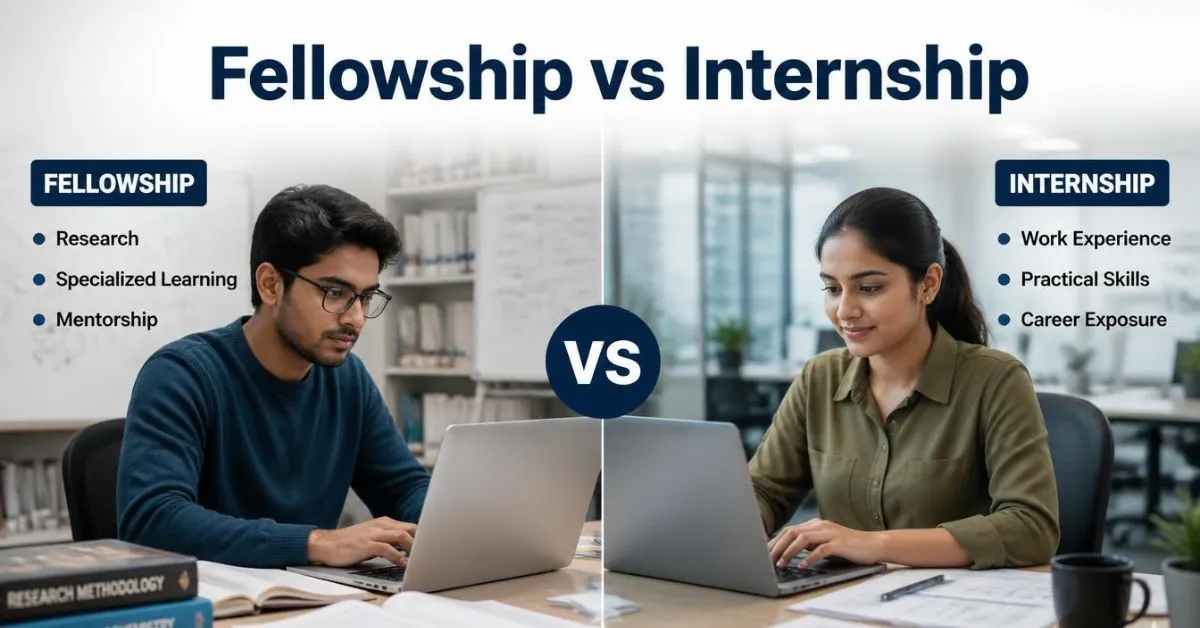
A fellowship usually supports research, specialized training, academic work, professional development, or a defined project, while an internship usually provides practical experience in a professional setting.
However, the two can overlap. Eligibility, pay, duration, responsibilities, and employment status depend on the specific program, so the official listing matters more than the title.
Key Takeaways
- An internship usually focuses on practical workplace experience and career exploration.
- A fellowship often focuses on research, specialized training, professional development, academic work, or a defined project.
- Fellowships are not only for graduate students.
- Fellowships may provide a stipend or other funding, while internships may be paid, unpaid, or offer academic credit depending on the program.
- Neither option is automatically better.
- The best choice depends on your career goals, field, experience level, and the specific program.
What Is a Fellowship?
A fellowship is a structured opportunity that may provide funding, research experience, professional training, academic support, or development around a particular field or project.
Fellowships are offered by universities, government agencies, nonprofits, foundations, research organizations, and other institutions. They can serve students, recent graduates, researchers, and professionals.
The exact meaning of fellowship varies by field. Some programs focus heavily on academic research, while others emphasize leadership, public service, professional development, or specialized training.
For example, Santa Clara University defines fellowships as funded opportunities that can support professional, academic, or personal development and may last from weeks to years.
Common Types of Fellowships
You may encounter:
- Research fellowships
- Graduate fellowships
- Postdoctoral fellowships
- Public service fellowships
- Leadership fellowships
- Professional development fellowships
- International fellowships
- Industry fellowships
Some fellowships provide a stipend, grant, tuition support, or other financial resources. Others may provide training, mentorship, research support, or access to professional networks.
What Is an Internship?
An internship is a temporary experiential learning opportunity that gives someone practical exposure to a professional field or workplace.
Interns typically work on real tasks or projects under the guidance of a supervisor, manager, faculty member, or mentor.
For example, a marketing intern might research audiences, assist with social media campaigns, prepare reports, or support a marketing team. A software engineering intern might help with coding, testing, documentation, or development projects.
Internships are common among students, although eligibility varies by organization. The federal government, for example, defines internships as experiential learning opportunities for people enrolled in qualifying educational programs.
Common Types of Internships
Examples include:
- Summer internships
- College internships
- Research internships
- Corporate internships
- Government internships
- Nonprofit internships
- Medical internships
- Engineering internships
- Remote internships
- Part-time internships
An internship may be full-time or part-time and may be paid, unpaid, or connected to academic credit depending on the program and applicable rules.
Fellowship vs Internship: What’s the Difference?
The simplest distinction is:
Internship = practical professional experience.
Fellowship = specialized research, training, development, study, or project support.
That distinction is useful, but it is not a strict rule.
Some internships involve advanced research, while some fellowships place participants inside professional organizations and include hands-on work. Current fellowship and internship programs show that the terms can overlap significantly.
Fellowship vs Internship at a Glance
| Feature | Fellowship | Internship |
|---|---|---|
| Main purpose | Research, training, study, development, or a defined project | Practical workplace and career experience |
| Typical setting | Academic, research, nonprofit, government, or professional | Company, organization, government, nonprofit, or institution |
| Eligibility | Varies widely by program | Often students or early-career participants |
| Pay | May include stipend, grant, or other funding | May be paid, unpaid, or credit-based |
| Work style | Can be research- or project-focused | Often task- and team-focused |
| Independence | May involve independent work | Often involves supervision and team support |
| Duration | Varies from short-term programs to multi-year opportunities | Often short-term, but varies |
| Application | May require proposal, statement, or academic materials | Often resembles a job application |
| Main outcome | Specialized development, research, training, or project experience | Practical professional experience |
These are general patterns, not universal rules. The specific program determines the actual terms.
1. Purpose
The main goal of an internship is usually to help you gain practical experience.
You may learn how a workplace operates, develop professional skills, contribute to team projects, and explore whether a particular career is right for you.
A fellowship often has a more specialized purpose.
It may support:
- Research
- Academic study
- Professional development
- Leadership
- Public service
- Specialized training
- A specific project
The University of Alaska Fairbanks similarly distinguishes fellowships as generally emphasizing professional development or academic research, while internships are more closely associated with gaining professional experience.
2. Type of Work
Interns commonly work within an existing organization and contribute to ongoing projects.
Their responsibilities may include:
- Researching information
- Preparing documents
- Analyzing data
- Supporting team projects
- Attending meetings
- Helping customers or clients
- Supporting daily operations
Fellows may work on a more specialized assignment or defined project.
Depending on the program, they might:
- Conduct research
- Develop a project
- Write reports or publications
- Study a specific issue
- Create a community initiative
- Complete specialized training
- Work toward a professional or academic goal
However, work structure varies. A fellowship can be highly structured, and an internship can give participants substantial responsibility.
3. Eligibility
Eligibility is one of the biggest areas of confusion.
It is not accurate to say that all fellowships are for graduate students.
Some fellowships are available to undergraduates. Others require a bachelor’s, master’s, doctoral degree, professional experience, or another qualification.
Internships also cover a wide range of education levels.
Some are designed for high school students, college students, graduate students, or recent graduates. Federal programs, for example, distinguish opportunities by education level and career stage.
Always check the individual program’s eligibility requirements.
4. Pay & Funding
Compensation is another major difference, but there is no universal rule.
Many fellowships provide financial support through a stipend, grant, scholarship, tuition support, or similar funding. Some fellowship programs are funded specifically to allow participants to focus on research, study, or professional development.
Internships may provide:
- Hourly wages
- A salary
- A stipend
- Academic credit
- No direct compensation
The important point is this:
Do not assume a fellowship is automatically paid or an internship is automatically unpaid.
Read the official program details carefully.
5. Duration
There is no universal duration for either opportunity.
An internship may last for:
- A summer
- A semester
- Several months
- A year or longer
Fellowships can also vary substantially. Some are short-term, while others last a year or more. Santa Clara University notes that fellowship opportunities can range from weeks to years.
So duration alone cannot tell you whether an opportunity is a fellowship or an internship.
6. Application Process
Internship applications often resemble entry-level job applications.
You may need:
- A resume
- Cover letter
- Application form
- References
- School information
- Interview responses
Fellowship applications can require additional materials related to the proposed work.
Depending on the program, you may need:
- Research proposal
- Project plan
- Personal statement
- Academic records
- Letters of recommendation
- Writing samples
- Career goals
Some fellowship programs specifically ask applicants to describe the research or project they plan to complete.
7. Level of Independence
This is an area where people often oversimplify the difference.
Internships frequently place participants within an existing team, where a supervisor provides assignments, feedback, and guidance.
Some fellowships, particularly research or project-based programs, may allow participants to work more independently.
But independence is not a defining rule.
A fellowship can have close supervision, and an internship can give an intern considerable responsibility.
The actual program structure matters more than the label.
Fellowship vs Internship: Which One Should You Choose?
Neither is automatically better.
The right choice depends on what you want to gain from the experience.
An Internship May Be Better for You If…
An internship may be a good fit if you want to:
- Explore a career
- Gain workplace experience
- Apply classroom knowledge
- Build practical skills
- Work with professionals
- Learn how an organization operates
- Strengthen your resume
- Explore a potential employer
For example, a college student interested in marketing might choose an internship to gain hands-on experience before graduation.
A Fellowship May Be Better for You If…
A fellowship may be a better fit if you want to:
- Conduct focused research
- Develop specialized knowledge
- Complete a defined project
- Receive funding for academic work
- Develop leadership skills
- Pursue specialized professional development
- Work on a public-service initiative
- Build expertise in a particular field
For example, someone pursuing research in a specialized field may prefer a fellowship that provides funding and dedicated time for that work.
Can You Do an Internship and a Fellowship?
Yes.
You do not necessarily have to choose one or the other for your entire career.
Someone might complete an internship during college and later pursue a fellowship for research, leadership, or advanced professional development.
The two experiences can complement each other.
An internship can give you practical workplace experience, while a fellowship can help you develop deeper expertise in a particular field or project.
In fact, organizations such as the CDC currently offer both internship and fellowship opportunities across different education and career stages.
How to Compare a Fellowship & Internship Listing
If you are choosing between two opportunities, do not make your decision based only on the title.
Compare these seven things:
- Who can apply? Check education and experience requirements.
- What will you actually do? Read the responsibilities carefully.
- How are you compensated? Look for salary, wages, stipend, grant, or other support.
- How long is it? Check the exact start and end dates.
- Who supervises you? Identify the manager, mentor, faculty member, or project leader.
- What will you produce? Look for a research project, report, publication, presentation, or other deliverable.
- What will you learn? Make sure the opportunity supports your career goal.
This is more reliable than assuming that every fellowship or internship follows the same model.
FAQs:
Is a fellowship better than an internship?
Neither is universally better. An internship may be better if your main goal is practical workplace experience, career exploration, and professional skills. A fellowship may be better if you want research, specialized training, academic development, leadership experience, or support for a defined project. Compare the actual program before deciding.
Do fellowships pay?
Many fellowships provide financial support through stipends, grants, scholarships, or other funding, but not every fellowship has the same arrangement. The official program description should explain what financial support is offered and whether it is a stipend, grant, salary, or another form of funding.
Are fellowships only for graduate students?
No. Some fellowships accept undergraduate students, while others are designed for graduate students, doctoral candidates, recent graduates, or experienced professionals. Eligibility varies by program. Current federal and public-health fellowship opportunities demonstrate that fellowships can span multiple education and career stages.
Is an internship a fellowship?
Not usually. An internship generally focuses on practical experiential learning in a professional setting, while a fellowship often supports research, specialized development, training, academic work, or a defined project. However, organizations do not always use these terms in exactly the same way.
Do fellowships count as work experience?
A fellowship can provide valuable professional, research, academic, or project experience. Whether it counts as formal employment depends on the specific program and its legal or administrative structure. Do not automatically describe a fellowship as employment unless the program’s terms support that description.
Can undergraduate students get fellowships?
Yes. Some fellowships specifically accept undergraduate students. Others require graduate-level study, a particular degree, or professional experience. Always review the eligibility requirements for the individual fellowship.
Can an internship lead to a full-time job?
It can. Some internships are designed to help students or recent graduates gain experience that can lead to future employment, although an internship does not guarantee a job offer. For example, some federal internship pathways can provide routes toward permanent employment when program requirements are met.
Conclusion:
The main difference in fellowship vs internship is usually the purpose of the experience.
An internship generally emphasizes practical professional experience, workplace learning, and career exploration. A fellowship often emphasizes research, specialized training, professional development, academic work, funding, or a defined project.
But there is no universal rule for every program.
The smartest way to compare opportunities is to look at eligibility, responsibilities, compensation, duration, supervision, deliverables, and learning goals.
Don’t choose based on the title alone. Choose the opportunity that best matches what you want to learn, accomplish, and build toward next.

Emily Carter is a dedicated author at ReplyGenius.com, creating helpful, natural, and engaging content focused on replies, messages, and everyday conversations.