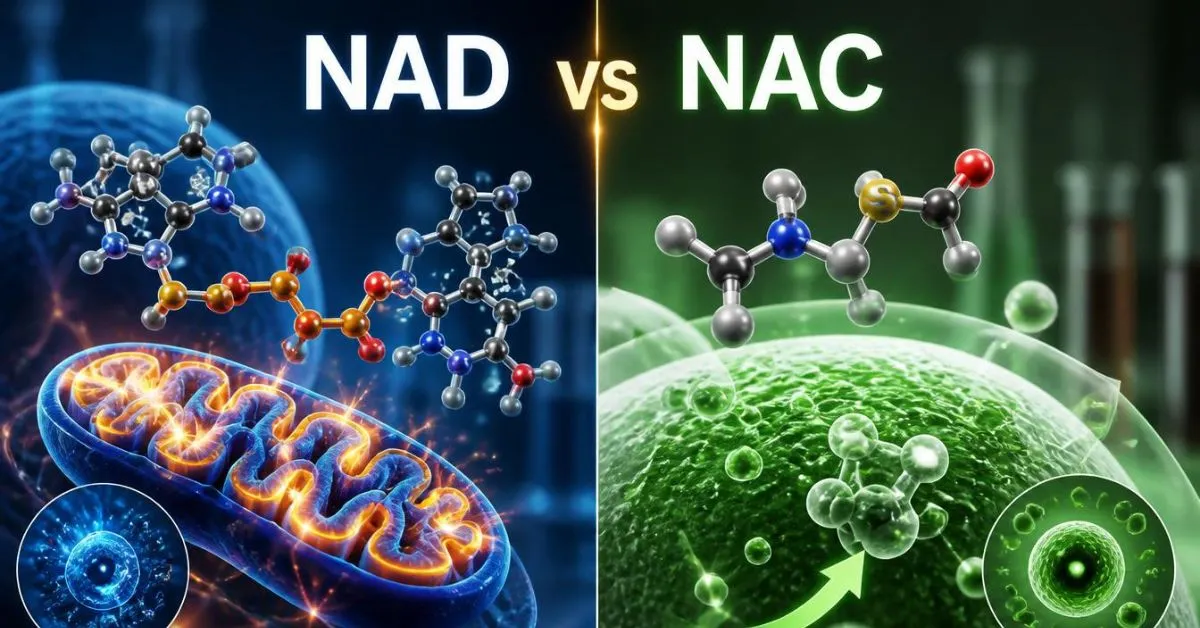
NAD and NAC are different compounds with different biological roles. NAD, or nicotinamide adenine dinucleotide, helps cells with metabolism, redox reactions, and signaling.
NAC, or N-acetylcysteine, provides a source of cysteine that supports glutathione production and has established medical uses. They are not interchangeable.
Key Takeaways
- NAD is a coenzyme that helps cells with metabolism and redox reactions.
- NAC is a cysteine derivative that helps support glutathione synthesis.
- NAC is not a precursor to NAD.
- NR and NMN help the body make NAD, but they are not forms of NAC.
- NAD and NAC are not competing versions of the same supplement.
- Current evidence does not establish one as universally better than the other.
NAD vs NAC at a Glance
The easiest way to understand NAD vs NAC is to look at the biological pathway each one belongs to.
NAD mainly helps cells with metabolism and redox processes.
NAC mainly supports cysteine availability and glutathione biology.
| Feature | NAD | NAC |
|---|---|---|
| Full name | Nicotinamide adenine dinucleotide | N-acetylcysteine |
| What it is | Coenzyme | Cysteine derivative |
| Main biological role | Cellular metabolism and redox reactions | Cysteine and glutathione biology |
| Related forms | NAD+, NADH | Cysteine, glutathione |
| Common research areas | Metabolism, aging, redox biology | Glutathione, mucus, oxidative stress |
| NAD precursor? | NAD is the target molecule | No |
| Related precursors | NR, NMN, nicotinamide, niacin | Not an NAD precursor |
| Established medical context | NAD-related interventions remain an active research area | Acetaminophen poisoning and mucolytic use |
The names may look similar, but NAD and NAC are chemically and biologically different.
What Is NAD?
NAD stands for nicotinamide adenine dinucleotide.
It is a coenzyme found throughout the body’s cells. NAD exists in different forms, including NAD+ and NADH, and plays an important role in oxidation-reduction reactions.
These reactions help cells process nutrients and carry out normal metabolic functions.
NAD also helps cells with signaling and other biological processes. This role has made NAD an important research topic in metabolism, mitochondrial biology, aging, and cellular stress.
What Does NAD+ Do?
NAD+ is the oxidized form of NAD.
One of its major functions is accepting electrons during metabolic reactions. NAD+ can accept electrons and become NADH. Cells can then convert NADH back to NAD+ as part of normal redox processes.
NAD+ also serves as a substrate for certain enzymes involved in cellular signaling and other processes.
That is why describing NAD simply as an “energy supplement” can be misleading. Its biological role is much broader.
NAD vs NAD+ vs NADH
These terms are related but not identical:
- NAD refers to the coenzyme.
- NAD+ is its oxidized form.
- NADH is its reduced form.
This distinction matters because many discussions about supplements specifically focus on NAD+, rather than NAD as a general term.
It is also important to separate NAD from its precursors.
NR and NMN are NAD-related precursors. They are not the same molecule as NAD+.
Research into these compounds has examined whether raising NAD-related biomarkers translates into meaningful health outcomes.
Current human evidence is still developing, and recent reviews have found that biological effects do not automatically translate into broad clinical benefits.
What Is NAC?
NAC stands for N-acetylcysteine.
It is a derivative of the amino acid L-cysteine.
One reason NAC is important biologically is its relationship with cysteine, which is needed to produce glutathione, one of the body’s major antioxidant molecules.
NAC also has established medical uses that are quite different from the wellness claims often associated with supplements.
What Does NAC Do?
NAC can contribute to cysteine availability, which is one reason it is studied in relation to glutathione production and oxidative stress.
It also has mucolytic properties, meaning it can help reduce the viscosity of thick mucus.
Most importantly, acetylcysteine has an established medical role in the treatment of acetaminophen overdose. FDA labeling identifies intravenous acetylcysteine as an antidote used to prevent or reduce liver injury after potentially toxic acetaminophen ingestion.
That medical use should not be confused with taking NAC as a general wellness supplement.
NAC and Glutathione
The basic relationship can be simplified as:
NAC → cysteine availability → glutathione synthesis
Glutathione is made from three amino acids:
- Cysteine
- Glutamate
- Glycine
Because cysteine availability can influence glutathione synthesis, NAC has been widely studied in this area.
However, saying that NAC simply “boosts antioxidants” oversimplifies its biology. Effects depend on factors such as the dose, route, biological setting, and reason for use.
NAD vs NAC: Key Differences
The biggest difference is the biological pathway each compound belongs to.
NAD is central to cellular redox reactions and metabolism.
NAC is closely connected with cysteine availability and glutathione synthesis.
So, NAD and NAC are not direct substitutes.
1. Biological Role
NAD functions as a coenzyme involved in metabolic and redox reactions.
NAC is a cysteine derivative that can contribute to cysteine availability and glutathione-related biology.
2. Chemical Relationship
NAD is related to compounds such as:
- NAD+
- NADH
- Nicotinamide
- Nicotinic acid
- NR
- NMN
NAC is related to:
- L-cysteine
- Glutathione
This is one of the clearest ways to see that the two compounds belong to different biochemical systems.
3. Medical Uses
NAC has established medical applications, particularly as an antidote for acetaminophen poisoning and as a mucolytic.
NAD itself is primarily being investigated in areas involving metabolism, aging, cellular function, and related biological processes. Current evidence for NAD-boosting interventions remains an active research area rather than proof of broad anti-aging or wellness benefits.
4. Supplement Context
NAD and NAC are both discussed as supplements, but they should not be viewed as two versions of the same product.
If someone is researching NAD supplementation, they will often encounter NR and NMN.
If someone is researching NAC, the relevant biological pathway is more closely connected to cysteine and glutathione.
5. Evidence
This is an important distinction.
NAC has specific established clinical uses supported by medical evidence.
NAD-related supplementation is more complicated. Recent systematic reviews indicate that oral NR and NMN can increase NAD-related biomarkers, but effects on broader outcomes such as metabolic, vascular, functional, or healthspan measures have been inconsistent.
So an increase in a biological marker should not automatically be interpreted as proof of a meaningful health benefit.
NAD vs NAC Comparison Table
| Category | NAD | NAC |
|---|---|---|
| Full name | Nicotinamide adenine dinucleotide | N-acetylcysteine |
| Main role | Coenzyme in cellular metabolism and redox reactions | Cysteine derivative |
| Main pathway | NAD metabolism | Cysteine/glutathione pathway |
| Related forms | NAD+, NADH | Cysteine, glutathione |
| Common research | Metabolism, aging, redox biology | Glutathione, mucus, oxidative stress |
| NAD precursor? | NAD is the target molecule | No |
| Related precursors | NR, NMN, nicotinamide, niacin | Not applicable |
| Established medical use | Different evidence base from NAC | Acetaminophen poisoning and mucolytic use |
| Interchangeable? | No | No |
If you remember only one thing:
NAD and NAC are not different forms of the same compound.
Is NAC a Precursor to NAD?
No. NAC is not a precursor to NAD.
This is one of the most important points in the entire comparison.
NAD can be produced through several biosynthetic pathways involving vitamin B3-related compounds and other precursors.
NAC belongs to the cysteine and glutathione pathway.
For NAD-related supplementation, commonly discussed precursors include NR and NMN. Current research continues to investigate how effectively these compounds increase NAD-related biomarkers and whether those changes produce meaningful clinical outcomes.
The basic distinction is:
NAD pathway:
NR / NMN / other precursors → NAD+
Glutathione pathway:
NAC → cysteine availability → glutathione
These pathways should not be confused.
Can You Take NAD & NAC Together?
There is no simple rule that NAD and NAC must always be combined or avoided together.
They are different compounds that participate in different biological pathways.
However, different pathways do not automatically mean that combining them provides an extra health benefit.
If you are considering a combination supplement or taking individual products, the relevant factors include the exact ingredients, doses, medications, health conditions, and intended use.
If you take prescription medicines or are considering supplements for a medical condition, discuss the specific products with a qualified healthcare professional.
NAD vs NAC: Which One Is Better?
There is no good basis for saying that NAD is universally better than NAC, or that NAC is universally better than NAD.
They are used and studied for different purposes.
| If your main interest is… | Relevant compound or pathway |
|---|---|
| NAD+ metabolism | NAD+, NR, NMN |
| Cellular redox reactions | NAD+/NADH |
| Cysteine availability | NAC |
| Glutathione synthesis | NAC and cysteine |
| Thick respiratory mucus | NAC’s mucolytic action |
| Acetaminophen poisoning | Medical acetylcysteine treatment |
This is a much more useful way to approach the comparison than asking which compound is simply “stronger.”
What About NAD Supplements for Anti-Aging?
This deserves special attention because NAD is frequently marketed in the context of longevity.
NAD biology is genuinely important, and researchers are studying NAD metabolism in aging and other areas of human health.
But the distinction between biological mechanism and proven clinical benefit is important.
A 2026 systematic review of 113 preclinical and human intervention studies found that oral NR and NMN generally increased NAD-related biomarkers and remained well tolerated over several weeks to months. However, effects on broader health, metabolic, vascular, and functional outcomes were inconsistent or sometimes absent. The review concluded that clinical effectiveness for anti-aging and wellness outcomes remains inconclusive.
Therefore, current evidence does not yet prove that NAD supplements can slow aging or broadly improve health.
FAQs:
Is NAC the Same as NAD?
No. NAC is N-acetylcysteine, while NAD is nicotinamide adenine dinucleotide. NAC is closely associated with cysteine and glutathione biology, while NAD is a coenzyme involved in cellular metabolism and redox reactions.
Is NAD the Same as NAD+?
Not exactly. NAD is the name of the coenzyme, while NAD+ is its oxidized form and NADH is its reduced form. NAD+ plays an important role in cellular redox reactions and also serves as a substrate for certain enzymes.
Is NAC a NAD Precursor?
No. NAC is not considered a precursor to NAD. NAC is associated with cysteine and glutathione metabolism. NAD-related precursors include compounds such as nicotinamide, nicotinic acid, NR, and NMN.
Are NMN and NR the Same as NAD?
No. NMN and NR are NAD-related precursors, not the same molecule as NAD+. They are studied because they can contribute to pathways involved in NAD+ production.
Which Is Better, NAD or NAC?
Neither is universally better. They have different biological roles. NAD helps cells with metabolism and redox processes, while NAC supports cysteine and glutathione pathways and has established medical uses. The appropriate choice depends on the specific purpose and the evidence for that use.
Does NAC Increase NAD?
NAC should not be treated as an NAD precursor. Its primary biochemical relationship is with cysteine and glutathione metabolism, not NAD biosynthesis.
Is NAD Proven to Be Anti-Aging?
Not conclusively. NAD biology is an active research area, and NAD-related compounds can affect NAD biomarkers. However, current human evidence has not established broad anti-aging benefits from NAD supplementation. Recent reviews describe the clinical evidence as limited or inconclusive.
What Is NAC Used For Medically?
Doctors use acetylcysteine for several medical purposes, including treating acetaminophen poisoning and loosening thick mucus. If you suspect an acetaminophen overdose, seek medical care right away instead of relying on an over-the-counter NAC supplement.
Conclusion:
NAD vs NAC is not really a competition between two versions of the same supplement.
NAD is a coenzyme that helps cells with metabolism, redox reactions, and other key processes. NAC is a cysteine derivative that supports cysteine availability and glutathione biology. It also has established medical uses.
If you are researching NAD, you will likely encounter NAD+, NADH, NR, and NMN. These terms are related but are not interchangeable.
If you are researching NAC, focus on its cysteine, glutathione, mucolytic, and established clinical uses.
The simplest answer is:
NAD is primarily associated with NAD metabolism and cellular redox biology; NAC is primarily associated with cysteine and glutathione biology.

Aiden Robert, an author at ReplyyGenius.com, where I share smart conversation tips, flirty replies, and practical communication ideas to help people reply with confidence.