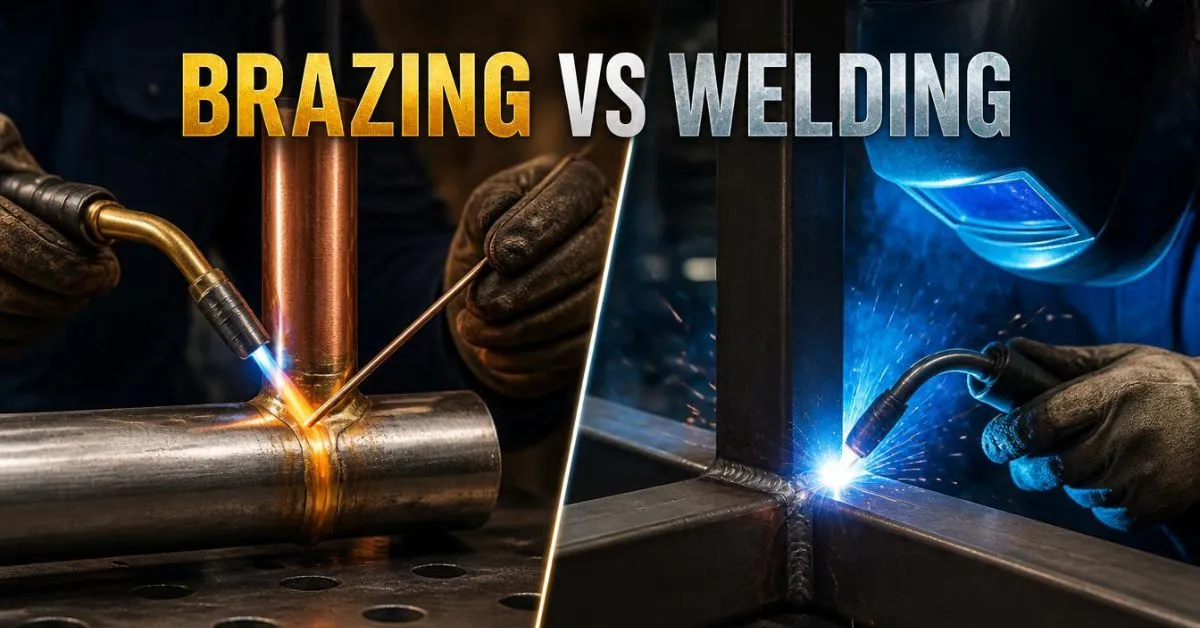
Brazing and welding join metal in different ways. Brazing melts a filler metal while the base metals usually stay solid. Fusion welding melts the base metal at the joint. Brazing is often useful for thin parts and different metals. Welding is often used for structural and heavy-load joints.
Key Takeaways
- Brazing melts the filler metal.
- Fusion welding melts the base metal.
- Brazing can work well for thin parts and different metals.
- Welding is common for structural and heavy-load jobs.
- A good brazed joint can still be very strong.
- Brazing and welding do not always cost the same.
- The best choice depends on the metal, joint, load, heat, and use.
Brazing vs Welding: What’s the Difference?
The main question is simple:
What melts?
With brazing, the filler metal melts. The base metals usually do not.
With fusion welding, the base metal melts at the joint. Filler metal may also be used.
For brazing, the filler metal has a liquidus temperature above 840°F (450°C) and below the solidus of the base metals.
So, the simple difference is:
Brazing uses molten filler metal to join parts. Welding uses fusion, which usually melts the base metal.
This difference affects heat, joint design, strength, and the type of metal you can join.
What Is Brazing?
Brazing is a way to join metal parts with a filler metal.
The parts are heated until the filler metal melts. The liquid filler wets the metal surfaces and flows into the joint.
The base metals normally do not melt.
Brazing is used in many fields, including:
- HVAC
- Refrigeration
- Automotive
- Aerospace
- Manufacturing
- Medical equipment
- Construction
- Oil and gas
How Does Brazing Work?
A good brazed joint needs:
- Clean metal surfaces
- The right joint gap
- The right filler metal
- Proper heat
- Good wetting
- Good filler flow
- Proper cooling
Capillary action is also important in many brazed joints.
The liquid filler flows into the small space between the parts.
So, brazing is not just about heating metal and adding filler. The joint needs the right design and gap.
What Is Welding?
Welding is a group of methods used to join parts.
These methods can use heat, pressure, or both.
In fusion welding, the base metal melts at the joint. Filler metal may or may not be added.
Common welding types include:
- MIG
- TIG
- Stick
- Flux-cored arc
- Resistance welding
- Laser welding
- Electron-beam welding
Welding is common in:
- Construction
- Structural steel
- Machinery
- Transportation
- Manufacturing
- Pipelines
- Repairs
How Does Welding Work?
A welding process adds enough energy to melt metal at the joint.
The melted metal then cools and becomes solid.
This heat can create a heat-affected zone (HAZ). It can also cause distortion.
The amount of heat and distortion depends on the:
- Metal
- Thickness
- Welding method
- Heat input
- Joint design
- Welding technique
This is not always a problem. For many structural jobs, melting and joining the base metal is exactly what is needed.
Brazing vs Welding: Quick Comparison
| Factor | Brazing | Welding |
|---|---|---|
| What melts? | Filler metal | Base metal in fusion welding |
| Base metal melts? | Usually no | Yes in fusion welding |
| Filler metal | Usually needed | May or may not be needed |
| Heat to base metal | Usually lower | Usually higher |
| Distortion | Often lower | Can be higher |
| Different metals | Often useful | Can be harder |
| Joint gap | Very important | Usually less important |
| Structural jobs | Depends on the job | Very common |
| Thin parts | Often useful | Also possible |
| Heavy loads | Usually not the first choice | Common choice |
| Appearance | Often clean | Weld bead may show |
| Automation | Possible | Possible |
| Service temperature | Limited by filler and design | Depends on metal and process |
The key point is simple:
Brazing and welding are made for different types of jobs.
Brazing is not just weak welding. Welding is also not always the better choice.
Is Brazing Stronger Than Welding?
Not always.
Welding is often used when a joint must handle heavy loads. But that does not mean every weld is stronger than every brazed joint.
Joint strength depends on:
- Base metal
- Filler metal
- Joint shape
- Joint size
- Load direction
- Service temperature
- Joint gap
- Surface prep
- Process quality
A well-designed brazed joint can be very strong.
For many heavy structural jobs, welding is usually the better choice because the base metals are fused together. TWI also notes that welding generally produces stronger joints than brazing, while brazing can offer other benefits.
For some HVAC, manufacturing, mechanical, and different-metal joints, brazing may work very well.
So do not ask only:
Which one is stronger?
Ask:
Which one is strong enough for this job?
Brazing vs Welding: Heat & Distortion
Brazing normally does not melt the base metals.
This can help reduce heat-related distortion compared with welding. Brazing also uses lower power input and can produce less thermal distortion and residual stress in many cases.
But brazing is not a cold process.
The whole part can still get very hot.
The result depends on:
- Heating method
- Metal type
- Joint shape
- Filler metal
- Process control
Welding can also be done with good heat control. Welding distortion depends on the process, joint shape, heat input, and technique.
So the simple rule is:
Brazing often creates less distortion, but both processes need good heat control.
Brazing vs Welding for Different Metals
Brazing can be useful for joining different metals.
The base metals usually do not need to melt together. The filler metal creates the joint.
This can help avoid some problems that may occur when different metals are fusion welded.
Brazing is known for its ability to join many compatible dissimilar materials.
But brazing does not work with every metal combination.
You should check:
- Filler compatibility
- Joint gap
- Surface condition
- Service temperature
- Corrosion risk
- Joint design
Brazing vs Welding for Thin Metal
Brazing can be a good choice for thin or delicate parts.
It can help when melting the base metal may cause damage or too much distortion.
But welding can also work well on thin metal.
The right welding process and good heat control can make a big difference.
So remember:
Thin metal may favor brazing, but thickness alone should not decide the process.
Brazing vs Welding: Which Should You Choose?
Here is a simple guide:
| If you need to… | Usually consider |
|---|---|
| Build a steel frame | Welding |
| Join HVAC copper tubing | Brazing |
| Join refrigeration tubing | Brazing |
| Join compatible different metals | Often brazing |
| Reduce distortion | Often brazing |
| Make a heavy structural joint | Welding |
| Join thick steel parts | Welding |
| Protect a thin part from melting | Brazing |
| Make many factory joints | Either |
| Melt and fuse base metals | Welding |
| Keep base metals from melting | Brazing |
This is a simple guide. Engineering rules, codes, and approved joining procedures may also apply.
Brazing vs Welding for Different Jobs
HVAC & Refrigeration
Brazing is often the preferred choice.
Copper tubing and fittings are common brazing jobs. Brazing is widely used in HVAC and refrigeration.
Structural Steel
Welding is usually preferred.
Structural steel joints often need strong and reliable connections. Welding is widely used for this type of work.
Automotive
Both methods can be useful.
Brazing can work well for some heat exchangers, thin parts, and different-metal joints.
Welding is common when the joint must carry a load.
Manufacturing
Either method may work.
The best choice depends on:
- Metal type
- Joint design
- Production volume
- Automation
- Strength needs
- Service conditions
- Cost
Is Brazing Cheaper Than Welding?
Not always.
The total cost can include:
- Equipment
- Filler metal
- Flux
- Shielding gas
- Labor
- Surface prep
- Fixtures
- Automation
- Inspection
- Finishing
- Production volume
- Rework
Brazing can be cost-effective for high-volume work with many similar joints.
Welding can also be cost-effective, especially when the job needs structural fusion and automation.
So do not ask only:
Which is cheaper?
Ask:
Which method gives the needed joint at the lowest total cost?
That is the better way to compare the two.
Advantages & Disadvantages of Brazing
Pros
- Base metals usually do not melt
- Often causes less distortion
- Can join many compatible different metals
- Can make clean-looking joints
- Good for some thin parts
- Can work well in factory production
- Used in many industries
Cons
- Joint gap is important
- Clean surfaces are needed
- Filler choice is important
- High service heat can limit some fillers
- Some jobs need flux or special gases
- Not usually the first choice for heavy structural joints
Advantages & Disadvantages of Welding
Pros
- Good for many structural jobs
- Fuses base metals directly
- Works with many joint types
- Good for thick parts
- Many welding methods are available
- Can make strong joints
Cons
- Creates more local heat
- Can cause distortion
- Creates a heat-affected zone
- Different metals can be harder to weld
- Some metals need special procedures
- Good skill and process control may be needed
FAQs:
Does Brazing Melt the Base Metal?
Normally, no. The filler metal melts while the base metals stay below their solidus temperature. The liquid filler then wets and flows into the joint.
Is Brazing Stronger Than Welding?
Usually, no. Welding is often used for heavy structural jobs. But a well-designed brazed joint can also be very strong. The right choice depends on the job.
Can Brazing Join Different Metals?
Yes. Brazing can work well for many compatible different-metal joints. The filler and service conditions still need to be checked.
Is Brazing Cheaper Than Welding?
Not always. Cost depends on labor, tools, materials, production volume, automation, inspection, and finishing.
Which Lasts Longer: Brazing or Welding?
Neither always lasts longer. Service life depends on the metal, joint design, heat, load, corrosion, and process quality.
Is Brazing Better for Thin Metal?
It can be. Brazing can help reduce some problems caused by melting thin base metals. But controlled welding can also work well.
What Is Better for Structural Steel?
Welding is usually the better choice. It is widely used for structural steel and can directly fuse the base metal.
Why Is Brazing Used for Copper Tubing?
Brazing is often used for copper tubing because the copper base metal does not normally need to melt. It is common in HVAC and refrigeration work.
Conclusion:
Brazing vs welding is about choosing the right process for the job.
Choose brazing when you want to join compatible metals without melting the base metals. It can be a good choice for different metals, thin parts, lower distortion, and clean joints.
Choose welding when you need direct fusion, strong structural joints, thick parts, or heavy-load connections.
For example, an HVAC copper joint and a steel building joint have very different needs. Brazing may fit the first job, while welding may fit the second.
The best choice depends on the metal, joint design, load, heat, and final use.

Olivia Smith is a professional author at ReplyGenius.com, where I create clear and engaging content on communication and writing.