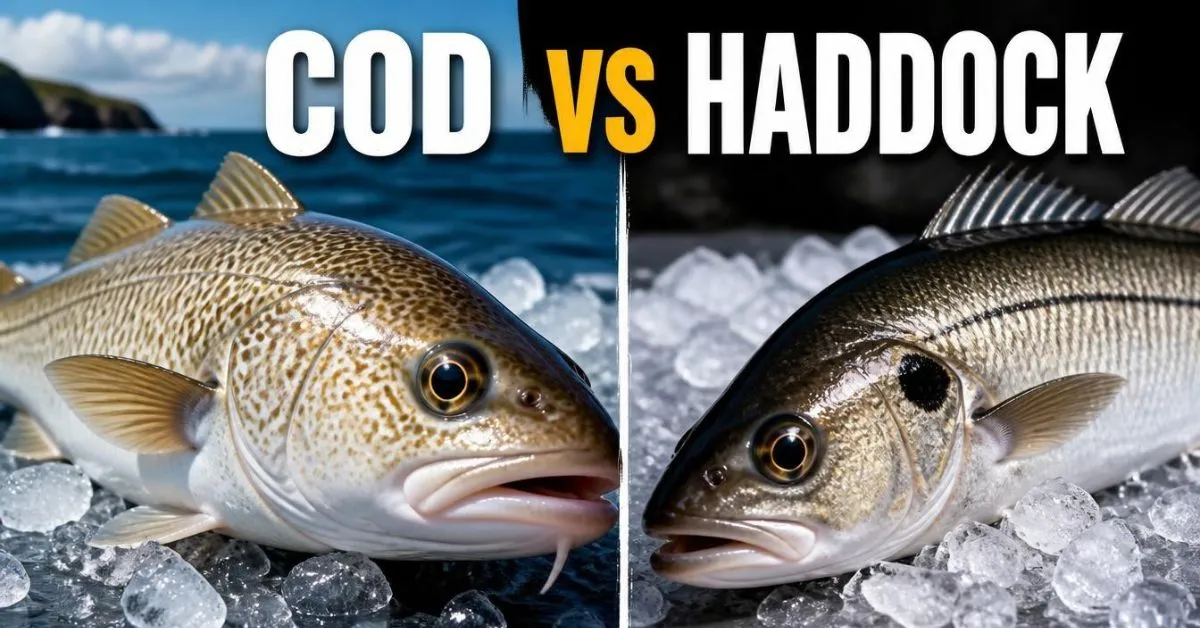
Cod and haddock are both mild, lean white fish, but they differ slightly in taste and texture. Cod has a mild, clean flavor and typically larger flakes, while haddock has a slightly sweeter taste and finer flakes.
The cod is a versatile all-purpose choice, while haddock is excellent when you want a little more flavor. Both are lower-mercury fish that the FDA lists as “Best Choices.”
Cod vs Haddock at a Glance
| Feature | Cod | Haddock |
|---|---|---|
| Flavor | Mild and clean | Mild and slightly sweet |
| Texture | Firm, typically larger flakes | Firm, typically finer flakes |
| Fat | Very low | Very low |
| Protein | High | High |
| Calories | Slightly lower in this comparison | Slightly higher in this comparison |
| Mercury | Low | Low |
| Best for | Versatility, baking, and simple seasoning | Frying, smoking, and slightly sweeter flavor |
| Fish and chips | Excellent | Excellent |
| Easy substitute | Yes | Yes |
Quick Verdict
| If you want… | Best choice |
|---|---|
| Mildest flavor | Cod |
| Slightly sweeter flavor | Haddock |
| Larger flakes | Cod |
| Finer flakes | Haddock |
| Everyday versatility | Cod |
| Fish and chips | Either |
| Baking | Cod, slight edge |
| Frying | Haddock, slight edge |
| Lower average mercury | Haddock |
| Slightly more protein in this comparison | Haddock |
| Slightly fewer calories in this comparison | Cod |
| Easy recipe substitution | Either |
| Best overall for most people | Cod |
There is no universal winner. Cod is the better all-purpose choice, while haddock is a strong pick if you prefer a slightly sweeter flavor and finer texture.
What Is the Difference Between Cod & Haddock?
Cod and haddock are closely related marine fish in the Gadidae family, but they are different species. Both are popular white fish because they have mild flavors, lean flesh, and many cooking uses.
The most noticeable differences are usually flavor, texture, flake size, and appearance.
Cod generally has a mild, clean flavor and firm flesh that tends to break into larger flakes when cooked. Haddock is also mild, but it often has a slightly sweeter, more distinctive flavor and finer flakes.
There is another important detail: cod is a common name used for more than one species. Atlantic cod and Pacific cod are different fish and can vary in texture, moisture, and cooking behavior.
So the simplest comparison is:
Cod = mild, clean, firm, typically larger flakes.
Haddock = slightly sweeter, delicate, typically finer flakes.
These are useful generalizations, not absolute rules. Freshness, species, fillet thickness, and cooking method can all affect the final result.
How to Tell Cod & Haddock Apart
If you are looking at whole fish rather than prepared fillets, there are some useful visual differences.
Atlantic cod usually has a lighter lateral line and a relatively large head and mouth.
Haddock has a distinctive dark spot above its pectoral fin, often described as a “thumbprint” or “fingerprint.” It also has a darker lateral line.
These markings can help distinguish the two fish when you are buying whole fish or viewing an identifiable fish.
Once the fish is skinned and cut into portions, however, visual identification becomes much harder. At that point, the species label or information from the seafood seller is more reliable than appearance alone.
Cod vs Haddock Taste
Taste is one of the biggest reasons to choose one over the other.
What Does Cod Taste Like?
Cod has a mild, clean flavor. It is not usually the strongest flavor in a heavily seasoned dish, which makes it easy to pair with many ingredients.
Cod works well with:
- Lemon and butter
- Garlic
- Fresh herbs
- Black pepper
- Breadcrumbs
- Tomato sauce
- Cream sauces
- Mild marinades
- Spices
If you want the seasoning, sauce, or coating to stand out, cod is often the easier choice.
What Does Haddock Taste Like?
Haddock is also mild, but it tends to have a slightly sweeter and more noticeable flavor.
It is still a delicate white fish, so “strong-tasting” would be an unfair description. The difference is more about a subtle seafood flavor that can stand out a little more than cod.
If you enjoy mild fish but want more flavor from the fish itself, haddock may be the better choice.
Taste Winner
Mildest flavor: Cod
Slightly sweeter flavor: Haddock
Neither fish is dramatically stronger than the other. Freshness and preparation can have a major effect on taste.
Cod vs Haddock Texture
Both fish have firm, lean flesh, but their flakes can feel different after cooking.
Cod typically forms large, substantial flakes. Haddock usually has smaller, finer flakes and can feel a little more delicate.
| Texture | Cod | Haddock |
|---|---|---|
| Typical flake | Larger | Finer |
| Flesh | Firm and tender | Firm and delicate |
| Mouthfeel | More substantial | Slightly more delicate |
| Best fit | Thick portions, baking, broad recipe use | Frying, baking, delicate dishes |
If you like a thick, substantial piece of flaky fish, cod may have the edge.
If you prefer a slightly finer texture, haddock may be more appealing.
Cod vs Haddock Nutrition
Nutritionally, cod and haddock are very similar.
Both are lean sources of protein and contain little fat and no carbohydrates. Small differences can occur depending on the species, serving size, and whether the fish is raw or cooked.
For the raw fish values used in this comparison, 100 grams of Atlantic cod contains about 82 calories, 17.81 grams of protein, and 0.67 grams of fat. The same amount of raw haddock contains about 87 calories, 18.91 grams of protein, and 0.72 grams of fat.
| Per 100 g raw | Atlantic Cod | Haddock |
|---|---|---|
| Calories | 82 | 87 |
| Protein | 17.81 g | 18.91 g |
| Fat | 0.67 g | 0.72 g |
| Carbohydrates | 0 g | 0 g |
Which Has More Protein?
In these values, haddock has slightly more protein.
- Cod: about 17.8 g
- Haddock: about 18.9 g
The difference is small, so it does not make haddock a major nutritional winner.
Which Has Fewer Calories?
Cod has slightly fewer calories in this comparison.
Again, the difference is small. Cooking method can have a much larger effect on the calories in the finished meal.
What About Omega-3s, Vitamins, and Minerals?
Both fish provide useful nutrients, including vitamin B12 and selenium, but they are not especially high-fat fish.
Their omega-3 content is generally lower than that of fatty fish such as salmon because cod and haddock are lean fish.
So if your main goal is getting more marine omega-3 fats, a fatty fish can be a better choice than either cod or haddock.
Which Is Healthier?
Neither is a clear overall winner.
Both can fit well into a balanced diet. Your overall meal, portion size, cooking method, and the rest of your diet matter more than the small nutritional differences between these two fish.
Cod vs Haddock Mercury
Both cod and haddock are considered lower-mercury seafood choices.
The FDA’s mercury data gives an average concentration of about 0.11 parts per million (ppm) for cod and 0.06 ppm for haddock. Both are included in the FDA’s “Best Choices” category.
Based on those average figures:
Lower average mercury: Haddock
However, this does not mean cod is a high-mercury fish. Both are considered lower-mercury choices.
If you are pregnant, breastfeeding, or choosing fish for children, follow the current FDA and EPA seafood advice for recommended fish choices and serving amounts.
Cod vs Haddock for Fish & Chips
Winner: Tie
Both cod and haddock are excellent choices for fish and chips.
Cod gives you a mild flavor and typically larger flakes. It works well when you want the crispy coating, sauce, or seasoning to be the main flavor.
Haddock has a slightly sweeter flavor and finer flakes. It can be a good choice if you want the fish itself to have a little more character.
Choose:
- Cod for mild flavor and larger flakes
- Haddock for slightly sweeter flavor and finer flakes
There is no universal winner.
Which Is Better for Baking?
Winner: Cod, Slight Edge
Cod is an excellent baking fish because its mild flavor works with many seasonings and sauces.
Try it with:
- Lemon
- Garlic
- Butter
- Olive oil
- Parsley
- Dill
- Breadcrumbs
- Black pepper
Haddock also works very well in the oven. Its slightly sweeter flavor can be especially good with simple seasonings.
The key with either fish is to avoid overcooking. Lean fish can become dry when cooked for too long.
Which Is Better for Frying?
Winner: Haddock, Slight Edge
Haddock’s slightly sweet flavor pairs well with a crisp coating, which makes it a popular choice for fried fish.
Cod is also excellent for frying and produces a substantial, flaky bite.
The difference is mostly preference:
Haddock = slightly sweeter flavor.
Cod = milder flavor and typically larger flakes.
Which Is Better for Grilling or Pan-Searing?
Winner: Cod for Versatility
Cod can work well when you want the fish to pair with a simple seasoning, crust, or sauce.
Haddock can also be pan-seared or grilled, but its finer flakes may make it feel somewhat more delicate.
With either fish, handle the fillet carefully and avoid overcooking it.
What Temperature Should Cod or Haddock Reach?
For food safety, cook fish to an internal temperature of 145°F (63°C), measured at the thickest part.
The fish should be opaque and separate easily with a fork, although appearance alone is not as reliable as checking the internal temperature.
Cooking time varies with:
- Fillet thickness
- Starting temperature
- Cooking method
- Oven or pan temperature
- Whether the fish is whole or portioned
That is why a recipe’s cooking time should be treated as a guide rather than a guarantee.
Can You Substitute Haddock for Cod?
Yes. In most everyday recipes, you can substitute haddock for cod.
Both can work in:
- Fish tacos
- Fish and chips
- Fish sandwiches
- Fish cakes
- Chowders
- Fish soups
- Baked fish
- Breaded fish
- Casseroles
The substitution may slightly change the final dish.
Haddock instead of cod: expect a somewhat sweeter flavor and finer flakes.
Cod instead of haddock: expect a milder flavor and typically larger flakes.
One important cooking tip: fillet thickness matters more than the fish name when deciding cooking time. A thick haddock fillet may take longer than a thin cod fillet.
Fresh vs Frozen Cod & Haddock
Both cod and haddock can be sold fresh or frozen, and frozen fish is not automatically lower quality.
Freezing can preserve fish soon after harvest, while “fresh” fish may have spent time in transport and storage before reaching the seafood counter.
When buying either fish, look for:
- A clean, mild smell
- Firm flesh
- No unusual discoloration
- Packaging without major damage
- Clear species and origin labeling
For frozen fillets, avoid packages with heavy freezer burn or excessive dehydration.
The best choice is often the fish that has been properly handled and stored, whether you buy it fresh or frozen.
How to Choose Good Cod or Haddock
At the seafood counter, do not choose only by the name of the fish.
Look at:
1. Smell
Fresh fish should have a clean, mild smell. A strong sour, rancid, or ammonia-like odor is a warning sign.
2. Appearance
The flesh should look moist and reasonably firm rather than dry, mushy, or badly discolored.
3. Packaging
For packaged fish, check the package condition and avoid products with signs of poor handling.
4. Species & Origin
Check the label when available. This is especially useful with cod because different species can be sold under different common names.
5. Price
Prices can vary widely by location, season, species, fishery, and store. Do not assume haddock or cod is always cheaper.
If both fish are in good condition and similarly priced, let taste and texture preference decide.
Smoked Haddock vs Cod
Haddock is especially well known in smoked form.
Smoked haddock has a much stronger flavor than fresh haddock because smoking changes the fish’s taste and aroma. It is commonly used in chowders, fish pies, and other traditional dishes.
This creates an important distinction:
Fresh haddock = mild and slightly sweet.
Smoked haddock = much more pronounced smoky and savory flavor.
Smoked haddock is therefore not a direct taste comparison with fresh cod.
Cod vs Haddock Sustainability
Sustainability is more complicated than simply asking whether cod or haddock is better.
The environmental impact can depend on:
- Species
- Fishing location
- Specific fish stock
- Fishing method
- Fishery management
- Certification
- Current stock condition
Atlantic cod from one fishery can have a different sustainability profile from cod from another fishery. The same applies to haddock.
So there is no universal sustainability winner.
If sustainability matters to you, check:
- The species
- Where it was caught
- The fishery or stock
- The current sustainability rating
- if a credible certification applies
This is more useful than choosing cod or haddock based only on the species name.
Is Cod or Haddock Better for Weight Loss?
Neither fish is automatically a better weight-loss food.
Both are naturally lean and high in protein, so either can fit into a calorie-conscious meal.
Preparation matters much more.
For example:
- Baked cod with vegetables can be relatively light.
- Deep-fried cod can be much higher in calories.
- Baked haddock with herbs can be relatively light.
- Fried haddock with a heavy coating can be much higher in calories.
If calories are your main concern, focus on portion size and preparation, not just the fish species.
Which Is Better for a High-Protein Diet?
Both are good choices.
In the nutrition values used above, haddock provides slightly more protein per 100 grams than Atlantic cod.
But the difference is small, so either fish can be a useful lean protein source.
If protein is your goal, the more important factors are serving size and your overall diet.
Cod vs Haddock: Which Should You Buy?
Your best choice depends on what matters most to you.
| Your priority | Best choice |
|---|---|
| Mild, clean flavor | Cod |
| Slightly sweeter flavor | Haddock |
| Larger flakes | Cod |
| Finer flakes | Haddock |
| Versatile everyday fish | Cod |
| Fish and chips | Either |
| Baking | Cod, slight edge |
| Frying | Haddock, slight edge |
| Lower average mercury | Haddock |
| Slightly more protein in this comparison | Haddock |
| Slightly fewer calories in this comparison | Cod |
| Easy substitution | Either |
Choose Cod If…
Pick cod if you want:
- A mild, clean flavor
- A versatile white fish
- Typically larger flakes
- A fish that works with many sauces and seasonings
- An easy everyday option
Choose Haddock If…
Pick haddock if you want:
- A slightly sweeter flavor
- Finer flakes
- A little more flavor from the fish itself
- A strong option for fried fish
- Smoked fish for certain recipes
What If Both Are Available?
If both look fresh and cost about the same, your preference can decide.
Want the easiest all-purpose choice? Pick cod.
Want a slightly sweeter, more distinctive white fish? Pick haddock.
FAQs:
Is haddock healthier than cod?
Not by a meaningful overall amount. Both are lean, protein-rich fish with very similar basic nutrition. Haddock has slightly more protein in the comparison values, while cod has slightly fewer calories and less fat. These differences are small.
Does haddock taste better than cod?
It depends on your preference. Haddock tends to have a slightly sweeter, more noticeable flavor, while cod is milder and cleaner. Choose cod for a neutral flavor or haddock if you want the fish to stand out a little more.
Which is better for fish and chips, cod or haddock?
Both are excellent. Cod typically has larger flakes and a mild flavor, while haddock tends to have finer flakes and a slightly sweeter flavor. There is no universal winner.
Which has more protein, cod or haddock?
In the nutrition values used here, haddock has slightly more protein per 100 grams than Atlantic cod: about 18.91 grams compared with 17.81 grams. The difference is relatively small.
Which has less mercury, cod or haddock?
Haddock has the lower average mercury concentration in the FDA data used here, at about 0.06 ppm compared with about 0.11 ppm for cod. However, both are classified as FDA “Best Choices.”
Can I use haddock instead of cod?
Yes. Haddock can replace cod in many recipes, including baked, fried, breaded, and soup dishes. Expect a slightly sweeter flavor and finer flakes.
Can I use cod instead of haddock?
Yes. Cod works as a substitute for haddock in many recipes. The finished dish may have a milder flavor and typically larger flakes.
Which is better for baking, cod or haddock?
Cod gets a slight edge for versatility because its mild flavor pairs easily with sauces, herbs, and seasonings. Haddock also bakes well and may be preferable if you want a slightly sweeter flavor.
Is cod or haddock better for frying?
Haddock gets a slight preference if you want the fish to have a little more flavor under a crispy coating. Cod is also an excellent frying fish, especially if you prefer a milder taste.
Is haddock a strong-tasting fish?
No. Haddock is generally a mild fish. It tends to have a slightly sweeter and more noticeable flavor than cod, but it is still a relatively delicate white fish.
Is frozen cod or haddock good?
Yes. Properly handled frozen fish can be a good choice. Look for intact packaging, minimal freezer burn, and clear species labeling. Frozen does not automatically mean lower quality.
Conclusion:
Cod vs haddock is less about finding one fish that is objectively better and more about choosing the qualities you want.
Choose cod when you want a mild, clean flavor, typically larger flakes, and broad recipe versatility. It is the better all-purpose choice for most home cooks.
Choose haddock when you want a slightly sweeter flavor, finer flakes, and a little more character from the fish. It is also an excellent choice for frying and is widely used in smoked preparations.
Nutritionally, the two are very close. In the comparison values above, haddock has slightly more protein, while cod has slightly fewer calories and less fat. Both are lower-mercury “Best Choices” according to the FDA.