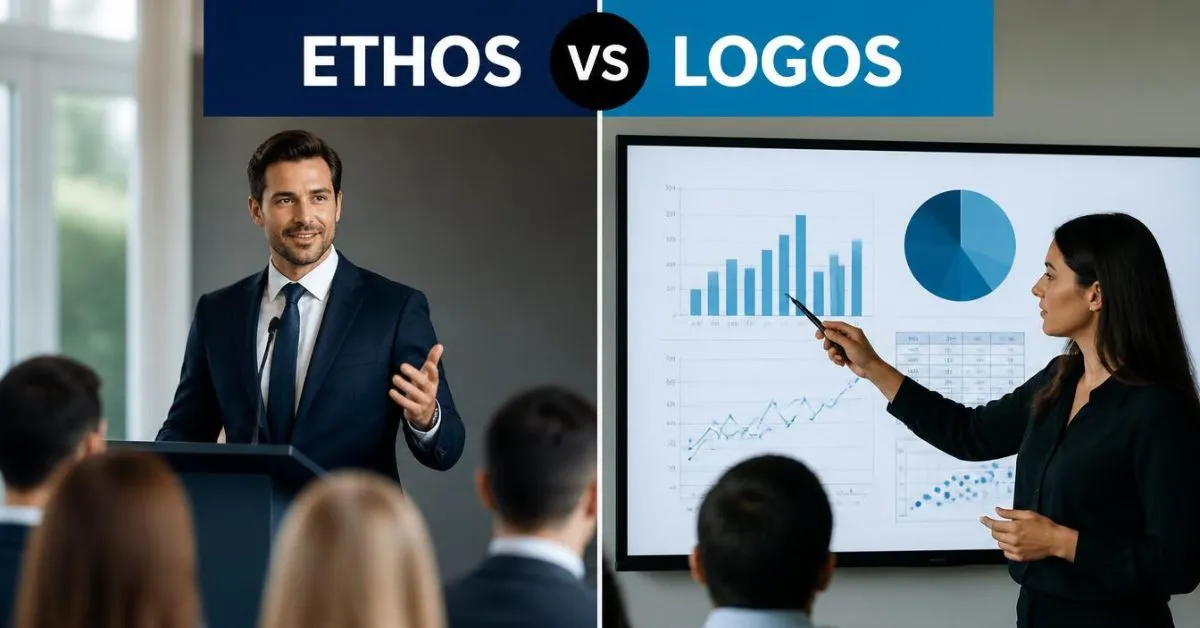
Ethos vs logos is mainly the difference between credibility and reasoning. Ethos makes an argument stronger by showing that the speaker or writer is trusted, fair, and knows the topic well. Logos makes an argument stronger by using facts, proof, examples, and clear reasoning to connect ideas.
In simple terms, ethos asks, “Why should I trust this source?” while logos asks, “Why should I accept this argument?”
Ethos and logos can also work together. A speaker may first show why they are qualified to speak about a topic and then use evidence and reasoning to support the claim. These appeals are commonly taught with pathos, which focuses on emotion and audience response.
Ethos vs Logos at a Glance
| Feature | Ethos | Logos |
|---|---|---|
| Main focus | Credibility and character | Reasoning and evidence |
| Main question | Why should I trust this source? | Why should I accept this claim? |
| Common tools | Expertise, experience, fairness, reliable sources | Facts, evidence, examples, data, reasoning |
| Main role | Builds credibility | Supports the argument |
| Common use | Speeches, essays, expert writing | Essays, debates, research, analysis |
| Can they overlap? | Yes | Yes |
Key Takeaways
- Ethos uses credibility, character, expertise, and reliability to persuade.
- Logos uses reasoning, evidence, facts, examples, and logical connections.
- Ethos is not limited to professional credentials.
- Logos is not simply a collection of facts or statistics.
- A fact becomes useful to logos when it is relevant and helps support a claim.
- Ethos and logos can appear in the same sentence or argument.
- Pathos is the third commonly taught rhetorical appeal and focuses on emotions, values, and audience response.
- The fastest test is: trust the source = ethos; follow the reasoning = logos.
What Is Ethos?
Ethos is a rhetorical appeal based on the character, credibility, reliability, or authority presented by a speaker or writer.
A person may build ethos through relevant experience, expertise, reliable sources, fairness, honesty, or a clear understanding of the subject and audience.
For example:
“As a pediatrician who has worked with children for more than 20 years, I recommend that parents discuss this concern with their child’s doctor.”
This statement uses ethos because the speaker’s medical experience gives the audience a reason to take the recommendation seriously.
But ethos is not simply having a job title.
A writer can also build ethos by:
- Using reliable sources
- Representing opposing views fairly
- Acknowledging limitations
- Avoiding exaggerated claims
- Showing knowledge of the topic
- Establishing common ground with the audience
- Being clear and honest about the evidence
Purdue OWL similarly describes ethos in terms of character, credibility, and reliability and notes that writers can establish it through credible sources, fair treatment of opposing views, common ground, and careful writing.
What Does Ethos Mean in Simple Terms?
The easiest way to remember ethos is:
Ethos = credibility.
Ask:
“Why should I trust this speaker or writer?”
If the answer comes from the person’s expertise, character, experience, reliability, or authority, ethos may be involved.
How Does Ethos Persuade?
Ethos gives an audience confidence in the person making the argument.
For example:
“I have worked as a high school teacher for 15 years, and I have seen how small reading groups can help struggling students.”
The speaker’s experience helps establish credibility.
However, expertise alone does not prove that a claim is correct. A credible speaker can still make a weak argument. This is why strong persuasion often combines ethos with logos.
How Do Writers & Speakers Build Ethos?
A writer or speaker can build ethos by:
- Showing relevant expertise
- Citing trustworthy sources
- Using accurate information
- Being fair to other viewpoints
- Admitting limits or uncertainty
- Understanding the audience
- Avoiding misleading claims
- Using an appropriate tone
In other words, ethos is not only what you say about yourself. It can also come from how you communicate.
Examples of Ethos
Medicine
“As an emergency nurse with more than 10 years of clinical experience, I have seen how important early treatment can be.”
The speaker uses professional experience to establish credibility.
Education
“After teaching college writing for 12 years, I have found that students often confuse evidence with reasoning.”
The speaker’s teaching experience contributes to ethos.
Business
“Our engineering team has designed commercial safety systems for more than 20 years.”
The company’s experience helps establish professional credibility.
Writing
“The study’s authors reviewed data from more than 10,000 participants and clearly explained the study’s limits.”
Here, credibility comes partly from careful use of research rather than a personal job title.
What Is Logos?
Logos is a rhetorical appeal based on reasoning, evidence, relationships between ideas, and the content and organization of an argument.
It is often explained as an appeal to logic. That is useful for beginners, but logos is broader than simply presenting facts. In rhetorical analysis, it is important to look at how evidence and ideas are used to support a claim.
Purdue OWL notes that logos originally referred to the content and organization of a speech and is now often discussed in terms of reasoning and logic.
Logos can include:
- Facts
- Evidence
- Research
- Statistics
- Examples
- Comparisons
- Cause-and-effect reasoning
- Explanations
- Premises and conclusions
- Organized reasoning
For example:
“The company reduced average delivery time from five days to two days after opening a regional warehouse.”
This information can contribute to logos when it is used to support a claim about delivery speed.
What Does Logos Mean in Simple Terms?
The easiest way to remember logos is:
Logos = reasoning.
Ask:
“What reasons or evidence support this claim?”
If the argument gives relevant evidence and explains how that evidence supports the conclusion, logos is likely present.
How Does Logos Persuade?
Logos gives the audience a reason to accept a claim.
For example:
“The school should offer more after-school tutoring because participating students receive extra instruction and more time with teachers.”
The argument connects the proposed action with reasons for believing it could help.
Strong logos is not just about having information. The information must fit the claim.
Claim, Evidence & Reasoning
One of the easiest ways to understand logos is:
Claim → Evidence → Reasoning → Conclusion
For example:
Claim: The school should expand its tutoring program.
Evidence: Students who attend receive additional instructional time.
Reasoning: More instructional time can give students extra opportunities to practice and ask questions.
Conclusion: Expanding the program could provide more academic support.
This structure makes the connection between evidence and the final claim easier to see. In argument writing, reasons, evidence, and the explanation of why the evidence supports the claim are important parts of a strong argument.
What Makes Logos Strong?
Strong logos usually has:
- Relevant evidence
- Accurate information
- Clear reasoning
- A reasonable connection between evidence and the claim
- Enough evidence for the conclusion
- Appropriate context
- Clear organization
Weak logos may involve:
- Irrelevant facts
- Cherry-picked evidence
- Unsupported assumptions
- False cause-and-effect claims
- Misleading statistics
- Conclusions that go beyond the evidence
So, more facts do not automatically create a stronger argument.
Ethos vs Logos: What’s the Difference?
The simplest difference is:
Ethos = why the source is credible.
Logos = why the argument makes sense.
For example:
“I am a structural engineer with 20 years of experience.”
This contributes to ethos because it establishes relevant expertise.
Now consider:
“The bridge design was tested against the expected load using these engineering calculations.”
This contributes to logos because the statement gives evidence and reasoning related to the technical claim.
Together:
“I have designed bridges for 20 years, and the calculations show that this design can support the expected load.”
The first part establishes ethos.
The second part contributes to logos.
The Simple Difference
Think of it this way:
Ethos: Trust the source.
Logos: Evaluate the reasoning.
This is a useful shortcut, but real arguments are more complex. A single statement can use both appeals.
Ethos vs Logos Examples
The difference becomes easier to understand when both appeals are used on the same topic.
School Example
Ethos:
“I have taught middle school science for 15 years, and I have seen how hands-on experiments help students understand difficult concepts.”
The teacher’s experience establishes credibility.
Logos:
“Students who spend more time practicing a skill have more opportunities to identify mistakes and improve.”
The statement uses a reason to support the value of practice.
Advertising Example
Ethos:
“Recommended by professional chefs.”
The advertisement uses the credibility of professionals.
Logos:
“This blender has a 1,200-watt motor and a 64-ounce container.”
The product features provide information that may support a buying decision.
Medical Example
Ethos:
“As a licensed physician who has treated patients with this condition, I recommend discussing the treatment with your healthcare provider.”
The speaker’s professional role contributes to credibility.
Logos:
“The treatment was studied in a controlled trial, and the researchers compared outcomes between the treatment and control groups.”
The evidence and comparison contribute to logos.
Speech Example
Ethos:
“I have worked with local small businesses for more than a decade.”
The speaker establishes relevant experience.
Logos:
“The proposed program would reduce application fees and give small businesses access to additional training.”
The speaker gives specific reasons for supporting the proposal.
Essay Example
Ethos:
“The argument draws on research from established academic sources and acknowledges important limitations.”
The writer builds credibility through careful research and fair treatment of the topic.
Logos:
“Because the data shows a consistent increase across the measured period, the evidence supports the conclusion that the trend is not limited to a single year.”
The writer connects evidence to a conclusion.
How to Identify Ethos vs Logos in a Passage
When reading a speech, essay, advertisement, debate, or article, ask what is doing the persuasive work.
Look for Ethos When You See:
- Credentials
- Relevant experience
- Expertise
- Professional authority
- Firsthand knowledge
- Fair treatment of opposing views
- Reliable sources
- A trustworthy presentation
- Shared values or common ground
Ask:
“Is the writer giving me a reason to trust the source?”
If yes, ethos may be present.
Look for Logos When You See:
- Facts
- Research
- Statistics
- Comparisons
- Examples
- Cause-and-effect reasoning
- Explanations
- Evidence
- Premises and conclusions
- A clear chain of reasoning
Ask:
“Is the writer giving me a reason to accept the claim?”
If yes, logos may be present.
The 3-Second Test
Use this quick test:
Trust the source → Ethos
Follow the reasoning → Logos
Feel or care → Pathos
It is only a shortcut. Real arguments can use several rhetorical appeals at once.
Why Context Matters
The same sentence can work differently depending on the situation.
For example:
“I have worked in this field for 20 years.”
In a speech about the speaker’s qualifications, this strongly supports ethos.
But if the speaker then uses that experience to explain why a particular conclusion is correct, the argument may also involve logos.
Rhetorical analysis should therefore consider the speaker, audience, purpose, message, and setting, rather than labeling every sentence in isolation.
Is a Fact Always Logos?
No.
This is one of the most common mistakes when identifying rhetorical appeals.
A fact can support logos, but a fact by itself does not automatically create a logical argument.
Consider:
“The product costs $200.”
That is factual information.
Now consider:
“The product costs $200, which is $50 less than a comparable model with similar features, so it may offer better value.”
Now the information is being used as part of a comparison and conclusion.
That is a clearer example of logos.
The same applies to statistics. A statistic can support logos when it is relevant, accurate, properly explained, and connected to the claim.
Can Ethos & Logos Appear Together?
Yes.
In fact, they often do.
Consider:
“As a climate scientist who has studied temperature records for 25 years, I believe the evidence shows that global temperatures are rising.”
The speaker’s experience contributes to ethos.
The reference to evidence and the conclusion drawn from it contribute to logos.
The two appeals are not opposites. They answer different persuasive needs.
Ethos: Why should I trust the source?
Logos: Why should I accept the reasoning?
A strong argument can provide both answers.
Ethos vs Logos vs Pathos
Ethos and logos are commonly taught alongside pathos, another rhetorical appeal associated with Aristotle’s work on persuasion.
| Appeal | Main Focus | Simple Question |
|---|---|---|
| Ethos | Credibility and character | Why should I trust this source? |
| Logos | Reasoning and evidence | Why should I accept this claim? |
| Pathos | Emotion, values, and audience response | Why should I care or feel something? |
For example:
Ethos:
“As a firefighter, I have seen how quickly a house fire can spread.”
Logos:
“A working smoke alarm can alert people to danger early, giving them more time to leave.”
Pathos:
“Imagine waking up at night and realizing your family has only moments to get outside.”
One message can use all three appeals.
How to Use Ethos & Logos in Writing
Ethos in Academic Writing
Writers can build ethos by:
- Using reliable sources
- Citing evidence correctly
- Representing opposing views fairly
- Avoiding exaggerated claims
- Acknowledging limitations
- Showing knowledge of the subject
Good academic writing does not pretend to know everything. Careful limits can actually make an argument more credible.
Logos in Academic Writing
Use logos by:
- Making a clear claim.
- Giving relevant evidence.
- Explaining the evidence.
- Showing how it supports the claim.
- Addressing important counterarguments.
- Reaching a reasonable conclusion.
A useful formula is:
Claim → Evidence → Explanation → Conclusion
How to Write About Ethos in a Rhetorical Analysis
Instead of writing:
“The author uses ethos.”
Explain how and why:
“The author uses ethos by establishing relevant professional experience, which makes the audience more likely to view the argument as credible.”
The important part is not just identifying the appeal. Explain its effect on the audience.
How to Write About Logos in a Rhetorical Analysis
Instead of:
“The author uses logos.”
Write:
“The author uses logos by presenting evidence and explaining how it supports the central claim, giving the audience a logical reason to accept the argument.”
This makes the analysis more specific.
Ethos in Speeches
A speaker can establish ethos by:
- Showing relevant experience
- Demonstrating knowledge
- Using reliable evidence
- Understanding the audience
- Speaking fairly about opposing views
- Explaining why the topic matters
Knowing the audience is especially important because effective communication changes with the audience’s knowledge, expectations, and needs.
Logos in Speeches
A speaker can use logos by:
- Giving evidence
- Explaining cause and effect
- Comparing options
- Showing problems and solutions
- Using relevant statistics
- Connecting reasons to a conclusion
For example:
“The proposed bus route would add three stops and reduce the average walking distance for students in the area.”
The specific information gives the audience a reason to consider the proposal.
What Weakens Ethos?
Ethos can become weaker when a speaker or writer:
- Makes unsupported claims about expertise
- Uses unreliable sources
- Misrepresents opposing views
- Hides important limitations
- Makes exaggerated promises
- Contradicts their own evidence
- Ignores relevant facts
- Uses a tone that damages credibility
For example, claiming to be an expert does not automatically make an argument credible.
Ethos must be supported by the way the source communicates and argues.
What Makes Logos Strong or Weak?
Strong Logos
Strong logos usually includes:
- Relevant evidence
- Accurate information
- Clear reasoning
- A direct connection between evidence and claim
- Appropriate comparisons
- Enough support for the conclusion
Weak Logos
Weak logos may include:
- Irrelevant facts
- Cherry-picked statistics
- Unsupported assumptions
- False cause-and-effect claims
- Contradictory evidence
- Conclusions that do not follow from the evidence
A useful question is:
“Does this evidence actually support the conclusion?”
If the answer is no, the argument has a logos problem.
Logos & Logical Fallacies
Weak reasoning can also involve logical fallacies.
Common examples include:
- False cause: Assuming one event caused another without enough evidence.
- Hasty generalization: Making a broad conclusion from too little evidence.
- False dilemma: Presenting only two choices when more options exist.
- Ad hominem: Attacking the person instead of addressing the argument.
- Circular reasoning: Using the conclusion as its own support.
Not every use of these patterns will look the same, but they can weaken the reasoning in an argument.
Ethos vs Ethics
Ethos and ethics are related, but they are not the same thing.
Ethics usually refers to principles about right and wrong behavior.
Ethos, in rhetorical analysis, refers to the character or credibility presented by a speaker or writer.
For example:
“The company believes honesty should guide every customer interaction.”
This statement concerns an ethical value.
But:
“The company openly explains its product limits and provides its sources.”
This can contribute to the company’s ethos because the communication may make the company appear more credible and trustworthy.
Logos vs Logic
Logos and logic overlap, but they are not perfect synonyms.
In everyday writing, logos is often explained as an appeal to logic.
In rhetorical studies, however, logos has a broader history. It can refer to the content and organization of an argument as well as its reasoning. Purdue OWL notes that reducing logos to simply “logic” can miss part of the concept.
So for a simple memory aid:
Logos = reasoning used in persuasion.
But for a rhetorical analysis, look beyond isolated facts and examine how the argument is built.
Are Ethos & Logos Only Used in Rhetoric?
No.
The words have broader meanings.
In everyday English, ethos can mean the characteristic beliefs, values, or spirit of a person, group, or organization.
For example:
“The company’s ethos emphasizes creativity and teamwork.”
That does not necessarily describe a rhetorical appeal.
Logos also has broader historical and theological meanings. The Greek word has been associated with ideas such as word, account, and reason, and Logos has a specific meaning in Christian theology.
However, when someone asks about ethos vs logos in writing, speeches, persuasion, or rhetorical analysis, the rhetorical meanings are usually the relevant ones.
Which Is More Effective: Ethos or Logos?
There is no universal winner.
The better appeal depends on the audience, purpose, topic, and situation.
Ethos may be especially important when the audience needs to know whether the speaker is qualified or credible.
Logos may be especially important when the audience needs evidence and reasoning before accepting a claim.
In many cases, the strongest argument combines both.
For example:
“I have spent 20 years studying this issue, and the latest research supports this recommendation.”
The first part contributes to ethos.
The second contributes to logos.
The best question is not:
“Which is always better?”
It is:
“What does this audience need in order to be persuaded?”
FAQs:
What is the difference between ethos and logos?
Ethos persuades through credibility, character, expertise, and reliability, while logos persuades through reasoning, evidence, and support for a claim. Ethos focuses on why the source should be trusted; logos focuses on why the argument should be accepted.
What is a simple example of ethos?
A doctor saying, “I have practiced emergency medicine for 20 years, and I recommend discussing this treatment with your doctor” is an example of ethos because the speaker uses relevant professional experience to establish credibility.
What is a simple example of logos?
“The store reduced the price from $50 to $35, so customers now pay $15 less” is a simple example of logos because the information supports a clear conclusion.
Is a statistic ethos or logos?
A statistic usually contributes to logos when it provides relevant evidence for a claim. However, a statistic alone does not guarantee strong reasoning. Its accuracy, context, relevance, and connection to the claim all matter.
Can an expert opinion be both ethos and logos?
Yes. The expert’s qualifications can contribute to ethos, while the evidence and reasoning supporting the expert’s conclusion can contribute to logos.
Can ethos and logos be used together?
Yes. A speaker can establish credibility through experience or expertise and then use evidence and reasoning to support the argument.
What are ethos, logos, and pathos?
They are commonly taught as three rhetorical appeals associated with Aristotle’s study of persuasion. Ethos relates to credibility or character, logos to reasoning and argument, and pathos to emotion, values, and audience response.
Is ethos the same as ethics?
No. Ethics concerns principles of right and wrong behavior. Ethos in rhetorical analysis concerns the character, credibility, or authority presented by a speaker or writer.
Is logos the same as logic?
Not exactly. Logos is often explained as an appeal to logic, but the rhetorical concept is broader and can include the content, structure, and reasoning of an argument.
How do you identify ethos and logos quickly?
Ask two questions:
“Why should I trust this source?” → Ethos
“Why should I accept this claim?” → Logos
If the message is mainly trying to create an emotional response, look for pathos.
Conclusion
The clearest way to understand ethos vs logos is to ask what is doing the persuasive work.
Ethos builds credibility. Logos builds support for a claim through reasoning and evidence.
If a passage highlights expertise, experience, character, reliability, or the credibility of a source, look for ethos. If it presents relevant evidence, explanations, comparisons, or logical connections, look for logos.
The two can also work together. A credible speaker can use strong evidence, and a well-reasoned argument can come from a source with strong credibility.
For a quick test, ask:
“Why should I trust this source?” → Ethos
“Why should I accept this reasoning?” → Logos
Once you learn to separate credibility from reasoning, identifying ethos and logos becomes much easier.

Harry Jack is a content writer at ReplyGenius.com who specializes in practical, natural sounding replies for texts, social media, relationships, and everyday conversations.