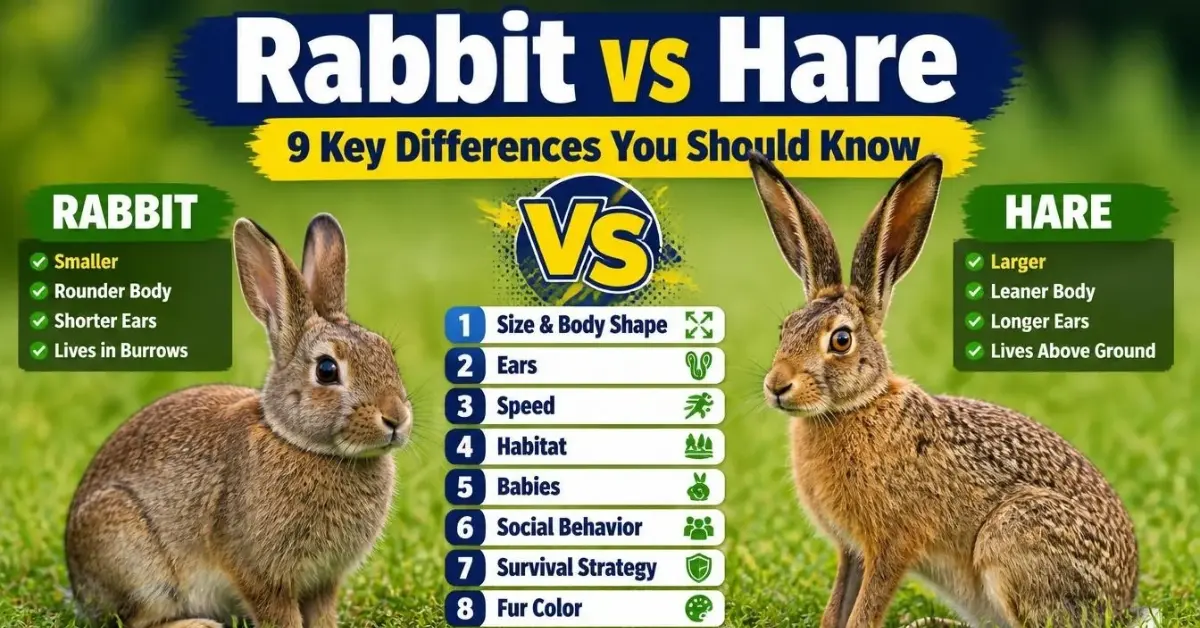
The main difference between a Rabbit and a Hare is their body structure, habitat, and newborn development. Hares are generally larger, have longer ears and stronger hind legs, and give birth to fully furred young with open eyes.
Rabbits are usually smaller, often live in burrows, and give birth to blind, hairless babies that need more care.
Key Takeaways
- Rabbits and hares belong to the same family, called Leporidae, but they are different groups of animals.
- Hares are generally larger, with longer ears, longer legs, and larger hind feet.
- Rabbits commonly use underground burrows, while hares usually rest in shallow nests above ground.
- Baby rabbits are called kits or kittens, while baby hares are called leverets.
- Jackrabbits are actually hares, despite having the word rabbit in their name.
Are Rabbits & Hares The Same Animal?
No, rabbits and hares are not the same animal, although they are closely related. Both belong to the family Leporidae and the order Lagomorpha. They share several physical features, including long ears, powerful back legs, and continuously growing teeth.
However, they have different physical characteristics, lifestyles, and reproductive habits. These differences help each animal survive in its natural environment.
Their Scientific Classification
Rabbits and hares belong to the same family, but they generally belong to different genera. Most familiar wild rabbits in the United States belong to the genus Sylvilagus. Meanwhile, hares belong to the genus Lepus.
For example, the eastern cottontail is a rabbit, while the snowshoe hare belongs to the hare group.
Why They Are Often Confused
At first glance, rabbits and hares can look almost identical. Both have furry bodies, long ears, short tails, and strong hind legs that help them jump.
Their similar appearance makes identification difficult, especially when you see them from a distance. However, their body proportions, preferred habitats, and newborn development provide useful clues.
Rabbit vs Hare: Main Differences at a Glance
The following table highlights the most important differences between these two animals.
| Feature | Rabbit | Hare |
| Body size | Usually smaller | Usually larger |
| Body shape | Compact and rounded | Longer and more slender |
| Ears | Generally shorter | Generally longer |
| Hind legs | Relatively shorter | Longer and stronger |
| Habitat | Burrows and dense vegetation | Open areas and shallow ground nests |
| Newborns | Blind and mostly hairless | Furred with open eyes |
| Baby name | Kit or kitten | Leveret |
| Social behavior | Some species live in groups | Generally more solitary |
| Escape strategy | Hides in cover or burrows | Relies more on speed |
| Seasonal fur | Often less dramatic color changes | Some species change coat color |
These are general differences. Individual species can vary, so no single feature is enough to identify every rabbit or hare.
Major Differences Between Rabbits & Hares
Size & Body Shape
One of the easiest ways to distinguish a rabbit from a hare is by looking at its overall size and body shape.
Rabbits are generally smaller and have compact, rounded bodies. Their shorter limbs give them a stockier appearance. Many familiar wild rabbits, such as eastern cottontails, have this body structure.
Hares are usually larger and have longer, more slender bodies. Their powerful hindquarters and extended limbs make them look more athletic.
However, size alone is not a reliable identification method because some rabbit species can be surprisingly large, while young hares may look relatively small.
Ears & Physical Features
Ears provide another useful clue when comparing rabbits and hares. Rabbits generally have shorter ears that fit their smaller body proportions. Their ear shape and length vary depending on the species.
Hares usually have longer ears, and many species have noticeable black tips. These ears help them detect sounds from their surroundings.
Hares also tend to have larger hind feet, which provide support when moving across open ground or snow.
Legs & Running Ability
Rabbits and hares both have strong back legs, but their body structures support different ways of escaping danger.
Rabbits often depend on quick movements, sharp turns, and nearby hiding places. When threatened, many wild rabbits quickly retreat into thick vegetation or underground shelters.
Hares have longer, stronger hind legs that help them cover greater distances. Their bodies are adapted for running across open habitats where hiding places may be limited.
This difference is closely connected to their survival strategies. Rabbits often seek shelter, while hares frequently rely on speed and distance to escape predators.
Habitat & Shelter
Habitat is one of the most important differences in the rabbit vs hare comparison. Rabbits commonly live in areas with thick vegetation, bushes, grass, and other natural cover. Some species dig burrows or use existing underground spaces for shelter.
Hares generally prefer open environments, including grasslands, fields, deserts, and certain woodland habitats. Instead of building extensive underground burrows, they usually rest in shallow depressions in the ground called forms.
Nevertheless, habitat preferences vary by species. For example, snowshoe hares are well adapted to forest environments.
Babies & Reproduction
One of the clearest biological differences appears when rabbits and hares have babies. Baby rabbits are called kits or kittens. They are born without fur, with their eyes closed, and depend heavily on their mother for warmth, protection, and nourishment.
Baby hares are called leverets. They are born with fur, open eyes, and a much greater ability to move independently shortly after birth. This difference reflects two distinct reproductive strategies.
Rabbits usually protect their young in carefully prepared nests, while hares give birth in shallow ground shelters. Their young develop differently because each species follows a different approach to protecting newborns.
Social Behavior
Rabbits are often more social than hares, although their behavior depends on the species.
Some rabbits, particularly European rabbits, live in organized groups and use interconnected underground burrows called warrens. These communities allow them to share shelter and maintain social relationships.
Hares are generally more independent. They often live alone or interact with other hares during breeding periods.
However, this is not a strict rule. Some hare species gather in groups under certain environmental conditions, especially when feeding or facing seasonal changes.
Survival Strategies
Rabbits and hares have developed different ways to avoid predators. Rabbits usually depend on nearby shelter. Their compact bodies and quick movements help them reach burrows, bushes, or dense vegetation when danger approaches.
Hares often use their powerful legs and speed to escape. Their larger bodies and longer limbs help them move efficiently across open ground.
Both animals also rely on camouflage. Their fur can blend into surrounding vegetation, soil, rocks, or snow, making them harder for predators to notice.
Fur & Seasonal Color
Fur color can also help distinguish certain rabbit and hare species. Many rabbits maintain relatively similar fur colors throughout the year, although their coats may change slightly with seasonal conditions.
Some hares have more noticeable seasonal changes. For example, snowshoe hares develop white winter coats in many northern regions, helping them blend into snowy surroundings. During warmer months, their fur becomes brown.
However, not every hare changes color. Seasonal coat changes depend on the species and its environment.
Diet & Feeding Habits
Rabbits and hares are both herbivores, meaning they eat plant-based foods.
Their diets commonly include:
- Grasses
- Leaves
- Clover
- Wildflowers
- Herbs
- Twigs
- Buds
- Other available vegetation
Rabbits often feed near areas with protective vegetation, where they can quickly retreat if threatened.
Hares also eat grasses and other green plants. Depending on the species and season, they may consume more woody vegetation, including buds, bark, and twigs.
Both animals have digestive systems adapted to extracting nutrients from fibrous plant material.
Rabbit vs Hare in the United States
The United States has several native rabbit and hare species. Knowing which animals live in a particular region can make wildlife identification easier.
Common American Rabbit Species
Some familiar American rabbit species include:
- Eastern Cottontail: Common in many parts of the eastern and central United States. It prefers fields, gardens, brush piles, and areas with thick vegetation.
- Desert Cottontail: Found across southwestern states, including Arizona, New Mexico, and parts of Texas. It is adapted to dry environments.
- Pygmy Rabbit: A small rabbit found in parts of the western United States. It depends heavily on sagebrush habitats.
- Swamp Rabbit: Lives in wetland environments across parts of the southeastern United States.
These species demonstrate that rabbits can adapt to different environments, from dry deserts to wet forests.
Common American Hare Species
Common American hares include:
- Snowshoe Hare: Found in northern forests and mountainous regions. Its large, furry feet help it move across snow.
- Black-Tailed Jackrabbit: Common in western and southwestern states, especially in open grasslands and desert areas.
- White-Tailed Jackrabbit: Found in parts of the western and northern United States. Its coat can become white during winter in colder regions.
The Utah Division of Wildlife Resources identifies snowshoe hares and both black-tailed and white-tailed jackrabbits as members of the hare group.
Is A Jackrabbit A Rabbit or A Hare?
A jackrabbit is actually a hare, not a true rabbit.
Despite its name, the jackrabbit belongs to the genus Lepus, which includes other hares. Its long ears, large hind legs, and strong running ability are typical hare characteristics.
The black-tailed jackrabbit is a familiar example in western America. It is commonly seen in open grasslands, deserts, and agricultural areas.
This is one of the most interesting facts about the rabbit vs hare comparison because the animal’s common name does not match its biological classification.
How to Tell a Rabbit From a Hare in the Wild
If you spot a rabbit-like animal outdoors, look at several features instead of relying on one characteristic.
Here are five useful identification clues:
- Check its size: A larger, longer-bodied animal may be a hare, while a smaller, rounder animal may be a rabbit.
- Look at its ears: Hares generally have longer ears, often with noticeable black tips.
- Observe its legs: Hares usually have longer hind legs and larger feet.
- Consider its surroundings: Rabbits often stay near thick vegetation or burrows, while hares commonly use open habitats.
- Notice its behavior: Rabbits frequently seek nearby shelter, while hares often depend on speed to escape danger.
Remember that these are general clues, not guaranteed identification rules.
For example, American cottontail rabbits do not typically dig their own extensive burrow systems. Checking the animal’s location and physical features together provides a more reliable identification.
FAQs:
1. Are hares bigger than rabbits?
Yes, hares are generally larger than rabbits. They usually have longer bodies, larger hind feet, and longer ears. However, size varies between species, so it should not be the only feature used to identify an animal.
2. Which is faster, a rabbit or a hare?
Hares are generally better adapted for fast running over open ground because of their longer legs and stronger hindquarters. Rabbits are also quick, but they often rely on sudden turns and nearby hiding places to avoid predators.
3. Are rabbits and hares related?
Yes. Both belong to the family Leporidae and the order Lagomorpha. They share many physical characteristics, but they differ in body structure, reproduction, habitat preferences, and behavior.
4. What is a baby hare called?
A baby hare is called a leveret. Leverets are born with fur and open eyes, allowing them to move around much sooner than newborn rabbits. Baby rabbits, meanwhile, are commonly called kits or kittens.
5. Do rabbits and hares eat the same food?
Both animals are herbivores and eat grasses, leaves, herbs, and other vegetation. Their exact diets depend on their species, habitat, and the season. Hares may also consume buds, bark, and twigs when other food is less available.
Conclusion:
Understanding the Rabbit vs Hare differences becomes easier when you compare their appearance, habitat, behavior, and newborn development. Although both animals belong to the same biological family, they have developed different ways of living and surviving.
Rabbits are generally smaller, often depend on protective vegetation or burrows, and give birth to helpless young. Hares are usually larger, have longer legs and ears, and produce fully furred babies with open eyes.
One final detail worth remembering is that a jackrabbit is actually a hare. By looking at several physical and behavioral clues together, you can better recognize these fascinating animals when exploring American wildlife.

Emily Carter is a dedicated author at ReplyGenius.com, creating helpful, natural, and engaging content focused on replies, messages, and everyday conversations.