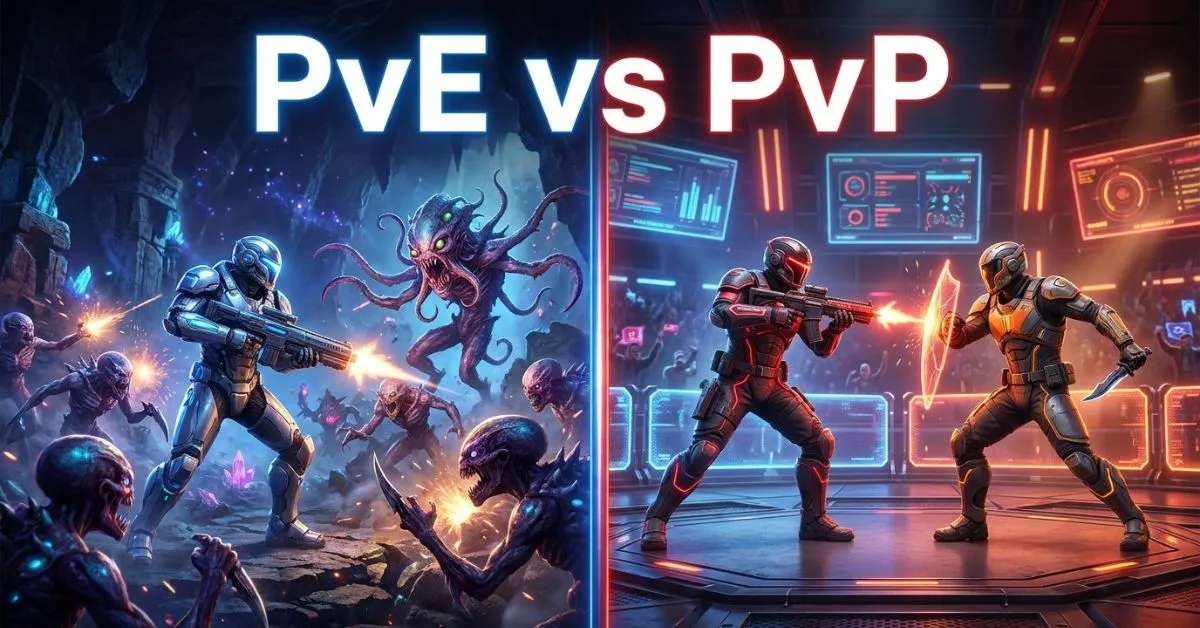
PvE vs PvP comes down to who or what you fight. PvE (Player vs. Environment) puts you against game-controlled enemies and challenges. PvP (Player vs. Player) puts you against other human players. Some games also offer PvPvE, which combines both.
The best choice depends on how you like to play. You may enjoy exploring a world, defeating bosses, and working with friends. Or you may prefer competing against real players and improving your skills through matches.
There is one important detail: the mode name does not tell you everything. A PvE game can have hard bosses and costly deaths. A PvP game can offer casual matches with little risk. Before you choose, check the combat rules, rewards, death penalties, and ways to play with friends.
Key Takeaways
- PvE: Fight game-controlled enemies, complete missions, and overcome challenges.
- PvP: Compete against other players in matches, battles, or shared worlds.
- PvPvE: Face human opponents and game-controlled threats in the same activity.
- Best for shared goals: Co-op PvE is a good fit if you enjoy working with others.
- Best for direct competition: PvP suits players who enjoy testing their skills against people.
- Best for mixed action: PvPvE combines enemy encounters with player-versus-player pressure.
- Before choosing: Check what happens to your gear, progress, and resources when you lose.
What Does PvE Mean in Gaming?
PvE stands for Player vs. Environment. It describes gameplay where the main challenge comes from the game itself. You may fight computer-controlled enemies, defeat bosses, complete quests, explore maps, or survive dangerous areas.
Your goal depends on the game. You might protect a base, finish a mission, collect supplies, or defeat a powerful enemy. Some PvE games focus on stories, while others focus on survival, crafting, or character progression.
Common PvE Activities
PvE can include:
- Story missions: Complete tasks and follow a game’s story.
- Boss fights: Learn enemy attack patterns and find a way to win.
- Co-op missions: Join friends to complete shared goals.
- Survival: Gather supplies, build shelter, and stay alive.
- Exploration: Search for useful items, hidden areas, or resources.
- Character progression: Earn experience, unlock skills, and improve your gear.
PvE does not mean single-player. You can play alone or with other people. In co-op PvE, your teammates work with you against shared threats instead of serving as your main opponents.
Real PvE Example: Fortnite Save the World
Fortnite Save the World is a clear example of PvE. Epic Games describes it as a cooperative campaign in which players defend against monster hordes. Its gameplay includes building defenses, crafting weapons, finding loot, and leveling up heroes. Players can tackle its challenges solo or with friends. Epic Games’ official Save the World guide explains the mode and its core features.
This example shows that PvE is not always easy. You may need to manage materials, plan your defenses, choose suitable weapons, and work with teammates. The main challenge comes from completing the game’s objectives, not from defeating other players.
What Does PvP Mean in Gaming?
PvP stands for Player vs. Player. It means you compete against other human players. These opponents make their own choices, change their plans, and react to your actions.
PvP can test your aim, movement, timing, strategy, teamwork, and decision-making. You may need to predict where an opponent will move, protect an objective, or change your approach when the other team adapts.
Common PvP Activities
PvP modes can include:
- Duels: One player fights another.
- Team battles: Groups compete against each other.
- Ranked matches: Players compete for a rank or rating.
- Battle royale: Players or teams try to be the last ones standing.
- Objective modes: Teams capture points or complete goals.
- Open-world PvP: Players can fight each other in a shared world when the rules allow it.
Not every PvP match is about getting the most eliminations. In an objective-based mode, a team may win by controlling areas or completing tasks. A player who supports the team and makes smart choices can help more than someone who only seeks fights.
Real PvP Example: Destiny 2 Crucible
Destiny 2’s Crucible offers several PvP modes. In Control, teams capture zones to earn points. In Elimination, teams fight in rounds and try to eliminate the opposing players. These rules create different goals within the same broad PvP category. Bungie’s official Destiny 2 Activities guide describes these modes.
The difference matters because PvP is not one single style of play. A mode based on controlling zones rewards map awareness and teamwork. A round-based elimination mode places more weight on survival, timing, and coordinated fights.
Is PvP Always Competitive?
No. Some games offer casual matches, private games, friendly duels, or optional PvP areas. Other modes use ranks, ratings, or seasonal rewards.
Before joining a mode, check whether losses affect your rank, whether you can lose items, and whether other players can attack you outside a match. These rules can change the experience more than the PvP label itself.
PvE vs PvP: Main Differences
The main difference is the source of the challenge. PvE focuses on game-controlled threats. PvP focuses on human opponents. However, the exact experience depends on the game’s rules.
| Feature | PvE | PvP |
|---|---|---|
| Main opponent | Game-controlled enemies or challenges | Human players |
| Main goal | Finish missions, survive, explore, or defeat enemies | Beat opponents or complete competitive objectives |
| Common skills | Planning, combat, exploration, resource use | Aim, timing, tactics, adaptation, teamwork |
| Enemy behavior | Follows the game’s systems and AI | Changes with players’ choices and skill |
| Teamwork | Often supports shared goals | May involve team competition or solo matches |
| Main pressure | Bosses, missions, timers, or survival limits | Opponents, time limits, or ranked results |
| Possible rewards | Gear, story progress, resources, or experience | Ranks, gear, cosmetics, or match rewards |
| Possible risks | Lost items, failed missions, or repeated attempts | Lost matches, lower ratings, or game-specific penalties |
These are common patterns, not fixed rules. Some PvE games are harder than some PvP games. Some PvP modes let you respawn without losing gear, while some PvE survival games punish death with lost resources. Always check the specific game’s rules.
PvE vs PvP: Which Is Harder?
Neither mode is always harder. The answer depends on the game, the challenge, and your experience.
Why PvE Can Be Hard
PvE enemies may have powerful attacks, complex patterns, or large health bars. Survival games can also limit food, tools, health, and safe places to rest.
You may need to prepare the right gear, learn a boss’s moves, manage resources, or coordinate with teammates. A mission can be difficult even when no human opponent is trying to stop you.
Why PvP Can Be Hard
PvP puts you against people who can change their plans and learn from your actions. You may need to react quickly, read the map, predict enemy moves, and work with your team.
Strong equipment does not always guarantee a win. Timing, positioning, and teamwork can change the result. Ranked modes can add pressure because your performance may affect your rating.
Choose PvE if you enjoy solving game challenges. Choose PvP if you enjoy adapting to human opponents. If both sound fun, look for a game that offers both.
PvE vs PvP: Rewards, Progress & Risk
Rewards depend on the game’s design, not just the mode name.
PvE Rewards & Risks
PvE may offer story progress, crafting materials, gear, levels, and achievements. It can suit players who enjoy improving their character over time.
But PvE does not always protect your progress. Some games make you repeat a mission after failure, lose resources after death, or prepare carefully before entering a dangerous area.
PvP Rewards & Risks
PvP may offer ranks, seasonal rewards, cosmetics, gear, or achievements. Competitive modes can help you track your progress against other players.
However, a win is not guaranteed. A loss may affect your rank in some modes, but other modes may have no ranking penalty at all. Rewards vary from game to game.
What Should You Check Before Playing?
Ask these four questions:
- Death rules: Do you respawn, restart the mission, or lose progress?
- Item rules: Do you keep your gear after defeat?
- Progress rules: Can a loss reduce your rank or remove earned items?
- World rules: Can other players attack your character, base, or stored resources?
These questions help you understand the real risk before you invest time in a game.
What Is PvPvE?
PvPvE stands for Player vs. Player vs. Environment. It combines human opponents with computer-controlled enemies or other game challenges.
You may need to defeat AI enemies, collect items, complete an objective, and watch for rival players at the same time. A fight against an AI enemy may leave you open to an attack from another player. A rival may also try to take the same resources or stop you from reaching your goal.
PvPvE is not one fixed game mode. The mix of player combat, AI threats, teamwork, and rewards depends on the game.
Real PvPvE Example: Destiny 2 Gambit
Destiny 2’s Gambit shows how PvPvE can work. Players fight waves of computer-controlled enemies and collect motes. Their team banks those motes to progress toward summoning a boss.
At the same time, the team races against another team completing the same task. Players can also invade the rival side and attack its players. Bungie’s official activity guide explains Gambit’s core loop.
This example combines three pressures:
- PvE pressure: Defeat enemies and collect motes.
- Objective pressure: Help your team progress toward the boss.
- PvP pressure: Deal with invasions and the rival team’s progress.
The key trade-off is that focusing on one threat can make you less ready for another. You may be doing well against AI enemies but still lose time or momentum when the other team interferes.
Common PvPvE Designs
| Design | How it works | Main trade-off |
|---|---|---|
| Shared objectives | Teams fight AI enemies while racing or competing with another team | You must balance the objective with player threats |
| Mixed combat areas | Players face AI enemies and can also fight other players | Fighting one threat may expose you to another |
| Loot-and-extract gameplay | Players search for resources while facing AI enemies and possible rival players, then try to leave with their loot | Valuable loot may create a reason to take risks, but losing a fight can threaten the run |
These are broad design patterns, not rules for every game. Some games use only one of these formats, and the consequences of defeat can vary greatly.
PvE vs PvP vs PvPvE: Which Should You Choose?
Use this player-scenario matrix to match your preferences with a starting mode.
| Your situation | Mode to try first | Why it may fit |
|---|---|---|
| You want to learn controls without fighting skilled players | PvE | You can focus on the game’s enemies and systems |
| You enjoy story missions and exploration | PvE | Progress often centers on game content |
| You want to fight bosses and learn their attack patterns | PvE | You can focus on a set encounter |
| You like helping friends reach a shared goal | Co-op PvE | Your team works against common threats |
| You want to improve aim and reactions against people | PvP | Human opponents make different choices |
| You enjoy rankings and competitive matches | Ranked PvP | Some modes track competitive performance |
| You want AI enemies and rival players in the same activity | PvPvE | Both types of threats can shape your choices |
| You like collecting loot but enjoy taking calculated risks | PvPvE, if the game offers it | Rival players can make a resource run less predictable |
| You prefer to build and explore with less direct player conflict | PvE mode or server, if available | The rules may limit player attacks |
| You enjoy different styles depending on your mood | A game with multiple modes | You can switch between different challenges |
This matrix is a starting point, not a promise. Check the rules of the specific game before choosing a mode or server.
Is PvE Better for Beginners?
PvE can be a useful starting point because it lets you learn controls, maps, gear, and combat without making human opponents your main challenge. You may have more time to understand the game before trying competitive matches.
But PvE is not always easy. Some games have complex crafting systems, hard bosses, or strict survival rules. If you are new, look for tutorials, adjustable difficulty, or beginner-friendly missions.
Is PvP Better for Experienced Players?
PvP can appeal to experienced players who enjoy competition, quick decisions, and learning from opponents. It can also suit beginners who prefer short matches and direct action.
Experience alone does not decide whether PvP is right for you. Think about whether you enjoy repeated matches, learning from losses, teamwork, and adapting to other people. If you are unsure, try a casual mode before moving to ranked play.
PvE vs PvP in Survival Games
Survival games make this choice important because your actions may affect more than one match.
In a PvE survival world, you may gather supplies, build a base, craft gear, explore, and fight computer-controlled enemies. Other players may share the world without being allowed to attack you directly, depending on the rules.
In a PvP survival world, players may be able to attack your character, raid your base, or take resources. This can make exploration more tense, but it may also cost you time and supplies.
Do not assume every PvE server is risk-free or every PvP server allows combat everywhere. Some games use safe zones, protected areas, event rules, or limits on player actions.
What to Check Before Joining a Survival Server
Read the server rules before spending hours building or collecting items.
- Player combat: Can other players attack you anywhere or only in certain areas?
- Base damage: Can other players destroy your buildings?
- Offline raiding: Can your base be attacked while you are away?
- Death penalties: What happens to your inventory when you die?
- Server wipes: Can the world or your progress reset?
- Resource rules: Can other players take or block access to key resources?
- Protection settings: Are there safe zones, raid limits, or protection timers?
- Community rules: Are cheating or certain forms of player interference restricted?
These checks help you choose a server that fits your schedule, risk tolerance, and play style.
Can a Game Have Both PvE & PvP?
Yes. A game can offer separate PvE and PvP modes, or it can mix both in one activity. It may use different servers, areas, playlists, or events.
Destiny 2 is a useful example because its Strikes are cooperative activities where fireteams complete objectives and face enemies, its Crucible offers PvP modes, and Gambit combines AI enemies with competition against another team. These examples show that a single game can support very different ways to play.
This is why you should check the exact mode, not just the game’s name. Two players can play the same game but have very different experiences because they choose different activities or rules.
FAQs:
Does PvE mean single-player?
No. PvE means the main challenge comes from the game environment or computer-controlled enemies. You can play alone or with others if the game supports co-op.
Does PvP mean fighting other players?
Yes. PvP involves player-versus-player competition. It may include duels, team battles, ranked matches, or objective-based modes. The exact rules depend on the game.
Is PvE easier than PvP?
Not always. PvE can be hard because of bosses, survival limits, or complex missions. PvP can be hard because human opponents adapt to your actions. The difficulty depends on the game and your skills.
Can you play PvE with friends?
Yes, if the game supports co-op play. You and your friends can work together to finish missions, defeat enemies, gather resources, or survive.
Can you lose items in PvE?
Yes. Some games remove items or resources when you die, even if you are not fighting other players. Check the game’s death and inventory rules before taking valuable gear into a risky area.
Is PvPvE the same as PvP?
No. PvP centers on human opponents. PvPvE combines human players with game-controlled enemies or challenges. Both types of threats can affect the same activity.
Which is better: PvE or PvP?
Neither is best for everyone. Choose PvE if you enjoy missions, exploration, bosses, or co-op goals. Choose PvP if you enjoy direct competition and adapting to real opponents. Try PvPvE if you want a mix of both.
Conclusion:
The main difference between PvE vs PvP is the source of the challenge. PvE focuses on game-controlled enemies and objectives. PvP tests you against other people. PvPvE brings both types of threats into one activity.
If you want to explore, complete missions, or work toward a shared goal, start with PvE. If you enjoy direct competition and learning from human opponents, try PvP. If you want to manage AI enemies while watching for rival players, PvPvE may be a better fit.
Before choosing, check the rules for death, loot, player combat, and server protection. These details can shape your experience more than the mode name alone. Start with the style that fits your preferences, then try another mode if you want a different kind of challenge.
Research note: The game-specific examples above are based on official Epic Games and Bungie documentation. Gameplay rules and available activities can change, so check the current official guide for the game you plan to play.

Olivia Smith is a professional author at ReplyGenius.com, where I create clear and engaging content on communication and writing.