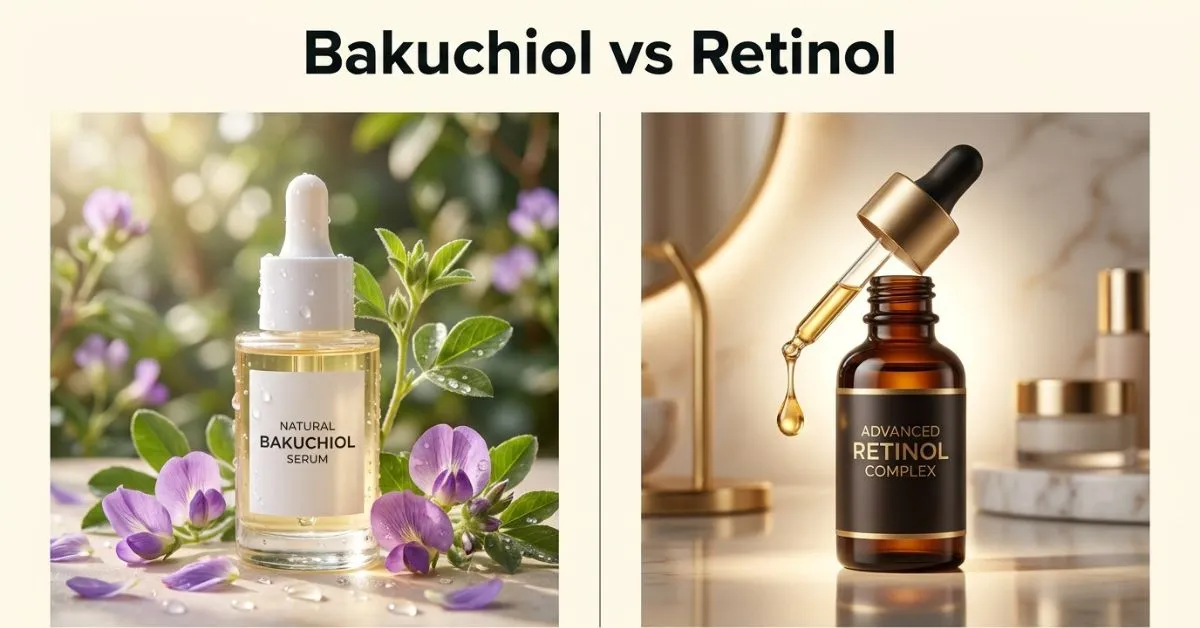
Bakuchiol vs. retinol comes down to your skin goals, your tolerance, and the strength of the evidence. Retinol has a longer research history for signs of skin aging.
Bakuchiol may help with fine lines and dark spots, and some people may find it easier to use. However, research on bakuchiol is still limited. Neither ingredient is right for everyone.
Key Takeaways
- Retinol: A vitamin A ingredient with more research for visible signs of skin aging.
- Bakuchiol: A plant-derived ingredient with early but limited research.
- Sensitive skin: Bakuchiol may cause less irritation for some people, but it can still cause a reaction.
- Fine lines and dark spots: Both showed improvement in one small, 12-week study.
- Acne: Some retinoids are proven acne treatments. Bakuchiol is not a proven replacement.
- Pregnancy: Avoid retinol and do not assume bakuchiol is safe. Ask your doctor before use.
What Is Bakuchiol?
Bakuchiol is a plant-derived ingredient found in skincare products. It comes from the babchi plant and is often sold as a gentle alternative to retinol.
Bakuchiol is not a form of vitamin A. It is also not a retinoid. Still, early research suggests it may help improve the look of fine lines, wrinkles, and uneven skin tone.
The main limit is the evidence. A 2024 review looked at 15 human clinical trials of topical bakuchiol. Twelve had no control group, and 10 tested bakuchiol with other ingredients. This makes it hard to tell how much of the reported benefit came from bakuchiol alone.
What this means: Bakuchiol is promising, but more strong human studies are needed. Its effects may also vary by product and formula.
Potential Benefits of Bakuchiol
Bakuchiol may offer these benefits:
- Fine lines: It may help soften the look of some wrinkles.
- Uneven skin tone: It may help reduce the look of some dark spots.
- Skin comfort: Some people may find it easier to tolerate than retinol.
- Plant-derived care: It may appeal to people who prefer plant-based skincare ingredients.
These benefits are not guaranteed. The formula, the other ingredients, and your skin all affect the results.
Bakuchiol is not automatically gentle just because it comes from a plant. It may cause redness, itching, dryness, or an allergic skin reaction.
If a product causes strong burning, swelling, or a lasting rash, stop using it. Seek medical advice if the reaction is severe or does not improve.
What Is Retinol?
Retinol is a form of vitamin A used in many over-the-counter skincare products. It belongs to a group of ingredients called retinoids.
Your skin changes as you age. Sun exposure can also cause fine lines, rough texture, and dark spots. Retinol can help improve some of these visible changes over time.
Your skin changes retinol into more active forms. These forms affect how skin cells grow and mature. Retinol may also help support collagen, a protein that helps keep skin firm.
Retinol is not the same as prescription treatments such as tretinoin. These products differ in strength, use, and evidence. Results from one product should not be treated as proof that all retinoids work in the same way.
Potential Benefits of Retinol
Retinol may help improve:
- Fine lines and wrinkles: It can soften the look of some signs of aging.
- Uneven tone: It may help fade some dark spots.
- Rough texture: It can help skin look smoother.
- Sun-related skin changes: It may improve some visible signs of sun damage.
Results take time. A stronger product is not always a better choice. A product that suits your skin and that you can use as directed may be more useful than one that causes ongoing irritation.
Possible Side Effects of Retinol
Retinol can cause dryness, redness, peeling, burning, or stinging. These effects are more likely when you first start or use the product too often.
To lower the risk of irritation:
- Start with a low-strength product.
- Use it less often at first, as the label allows.
- Apply moisturizer to help reduce dryness.
- Use broad-spectrum sunscreen with SPF 30 or higher each day.
If your skin becomes very sore, swollen, or stays red and irritated, stop using the product and seek medical advice.
Bakuchiol vs Retinol: Main Differences
| Feature | Bakuchiol | Retinol |
|---|---|---|
| Ingredient type | Plant-derived compound | Vitamin A derivative |
| Main use | Signs of aging and uneven tone | Signs of aging and uneven tone |
| Research | Promising but limited | Longer research history |
| Fine lines | May improve their appearance | May improve their appearance |
| Dark spots | Early evidence of benefit | More established use in skincare |
| Irritation | May be easier to tolerate for some | Can cause dryness and peeling |
| Acne | Evidence is limited | Some retinoids treat acne |
| Pregnancy | Safety is not well established | Avoid during pregnancy |
| Best fit | People seeking a non-retinoid option | People seeking a well-studied aging-skin ingredient |
Neither ingredient wins for every person. Your skin goals, medical needs, and response to a product should guide your choice.
Is Bakuchiol as Effective as Retinol?
The short answer is we do not know if bakuchiol works as well as retinol in all cases.
A 2019 study in the British Journal of Dermatology compared two creams over 12 weeks. One contained 0.5% bakuchiol and was used twice a day. The other contained 0.5% retinol and was used once a day.
The study included 44 people. Both groups showed less wrinkle surface area and less skin discoloration. The researchers found no clear difference between the groups. People in the retinol group reported more skin scaling and stinging.
However, this study has limits:
- It included only 44 people.
- It lasted 12 weeks.
- It tested two specific creams, not every product on the market.
- The creams were used at different daily rates.
- It did not prove that bakuchiol matches prescription retinoids.
A 2024 review also found that many bakuchiol studies had weak methods or used products with other active ingredients.
The practical answer: Bakuchiol may help improve some signs of skin aging and may be easier for some people to tolerate. Retinol has a stronger research base. More studies are needed before we can say the two work equally well.
Which Is Better for Your Skin?
The best choice depends on what you want to improve and how your skin responds.
For Fine Lines & Wrinkles
Retinol is a strong option if your main goal is to improve visible signs of skin aging and your skin can tolerate it.
Bakuchiol may also help soften the look of fine lines. It may suit people who do not tolerate retinol well. However, its research base is smaller.
Neither ingredient removes every wrinkle. Daily sun protection also matters because sun exposure contributes to skin aging.
For Sensitive Skin
Bakuchiol may be worth trying if retinol causes dryness, peeling, or stinging. In the 2019 study, people who used retinol reported more scaling and stinging.
But sensitive skin can react to bakuchiol, too. Other ingredients in the formula, such as fragrance, may also cause problems.
If your skin is already red, cracked, or inflamed, pause products that make it worse. A dermatologist can help you choose a routine that fits your skin.
For Acne
Do not rely on bakuchiol as a proven acne treatment. Some studies have explored its use for acne, but the evidence is limited.
Certain retinoids, such as adapalene and prescription tretinoin, have established roles in acne care. Cosmetic retinol is not the same as these treatments.
If you have painful acne, deep spots, or acne scars, ask a dermatologist for help. The right treatment may prevent further marks and scars.
If you are pregnant or planning a pregnancy, speak with your doctor before using acne products.
For Dark Spots & Uneven Skin Tone
Both ingredients may improve the look of some dark spots. The 2019 study found improvement in both groups, but it cannot predict how every product will work.
Sunscreen is a key part of dark-spot care. Choose a broad-spectrum sunscreen with SPF 30 or higher and use it every day. Sun exposure can make dark spots darker and lead to new ones.
If a dark patch changes, grows, or does not improve, ask a dermatologist to check it. Different skin problems can look alike but need different care.
For People Who Want a Non-Retinoid Option
Bakuchiol may suit people who want to try a non-retinoid ingredient for signs of aging.
But do not choose it only because it is plant-derived. Natural ingredients can still cause side effects. Check the full ingredient list and follow the product directions.
If you need treatment for acne or another skin condition, ask a healthcare professional whether bakuchiol is suitable for your needs.
Can You Use Bakuchiol & Retinol Together?
Some products contain both ingredients. Some people also use them in the same routine. However, strong evidence does not show that using both always gives better results or prevents retinol irritation.
The 2019 study compared separate bakuchiol and retinol treatments. It did not test whether using both together was better.
If you are new to either ingredient, start with one product at a time. This makes it easier to spot a reaction and see what works.
Check the full label. A product sold as a bakuchiol serum may also contain retinol or other active ingredients.
If retinol already works well for your skin, you may not need to add bakuchiol. A simple routine that you can follow is often easier to maintain.
How to Use Bakuchiol or Retinol
Follow these steps to lower the risk of irritation:
- Start with one product. Do not add several new active ingredients at once.
- Read the label. Follow the directions for your product.
- Start retinol slowly. Use it less often at first if the label allows. Increase use only as your skin tolerates it.
- Use moisturizer. This can help reduce dryness and support your skin barrier.
- Wear sunscreen daily. Choose broad-spectrum SPF 30 or higher.
- Watch for reactions. Stop using the product if you develop a strong or lasting reaction.
A patch test may help you spot a reaction before you use a product on your whole face. It cannot guarantee that you will never have a reaction.
Do not judge a product after only a few uses. The 2019 study lasted 12 weeks, but this does not mean every product will show results in that time.
Also, check the full formula. Two products with the same main ingredient can act differently because they have different strengths, bases, and other ingredients.
Is Bakuchiol Safe During Pregnancy?
Do not assume bakuchiol is safe during pregnancy just because it comes from a plant or is not a retinoid. Its safety during pregnancy has not been well established.
The American Academy of Dermatology advises people who are pregnant to avoid retinoids, including retinol. If you are pregnant, trying to become pregnant, or breastfeeding, ask your doctor which skincare products are right for you.
Check the full ingredient list, not just the claims on the front of the package. If you are unsure about a product, wait until your healthcare professional confirms that it is suitable for you.
FAQs:
Does bakuchiol cause purging?
There is not enough evidence to say that bakuchiol causes skin purging in a predictable way. New bumps may be acne, irritation, or a reaction to another ingredient. Stop using the product if you develop a painful or lasting rash.
Does retinol work faster than bakuchiol?
There is not enough strong evidence to prove that retinol always works faster. One small study found improvement with both ingredients over 12 weeks. Results can vary by product and person.
Can bakuchiol replace retinol?
Bakuchiol may be an option for people who want a non-retinoid product for signs of aging. But it has not been shown to work as well as retinol for every skin concern. It is not a full replacement for prescription retinoids.
Can you use bakuchiol every day?
That depends on the product and your skin. Follow the label, start with one new product, and watch for irritation. Plant-derived does not mean reaction-free.
Is bakuchiol safe during pregnancy?
Its safety during pregnancy has not been well established. Do not treat it as a proven pregnancy-safe alternative to retinol. Ask your doctor before using it.
Conclusion:
In the bakuchiol vs retinol comparison, retinol has the longer research history for visible signs of skin aging. Bakuchiol is a promising non-retinoid option that may help with fine lines and uneven tone. Some people may also find it easier to tolerate.
Still, one small study does not prove that both ingredients work equally well for everyone. Choose a product based on your skin goals, tolerance, and the full formula. Use sunscreen each day, add new products one at a time, and seek medical advice for ongoing skin problems or questions about pregnancy.