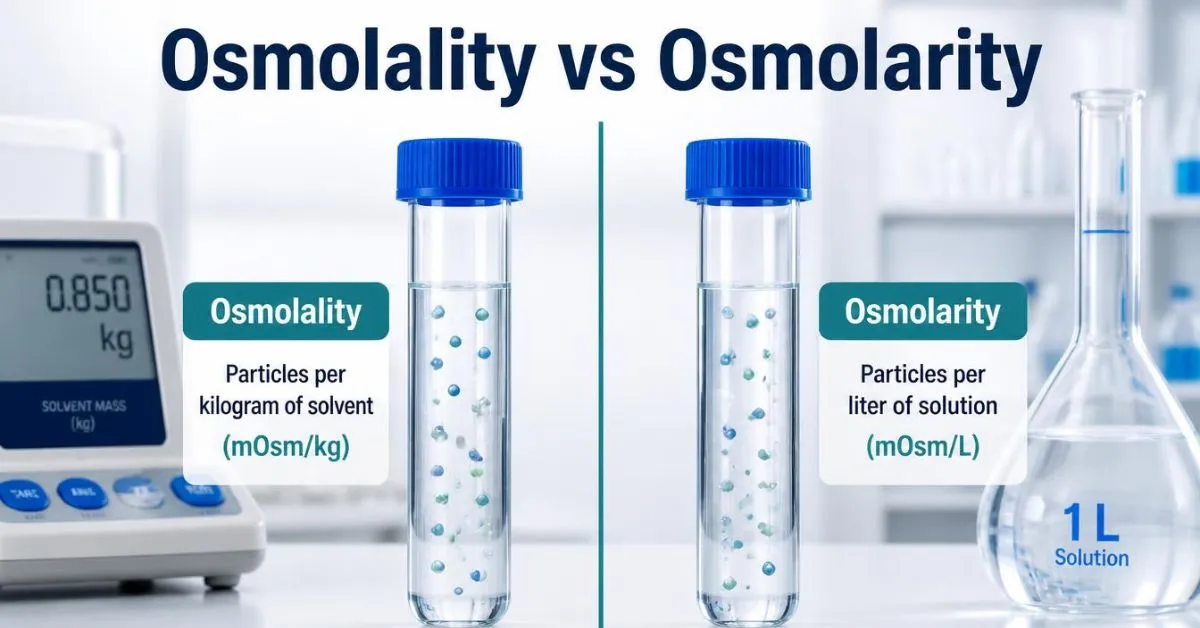
Osmolality vs. osmolarity comes down to how dissolved particles are measured. Osmolality measures osmoles per kilogram of solvent. Osmolarity measures osmoles per liter of solution.
Their values can be close in dilute body fluids, but they are not the same. This difference matters in lab tests, body fluid balance, and IV fluid care.
Key Takeaways
- Osmolality: Osmoles per kilogram of solvent, usually water.
- Osmolarity: Osmoles per liter of the full solution.
- Medical tests: Blood and urine osmolality help doctors assess water balance.
- Formulas: Calculated osmolality is an estimate, not a direct lab measurement.
- Tonicity: Shows how a solution may affect cell size.
What Is Osmolality?
Osmolality measures the number of dissolved particles in a set mass of solvent. In blood and urine, the solvent is mainly water.
These particles include sodium, other ions, glucose, and urea. More particles in the same amount of water mean higher osmolality.
Osmolality is usually reported in milliosmoles per kilogram of water (mOsm/kg H₂O).
Doctors use blood osmolality to help check water balance. Urine osmolality shows how dilute or concentrated urine is. Together, these tests can help doctors assess how the body handles water.
How Is Osmolality Measured?
A lab can measure osmolality with an instrument called an osmometer. One common method uses freezing-point depression.
Dissolved particles lower the freezing point of water. The instrument measures this change and uses it to find the sample’s osmolality.
There are two main ways to get an osmolality value:
- Measured osmolality: A lab tests the sample with an osmometer.
- Calculated osmolality: A formula estimates the value from selected lab results.
These values may be close, but they are not always the same. A formula may leave out particles that affect the measured result.
What Is Osmolarity?
Osmolarity measures the number of dissolved particles in a set volume of solution.
It is usually reported in milliosmoles per liter (mOsm/L).
For example, salt can split into sodium and chloride ions when it dissolves in water. These particles contribute to the solution’s osmolarity.
Osmolarity is used in chemistry, biology, and medicine. It helps describe lab solutions and IV fluids.
However, osmolarity alone does not tell you how a fluid will affect cells. That also depends on which particles can cross the cell membrane.
Osmolality vs Osmolarity: Key Differences
| Feature | Osmolality | Osmolarity |
|---|---|---|
| Definition | Osmoles per kilogram of solvent | Osmoles per liter of solution |
| Common unit | mOsm/kg H₂O | mOsm/L |
| Based on | Mass | Volume |
| Effect of temperature | Mass stays the same | Volume can change |
| Common method | Measured with an osmometer or calculated | Often calculated from solution makeup |
| Medical use | Common in blood and urine tests | Used to describe solution concentration |
| Relationship | May be close to osmolarity in dilute fluids | May be close to osmolality in dilute fluids |
The key difference is the reference used for each measurement. Osmolality uses the mass of the solvent. Osmolarity uses the volume of the whole solution.
Their values may be close in dilute body fluids, but their units are different. Do not treat them as the same measurement.
A 2025 review in the European Journal of Medical Research explains why this difference matters when comparing fluids with different water content.
Why Can Osmolality & Osmolarity Differ?
The difference comes from how each value is worked out.
A solution contains:
- Solvent: The liquid that dissolves another substance, such as water.
- Solute: A substance that dissolves, such as salt or glucose.
- Solution: The full mixture of solvent and solutes.
Osmolality is based on the mass of the solvent alone. Osmolarity is based on the volume of the full solution.
Mass does not change when temperature changes. Volume can change with temperature. Also, dissolved substances affect the final volume of a solution.
For these reasons, the two values do not always match.
This matters in the body, too. Blood plasma and red blood cells have different amounts of water and different distributions of dissolved substances. A value based on volume may not give the same result as one based on solvent mass.
The 2025 review discusses these differences in body fluids and IV solutions. It also explains why the right measurement matters when comparing fluids used in patient care.
Osmolality vs Osmolarity Formulas
The basic formulas are:
Osmolality
Osmolality = osmoles of dissolved particles ÷ kilograms of solvent
Osmolarity
Osmolarity = osmoles of dissolved particles ÷ liters of solution
These formulas show what goes in the bottom of each calculation. Real values also depend on the particles in the solution and how they behave.
Osmolarity Example: Salt in Water
Suppose a solution contains 1 mole of sodium chloride per liter.
In an ideal case, sodium chloride splits into two main types of particles: sodium ions and chloride ions.
This gives about 2 osmoles of particles per liter, so the ideal osmolarity is about 2 Osm/L, or 2,000 mOsm/L.
This is a simplified example. Real solutions may behave differently because dissolved particles interact with one another.
How Do You Calculate Serum Osmolality?
A commonly used clinical estimate in the United States is:
Calculated serum osmolality ≈ 2 × sodium + glucose ÷ 18 + BUN ÷ 2.8
Use these units:
- Sodium: mmol/L or the numerically equivalent mEq/L
- Glucose: mg/dL
- BUN (blood urea nitrogen): mg/dL
For example, suppose the results are:
| Test | Result |
|---|---|
| Sodium | 140 mmol/L |
| Glucose | 90 mg/dL |
| BUN | 14 mg/dL |
Now use the formula:
- (2 \times 140 = 280)
- (90 \div 18 = 5)
- (14 \div 2.8 = 5)
Add the values:
280 + 5 + 5 = 290 mOsm/kg
The estimated serum osmolality is 290 mOsm/kg.
This is a calculated estimate, not a direct measurement. Different clinical formulas may use different terms or factors. Some labs use a formula with an added factor for glucose. Always follow the method used by the lab when reviewing a clinical result.
Which Is More Accurate: Osmolality or Osmolarity?
Neither is always more accurate. They measure different things.
For blood and urine testing, labs commonly measure osmolality with an osmometer. A calculated value estimates osmolality from selected substances in the sample.
A calculated result can be useful, but it may not include every substance that affects the measured result.
When you read a lab report, check three things:
- Was the value measured or calculated?
- Which unit does the report use?
- Which formula and reference range apply?
A number alone does not tell the whole story. Similar values do not mean the two measurements are interchangeable.
Why Do Doctors Measure Osmolality?
Osmolality tests help doctors assess the balance between water and dissolved particles in the body.
A serum or plasma osmolality test measures the concentration of particles in blood. A urine osmolality test shows how concentrated the urine is.
Doctors may use these tests to help assess:
- Dehydration or excess water
- Low or high blood sodium
- Unusual thirst or frequent urination
- Kidney problems that affect water balance
- Possible diabetes insipidus
- Possible exposure to certain toxic substances
In some cases, doctors may also use stool osmolality when they assess certain causes of ongoing diarrhea.
An abnormal result does not prove a disease. Doctors look at symptoms, medical history, and other lab results before deciding what it means.
What Is the Osmolal Gap?
The osmolal gap is the difference between measured serum osmolality and calculated serum osmolality.
Osmolal gap = measured osmolality − calculated osmolality
For example, suppose:
- Measured osmolality = 310 mOsm/kg
- Calculated osmolality = 290 mOsm/kg
Then:
Osmolal gap = 310 − 290 = 20 mOsm/kg
This means the measured value is 20 units higher than the calculated estimate.
A high gap can point to substances that the formula does not fully account for. These may include ethanol, methanol, ethylene glycol, isopropanol, or other compounds.
However, the gap depends on the formula used. Ethanol can also affect the result if the calculation does not include it.
A value above 10 or 15 mOsm/kg may be considered high in some clinical settings. There is no single cutoff that works for every formula or patient.
Important: A high gap does not prove poisoning. A normal gap does not rule out every case of toxic alcohol poisoning. If toxic alcohol exposure is possible, seek emergency medical care. Do not wait for a gap calculation to decide whether help is needed.
Osmolality vs Osmolarity vs Tonicity
These three terms are related, but they do not mean the same thing.
- Osmolality: Counts particles per kilogram of solvent.
- Osmolarity: Counts particles per liter of solution.
- Tonicity: Describes how a solution affects cell volume.
Tonicity depends mainly on particles that cannot cross a cell membrane freely. These particles can cause water to move into or out of cells.
For example, urea adds to measured osmolality. But it can cross many cell membranes. For this reason, urea often has less effect on lasting cell swelling or shrinking than particles that cannot cross the membrane as easily.
Sodium salts are important to tonicity because sodium is a major part of the fluid outside cells.
Two solutions can have similar total particle concentrations but affect cells in different ways. So, osmolarity alone cannot tell you whether a solution will make cells swell or shrink.
Real-World Examples: When Does the Difference Matter?
| Situation | What matters most? | Why |
|---|---|---|
| Blood test | Serum osmolality | Helps assess water balance and dissolved particles |
| Urine test | Urine osmolality | Shows how concentrated the urine is |
| IV fluid | Product-specific concentration and clinical properties | Osmolarity alone does not show the full effect on cells |
| Possible toxic alcohol exposure | Measured osmolality and osmolal gap | May help identify unmeasured substances |
| Cell swelling or shrinking | Tonicity | Depends on how solutes cross the cell membrane |
The right measure depends on the question. Blood and urine tests often use osmolality, while solution chemistry may use osmolarity. Tonicity helps explain how a fluid affects cells.
FAQs:
Are osmolality and osmolarity the same?
No. Osmolality measures particles per kilogram of solvent. Osmolarity measures particles per liter of solution. Their values may be close in dilute fluids, but the units and meanings differ.
What is the normal range for serum osmolality?
A common adult reference range is about 275–295 mOsm/kg H₂O. The range may vary by lab and clinical setting. Use the range printed on your own lab report.
Is osmolarity always higher than osmolality?
No. There is no universal rule that osmolarity must be higher or lower. Their relationship depends on the solution, its water content, and its physical properties.
Why is osmolality commonly used in medical testing?
Osmolality is based on the mass of the solvent and can be measured directly with an osmometer. It is useful in blood and urine tests because it helps doctors assess water balance. Calculated estimates can also help, but their accuracy depends on the formula and the substances included.
Does high osmolality always mean dehydration?
No. Dehydration is one possible cause. Sodium, glucose, and other substances can also affect blood osmolality. Doctors use the result with other tests and symptoms to find the cause.
What is the difference between the osmolal gap and osmolality?
Osmolality measures the concentration of dissolved particles per kilogram of solvent. The osmolal gap compares measured osmolality with a calculated estimate. Doctors may use it to investigate unmeasured substances, but it cannot confirm or rule out poisoning on its own.
Conclusion:
The main difference between osmolality and osmolarity is how dissolved particles are measured. Osmolality uses a kilogram of solvent, while osmolarity uses a liter of solution.
Their values can be close in dilute body fluids, but they are not the same measurement. In medicine, it also matters whether osmolality was measured or calculated. The osmolal gap can help doctors look for unmeasured substances, while tonicity helps explain how fluids affect cell size.
When reviewing a lab result, check the unit, method, and reference range. These details help you understand what the number means and avoid comparing values that measure different things.

Harry Jack is a content writer at ReplyGenius.com who specializes in practical, natural sounding replies for texts, social media, relationships, and everyday conversations.