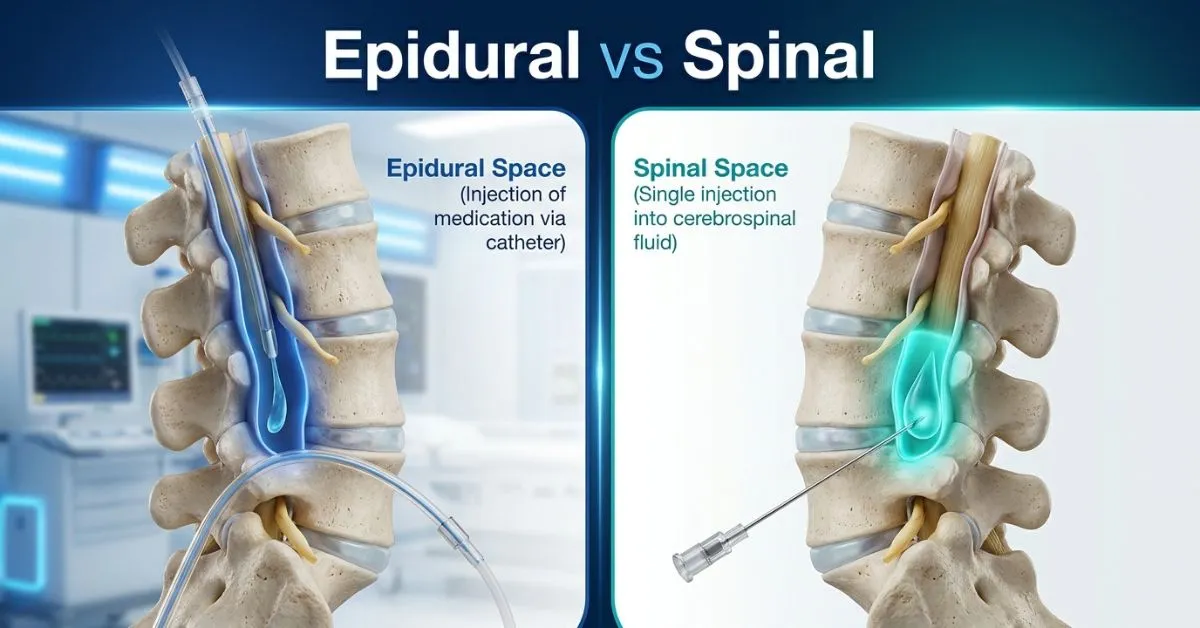
Epidural vs. spinal anesthesia comes down to where the medicine goes and how it is given. An epidural places medicine outside the sac that holds spinal fluid.
A spinal puts medicine into that fluid. A spinal usually works faster, while an epidural uses a thin tube to give more medicine as needed. Both can block pain during labor and surgery.
Key Takeaways
- Epidural: Often used during labor because pain relief can continue through a thin tube.
- Spinal: Usually works within minutes and gives a strong block for a set time.
- C-section: Spinal anesthesia is common for planned C-sections. An epidural may also be used.
- Risks: Both can cause low blood pressure, numbness, headache, and rare serious problems.
- Recovery: Most people regain feeling and strength as the medicine wears off.
- Best choice: Your health, procedure, and care needs help guide the choice.
Epidural vs Spinal: What’s the Difference?
An epidural and a spinal are both types of regional anesthesia. They block pain in part of the body without always needing general anesthesia. The main difference is where the medicine goes.
An epidural places medicine in the epidural space. This space lies outside the sac that holds the fluid around the spinal nerves. A thin tube, called a catheter, often stays in place. The care team can use it to give more medicine.
A spinal puts medicine into the fluid around the spinal nerves. It is usually given as one shot with a fine needle. It works fast and often gives a strong block of pain and feeling in the lower body.
Neither method is best for every person or procedure. Your anesthesiologist will consider how fast the block must work, how long it must last, and your health needs.
Epidural vs Spinal: Comparison Table
| Feature | Epidural | Spinal |
|---|---|---|
| Where medicine goes | Epidural space | Fluid around spinal nerves |
| How it is given | Often through a thin tube | Usually one injection |
| How fast it works | Often 10–20 minutes | Usually within minutes |
| How long it lasts | Can be continued with more medicine | Limited by the drug and dose |
| Dose changes | More medicine can be given through the tube | The original dose cannot be topped up |
| Labor pain relief | Commonly used | Used in selected cases |
| Planned C-section | Can be used | Commonly used |
| Main benefit | Ongoing, adjustable pain relief | Fast, strong block |
| Main limit | May take longer or work unevenly | Has a set period of action |
These are general patterns, not guarantees. The drug, dose, and type of procedure can change how each method works.
How Does an Epidural Work?
An epidural is often used during labor. It can also help control pain during some operations and after certain surgeries.
First, the care team cleans your lower back. They numb the skin with local anesthetic. Then, the clinician guides a needle into the epidural space and passes a thin tube through it.
The needle is removed, but the tube usually stays in place. Medicine flows through the tube and blocks pain signals from the lower body.
The care team can give more medicine or change the dose as needed. This makes an epidural useful when pain relief must continue for hours.
Benefits of an Epidural
- It can provide pain relief over a long period.
- The dose can be changed as labor or treatment continues.
- It may help reduce the need for other pain medicines.
- An existing epidural tube may be used for a C-section if it provides a good enough block.
Limits of an Epidural
An epidural may not block pain evenly. One side may feel more numb than the other. Pain relief may also fade or fail to cover every area.
If this happens, the care team may change your position, adjust the dose, or replace the tube. Another type of anesthesia may be needed if the block does not work well enough.
You may still feel pressure or movement during labor or surgery. But sharp or strong pain during a C-section should be reported to the anesthesia team right away.
How Does Spinal Anesthesia Work?
Spinal anesthesia is usually given as one shot in the lower back.
First, the clinician cleans the area and numbs the skin. Then, a fine needle passes into the fluid around the spinal nerves. The medicine is injected, and the needle is removed.
The medicine usually works within minutes. It can block pain and feeling in the lower body. Your legs may also feel weak until the drug wears off.
Spinal anesthesia is often used for planned C-sections and some operations on the lower abdomen, hips, legs, or urinary tract.
A standard spinal shot does not leave a tube in place for more medicine. The anesthesiologist must choose a drug and dose that suit the expected length of the procedure.
Benefits of Spinal Anesthesia
- It usually works fast.
- It often gives a strong block for surgery.
- It does not usually need a tube to stay in your back.
- It can be a good choice when a fast block is needed for a procedure of limited length.
Limits of Spinal Anesthesia
A single spinal dose lasts for a limited time. The care team cannot add more medicine through the same needle after the shot is complete.
The block may also last longer or shorter than expected. The choice must take into account the procedure, your health, and the medicine used.
Epidural vs Spinal for Labor
An epidural is a common choice for labor because it can keep working as labor goes on.
If contractions become more painful, the care team can give more medicine through the tube. Your legs may feel heavy or weak, depending on the dose and type of medicine.
An epidural may also affect your bladder. You may need help to pass urine while the block is active.
Some low-dose methods allow more movement, but not everyone can walk safely with an epidural. Do not get out of bed until your care team says it is safe.
A single spinal shot may give fast pain relief in selected cases. But it often does not last long enough to cover an entire labor.
A combined spinal-epidural (CSE) uses both methods. The spinal part gives fast relief, while the epidural tube allows more medicine later.
The best option depends on your needs, health, and the stage of labor. Ask your care team to explain the benefits and risks before you decide.
Epidural vs Spinal for a C-Section
Spinal anesthesia is common for a planned C-section. It works fast and often gives a strong block for surgery.
An epidural may also be used. This is more likely if an epidural tube is already in place for labor.
If a C-section becomes necessary, the anesthesiologist may give a stronger dose through the existing tube. But this does not always provide enough anesthesia for surgery.
The team checks the block before surgery starts. If it is not strong enough, they may give more medicine, use another method, or switch to general anesthesia.
The choice may depend on:
- Whether the C-section is planned or urgent
- Whether an epidural tube is already in place
- How well the epidural has worked so far
- Your health and the medicines you take
- How fast the block is needed
- How long the surgery may take
No single method is best for every C-section.
If you feel sharp or strong pain during a C-section, tell your anesthesiologist at once. You do not have to stay quiet or bear the pain. The team should check the cause and treat your pain.
Which Works Faster: Epidural or Spinal?
Spinal anesthesia usually works faster. It often starts within minutes because the medicine goes into the fluid around the spinal nerves.
An epidural often takes about 10–20 minutes to begin working. It may take longer to reach the level of pain relief needed for a procedure.
This difference matters when a fast, strong block is needed. But speed alone does not decide which method is best.
The type of surgery, how soon it must start, how long it may last, and your health all matter.
Which Lasts Longer?
An epidural can continue for as long as needed within safe treatment limits. The care team can give more medicine through the tube.
A single spinal shot has a limited duration. How long it lasts depends on the drug, dose, and other factors.
This does not mean an epidural is always better for a long operation or that a spinal is always right for a short one. The anesthesiologist must choose a method that can provide a strong enough block for the procedure.
Side Effects & Risks of Epidural vs Spinal
Both methods are widely used. Most people recover without serious problems. Still, both have side effects and rare but serious risks.
Common or Short-Term Side Effects
Low blood pressure: Both methods can lower blood pressure. This may cause nausea or dizziness. The care team checks your blood pressure and treats a drop when needed.
Temporary numbness or weakness: Your legs may feel heavy or weak until the medicine wears off.
Nausea or itching: Some medicines used with the block can cause these effects.
Trouble passing urine: The block can affect bladder function for a short time. You may need help to empty your bladder.
Incomplete pain relief: An epidural may not block pain evenly. A spinal may not provide the level or length of anesthesia needed.
Headache After an Epidural or Spinal
A headache can occur if the needle makes a hole in the membrane around the spinal fluid. This can cause a leak of spinal fluid.
A headache from this problem often gets worse when you sit or stand and feels better when you lie down.
Contact your care team if you develop a strong headache after an epidural or spinal. Tell them how the pain changes with your position. Your doctor can check the cause and suggest treatment.
Some people need a treatment called an epidural blood patch. This uses a small amount of your own blood near the leak to help seal it.
Not every headache after anesthesia is caused by a spinal fluid leak. A new, severe, or unusual headache needs medical review.
Rare but Serious Risks
Rare problems can include:
- Infection near the spine
- Bleeding around the spinal nerves
- Nerve injury
- A severe reaction to the medicine
Seek urgent medical care if you develop new or worsening leg weakness, loss of bladder or bowel control, or severe back pain after the procedure. Fever with severe back pain or new nerve problems also needs urgent review.
Before the procedure, tell your anesthesiologist if you take blood thinners, have a bleeding problem or infection, have drug allergies, or have had spine surgery.
Do not stop a prescribed blood thinner on your own. Your care team must decide whether it is safe to have the procedure and when your medicine should be taken.
What Happens If the Block Does Not Work Well Enough?
Sometimes, an epidural or spinal does not give enough pain relief or a strong enough block for surgery. This can happen even when the procedure is done correctly.
The care team checks how well the block works before surgery. If it is not enough, they may give more medicine through an epidural tube, use another nerve block, or give other medicines.
In some cases, general anesthesia may be needed. This means you are fully unconscious during the procedure.
During a C-section, tell the anesthesiologist if you feel sharp or strong pain. The team should listen, check what is happening, and treat your pain. Pressure or pulling may occur, but significant pain should not be ignored.
The next step depends on the block, the stage of surgery, and how urgent the situation is.
Can You Have Both an Epidural & a Spinal?
Yes. This is called a combined spinal-epidural (CSE).
The spinal part can give fast pain relief. The epidural tube then allows more medicine to be given later.
This may help in selected labor or surgery cases. But it is not the best choice for everyone. The care team weighs the benefits, risks, and your needs before choosing it.
Recovery After an Epidural or Spinal
After either method, you will be watched as the medicine wears off. Your care team may check your blood pressure, leg strength, feeling, and ability to pass urine.
You may feel tired, dizzy, sick, or weak for a short time. These effects often improve as the block fades.
Your legs may stay numb or weak for a while. Do not stand or walk alone until your care team says it is safe. This helps prevent falls.
You may also have mild soreness where the needle went in. This often gets better with time. But severe or worsening back pain should not be ignored.
Recovery time varies. It depends on the medicine, dose, procedure, and your health. Your care team will tell you when you can walk, eat, drink, and go home.
Seek urgent medical help for new leg weakness, loss of bladder or bowel control, fever with severe back pain, or other serious symptoms. Contact your care team if a strong headache develops after the procedure, especially if it gets worse when you sit or stand.
Is an Epidural for Back Pain the Same as an Epidural for Labor?
No. The word epidural is used for more than one treatment.
An epidural for labor or surgery uses medicine to block pain. An epidural steroid injection is a different treatment. It puts steroid medicine near irritated spinal nerves to help reduce swelling and some types of back or leg pain.
A spinal anesthetic is also different from an epidural steroid injection.
If you want help for sciatica, a herniated disk, or long-term back pain, ask about treatments for that condition. Do not confuse a steroid shot with anesthesia used for childbirth or surgery.
FAQs:
Is spinal anesthesia better than an epidural for a C-section?
Spinal anesthesia is common for planned C-sections because it works fast and often gives a strong block. An epidural may be used when a tube is already in place or ongoing dosing is needed. The best choice depends on the situation and your anesthesiologist’s advice.
Can you walk after an epidural?
Sometimes, but not always. An epidural can affect leg strength and feeling. Some low-dose methods allow more movement. Walk only when your care team confirms it is safe.
Does an epidural cause long-term back pain?
Some people have short-term soreness at the injection site. Back pain after childbirth or surgery can also have other causes. Do not assume an epidural caused every case of back pain. Ask for medical advice if pain is severe, gets worse, or comes with other symptoms.
Is spinal anesthesia safer than an epidural?
Neither method is always safer. Both have benefits, limits, and possible risks. Your health, medicines, procedure, and clinical needs help guide the choice.
What should I tell my anesthesiologist before the procedure?
Tell your doctor about your health problems, allergies, past anesthesia, spine surgery, and all medicines you take. Include blood thinners and supplements. Ask which method is best for you, how long it may last, and what happens if the block does not work well enough.
How long does it take to recover from spinal or epidural anesthesia?
It depends on the medicine, dose, and procedure. Feeling and strength often return as the medicine wears off. Your care team will check that you can move safely before you stand or walk.
Conclusion:
The main difference between an epidural and a spinal is how the medicine is given. An epidural often uses a tube for ongoing pain relief. A spinal is usually one shot that works fast and gives a strong block for a limited time.
An epidural is common during labor, while spinal anesthesia is often used for planned C-sections. Both can work well, but neither is right for every person or procedure.
Your health, the type of procedure, and how long the block must last all help guide the choice. Talk with your anesthesiologist about the benefits, risks, and recovery before the procedure.
Medical note: This article is for general education. It does not replace advice from your own healthcare team. Medical claims should be checked by a qualified clinician before publication.

Eric Walker, an author at replyygenius.com, where I create clear and helpful content for readers.
I focus on writing useful, engaging, and easy to understand articles that deliver real value.