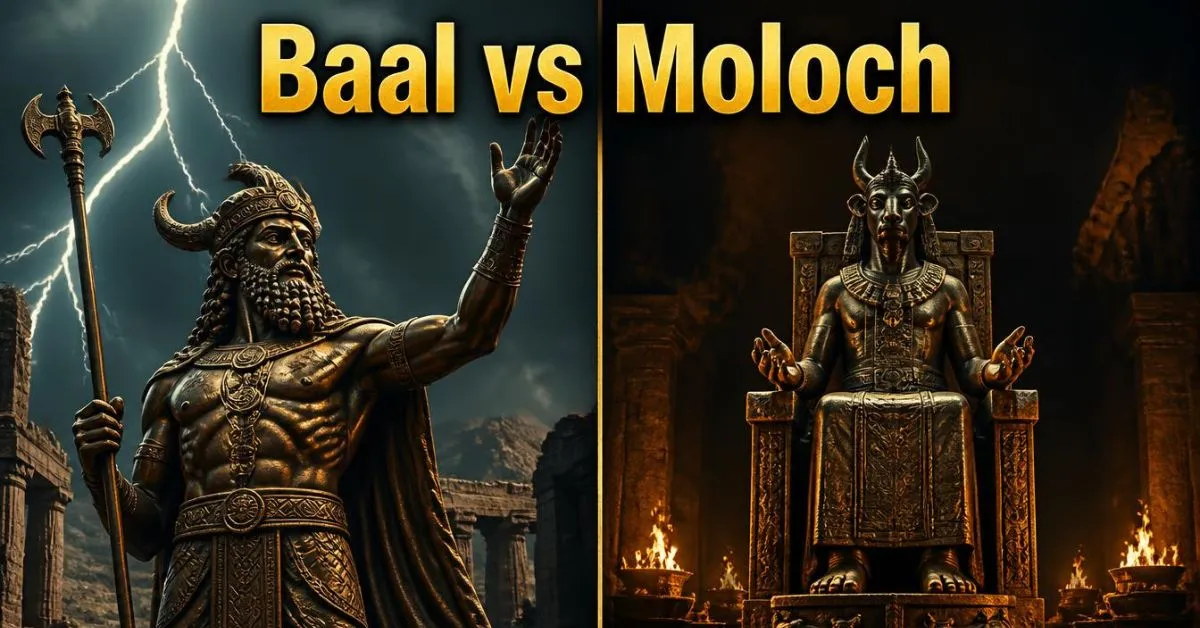
Baal and Moloch are names linked to ancient beliefs and Bible stories. Baal was a god linked to storms and rain in ancient texts.
Moloch, also called Molech, is linked to Bible laws against child offerings. But scholars still debate what Moloch was. Some say he was a god. Others say the name meant a type of offering.
The key difference is the evidence. Ancient texts give us clear details about Baal. The meaning of Moloch is less clear. The Bible links both names to child offerings, but this does not prove that they were the same god.
Key Takeaways
- Baal means lord or master. It can also be the name of a god.
- Moloch is linked to Bible laws against child offerings.
- Scholars do not agree on what Moloch was.
- Jeremiah 19:5 links Baal to child offerings.
- Jeremiah 32:35 mentions Baal’s high places and offerings to Molech.
- Some scholars say Moloch was a god. Others say molekh meant a type of offering.
- Milcom was the god of the Ammonites. His link to Moloch is still debated.
Who Was Baal in the Bible?
Baal was a god worshipped in parts of the ancient Near East. The word baal means lord or master. People could use it as a title or as the name of a god.
Old texts from Ugarit link Baal with Hadad, a storm god. They connect him with thunder and rain. Rain was vital for crops, so storm gods were important to many farming groups.
In the Bible, Baal often appears in stories about rival forms of worship. In 1 Kings 18, the prophet Elijah faces the prophets of Baal on Mount Carmel. The story shows a test between the worship of Yahweh and the worship of Baal.
Still, the name Baal did not always mean the same thing in every place or time. Its meaning depends on the text.
What Was Baal Known For?
Baal was linked to:
- Storms and rain
- Fertility and crop growth
- Power over nature
- Religious worship in the ancient Near East
Old texts support these links. The Bible also speaks of acts tied to Baal that its writers reject. One key example appears in Jeremiah 19:5, which links Baal with child offerings.
Who Was Moloch in the Bible?
Moloch is a name linked to child offerings in several Bible passages. Some English Bibles spell the name Molech. Scholars may use the form Molekh when they discuss the Hebrew word.
Leviticus 18:21 bans giving children to Molech. Leviticus 20:2–5 also speaks against this act and sets out its penalty. Other passages, such as 2 Kings 23:10 and Jeremiah 32:35, speak of children passing through fire in connection with Molech.
Many readers and scholars have taken Molech to be a god to whom children were offered. But this is not the only view.
Some scholars say molekh was a type of offering, not the name of a god. They compare the Bible’s wording with old terms found in Punic writings from the ancient world.
George C. Heider reviews these views in a chapter on Moloch in the 2025 Oxford Handbook of Biblical Monsters. The debate is still open, so neither view should be called proven.
Was Moloch a God or a Type of Offering?
There are two main views.
View 1: Moloch was a god.
This view says the Bible speaks of a god linked to child offerings. Those who support it point to verses such as Leviticus 20:5, which speaks of people following Molech.
View 2: Molekh was a type of offering.
This view says the word named a kind of ritual, not a god. Scholars who support it compare the Bible’s wording with mlk terms found in old Punic writings.
These writings show that mlk was used in texts about offerings. But scholars still debate how closely those terms match the Bible’s use of molekh.
What do we know for sure? The Bible links Molech with banned child offerings. But scholars still debate whether the name meant a god or a type of offering.
Baal vs Moloch: Main Differences
| Feature | Baal | Moloch |
|---|---|---|
| Name | Means lord or master; also a god’s name | Also spelled Molech or Molekh |
| Main sources | Old Near Eastern texts, including Ugaritic texts | Mainly Bible passages and related research |
| Main link | Storms, rain, and crop growth | Child offerings in Bible texts |
| Role in the Bible | Often appears in stories about rival worship | Appears in laws and warnings about child offerings |
| Key verses | 1 Kings 18; Jeremiah 19:5 | Leviticus 18:21; Leviticus 20:2–5 |
| Link to child offerings | Jeremiah 19:5 links Baal with them | Several Bible passages link Molech with them |
| What we know | Well known as a god in old texts | Scholars debate whether the name meant a god or an offering |
| Related name | Hadad is linked to Baal in Ugaritic texts | Some scholars link Molech with Milcom |
The main difference is the kind of proof we have. Old texts give clear details about Baal as a god. The Bible links Molech to child offerings, but scholars still debate what the name meant.
The Bible also links Baal with child offerings. This is why the two names need a careful study. The link does not prove that they were the same god.
Were Baal & Moloch the Same God?
The sources do not prove that Baal and Moloch were the same god.
Three questions can help us study the issue:
- What do the Bible verses say?
- What do other old texts show?
- What can scholars learn from this evidence?
Old Ugaritic texts show Baal as a storm god. The case for Moloch is less clear because scholars do not agree on the meaning of the name.
Jeremiah 19:5 speaks of high places of Baal and says that children were burned as offerings. Jeremiah 32:35 also speaks of high places of Baal and children being offered la-molekh.
Scholars read this wording in two main ways. If Molech was a god, the verses may refer to two gods linked with acts that the Bible rejects. If molekh was a type of offering, the verses may link a ritual to the worship of Baal.
Neither view proves that Baal and Moloch were one god. The verses also do not settle every detail of the old rites.
The safest answer is that the Bible links both names to child offerings, but it does not prove that they were the same god.
What Does the Word Molekh Mean?
The meaning of molekh is at the heart of this debate.
View 1: Molekh Was a God’s Name
Some scholars read Molech as the name of a god. They see the Bible’s laws as bans on giving children to this god.
This is the older and common view of the passages in Leviticus 18:21 and 20:2–5. Some scholars also look for links between Molech and Milcom, the god of the Ammonites.
View 2: Molekh Was a Type of Offering
Other scholars say molekh meant a kind of offering. They compare the Bible’s word with mlk terms in old Punic writings.
This view may help explain why Jeremiah 32:35 speaks of Baal’s high places and offerings la-molekh in the same passage. The words may describe a rite, rather than a second god.
Still, a word used in one culture may not have the same meaning in another. Scholars must study the words and the setting before they draw a firm link.
The idea that Molekh was a type of offering is a theory, not a proven fact. The view that Molech was a god also remains part of the debate.
What Does the Historical Evidence Show?
The proof for Baal and Molech is not the same. It also comes from different sources.
Evidence for Baal
Old Ugaritic texts give clear proof of Baal’s role in the ancient Near East. They link him with storms, thunder, and rain.
This shows that Baal was a known god. But it does not mean that every use of the word baal in every old text refers to the same figure.
Evidence for Molekh or Moloch
The Bible clearly links Molech with child offerings. The main question is whether the name refers to a god or a type of offering.
Scholars study Bible verses, old writings, and other records to test both views. The evidence helps explain the debate, but it does not settle every question.
What Do Punic Writings Show?
Punic writings matter because some use the term mlk when they speak of offerings. Scholars who support the offering theory compare these terms with the Bible’s word molekh.
They must ask whether the word had the same meaning in both places. They must also look at the time, language, and faith of the people who used it.
So, these writings help test one theory. They do not prove that every Bible verse about Molech refers to the same rite.
What Does Archaeology Show?
Archaeologists have studied sites called tophets in parts of the old Punic world. These sites contain burned remains of children and animals, as well as written records. Scholars still debate what the finds mean and how the rites took place.
This evidence matters to the study of old sacrifice. But finds from Punic sites do not prove what took place at every site named in the Bible. They also do not prove that Baal and Moloch were the same god.
The key point is this: old texts give clear proof of Baal as a god. The meaning of Molech is still debated.
Why Are Jeremiah 19:5 & Jeremiah 32:35 Important?
These two verses are key to the debate because they link Baal and Molech with child offerings.
Jeremiah 19:5 speaks of high places of Baal and says that children were burned as offerings. This links Baal with a practice that the Bible condemns.
Jeremiah 32:35 speaks of high places of Baal in the Valley of Ben-Hinnom. It also says that children were made to pass through fire la-molekh.
Scholars debate what this wording means. If Molech was a god, the passage may link two gods with these acts. If molekh meant a type of offering, it may describe a rite tied to the worship of Baal.
The verses show a link between the names and the same broad topic. But they do not prove that Baal and Moloch were the same god.
This is why it is wrong to say that the Bible links child offerings only to Molech. Jeremiah 19:5 also names Baal. Yet this does not settle the full story of either name.
Moloch vs Milcom: Are They Related?
Milcom is named in the Bible as the god of the Ammonites. Some scholars link Milcom with Molech, but others say they may be different.
Those who link them think the names may refer to the same god or to related names. Others note that similar names do not prove a shared identity.
The Bible and other old records do not settle the matter. It is best to say that Milcom was an Ammonite god and that his link to Molech remains uncertain.
What Were Topheth & the Valley of Hinnom?
Topheth and the Valley of Hinnom appear in Bible passages about child offerings.
Second Kings 23:10 says King Josiah made Topheth unfit for use. It was in the Valley of Hinnom, where people had made their children pass through fire to Molech. Jeremiah 7:31 and 19:5 also speak against acts involving children at this place.
These verses help explain the setting of the Bible’s warnings. They link Topheth with rites that the Bible rejects.
But the verses do not tell us every detail of these rites. Claims about a large statue of Moloch, its shape, or the exact way people worshipped it need their own proof.
It is best to keep the Bible’s words apart from later stories and images that may add details.
Why Did the Bible Condemn These Practices?
The Bible’s writers condemn child offerings as acts that broke their laws and beliefs.
Leviticus 18:21 bans giving children to Molech. Leviticus 20:2–5 sets out penalties for this act. Jeremiah 7:31 and 19:5 also condemn child offerings. Jeremiah 32:35 links them with Molech.
These verses show how the Bible’s writers viewed the acts. Historians ask other questions. They study what the words meant, how the rites may have worked, and how the Bible compares with other old texts.
Keeping these questions apart helps avoid false claims. A text may clearly condemn an act without giving us every detail about its history.
Evidence Check: What Can We Say With Confidence?
| Claim | What the sources show | Careful answer |
|---|---|---|
| Baal was linked to storms and rain | Old Ugaritic texts | Well supported |
| The Bible links Molech with child offerings | Direct Bible verses | Clear in the text |
| Jeremiah 19:5 links Baal with child offerings | Direct Bible verse | Clear in the text |
| Molech was a separate god | Scholars disagree | Not settled |
| Molech and Milcom were the same | Some scholars link them; others do not | Uncertain |
| Baal and Moloch were the same god | The verses do not prove this | Not proven |
| Punic mlk terms help explain molekh | Scholars use them to test a theory | Useful but debated |
| Archaeology settles every question about Molech | Finds come from different places and settings | Not proven |
This table separates what the sources say from what scholars think the evidence may mean. That is important when the past does not give us one clear answer.
FAQs:
Is Baal the same as Moloch?
The sources do not prove that Baal and Moloch were the same god. Baal is well known in old Near Eastern texts. Molech is linked to Bible warnings about child offerings, but scholars still debate what the name meant.
Was Baal a god of child sacrifice?
Jeremiah 19:5 links Baal with child offerings. So, it is wrong to say that the Bible links this practice only to Molech. But the verse does not answer every question about how people worshipped Baal.
Was Moloch a real god?
Scholars do not agree. Some say Molech was a god. Others say molekh was a type of offering. The Bible links the name with child offerings, but its full meaning remains in debate.
What is the difference between Moloch and Milcom?
Milcom is named as the god of the Ammonites. Some scholars link him with Molech, while others treat them as different. The evidence does not settle the issue.
What does Baal mean?
Baal means lord or master. It can be a title or the name of a god. Old Ugaritic texts link Baal with storms, thunder, and rain.
What was Topheth?
Topheth was a place in the Valley of Hinnom. Bible verses link it with child offerings and the act of making children pass through fire to Molech.
Why is Moloch linked to child sacrifice?
Leviticus 18:21 and 20:2–5 link Molech with child offerings. Second Kings 23:10 and Jeremiah 32:35 also speak of children passing through fire. Scholars still debate whether Molech was a god or a type of offering.
What evidence links Moloch with Baal?
Jeremiah 19:5 links Baal with child offerings. Jeremiah 32:35 speaks of Baal’s high places and offerings la-molekh. These verses link both names to the same broad topic, but they do not prove that the names refer to one god.
Conclusion:
Baal and Moloch have different roles in the Bible and in old texts. Ugaritic texts link Baal with storms and rain. The Bible links Molech with banned child offerings, but scholars still debate whether the name meant a god or a type of offering.
Jeremiah 19:5 links child offerings with Baal. Jeremiah 32:35 speaks of Baal’s high places and offerings la-molekh. These verses show why the topic is not simple. They do not prove that Baal and Moloch were the same god.
The best answer is to state what the sources show and where the evidence ends. Baal is well known as a god in old texts. The meaning of Molech is still debated, so it should not be presented as a settled fact.

Emily Carter is a dedicated author at ReplyGenius.com, creating helpful, natural, and engaging content focused on replies, messages, and everyday conversations.