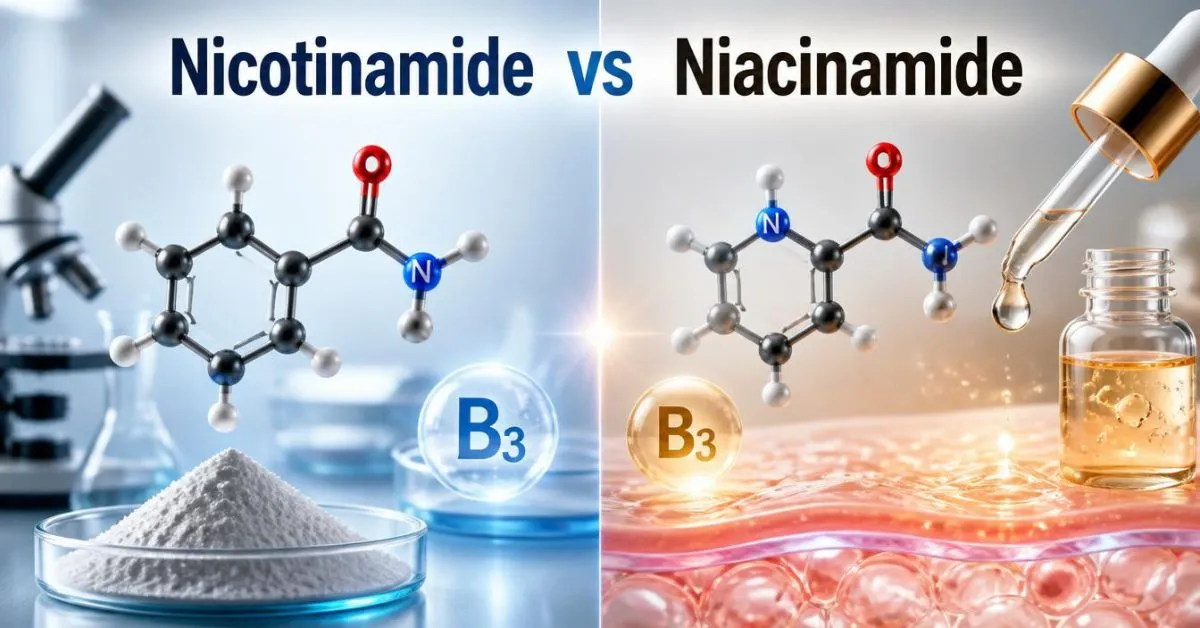
Nicotinamide and niacinamide are the same chemical compound. Both names refer to the amide form of vitamin B3, also known as pyridine-3-carboxamide. Niacinamide is commonly used in skincare, while nicotinamide is common in medical and scientific sources.
They should not be confused with niacin, which can refer to nicotinic acid, a different form of vitamin B3.
Key Takeaways
- Nicotinamide and niacinamide are two names for the same compound.
- Both are forms of vitamin B3.
- Niacinamide is especially common on skincare labels.
- Nicotinamide is often used in medical and scientific writing.
- Niacin or nicotinic acid is different from nicotinamide/niacinamide.
- Nicotinic acid can cause the familiar niacin flush, while nicotinamide does not cause the same flushing effect.
Are Nicotinamide & Niacinamide the Same?
Yes. Nicotinamide and niacinamide are the same chemical compound.
The two names can make it seem as though you are choosing between two different forms of vitamin B3, but that is not the case. Both terms refer to pyridine-3-carboxamide, the amide form of vitamin B3.
The National Cancer Institute lists nicotinamide and niacinamide as names for the same vitamin B3 compound. PubChem also lists niacinamide as a synonym for nicotinamide.
So if you see nicotinamide in a medical article and niacinamide on a skincare label, the different wording does not mean that the products contain different compounds.
Nicotinamide vs Niacinamide at a Glance
| Feature | Nicotinamide | Niacinamide |
| Same compound? | Yes | Yes |
| Vitamin | B3 | B3 |
| Chemical name | Pyridine-3-carboxamide | Pyridine-3-carboxamide |
| Molecular formula | C6H6N2O | C6H6N2O |
| Common use of the name | Medical and scientific sources | Skincare and cosmetics |
| Different from nicotinic acid? | Yes | Yes |
Bottom line: There is no chemical difference between nicotinamide and niacinamide. They are simply different names for the same compound.
Why Are Nicotinamide & Niacinamide Called Different Names?
The main reason for the confusion is terminology.
Different industries and scientific fields may prefer different names for the same substance. In skincare, niacinamide is a very familiar ingredient name. It appears on labels for products such as serums, moisturizers, and cleansers.
In medical, nutritional, and scientific literature, nicotinamide is also widely used.
This is similar to having a substance with a scientific name and a commonly used industry name. The name changes, but the underlying compound does not.
That means you should not assume that a product containing niacinamide is chemically different from one described as containing nicotinamide.
How Do Nicotinamide & Niacinamide Relate to Vitamin B3?
Vitamin B3 is the broader nutritional term.
The NIH Office of Dietary Supplements explains that niacin is a generic term that includes nicotinic acid and nicotinamide. Both are related forms of vitamin B3.
Vitamin B3 is important for normal energy metabolism and many cellular processes. The body also gets niacin from food and can make it from the amino acid tryptophan.
A simple way to understand the terminology is:
Vitamin B3 → Nicotinamide = Niacinamide
But there is another important branch:
Vitamin B3 → Nicotinic acid = commonly called niacin
This is where many online comparisons become confusing.
Nicotinamide and niacinamide are the same compound. Nicotinic acid is different.
Nicotinamide vs Niacin: What Is the Difference?
If you are actually trying to understand the difference between niacinamide and niacin, the answer is more complicated.
The word niacin can be used broadly when discussing vitamin B3. However, it is also commonly used to refer specifically to nicotinic acid.
Nicotinamide and nicotinic acid are different forms of vitamin B3 and have different effects in the body.
One important difference is flushing.
Nicotinic acid can cause niacin flushing, which may involve warmth, redness, itching, burning, or tingling of the skin. Nicotinamide does not cause this typical flushing response.
That is why it is important to look at the specific form of vitamin B3 rather than assuming that every product labeled “niacin” works in exactly the same way.
The Simple Difference
| Term | What it means |
| Vitamin B3 | Broad nutrient category |
| Nicotinamide | A form of vitamin B3 |
| Niacinamide | Another name for nicotinamide |
| Nicotinic acid | A different form of vitamin B3 |
| Niacin | Can be used broadly for vitamin B3 or specifically for nicotinic acid |
If your original search was nicotinamide vs niacinamide, there is no winner between the two because they are the same compound.
If your question is really about niacinamide vs niacin, then the form of vitamin B3 matters.
What Is Nicotinamide Used For?
Nicotinamide is used in nutritional, medical, research, and skincare contexts.
As a form of vitamin B3, it contributes to the body’s supply of vitamin B3 needed for normal cellular functions.
It is also used in topical skincare products, where the ingredient is more commonly called niacinamide.
This is why you may encounter the word in very different settings:
- Vitamin B3 supplements
- Medical research
- Dermatology
- Skincare products
- Nutrition information
- Scientific literature
The context changes, but nicotinamide and niacinamide still refer to the same compound.
What Is Niacinamide Used For in Skincare?
Niacinamide is widely used as a topical skincare ingredient.
Research has investigated topical niacinamide for several skin-related concerns, including the skin barrier, uneven pigmentation, inflammation, and visible signs of skin aging.
You may find niacinamide in:
- Serums
- Moisturizers
- Cleansers
- Toners
- Creams
- Other facial skincare products
The concentration and formulation can vary from one product to another.
It is therefore better to evaluate a skincare product based on its complete formula and intended use, rather than assuming that every niacinamide product will produce the same result.
Most importantly for this article, niacinamide on a skincare label is nicotinamide.
Is Nicotinamide Used in Supplements?
Yes. Nicotinamide is one form of vitamin B3 used in dietary supplements.
You may see it listed as:
- Nicotinamide
- Niacinamide
- Niacin, as nicotinamide
The exact wording depends on the product and labeling conventions.
The NIH Office of Dietary Supplements notes that dietary supplements can contain different forms of niacin, including nicotinic acid and nicotinamide.
This makes it important to read the Supplement Facts panel carefully if you are comparing vitamin B3 products.
Does More Vitamin B3 Mean Better Results?
Not necessarily.
Vitamin and mineral supplements can have different effects at different amounts, and high doses are not automatically better.
The NIH notes that high supplemental intakes of nicotinamide can cause adverse effects, including nausea and vomiting, while very high amounts can be associated with liver toxicity.
If you are considering a high-dose vitamin B3 supplement, especially for a specific health reason, talk with a healthcare professional about the appropriate amount.
Does Nicotinamide Cause Niacin Flush?
Nicotinamide does not cause the typical niacin flush associated with nicotinic acid.
This difference is one of the clearest ways to understand why nicotinamide and nicotinic acid should not be treated as identical substances.
Nicotinic acid can cause flushing because of its effects on the body. Nicotinamide has a different chemical structure and does not produce the same typical flushing response.
So when someone says that “niacin causes flushing,” check which form they mean.
Nicotinic acid: Can cause flushing.
Nicotinamide/niacinamide: Does not cause the typical niacin flush.
Which Name Should You Look for on a Label?
You do not need to choose between nicotinamide and niacinamide based on the name alone.
If you are buying skincare, you will commonly see niacinamide listed as the ingredient.
If you are reading medical or scientific information, you may see nicotinamide instead.
For supplements, check the complete label to see which form of vitamin B3 is included.
The more important question is whether you are looking at nicotinamide/niacinamide or nicotinic acid, because those are different compounds.
Common Confusion About Nicotinamide & Niacinamide
Here are the most common mistakes to avoid:
Mistake 1: Thinking they are two different ingredients.
They are not. Nicotinamide and niacinamide are synonyms for the same compound.
Mistake 2: Assuming niacin and niacinamide are identical.
They are not necessarily the same. Niacin can refer broadly to vitamin B3, while nicotinic acid is a specific form that differs from nicotinamide.
Mistake 3: Assuming all vitamin B3 products cause flushing.
The typical flushing response is associated with nicotinic acid, not nicotinamide.
Mistake 4: Choosing a supplement based only on the name.
Check the form, amount, and purpose of the product.
FAQs:
Is nicotinamide the same as niacinamide?
Yes. Nicotinamide and niacinamide are two names for the same chemical compound. Both refer to the amide form of vitamin B3, also called pyridine-3-carboxamide. The difference is mainly the terminology used in different fields.
Is nicotinamide better than niacinamide?
Neither is better because they are the same compound. If you are comparing two products, other factors such as concentration, formulation, dosage, intended use, and additional ingredients are more relevant than whether the label says nicotinamide or niacinamide.
Is niacinamide the same as niacin?
No, not when “niacin” refers specifically to nicotinic acid. Niacinamide is another name for nicotinamide. Nicotinic acid is a different form of vitamin B3 and can produce a flushing reaction at certain supplemental doses.
Can nicotinamide and niacinamide be used interchangeably?
When referring to the chemical compound, yes. They are synonyms. However, the appropriate product still depends on how it is formulated and whether it is intended for topical skincare, nutrition, or another purpose.
Does niacinamide contain vitamin B3?
Yes. Niacinamide is a form of vitamin B3. It is also called nicotinamide and is recognized as one of the forms of niacin used in nutritional science.
Conclusion:
The answer to nicotinamide vs niacinamide is straightforward: they are the same compound.
Nicotinamide is another name for niacinamide, the amide form of vitamin B3. The name niacinamide is especially common in skincare, while nicotinamide is frequently used in medical and scientific contexts.
The bigger distinction is between nicotinamide/niacinamide and nicotinic acid. They are different forms of vitamin B3, and nicotinic acid can cause the typical niacin flush.
So, when you see nicotinamide and niacinamide in different sources, you do not need to treat them as two separate ingredients. Look at the context, dosage, formulation, and specific form of vitamin B3 to understand what a product or source actually means.

Aiden Robert, an author at ReplyyGenius.com, where I share smart conversation tips, flirty replies, and practical communication ideas to help people reply with confidence.