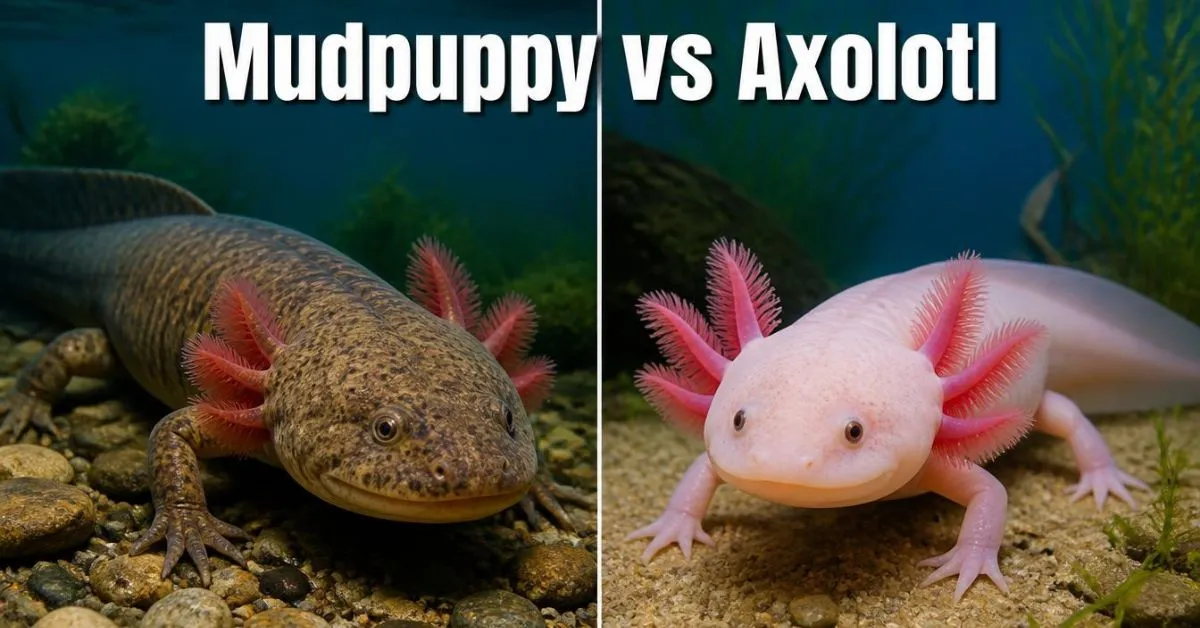
Mudpuppies and axolotls look alike because both are aquatic salamanders. They have long tails, short legs, and feathery gills on the sides of their heads. But they are not the same animal.
The easiest way to tell them apart is to check their toes. A mudpuppy has four toes on each foot. An axolotl has four toes on its front feet and five on its back feet. Their body shape, natural range, and conservation status also differ.
The main difference: A mudpuppy (Necturus maculosus) is native to parts of the United States and Canada. An axolotl (Ambystoma mexicanum) is native to a small area in Mexico City. Both stay in water as adults, but they belong to different salamander families.
Mudpuppy vs Axolotl: Quick Comparison
| Feature | Mudpuppy | Axolotl |
| Scientific name | Necturus maculosus | Ambystoma mexicanum |
| Animal group | Salamander | Salamander |
| Family | Proteidae | Ambystomatidae |
| Native range | Parts of the United States and Canada | Southern Mexico City, Mexico |
| Toes | Four on each foot | Four front toes, five back toes |
| External gills | Yes | Yes |
| Common color | Gray or brown, often with dark spots | Dark and mottled in wild-type animals |
| Body shape | Stout body and broad, flat head | Broad head, slender limbs, long tail |
| Adult habitat | Freshwater | Freshwater |
| Typical length | About 8–13 inches | Often around 9–12 inches in captivity; size varies |
| Pet trade | Less common | More common |
| Wild conservation status | Not globally endangered, but some populations face threats | Critically Endangered |
Size and color can vary. Use more than one feature to identify an animal.
Sources: USGS mudpuppy profile and IUCN axolotl assessment.
1. What Is a Mudpuppy?
A mudpuppy is a fully aquatic salamander with the scientific name Necturus maculosus. It lives in parts of the United States and Canada. Its habitat includes lakes, rivers, and streams.
The mudpuppy has a broad, flat head, a stout body, short legs, and a long tail. Its skin is often gray or brown, with dark spots. Three pairs of feathery gills sit behind its head. These gills help the animal take oxygen from the water.
A mudpuppy keeps these external gills throughout its life. It does not change into a land-dwelling adult form.
Mudpuppies often hide under rocks, logs, and other cover. They are mostly active at night, although they may also move around during the day.
Despite its name, a mudpuppy is not a dog or a fish. It is an amphibian in the salamander group.
For more details on its range and habitat, see the U.S. Geological Survey’s mudpuppy profile.
2. What Is an Axolotl?
An axolotl is an aquatic salamander known for its external gills and ability to regrow some body parts. Its scientific name is Ambystoma mexicanum.
Wild axolotls are native to a small area in southern Mexico City. They are linked to the freshwater canals and wetlands around Xochimilco. Their wild habitat is much smaller than the mudpuppy’s range.
Axolotls have broad heads, small eyes, short legs, and long tails. Their feathery gills extend from both sides of the head. Wild-type axolotls are usually dark, with a mottled look. Captive-bred axolotls may be pale, pink, white, or golden.
One key trait is called neoteny. An axolotl can grow into an adult and still keep some young salamander traits, such as external gills. It normally remains aquatic throughout its life.
Axolotls can regrow some body parts, such as limbs. But this does not mean they can recover from every injury or live in poor water conditions.
Axolotls are common in aquariums and research settings. Yet wild axolotls face a serious risk of extinction. The IUCN Red List lists the species as Critically Endangered. Habitat loss, polluted water, and invasive species are key threats.
3. How to Tell a Mudpuppy From an Axolotl
If you see one of these salamanders, do not use color alone. Check the feet, head, body shape, and location together.
Check the toes first
Toe count is one of the clearest visible differences.
- Mudpuppy: Four toes on each foot.
- Axolotl: Four toes on each front foot and five on each back foot.
If you can see the back feet clearly, count the toes. They may overlap, so a poor view can lead to a wrong count.
Compare the head & body
A mudpuppy often has a broad, flat head and a stout body. Dark spots may cover much of its back.
An axolotl also has a broad head, but its body and limbs may look more slender. Its external gills often spread out like soft branches on both sides of its head.
These are useful clues, not perfect rules. Body shape can change with age, health, and natural variation.
Look at the gills
Both animals keep external gills as adults. Mudpuppy gills often look bushy and reddish. Axolotl gills may be pink, red, dark, or pale, based on the animal’s color.
Do not use gills alone to identify either animal. Both have them, so toe count and body shape offer better clues.
Use the location as another clue
Mudpuppies are native to parts of North America. Axolotls have a much smaller native range in Mexico City.
Still, location is not proof. A captive animal may escape or be released outside its native range. Use location to support your identification, not to make the final decision.
4. Size & Appearance: Which One Is Bigger?
Mudpuppies generally reach about 8–13 inches long. The USGS gives a typical range of 20–33 cm, which is about 8–13 inches.
Axolotl size varies with age, genetics, and care. Many pet axolotls reach around 9–12 inches, though some may be smaller or larger.
These ranges overlap. A large mudpuppy may be similar in length to an axolotl, so size alone cannot tell you which animal you are seeing.
Color is also not a sure sign. Wild-type axolotls are often dark and mottled, but captive-bred animals can have pale or golden skin. Mudpuppies also vary in shade and spot pattern.
Best identification tip: Check toe count first, then compare the body shape and other features. Use size and color as extra clues.
5. Habitat: Where Do They Live?
Mudpuppy habitat
Mudpuppies live in freshwater across parts of the United States and Canada. They use lakes, rivers, and streams. Some live in clear water, while others occur in streams with muddy banks or thick plant growth.
They often hide under rocks and logs. These shelters help them avoid danger and find food. Water quality matters, and local populations may suffer when their habitat is damaged.
Axolotl habitat
Wild axolotls have a much smaller native range. They are linked to the canals and wetlands around Xochimilco in southern Mexico City.
The axolotl once lived across a wider wetland system, but much of that habitat has been lost or changed. City growth, pollution, and invasive fish have harmed the remaining wild population.
The key difference is range. Mudpuppies occur across parts of two countries, while wild axolotls survive in a very limited area.
6. Diet & Behavior
Both animals are carnivores. They eat small animals found in the water, but their exact diet depends on their size and habitat.
Mudpuppies may eat aquatic insects, worms, snails, crayfish, and small fish. They often search for food near the bottom of lakes and rivers. They may be more active at night.
Axolotls eat small aquatic prey, including worms and other suitable food. Pet axolotls need a diet that meets their needs and suits their size and age.
Both animals may try to eat smaller tank mates. Fish may also bite or damage an axolotl’s gills. For these reasons, do not assume either salamander can safely share a tank with other animals.
7. Can You Keep a Mudpuppy or Axolotl as a Pet?
Axolotls are more common in the pet trade. Mudpuppies are less common, and local rules may limit their collection or ownership.
Neither animal should be treated as a simple, low-care pet. Both need clean water, enough space, hiding places, suitable food, and a stable aquatic habitat.
Axolotl care
An axolotl needs a fully aquatic tank with cool, clean water and gentle filtration. Set up and cycle the tank before adding the animal. Test the water and monitor its temperature on a regular basis.
Avoid small gravel that the axolotl may swallow. Do not assume that fish or other tank mates are safe. They may injure the axolotl, or the axolotl may try to eat them.
Mudpuppy care
A mudpuppy also needs clean water, a suitable tank, shelter, and conditions that fit its species-specific needs. Do not rely on an axolotl care guide as a complete guide to keeping a mudpuppy.
Before buying or collecting either animal, check the laws where you live. Rules may differ by state, province, or country. Never take a wild salamander from its habitat unless you have confirmed that doing so is legal.
Pet verdict: Axolotls may be easier to find from reputable captive-bred sources. But being common in the pet trade does not make them easy to care for. Learn their needs before bringing one home.
8. Conservation: Which Animal Is More at Risk?
The axolotl faces a much greater risk in the wild. The IUCN lists it as Critically Endangered. Its remaining natural range is small, and its population has been harmed by habitat loss, water pollution, and invasive species.
Mudpuppies have a wider range, but that does not mean every population is safe. Research has found concerns about some local populations, including declines in parts of the Great Lakes region. Pollution and habitat changes can also harm them.
It is important to separate wild populations from captive animals. Many axolotls are bred in captivity for research and the pet trade. A large captive population does not mean the wild population is healthy.
Protecting wetlands, keeping water clean, and controlling invasive species can help local water animals survive. Conservation needs vary by area, so check local wildlife sources to learn about mudpuppies in your region.
FAQs:
Are mudpuppies and axolotls the same animal?
No. Both are aquatic salamanders, but they are different species. A mudpuppy is Necturus maculosus, while an axolotl is Ambystoma mexicanum.
Do mudpuppies and axolotls both have external gills?
Yes. Both keep external gills as adults. This is one reason they look alike, but it is not enough to tell them apart.
How many toes does a mudpuppy have?
A mudpuppy has four toes on each foot. An axolotl has four toes on each front foot and five on each back foot.
Can a mudpuppy live on land?
Mudpuppies are fully aquatic. They keep their external gills and do not turn into the usual land-dwelling adult form seen in many salamanders.
Can an axolotl turn into a land salamander?
Axolotls normally remain aquatic. Under certain conditions, an axolotl may undergo metamorphosis, but this is not something an owner should try to cause. Such a change can put the animal at risk.
Are axolotls endangered in the wild?
Yes. The IUCN lists the axolotl as Critically Endangered. Its wild habitat is limited and has been affected by urban growth, pollution, and invasive species.
Which is better as a pet?
It depends on the owner, local laws, and access to proper care. Axolotls are more common in the pet trade, but they still need clean, cool water and careful tank management. Mudpuppies also need species-specific care.
Conclusion:
Mudpuppies and axolotls both live in water. But they differ in toe count, body shape, where they live in the wild, and their risk of extinction.
The quickest clue is the feet: mudpuppies have four toes on every foot, while axolotls have five toes on each back foot. Their gills can look alike, so use more than one feature to identify them.
Mudpuppies live across parts of the United States and Canada. Wild axolotls are native to a small area in Mexico City and face a much greater risk of extinction. Both animals need clean water, and both deserve careful treatment in the wild and in captivity.

Emily Carter is a dedicated author at ReplyGenius.com, creating helpful, natural, and engaging content focused on replies, messages, and everyday conversations.