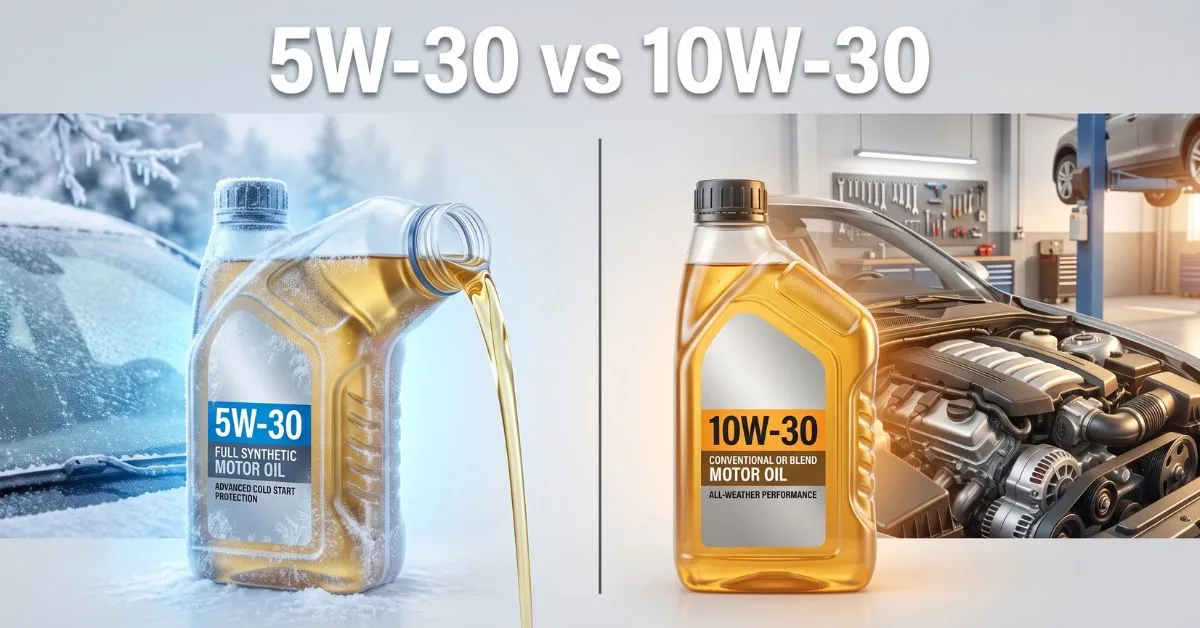
5W-30 and 10W-30 are both multigrade motor oils. The main difference is their winter viscosity grade. 5W-30 flows better than 10W-30 in cold weather. It helps your engine start more easily in the cold.
Both oils must be approved for your engine. Both carry an SAE 30 hot-viscosity grade. However, the best oil for your car depends on its owner’s manual, required oil standards, and operating conditions.
Key Differences at a Glance
| Feature | 5W-30 | 10W-30 |
| Winter viscosity grade | 5W | 10W |
| Low-temperature performance | Meets stricter cold-temperature requirements | Meets less demanding cold-temperature requirements |
| Hot-viscosity grade | SAE 30 | SAE 30 |
| Cold starts | Often the better fit in colder conditions | May suit milder conditions if approved |
| Hot-weather use | Suitable when approved | Suitable when approved |
| Fuel economy | Depends on the engine and oil formula | Depends on the engine and oil formula |
| Engine protection | Depends on viscosity, oil performance, and engine needs | Depends on viscosity, oil performance, and engine needs |
| Best choice | Follow the owner’s manual | Follow the owner’s manual |
SAE J300 classifies engine oils by viscosity. It does not measure every part of an oil’s quality or performance. (SAE International)
What Do 5W-30 & 10W-30 Mean?
The numbers on a motor oil bottle show its viscosity grades. Viscosity means how easily a liquid flows.
What Does 5W-30 Mean?
The first part, 5W, describes the oil’s winter grade. The W stands for winter, not weight. This grade covers low-temperature performance under set test conditions.
The second part, 30, is its high-temperature viscosity grade. It shows that the oil meets the SAE 30 limits in the standard’s tests.
What Does 10W-30 Mean?
The 10W part means the oil meets a different winter grade from 5W-30. It does not meet the same low-temperature requirements as 5W-30.
Both oils have an SAE 30 high-temperature grade. This does not mean they have identical formulas or perform the same in every engine.
Important: The 5W and 10W numbers are not exact outdoor temperature limits. Do not use them alone to decide the coldest temperature at which your car can run. Check the vehicle manual for its approved oil grades and temperature guidance.
5W-30 vs 10W-30 in Cold Weather
5W-30 is generally better suited to cold starts than 10W-30. It meets stricter low-temperature viscosity requirements under the SAE J300 standard.
When an engine sits overnight, its oil cools down. Cold oil can resist flow more than warm oil. After you start the engine, the oil needs to move through its lubrication system.
The right oil helps the engine receive the lubrication it needs under the conditions it was designed for. In colder climates, a suitable lower winter grade can help with cold starts.
Still, do not assume that 5W-30 is right for every vehicle. Some engines need a specific grade or oil specification. Always check the manual before changing oil.
Is 10W-30 Better in Hot Weather?
Not automatically. Both 5W-30 and 10W-30 have an SAE 30 high-temperature viscosity grade.
Hot weather alone is not a good reason to switch from 5W-30 to 10W-30. Your engine’s design and the manufacturer’s oil requirements matter more.
If your manual permits both grades, follow its guidance for the temperatures you expect. If it calls for 5W-30, do not switch just because summer has arrived.
Also, the number 30 does not tell you everything about an oil’s ability to protect an engine. Oil performance depends on more than its thickness. You should also check its test ratings and make sure it is right for your engine.
Can You Use 5W-30 Instead of 10W-30?
You can use 5W-30 instead of 10W-30 only if the vehicle manufacturer permits it.
The lower winter grade can be useful in colder conditions. But matching the viscosity grade is only one part of choosing the right oil.
Before switching, check these three things:
- Approved viscosity: Does your owner’s manual list 5W-30?
- Performance standard: Does the oil meet the required API or ILSAC specification?
- Manufacturer requirements: Does your car need a certain oil grade or approval for hot or cold weather and your driving needs?
If the oil meets all the requirements, it may be suitable. If your manual does not allow the change, do not assume that the shared SAE 30 grade makes the oils interchangeable.
Can You Use 10W-30 Instead of 5W-30?
Use 10W-30 instead of 5W-30 only if your owner’s manual allows it.
The two oils share an SAE 30 high-temperature grade, but their winter grades differ. That difference can matter when you start your engine in cold weather.
Some vehicle manuals list more than one approved viscosity grade. Others specify one grade or set limits based on temperature. Follow the guidance for your exact engine.
Do not switch to 10W-30 just because your car is older or the weather is warm. Those facts alone do not prove that the change is safe or beneficial.
Does 5W-30 Protect Your Engine Better?
Neither oil is always better. The correct choice depends on your engine and the oil specifications it needs.
Viscosity tells you how the oil meets certain flow-related limits. It does not show how well the oil protects engine parts, prevents buildup, or handles heat. SAE confirms that its viscosity classification covers rheological properties, not all oil characteristics. (SAE International)
Oil standards help cover other performance needs. For example, API service categories describe performance requirements for engine oils. Some oils also carry ILSAC certifications or meet specific vehicle-maker requirements.
The American Petroleum Institute says to check your car’s owner’s manual before choosing oil. (API Oil Categories)
For the best fit, match the viscosity grade and all required performance standards. A more suitable oil is not simply the one with the higher number.
Is 10W-30 Better for Older or High-Mileage Engines?
Not by default. An older engine does not always need thicker oil.
A high-mileage engine may burn oil or develop leaks. But these problems can have different causes. Changing the oil grade may not fix them.
Check your owner’s manual first. If your engine uses too much oil, leaks, makes odd noises, or shows a low oil pressure warning, ask a skilled mechanic to check it.
Do not change oil grades just because your car has high mileage. Use a different grade only if your car maker allows it or a skilled mechanic says it is safe for your engine.
Can You Mix 5W-30 & 10W-30?
It is best not to mix different viscosity grades on purpose when you can avoid it. Use the grade and performance standard listed in your manual.
If your oil level is low and you cannot find the right oil, check your manual for another approved oil. Adding the right oil may be safer than running the engine with too little oil. The best choice depends on your car and the problem.
Do not mix oils to make a new oil grade. The mix may not work as you expect.
If the oil pressure light stays on while the engine runs, stop in a safe place and turn off the engine. Do not keep driving to see if the light goes off. Adding oil may not fix the problem.
Does Synthetic Oil Change the Difference?
No. Synthetic oil does not change the viscosity grade printed on the bottle.
For example, synthetic 10W-30 remains 10W-30. It does not become 5W-30 because it uses a synthetic base oil.
Synthetic and conventional oils can differ in formulation and performance. However, the word synthetic alone does not prove that an oil is the best choice for your engine.
Check the viscosity grade, API or ILSAC specification, and any vehicle-maker requirements. Choose a product that meets all the requirements in your manual.
How to Choose the Right Oil for Your Car
Use this simple process before buying motor oil.
- Find your owner’s manual. Look for the engine oil section.
- Check the viscosity grade. Confirm which grades the manufacturer allows.
- Check the oil standard. Look for the required API category, ILSAC certification, or other stated specification.
- Review temperature guidance. If the manual lists different grades for different temperatures, follow that chart.
- Check the bottle label. Make sure the oil meets the required specifications.
- Ask for help if needed. If the manual is unclear, contact the vehicle maker or a qualified mechanic.
This method is more reliable than choosing oil based only on the weather, car mileage, or oil grade on the bottle.
FAQs:
Is 5W-30 thinner than 10W-30?
5W-30 meets a lower winter viscosity grade than 10W-30. Both have an SAE 30 high-temperature grade. Their exact behavior also depends on the oil formula and test conditions.
Can I use 5W-30 all year?
Yes, if your vehicle manufacturer approves it for your engine and operating conditions. Check the manual before using it year-round.
Is 10W-30 better for summer?
Not by default. Both oils have an SAE 30 high-temperature grade. Use the viscosity that your manual approves for your engine and expected temperatures.
Will 5W-30 improve gas mileage?
Not always. Fuel economy depends on the engine, oil formulation, driving conditions, and other factors. Do not expect a guaranteed fuel-saving benefit from switching grades.
Should I use 10W-30 in a high-mileage car?
Only if it meets your vehicle’s requirements. High mileage alone does not mean the engine needs thicker oil.
Can I switch between 5W-30 and 10W-30 at my next oil change?
You can switch only if the new grade meets the vehicle maker’s requirements. Check the manual before making the change.
Conclusion:
5W-30 works better in cold weather, while 10W-30 may also work if your car’s manual allows it. Neither oil is best for every car, and hot weather alone does not make 10W-30 the better choice.
Check the approved viscosity, required oil performance standard, and manufacturer’s guidance before buying. These details matter more than choosing an oil based on one number alone.

Eric Walker, an author at replyygenius.com, where I create clear and helpful content for readers.
I focus on writing useful, engaging, and easy to understand articles that deliver real value.