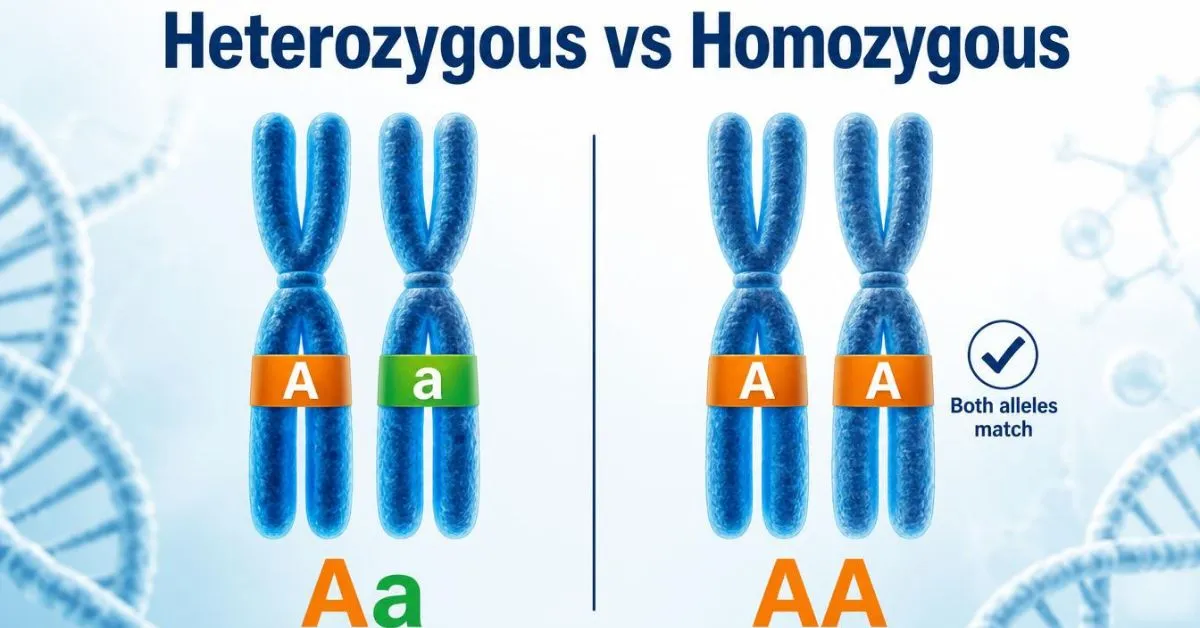
Heterozygous vs homozygous describes if a person has two different or two matching alleles of a gene. A heterozygous genotype has two different alleles, such as Aa. A homozygous genotype has two matching alleles, such as AA or aa.
Neither term tells you if someone is healthy or sick. The meaning depends on the gene, the specific variants, and how they affect the body.
Key Takeaways
- Heterozygous: Two different alleles of a gene, such as Aa.
- Homozygous: Two matching alleles, such as AA or aa.
- Dominant and recessive: These terms describe how alleles affect a trait.
- Health and disease: Neither genotype alone proves that someone has a genetic condition.
- Genetic testing: The exact gene, variant, and inheritance pattern help explain a test result.
What Does Heterozygous Mean?
Heterozygous means having two different alleles at a particular gene location.
An allele is a version of a gene. Most genes on the non-sex chromosomes have two copies in each cell. A person usually inherits one copy from each biological parent. These copies may have the same or different DNA sequences.
For example, imagine a gene with two alleles labeled A and a.
A person with the genotype Aa is heterozygous because the two alleles differ.
This difference may affect a person’s traits or health. However, many genetic variants have no harmful effect. Others may change how a gene works or increase the risk of a condition.
A heterozygous person may:
- Have a trait linked to a dominant allele.
- Carry one disease-related variant linked to a recessive condition.
- Have a condition caused by a disease-related variant that affects one copy of a gene.
- Have a genetic variant with no known effect on health.
The result depends on the specific gene and variant. Being heterozygous does not automatically mean that someone is a carrier or has a disease.
What Does Homozygous Mean?
Homozygous means having two matching alleles at a particular gene location.
Using the same example, a person can have AA or aa. Both genotypes are homozygous because the two alleles match.
There are two common terms in a simple dominant-recessive model:
- Homozygous dominant (AA): Two copies of the allele labeled A.
- Homozygous recessive (aa): Two copies of the allele labeled a.
These labels help explain basic genetics. They do not tell you whether the alleles are harmful.
For example, two matching alleles may have no effect on health. In other cases, a person may inherit two disease-causing variants and develop a genetic condition.
The key point is simple: homozygous describes the allele combination, not a person’s health.
Heterozygous vs Homozygous: Main Differences
The main difference is whether the two alleles match.
| Feature | Heterozygous | Homozygous |
|---|---|---|
| Meaning | Two different alleles | Two matching alleles |
| Example | Aa | AA or aa |
| Do the alleles match? | No | Yes |
| Can it affect traits? | Yes | Yes |
| Can it relate to a genetic condition? | Yes | Yes |
| Does it always cause disease? | No | No |
| Can it indicate carrier status? | Yes, for some conditions | It depends on the condition and variants |
| What determines its meaning? | The gene, variants, and inheritance pattern | The gene, variants, and inheritance pattern |
For example, Aa is heterozygous because A and a differ. AA and aa are homozygous because their two alleles match.
The letters are teaching symbols. They do not represent one specific gene or disease in every case.
Examples of Heterozygous & Homozygous Genotypes
A simple model uses three genotypes to explain the difference.
AA → Homozygous Dominant
Both alleles are A. They are the same.
Aa → Heterozygous
One allele is A, and the other is a. They are different.
aa → Homozygous Recessive
Both alleles are a. They are the same.
Assume A is fully dominant over a in this example.
- AA: The person has two A alleles.
- Aa: The person has one A allele and one a allele.
- aa: The person has two a alleles.
Under this model, AA and Aa show the dominant trait, while aa shows the recessive trait.
This example is a simplified teaching model. Real genes may follow other patterns, and some traits depend on several genes or environmental factors.
How Do Dominant & Recessive Alleles Work?
Dominant and recessive describe how alleles affect a trait when they occur together.
In a simple model, a dominant allele can affect a trait when only one copy is present. A recessive trait linked to a single gene usually appears when the required recessive alleles are present in both copies.
Dominant does not mean stronger, better, or more common. It describes how an allele affects a trait.
Autosomal Dominant Inheritance
An autosomal dominant condition can occur when a person has one disease-causing variant in a gene on a non-sex chromosome.
A person with genotype Aa may therefore have a genetic condition if A represents a disease-causing dominant variant.
However, the exact effect varies. Some people with a disease-related variant may have mild symptoms, while others may have more serious effects. Some conditions do not affect every person who carries the variant.
Autosomal Recessive Inheritance
An autosomal recessive condition usually requires disease-causing variants in both copies of a gene.
A person with one disease-causing variant and one working copy may be a carrier. Carriers often do not have the condition, but they may pass the variant to their children.
A person with two disease-causing variants may develop the condition. The exact outcome depends on the gene and the variants involved.
What Are Codominance & Incomplete Dominance?
Not all traits follow a simple dominant-recessive pattern.
- Codominance: Both alleles contribute to the observed trait. Type AB blood is an example because both A and B blood group antigens are present.
- Incomplete dominance: The combined trait falls between the traits linked to the two alleles in a simplified model.
These patterns show why the genotype alone may not tell you exactly how a trait will appear. The relationship between the alleles also matters.
Can Two Heterozygous Parents Have an Affected Child?
Yes. If both parents carry a disease-causing variant for the same autosomal recessive condition, a child may inherit one copy from each parent.
Suppose both parents have genotype Aa.
In this example, a represents the disease-causing recessive variant.
| A from Parent 2 | a from Parent 2 | |
|---|---|---|
| A from Parent 1 | AA | Aa |
| a from Parent 1 | Aa | aa |
For each pregnancy, the expected chances are:
- 25% AA: The child inherits neither copy of the a variant.
- 50% Aa: The child inherits one copy and is a carrier.
- 25% aa: The child inherits two copies and may develop the condition.
These chances apply to each pregnancy. They do not mean that a family will have exactly one affected child for every four children.
For example, a couple may have two children who are carriers, or they may have a child who inherits both disease-causing variants. Each pregnancy has the same stated chances under this model.
The example also assumes that the condition follows the stated autosomal recessive pattern and that the variants have the effects described. Real genetic results may need more detailed review.
What Does Heterozygous or Homozygous Mean on a Genetic Test?
A genetic test may report that a person is heterozygous or homozygous for a specific gene variant. These words describe the detected genetic finding. They do not, by themselves, confirm a disease.
To understand a result, check these details:
- Gene: Which gene was tested?
- Variant: What exact DNA change did the lab find?
- Classification: Is the variant benign, likely benign, uncertain, likely pathogenic, or pathogenic?
- Inheritance pattern: Does the condition follow a dominant, recessive, or another pattern?
- Medical history: Do the person’s symptoms and family history fit the finding?
A variant’s classification matters because not all DNA changes cause disease. A variant in a gene linked to a condition is not automatically harmful.
What Does a Variant of Uncertain Significance Mean?
A variant of uncertain significance (VUS) is a DNA change whose link to disease is not yet clear.
Scientists may need more research, family information, or other evidence to understand its effect.
A VUS is not proof that a person has a genetic disorder. It also cannot rule out a disorder. Do not use a VUS alone to make medical decisions. A healthcare professional or genetic counselor can explain the result and whether follow-up is needed.
What Should You Do After a Genetic Test?
If your report says heterozygous or homozygous:
- Read the full result, not just the genotype label.
- Check the variant classification and the condition it may affect.
- Ask whether the result shows carrier status, increased risk, or evidence of a diagnosis.
- Ask whether family testing or further tests may help.
- Discuss the result with a healthcare professional or genetic counselor.
A positive result can have different meanings depending on the test. It may help confirm a diagnosis, show carrier status, or point to a higher risk. Some tests also have limits and may not detect every disease-related variant.
What Is Compound Heterozygous?
Compound heterozygous means having two different variants in the same gene, usually one on each copy of that gene.
For example, imagine a person inherits variant a from one parent and variant b from the other. If both variants affect the same gene and lie on opposite copies, the person is compound heterozygous for that gene.
This differs from being homozygous for one variant.
- Homozygous: The same variant is present on both copies of a gene.
- Compound heterozygous: Two different variants affect the two copies of the same gene.
Both findings can matter in autosomal recessive conditions. Two disease-causing variants may lead to a condition even when the variants are different.
However, finding two variants does not automatically prove that a person has a condition. Their effects, location, and relationship to the disease must be reviewed. A genetic professional may need to confirm that the variants are on opposite copies of the gene.
Does Heterozygous or Homozygous Always Apply to Every Gene?
No. The basic AA, Aa, and aa model works best for genes that have two copies in a cell.
Many genes on non-sex chromosomes have two copies. However, some genes on sex chromosomes do not follow the same two-copy pattern in every person. In these cases, a person may have only one copy of a gene.
For this reason, a genetic report must be read in the context of the gene and chromosome being tested. The simple dominant-recessive model does not explain every genetic condition.
FAQs:
Is heterozygous dominant or recessive?
Neither. Heterozygous means having two different alleles. Dominant and recessive describe how alleles affect a trait. A heterozygous person may show a dominant trait, carry a recessive variant, or have a condition linked to a dominant variant.
Is homozygous always bad?
No. Homozygous means that two alleles match. Many matching alleles have no harmful effect. The result depends on the gene and the specific variants.
Can a heterozygous person have a genetic disorder?
Yes. One disease-causing variant may be enough to cause an autosomal dominant condition. In other cases, a heterozygous person may carry a variant linked to a recessive condition without having the condition themselves.
What is the difference between genotype and phenotype?
A genotype describes the alleles or genetic variants a person has at a particular gene location. A phenotype describes an observable trait or feature, such as blood type or a physical characteristic. Genes help shape a phenotype, but other genes and environmental factors may also affect it.
Can two heterozygous parents have a child with a recessive condition?
Yes. If both parents carry a disease-causing variant for the same autosomal recessive condition, each pregnancy has a 25% chance of a child inheriting both copies under the usual inheritance model. The exact health outcome depends on the condition and variants involved.
What is the difference between homozygous and compound heterozygous?
Homozygous means having the same allele or variant on both copies of a gene. Compound heterozygous means having two different variants in the same gene, usually one on each copy. Both can matter in recessive conditions.
Conclusion:
The difference between heterozygous vs homozygous is if a person has two different alleles or two matching alleles at a particular gene location.
- Aa: Heterozygous.
- AA: Homozygous for A.
- aa: Homozygous for a.
These terms help explain genetic traits, inheritance, and some disease risks. But neither term tells you if someone is healthy or sick on its own. The specific gene, the variants, and the inheritance pattern provide the full picture.
If you are reading a genetic test report, focus on the exact variant and its classification. Ask a healthcare professional or genetic counselor to explain what the result means for your health and family.