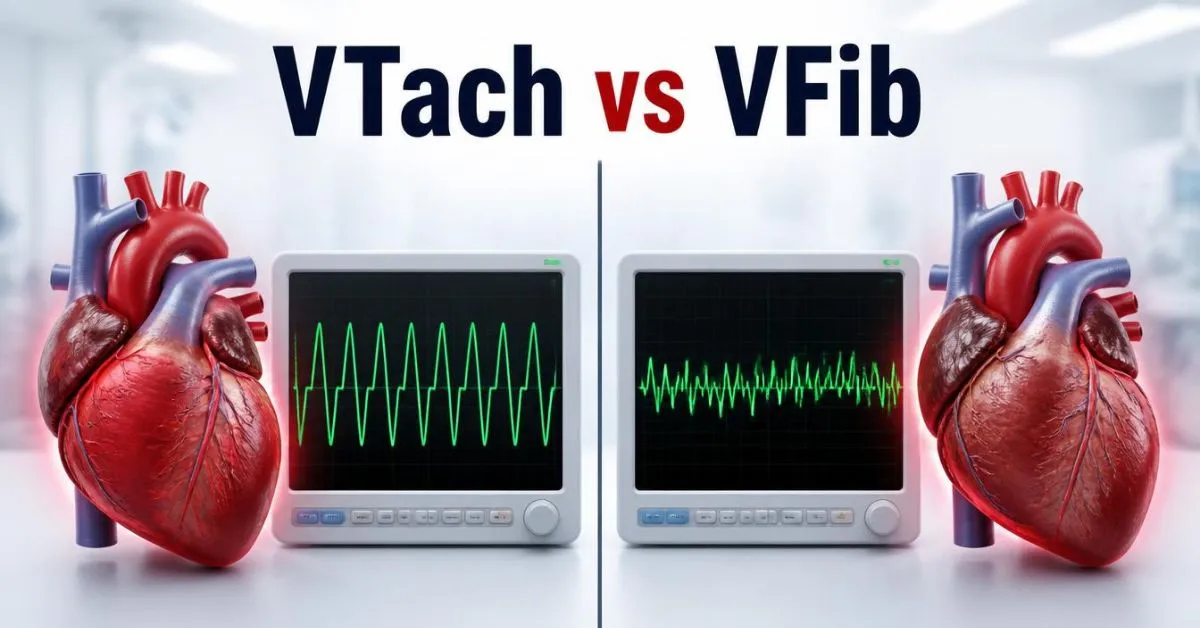
VTach and VFib are two dangerous heart rhythm problems that start in the heart’s lower chambers. VTach makes the ventricles beat very fast. The heart may still pump blood, but it may not pump enough.
VFib causes chaotic electrical activity, so the heart cannot pump blood well. Both can cause cardiac arrest. VFib and pulseless VTach need immediate emergency treatment.
Key Takeaways
- VTach: A very fast heart rhythm that starts in the heart’s lower chambers.
- VFib: A chaotic rhythm that stops the ventricles from pumping blood well.
- Pulse: A person with VTach may have a pulse. A person in cardiac arrest from VFib will not have an effective pulse.
- Treatment: VTach treatment depends on the person’s condition. VFib and pulseless VTach need CPR and rapid defibrillation.
- Emergency action: If someone is unresponsive and not breathing normally, call 911 or your local emergency number, start CPR, and use an AED as soon as possible.
What Are VTach & VFib?
VTach and VFib are types of heart rhythm problems called ventricular arrhythmias. They start in the ventricles, which are the heart’s two lower chambers.
The ventricles pump blood to the lungs and the rest of the body. Electrical signals tell the heart when to squeeze. When these signals go wrong, the heart may not pump enough blood to keep the brain and other organs working.
VTach and VFib affect the ventricles in different ways. This difference helps doctors choose the right treatment.
What Is VTach?
During VTach, the ventricles beat so fast that they may not have enough time to fill with blood between beats. As a result, the heart may pump less blood than the body needs.
VTach stands for ventricular tachycardia. It is a very fast heart rhythm that starts in the ventricles. It is also called V-tach or VT.
Some short episodes stop on their own. Other episodes last longer, lower blood pressure, cause fainting, or lead to cardiac arrest.
VTach can occur with a pulse or without one. A person may also have stable or unstable VTach. These terms describe how well the person is coping with the rhythm.
Doctors often call VT sustained when it lasts at least 30 seconds or needs earlier treatment because it causes serious problems. Shorter episodes may be called nonsustained VT.
Even if an episode stops, a medical check is important. The rhythm may return, and the cause may need treatment.
What Is VFib?
VFib stands for ventricular fibrillation. It is a chaotic heart rhythm that starts in the ventricles. It is also called V-fib or VF.
During VFib, the heart muscle quivers instead of squeezing in an organized way. The ventricles cannot pump blood well enough to supply the brain and other organs.
VFib causes cardiac arrest. A person may suddenly collapse, lose consciousness, and stop breathing normally.
This is a life-threatening emergency. Call 911 or your local emergency number, begin CPR, and use an automated external defibrillator (AED) as soon as one is available.
The AED checks the heart rhythm and gives a shock if one is needed. Quick action can improve the chance of survival.
VTach vs VFib: Key Differences
| Feature | VTach | VFib |
|---|---|---|
| Full name | Ventricular tachycardia | Ventricular fibrillation |
| Electrical activity | Very fast, often organized | Chaotic and disorganized |
| Heart action | Fast beats that may pump blood | Quivering without effective pumping |
| Pulse | May be present or absent | No effective pulse during cardiac arrest |
| Symptoms | Racing heartbeat, dizziness, chest pain, or fainting | Sudden collapse and loss of response |
| ECG pattern | Usually fast, wide QRS complexes | Chaotic waves without clear, repeating QRS complexes |
| Main danger | Poor blood flow or cardiac arrest | Cardiac arrest |
| Emergency treatment | Depends on the pulse and the person’s condition | CPR and rapid defibrillation |
| Long-term care | May include medicine, ablation, or an ICD | Depends on the cause and risk of another episode |
The main difference is how well the heart pumps blood. VTach may allow some blood flow, while VFib prevents effective pumping.
However, VTach is not always less dangerous. If it causes cardiac arrest, it is just as urgent as VFib.
What Do VTach & VFib Look Like on an ECG?
An electrocardiogram (ECG or EKG) records the heart’s electrical activity. Doctors use it to identify abnormal rhythms and help choose treatment.
VTach on an ECG
VTach often shows fast, wide QRS complexes. A QRS complex is the part of an ECG that records the main electrical signal as the ventricles activate.
Two common types of VTach are:
- Monomorphic VT: The QRS complexes have a similar shape from beat to beat.
- Polymorphic VT: The shape of the QRS complexes changes from beat to beat.
Monomorphic VT may look regular. Polymorphic VT has a changing pattern and can be especially dangerous. Sustained polymorphic VT that needs electrical treatment requires an unsynchronized shock.
VFib on an ECG
VFib shows chaotic electrical waves without clear, repeating QRS complexes. The ventricles are not producing organized beats that pump blood.
Doctors can use the ECG pattern to identify VFib and guide emergency treatment.
ECG images can help explain these rhythms, but they cannot replace medical assessment. Do not try to diagnose VTach or VFib from an online picture.
Symptoms of VTach vs VFib
The symptoms depend on how much blood the heart can pump. The two rhythms can share some warning signs, but VFib often causes sudden collapse.
Common VTach Symptoms
VTach may cause:
- A racing or pounding heartbeat
- Dizziness or lightheadedness
- Shortness of breath
- Chest pain
- Fainting
- Loss of consciousness in severe cases
Some people have short episodes with few or no symptoms. Others develop very low blood pressure or cardiac arrest.
Common VFib Symptoms
VFib may cause:
- Sudden collapse
- Loss of consciousness
- No normal breathing or only gasping
- No response when spoken to or gently tapped
Some people have chest pain, dizziness, nausea, or a racing heartbeat before they collapse. Others have little or no warning.
Important: Symptoms alone cannot tell you which rhythm a person has. If someone is unresponsive and is not breathing normally or is only gasping, treat it as a possible cardiac arrest. Call emergency services, start CPR, and use an AED. Do not wait to identify the rhythm.
What Causes VTach & VFib?
Both rhythms can develop when the heart’s electrical system is disturbed. Damage to the heart muscle can also create areas where electrical signals travel in the wrong way.
Common causes and risk factors include:
- Heart attack: A heart attack can damage heart muscle and disrupt its electrical signals.
- Coronary artery disease: Narrowed heart arteries can reduce the blood and oxygen that reach the heart.
- Heart muscle disease: Conditions such as cardiomyopathy can raise the risk of dangerous rhythms.
- Heart failure: A damaged or weakened heart may be more likely to develop an abnormal rhythm.
- Electrolyte problems: Very low or high levels of potassium or abnormal magnesium levels can affect the heart’s electrical activity.
- Certain medicines: Some medicines can change the heart rhythm or increase the risk of an abnormal beat.
- Stimulant drugs: Cocaine and methamphetamine can trigger dangerous heart rhythms.
- Inherited conditions: Some genetic heart conditions can raise the risk of VTach or VFib.
- Lack of oxygen: Low oxygen levels can affect the heart’s electrical system.
Sometimes, doctors cannot find one clear cause. A person’s risk also depends on their heart health, medical history, and the type of rhythm.
How Are VTach & VFib Diagnosed?
Doctors use the heart rhythm, symptoms, medical history, and test results to make a diagnosis.
Common tests include:
- ECG: Records the heart’s electrical activity and helps identify the rhythm.
- Heart monitoring: Tracks the rhythm over time to find episodes that may come and go.
- Blood tests: Check for electrolyte problems and signs of heart damage.
- Echocardiogram: Uses sound waves to show the heart’s structure and pumping action.
- Heart imaging: A CT scan or MRI may help find the cause in selected cases.
- Electrophysiology study: A heart specialist may use this test to study the heart’s electrical signals in detail.
Not everyone needs every test. The doctor chooses tests based on the person’s condition and medical history.
If cardiac arrest is suspected, emergency treatment must not wait for a full set of tests.
How Are VTach & VFib Treated?
Treatment depends on the rhythm, whether a pulse is present, and whether the person is stable.
These decisions must be made by trained medical staff. A bystander should not try to choose a heart treatment or give medicine.
Treatment for VTach With a Pulse
If a person has VTach with a pulse, doctors check blood pressure, breathing, and signs of poor blood flow.
If the rhythm causes severe problems, such as very low blood pressure, shock, or changes in awareness, urgent electrical treatment may be needed.
Treatment may include:
- Synchronized cardioversion: An electrical shock timed with the heartbeat for certain fast rhythms.
- Antiarrhythmic medicines: Drugs that help control abnormal heart rhythms.
- Heart monitoring: Close monitoring to watch for changes or a return of the rhythm.
- Treatment of the cause: For example, treating a heart attack or correcting an electrolyte problem.
A person who is stable may receive medicine or other treatment under medical supervision. A pulse does not mean VTach is harmless.
Treatment for Pulseless VTach & VFib
Pulseless VTach and VFib are both shockable rhythms during cardiac arrest.
Emergency care includes:
- Call 911 or your local emergency number.
- Start CPR if the person is unresponsive and is not breathing normally.
- Get an AED and turn it on as soon as possible.
- Follow the AED’s voice instructions.
- Continue CPR and follow the AED prompts until the person shows signs of life or emergency responders take over.
In a hospital, trained teams may also give medicines and provide advanced life support. The goal is to restore a rhythm that pumps blood and treat the cause of the cardiac arrest.
Cardioversion vs Defibrillation
Both treatments use an electrical shock, but they work in different ways.
| Treatment | How it works | Common use |
|---|---|---|
| Synchronized cardioversion | Times the shock with a specific part of the heartbeat | Certain fast rhythms when a pulse is present |
| Defibrillation | Gives an unsynchronized shock | VFib and pulseless VT during cardiac arrest |
Not every VT rhythm receives synchronized cardioversion. Sustained polymorphic VT that needs a shock is treated with an unsynchronized shock.
Clinicians choose the treatment based on the rhythm and the person’s condition.
Can VTach Turn Into VFib?
Yes. VTach can sometimes change into VFib, especially when the heart is damaged or the electrical problem is severe.
However, this does not happen in every case. Some VTach episodes stop on their own. Others continue, reduce blood flow, or lead to cardiac arrest.
A suspected episode of VTach needs medical assessment, even if the heartbeat later seems normal. A doctor can look for the cause and assess the risk of another episode.
Can VTach or VFib Come Back?
Yes. Both rhythms can return, depending on the cause and the person’s heart health.
After VTach, a doctor may recommend medicine, catheter ablation, or an implantable cardioverter-defibrillator (ICD).
An ICD is a small device placed under the skin. It watches the heart rhythm and can deliver treatment if it detects certain dangerous rhythms.
After VFib, the medical team works to find and treat the cause. This may involve treating blocked heart arteries, correcting electrolyte problems, reviewing medicines, or checking for an inherited heart condition.
The best plan depends on the person. Follow-up care is important even after the immediate emergency has passed.
What Should You Do During a Suspected Cardiac Arrest?
If someone suddenly collapses, does not respond, and is not breathing normally or is only gasping, act at once.
- Call for help. Call 911 or your local emergency number. Use speakerphone if possible.
- Start chest compressions. For an adult, push hard and fast in the center of the chest.
- Keep a steady pace. Aim for 100–120 compressions per minute.
- Get an AED. Ask another person to bring one if possible.
- Follow the AED prompts. Turn it on, attach the pads, and follow its instructions. Do not delay using it while trying to identify the heart rhythm.
- Continue CPR. Keep going until the person shows signs of life or trained help takes over.
If you are not trained in rescue breaths, hands-only CPR is better than doing nothing for a sudden adult collapse. Follow the emergency dispatcher’s instructions.
Do not delay emergency care to read this article or search for more information.
FAQs:
Which is more dangerous, VTach or VFib?
VFib causes cardiac arrest because the ventricles cannot pump blood effectively. However, VTach can also be fatal if it causes severe problems or occurs without a pulse. Both can be life-threatening and need urgent medical care.
Can you have VTach and still have a pulse?
Yes. VTach can occur with a pulse, but the heart may still pump too little blood. In other cases, VTach causes cardiac arrest and there is no pulse. Doctors use the ECG and the person’s condition to guide treatment.
Are VTach and VFib both shockable rhythms?
Yes. VFib and pulseless VTach are shockable rhythms during cardiac arrest. An AED checks the rhythm and tells the user if a shock is advised. VTach with a pulse needs a different treatment plan.
Can someone survive VFib?
Yes. Survival is possible, especially when CPR and defibrillation begin quickly. VFib stops effective blood flow, so urgent treatment is vital to protect the brain and other organs.
Is VTach always an emergency?
VTach can be an emergency even when symptoms seem mild. A short episode may stop on its own, but a medical assessment is needed to judge the risk. Chest pain, fainting, trouble breathing, or signs of poor blood flow need urgent care.
What is the difference between VT and VF?
VT means ventricular tachycardia, while VF means ventricular fibrillation. VT is a very fast rhythm that may still allow the heart to pump blood. VF is chaotic electrical activity that prevents effective pumping and causes cardiac arrest.
Can VFib happen without a known heart problem?
Yes. VFib can occur in people who have no known history of heart disease. A heart attack, inherited condition, medicine, injury, or electrolyte problem may trigger it. Doctors work to find the cause after emergency treatment.
Conclusion:
The main difference between VTach and VFib is how the heart’s lower chambers respond to electrical signals. VTach causes a very fast rhythm that may still produce a pulse. VFib causes chaotic activity that prevents effective pumping.
Both can cause cardiac arrest, but treatment depends on the rhythm and the person’s condition. If someone is unresponsive and not breathing normally, call emergency services, start CPR, and use an AED as soon as possible.
Medical disclaimer: This article is for education only. It does not replace medical advice, diagnosis, or emergency care.

Olivia Smith is a professional author at ReplyGenius.com, where I create clear and engaging content on communication and writing.