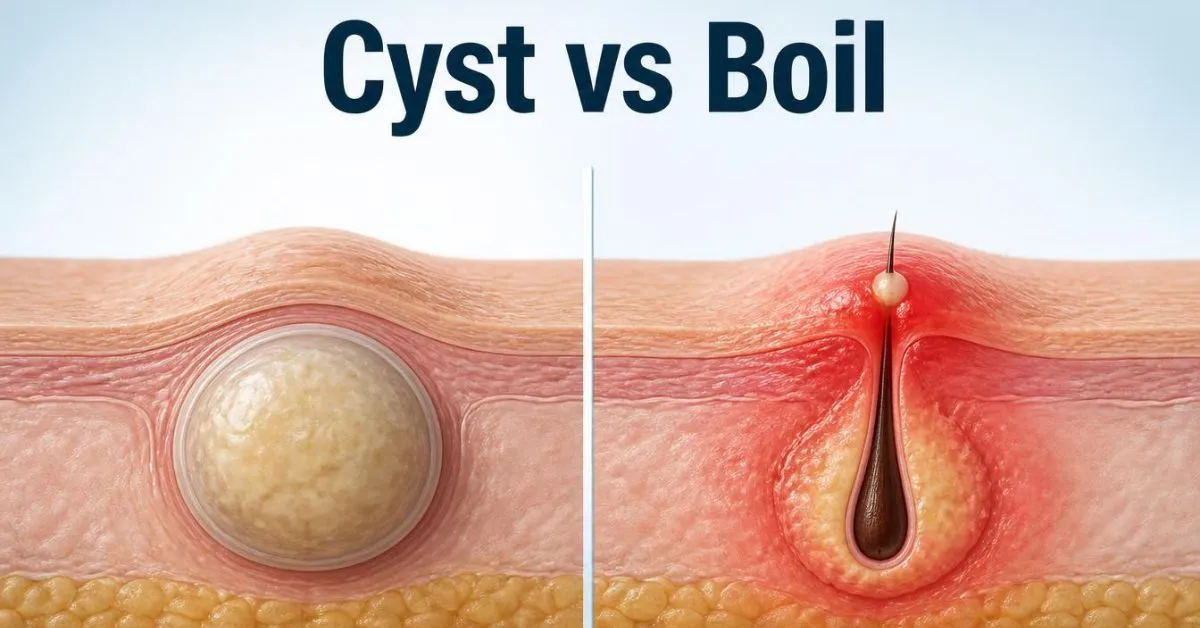
A cyst is a sac under the skin that may contain thick material or fluid. A boil is a painful lump caused by a bacterial infection, often in a hair follicle.
A cyst often grows slowly and may not hurt, while a boil tends to swell and become painful over a few days. Both can look alike, so a healthcare professional may need to examine the lump to identify it.
Key Takeaways
- Cyst: A sac under the skin that often grows slowly.
- Boil: A painful skin infection that fills with pus.
- Main clue: A long-lasting, painless lump may be a cyst. A fast-growing, tender lump may be a boil.
- Important exception: A cyst can become swollen and painful without being infected.
- Home care: Warm compresses may help a small boil drain.
- Safety: Never pop, squeeze, or cut open a cyst or boil yourself.
Cyst vs Boil: What Is the Main Difference?
The main difference is how the lump forms. A cyst develops when material collects inside a sac under the skin. A boil forms when bacteria infect a hair follicle and cause pus to build up.
| Feature | Cyst | Boil |
|---|---|---|
| Main cause | A sac forms under the skin | A bacterial infection |
| Growth | Often slow | Often faster |
| Pain | May not hurt | Usually painful |
| Feel | Firm or soft | Tender, swollen, sometimes soft in the center |
| Appearance | Often a round lump | Often a swollen lump that may fill with pus |
| Skin changes | May look normal | May feel warm or look red, purple, or darker |
| Central spot | May have a small opening | May develop a white or yellow tip |
| Treatment | May need no care or removal | May need warm compresses or medical drainage |
| Contagious? | A simple cyst is not contagious | Bacteria may spread from infected drainage |
These signs are clues, not a sure diagnosis. An inflamed cyst can look much like a boil. A boil may also lack a clear white or yellow tip.
What Is a Cyst?
A skin cyst is a sac that forms under the skin. It may hold fluid or a thick protein called keratin. Keratin is found in skin, hair, and nails.
One common type is an epidermoid cyst. It often appears on the face, neck, back, or trunk. It usually grows slowly and may stay the same size for months or years.
Common signs of a cyst
A cyst may:
- Form a round lump under the skin.
- Feel firm or slightly soft.
- Grow slowly.
- Cause little or no pain.
- Have a small opening or dark spot in the center.
- Release thick material with a strong smell if it opens.
Not every cyst has all these signs. A new or unexplained lump should be checked rather than diagnosed by appearance alone.
Does a cyst hurt?
A cyst often does not hurt when it is calm. It can become painful if it grows, breaks open under the skin, or becomes inflamed.
Pain does not always mean a cyst is infected. The body’s response to material released from a damaged cyst can cause swelling and soreness even without a bacterial infection.
A healthcare professional can check whether the cyst is inflamed, infected, or caused by something else.
What Is a Boil?
A boil, also called a furuncle, is a skin infection that often starts in a hair follicle. Bacteria enter the skin and cause swelling and pus to build up.
One common cause is Staphylococcus aureus, also known as staph. These bacteria can live on the skin without causing harm, but they can cause an infection if they enter the skin.
Boils often form on the face, neck, armpits, thighs, and buttocks. They can also appear in other areas of the body.
Common signs of a boil
A boil may:
- Start as a small, sore bump.
- Grow larger over a few days.
- Feel warm and tender.
- Cause swelling around the lump.
- Develop a white or yellow center.
- Release pus when it opens.
- Cause fever or chills if the infection is more serious.
On brown or Black skin, redness may be harder to see. Warmth, swelling, pain, and changes in skin color can also be signs of infection.
What is a carbuncle?
A carbuncle is a group of connected boils. It can cause a deeper and more serious infection than one boil.
A carbuncle may cause more pain, drainage, and scarring. It can also make you feel unwell. Seek medical care rather than trying to drain a group of boils at home.
Cyst vs Boil vs Abscess: What Is the Difference?
These terms are related, but they do not mean the same thing.
- Cyst: A sac under the skin that holds fluid or other material. It may not be infected.
- Boil: An infection that starts around a hair follicle and forms a painful lump with pus.
- Abscess: A pocket of pus caused by an infection. It can form in many parts of the body.
A boil is a type of skin abscess. However, not every skin abscess is a boil. An abscess can form deeper in the skin or in tissue that is not linked to a hair follicle.
A cyst can also become infected and form an abscess. This is one reason these lumps can look alike.
Can a Cyst Turn Into a Boil?
A cyst does not simply turn into a boil. They start in different ways. However, a cyst can become inflamed, break open, or develop an infection. This can make it look and feel like a boil.
Here is how they differ:
- Uninflamed cyst: A lump that may stay painless for a long time.
- Inflamed cyst: A lump that becomes swollen or sore. It may not have an infection.
- Infected cyst: A cyst that develops a bacterial infection and may become painful, warm, or swollen.
- Boil: A lump caused by an infection that often starts around a hair follicle.
If a lump becomes more painful, grows quickly, or leaks pus, have it checked. Do not assume it is only a cyst or boil based on its appearance.
How to Treat a Cyst vs Boil
Treatment depends on the cause, size, location, and symptoms of the lump. The right care for a cyst may not be the right care for a boil.
How to care for a cyst
A small cyst that causes no problems may not need treatment. A healthcare professional may suggest watching it for changes.
To care for the area:
- Keep the skin clean.
- Do not squeeze or pick at the lump.
- Watch for new pain, swelling, or changes in size.
- Get medical advice if the lump grows, breaks open, or becomes sore.
A warm, moist cloth may help soothe the area. However, it will not remove the cyst sac.
If a cyst is painful, infected, or bothers you, a clinician may suggest treatment. Options may include draining the cyst or removing it.
Draining and removing a cyst are not the same. Drainage can ease pressure, but the sac may remain and fill again. Removing the whole sac can lower the chance of the cyst returning. A clinician may wait until swelling has settled before removing an inflamed cyst.
How to care for a boil
A small boil may improve with warm compresses.
- Wet a clean washcloth with warm water.
- Hold it gently on the boil for about 10 minutes.
- Repeat about four times a day.
- Use a clean cloth each time.
- If the boil opens, clean the area gently and cover it with a clean dressing.
- Wash your hands before and after touching the area or changing the dressing.
Warm compresses may ease pain and help the boil drain on its own.
Do not pop, squeeze, pierce, or cut a boil. This can spread the infection or damage the skin.
When do cysts and boils need medical treatment?
A healthcare professional may drain a large boil or abscess with a small cut. Antibiotics may also be needed in some cases.
A cyst may need removal if it keeps growing, causes pain, or returns. Antibiotics do not remove a cyst sac, and they are not needed for every red or swollen cyst.
The right treatment depends on whether the lump is inflamed, infected, or caused by another condition. Do not use leftover antibiotics or someone else’s medicine.
When Should You See a Doctor?
See a healthcare professional if you have a skin lump and do not know what it is. This is especially important if it grows, keeps returning, or does not heal.
Get medical advice if:
- The lump becomes more painful or swollen.
- The skin around it feels hot.
- It grows quickly or leaks pus.
- You have several boils or they keep coming back.
- A boil does not improve after about two weeks.
- The lump is on your face.
- You have diabetes or a weakened immune system.
Seek urgent medical care if you have fever or chills with a skin lump, severe pain, or swelling that spreads quickly. Red streaks spreading away from the lump can also be a warning sign of a spreading infection.
Do not wait for every warning sign to appear. If the lump is getting worse or you feel unwell, seek care promptly.
Repeated boil-like lumps in the armpits, groin, buttocks, or under the breasts may be linked to a condition called hidradenitis suppurativa. This is a long-term skin condition that can cause painful lumps, drainage, and scars. A dermatologist can check the cause and discuss treatment.
How Can You Help Prevent Boils?
You cannot prevent every cyst or boil. But good skin care can lower the chance of some skin infections.
- Wash your hands often.
- Keep cuts and scrapes clean and covered.
- Do not share towels, razors, or other personal items that touch the skin.
- Keep a draining boil covered with a clean dressing.
- Wash towels, clothes, and bedding that touch infected drainage.
- Wash your hands after changing a dressing.
- Avoid picking at bumps or broken skin.
If boils keep coming back, ask a healthcare professional about the cause. Repeated infections may need further checks or a different treatment plan.
FAQs:
How can you tell if a lump is a cyst or a boil?
A cyst often grows slowly and may not hurt. A boil usually becomes sore, warm, and swollen over a few days. A boil may also fill with pus. These signs can overlap, so a clinician may need to examine the lump to identify it.
Is a cyst or boil contagious?
A simple, uninfected cyst is not contagious. Bacteria from a boil can spread through infected drainage or contaminated items, such as towels. Keep a draining boil covered, wash your hands, and do not share towels or razors while it heals.
Can a cyst or boil go away on its own?
Some cysts remain harmless and need no treatment. Some small boils drain and heal on their own. However, a lump may need medical care if it grows, becomes more painful, or does not heal. Do not squeeze either one to make it go away faster.
Does a boil always have pus?
A boil often fills with pus, but it may not have a clear white or yellow head at first. It can start as a sore, swollen bump. Do not press it to check for pus. If it grows or becomes more painful, seek medical advice.
Should you use antibiotics for a cyst or boil?
Not always. Antibiotics may help treat a bacterial infection, but they do not remove a cyst sac. Some boils need drainage rather than antibiotics alone. A clinician can decide whether medicine, a procedure, or home care is the right choice.
Why does a cyst smell when it drains?
An epidermoid cyst can release thick, foul-smelling material made mainly of keratin. This smell does not prove that the cyst is infected. However, new pain, warmth, swelling, or other signs of infection should be checked.
Conclusion:
The main difference between a cyst and a boil is the cause. A cyst is a sac under the skin, while a boil is a skin infection that often starts in a hair follicle.
Cysts often grow slowly and may not hurt. Boils usually become painful and swollen over a short time. But an inflamed or infected cyst can look much like a boil.
Do not pop or squeeze either lump. Use safe home care for minor symptoms, and seek medical advice if the lump is new, growing, very painful, or not healing.
This article is for general information. It cannot diagnose a skin lump. A healthcare professional can examine the area and recommend the right care.