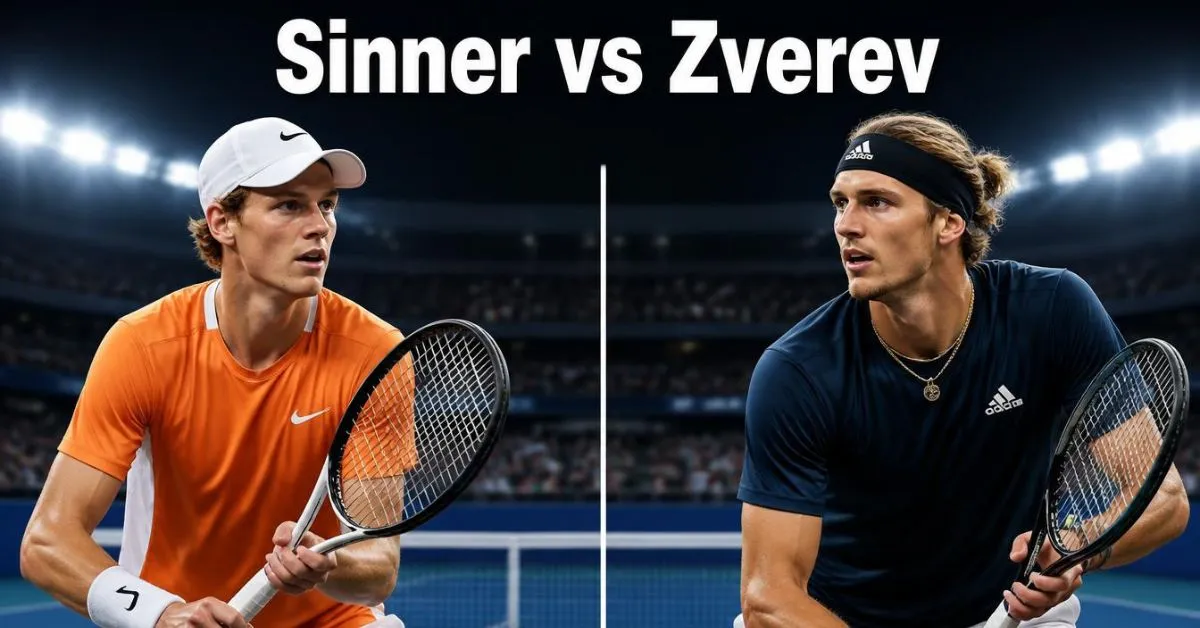
Jannik Sinner leads Alexander Zverev 11–4 in their ATP head-to-head record after beating him in the Wimbledon 2026 final.
Sinner won 6–7(7), 7–6(2), 6–3, 6–4 on July 12, 2026. He has won their last 10 matches, including the Australian Open 2025 and Wimbledon 2026 finals. Source: ATP Tour.
Key Takeaways
- Head-to-head record: Sinner leads 11–4 across 15 matches.
- Latest meeting: Sinner beat Zverev in the Wimbledon 2026 final.
- Winning streak: Sinner has won 10 matches in a row against Zverev.
- Grand Slam finals: Sinner beat Zverev at the Australian Open in 2025 and Wimbledon in 2026.
- Surface records: Sinner leads on outdoor hard, indoor hard, clay, and grass in the published 15-match record.
- Main difference: Sinner uses fast groundstrokes and strong returns. Zverev relies on his serve, reach, and powerful shots.
- Next match: Past results favor Sinner, but they cannot guarantee another win.
Sinner vs Zverev Head-to-Head Record
Sinner leads Zverev 11–4 across 15 ATP Tour singles meetings. Zverev won four matches in a row from 2020 to 2023, but Sinner has won every meeting since his victory in Cincinnati in 2024.
| Head-to-head stat | Jannik Sinner | Alexander Zverev |
|---|---|---|
| Career wins | 11 | 4 |
| Total meetings | 15 | 15 |
| Current winning streak | 10 matches | 0 |
| Latest match | Wimbledon 2026 final | Wimbledon 2026 final |
| Latest result | Won | Lost |
| Most recent win against opponent | July 12, 2026 | September 2023 |
Record based on the published ATP rivalry history following Wimbledon 2026.
The rivalry has changed a great deal. Zverev had the early advantage, but Sinner has taken control of their recent meetings.
Sinner’s run includes wins at major tournaments and Masters events. He has also won both Grand Slam finals the pair have played.
Still, the overall record does not explain every match. The court surface, serve quality, fitness, and play under pressure can all affect the result.
Who Won the Latest Sinner vs Zverev Match?
Jannik Sinner defeated Alexander Zverev in the Wimbledon men’s singles final on July 12, 2026.
| Match detail | Result |
|---|---|
| Tournament | Wimbledon 2026 |
| Round | Men’s singles final |
| Surface | Grass |
| Winner | Jannik Sinner |
| Final score | 6–7(7), 7–6(2), 6–3, 6–4 |
| Match duration | 3 hours, 46 minutes |
| Winners by Sinner | 58 |
| Break points faced by Sinner | 1 |
| Break points saved by Sinner | 1 |
How Sinner won the final
Zverev won the first set in a close tiebreak. Sinner then won the second-set tiebreak 7–2 to level the match.
Sinner took the third set 6–3 and the fourth 6–4. He broke Zverev’s serve once in each of those sets to secure the title.
The match showed Sinner’s ability to stay calm under pressure. Zverev served well and played with more aggression than usual, but Sinner kept his groundstrokes deep and took his chances when they came.
Sinner hit 58 winners and saved the only break point he faced. Those numbers help explain how he held firm during a match that lasted almost four hours.
The win gave Sinner his second Wimbledon title and fifth Grand Slam singles title. It also extended his winning streak against Zverev to 10 matches.
Complete Sinner vs Zverev Match History
The table below lists all 15 meetings in the published ATP rivalry record, from the latest match to the earliest.
| Date | Tournament | Round | Surface | Winner | Score |
|---|---|---|---|---|---|
| July 2026 | Wimbledon | Final | Grass | Sinner | 6–7(7), 7–6(2), 6–3, 6–4 |
| May 2026 | Madrid Open | Final | Clay | Sinner | 6–1, 6–2 |
| April 2026 | Monte-Carlo Masters | Semifinal | Clay | Sinner | 6–1, 6–4 |
| March 2026 | Miami Open | Semifinal | Outdoor hard | Sinner | 6–3, 7–6(4) |
| March 2026 | Indian Wells | Semifinal | Outdoor hard | Sinner | 6–2, 6–4 |
| November 2025 | ATP Finals | Round robin | Indoor hard | Sinner | 6–4, 6–3 |
| November 2025 | Paris Masters | Semifinal | Indoor hard | Sinner | 6–0, 6–1 |
| October 2025 | Vienna Open | Final | Indoor hard | Sinner | 3–6, 6–3, 7–5 |
| January 2025 | Australian Open | Final | Outdoor hard | Sinner | 6–3, 7–6(4), 6–3 |
| August 2024 | Cincinnati Open | Semifinal | Outdoor hard | Sinner | 7–6(9), 5–7, 7–6(4) |
| September 2023 | US Open | Round of 16 | Outdoor hard | Zverev | 6–4, 3–6, 6–2, 4–6, 6–3 |
| April 2022 | Monte-Carlo Masters | Quarterfinal | Clay | Zverev | 5–7, 6–3, 7–6(5) |
| September 2021 | US Open | Round of 16 | Outdoor hard | Zverev | 6–4, 6–4, 7–6(7) |
| October 2020 | Cologne 2 | Semifinal | Indoor hard | Zverev | 7–6(3), 6–3 |
| October 2020 | French Open | Round of 16 | Clay | Sinner | 6–3, 6–3, 4–6, 6–3 |
What does the match history show?
The biggest change came after the 2023 US Open. Zverev won that five-set match, but Sinner won their next meeting in Cincinnati in 2024.
Sinner then built his winning streak through 2025 and 2026. His wins included two Grand Slam finals, Masters events, and the ATP Finals.
Not every win was close. Sinner won some matches in straight sets, including the 6–0, 6–1 result at the 2025 Paris Masters. Other matches were much tighter, such as the three-set Cincinnati semifinal in 2024.
This pattern suggests that Sinner has found ways to handle Zverev’s game across several conditions. It does not mean that future matches will follow the same pattern.
Sinner vs Zverev Head-to-Head by Surface
Court surface can change how a tennis match plays out. The ball bounces differently on clay, grass, and hard courts. This can change the value of a serve, a return, or a groundstroke.
The published 15-match record gives the following surface split:
| Surface | Sinner wins | Zverev wins | Leader |
|---|---|---|---|
| Outdoor hard | 4 | 2 | Sinner |
| Indoor hard | 3 | 1 | Sinner |
| Clay | 3 | 1 | Sinner |
| Grass | 1 | 0 | Sinner |
| Total | 11 | 4 | Sinner |
Hard courts
Hard courts make up most of their meetings. Sinner leads 4–2 outdoors and 3–1 indoors in this record.
His wins include the Australian Open 2025 final and the 2025 indoor events in Vienna, Paris, and Turin. His ability to return serve and hit deep groundstrokes has worked well in this matchup.
Clay
Sinner leads 3–1 on clay in the listed record. Their clay meetings include the 2020 French Open, the 2022 Monte-Carlo quarterfinal, and two 2026 events.
Clay often gives players more time to reach the ball. The higher bounce can also help players use spin and build longer rallies. However, the record shows that Sinner has won their recent clay meetings too.
Grass
Sinner leads 1–0 on grass after the Wimbledon 2026 final.
One match is too small a sample to prove that grass always favors Sinner in this matchup. His Wimbledon win shows that he can beat Zverev on the surface, but more meetings would be needed to draw a stronger conclusion.
Sinner vs Zverev: Australian Open 2025 Final
Sinner beat Zverev 6–3, 7–6(4), 6–3 in the Australian Open 2025 final on January 26.
Zverev stayed close in the second set, but Sinner won the tiebreak. That gave Sinner a two-set lead and left Zverev with little room to recover.
Sinner’s steady groundstrokes and strong play on key points helped him finish the match in straight sets. The win gave him his second Australian Open title and his first Grand Slam final victory over Zverev.
The result also marked a key point in their rivalry. Sinner kept winning their meetings after Cincinnati in 2024 and later beat Zverev again in the Wimbledon 2026 final.
How Do Sinner & Zverev Play?
Both players can hit hard from the baseline, serve well, and defend under pressure. Their main strengths are different, though.
Jannik Sinner’s strengths
Sinner hits fast, deep groundstrokes and takes the ball early. His forehand and backhand can push opponents behind the baseline. His return game also helps him put pressure on the other player’s serve.
When Sinner controls the depth of a rally, he can take time away from his opponent. This may force a short reply that he can attack.
His recent record against Zverev suggests that this approach has worked well in their meetings. Still, no single tactic explains every result.
Alexander Zverev’s strengths
Zverev has a powerful serve and a strong two-handed backhand. At 6 feet 6 inches (198 cm), he also has a long reach that helps him cover the court.
His serve can earn quick points and make it harder for an opponent to attack. When he serves well and hits deep groundstrokes, he can control rallies before they become too long.
Zverev’s early wins over Sinner show that he can make this matchup difficult. His best chance is to serve well, attack short balls, and avoid giving Sinner easy chances to take control.
Main playing-style differences
| Feature | Sinner | Zverev |
|---|---|---|
| Main strengths | Fast groundstrokes and returns | Powerful serve and backhand |
| Rally approach | Takes the ball early | Uses depth, power, and reach |
| Serve | Strong and varied | A major weapon |
| Return game | A key strength | Can be effective |
| Route to control | Put pressure on the next shot | Win quick points and attack short balls |
These are general playing traits, not fixed limits. Both players can change their tactics during a match.
Sinner vs Zverev: Player Stats Comparison
| Stat | Jannik Sinner | Alexander Zverev |
|---|---|---|
| Country | Italy | Germany |
| Date of birth | August 16, 2001 | April 20, 1997 |
| Height | 6 ft 3 in (191 cm) | 6 ft 6 in (198 cm) |
| Playing hand | Right-handed | Right-handed |
| Career-high singles ranking | World No. 1 | World No. 2 |
Sinner is younger, while Zverev is taller. Neither fact decides a tennis match on its own. Serve quality, return skill, movement, fitness, and play under pressure all matter.
For a deeper match comparison, these stats are useful:
- First-serve percentage: How often a player lands a first serve.
- First-serve points won: How often the player wins a point after landing the first serve.
- Second-serve points won: How well the player handles points after a missed first serve.
- Return points won: How often the player wins points when returning serve.
- Break points saved: How often the player stops an opponent from breaking serve.
- Break points converted: How often the player wins a game when given a chance to break serve.
- Unforced errors: Mistakes that are not forced by a difficult shot from the opponent.
These stats help explain how a match was won. To make a fair comparison, use the same time period and surface for both players.
Who Is Better: Sinner or Zverev?
Based on their head-to-head record, Sinner has the clear edge. He leads 11–4 and has won their last 10 meetings. His wins in the Australian Open 2025 and Wimbledon 2026 finals add weight to that record.
But “better” can mean different things.
- Head-to-head record: Sinner leads.
- Recent meetings: Sinner has the stronger record.
- Serve and reach: Zverev has clear strengths.
- Baseline pressure and returns: Sinner’s game has worked well in this matchup.
- Next match: The result will depend on form, fitness, surface, and tactics.
Zverev has beaten Sinner before, including at the 2023 US Open. To turn the rivalry around, he would need to serve well, attack at the right times, and avoid giving Sinner easy chances to control rallies.
Sinner should be considered the favorite based on their past meetings alone. That does not mean a future win is certain.
FAQs:
Who leads the Sinner vs Zverev head-to-head?
Jannik Sinner leads Alexander Zverev 11–4 across 15 ATP Tour singles meetings. Sinner has won their last 10 matches, including the Wimbledon 2026 final.
When did Sinner and Zverev last play?
Their latest meeting was the Wimbledon 2026 final on July 12. Sinner won 6–7(7), 7–6(2), 6–3, 6–4 in 3 hours and 46 minutes.
Who won the Australian Open 2025 final?
Sinner defeated Zverev 6–3, 7–6(4), 6–3 on January 26, 2025. He won the final in straight sets.
Has Zverev ever beaten Sinner?
Yes. Zverev won four meetings in a row from 2020 to 2023. His 2023 US Open win over Sinner was a five-set match. Sinner has won every meeting since Cincinnati in 2024.
What is Sinner’s record against Zverev on clay?
Sinner leads 3–1 on clay in the published 15-match record. His clay wins include the 2020 French Open match and meetings in Monte-Carlo and Madrid in 2026.
Who has the stronger serve?
Zverev is known for his powerful serve, which can help him win quick points. Sinner also serves well, but his return game and fast groundstrokes are key parts of his success against Zverev. The better server in any one match depends on that day’s performance.
Who is more likely to win their next match?
Sinner’s head-to-head record favors him. However, a fair prediction should also consider current form, injuries, court surface, and recent match stats. Past results alone cannot guarantee the winner.
Conclusion:
Sinner leads Zverev 11–4 and has won their last 10 meetings. His victories in the Australian Open 2025 and Wimbledon 2026 finals are two of the biggest results in their rivalry.
The full match history shows that Sinner’s lead extends across outdoor hard, indoor hard, clay, and grass in the 15 meetings listed. His fast groundstrokes and strong returns have helped him gain control of the matchup, while Zverev’s serve, reach, and power remain major strengths.
For now, Sinner has the stronger head-to-head record. But the next match should be judged on its own conditions, not on past results alone.

Olivia Smith is a professional author at ReplyGenius.com, where I create clear and engaging content on communication and writing.