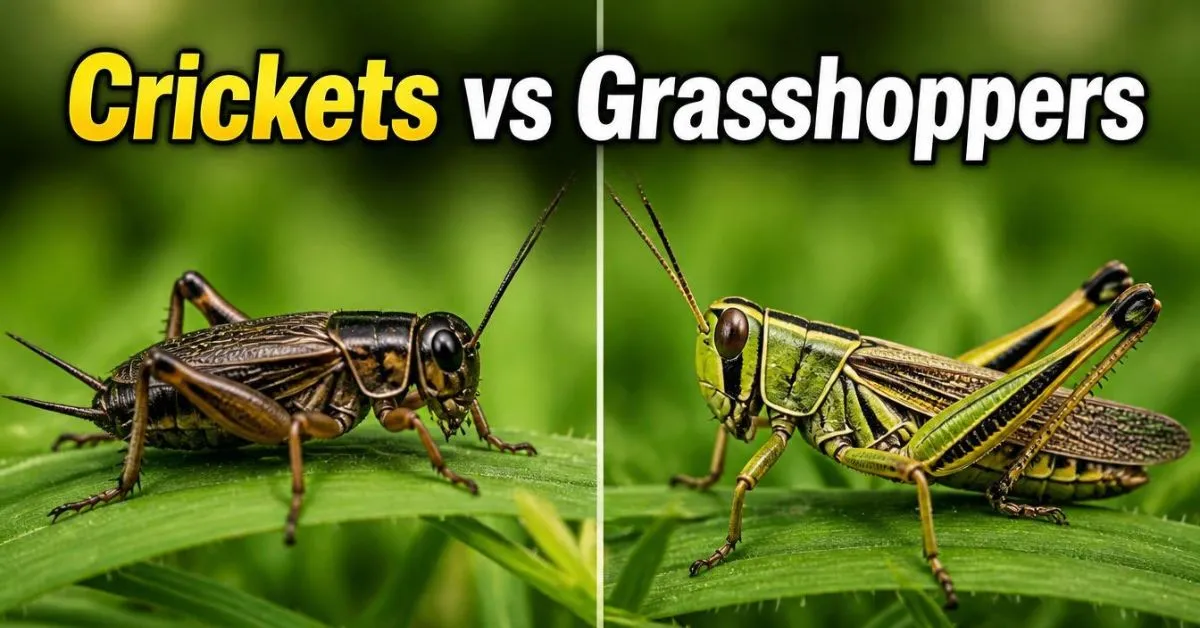
Crickets and grasshoppers are related insects in the order Orthoptera, but they are different insects. Crickets usually have long, thin antennae, are often active at night, and male crickets make their familiar chirp by rubbing their wings together.
Grasshoppers usually have shorter antennae, are more active during the day, and many species make sounds by rubbing their hind legs against their wings.
Key Takeaways
- Crickets usually have long, thin antennae, while grasshoppers have much shorter antennae.
- Crickets are often active at night, while grasshoppers are more commonly active during the day.
- Male crickets make their familiar chirp by rubbing their wings together.
- Many grasshoppers make sound by rubbing their hind legs against their wings.
- Crickets and grasshoppers both have powerful hind legs for jumping.
- Grasshoppers are mainly plant eaters, while many crickets have broader diets.
- Both belong to Orthoptera, but they are placed in different major branches of the group.
- Long antennae do not always mean cricket because katydids also have long antennae.
Are Crickets & Grasshoppers the Same?
No. Crickets and grasshoppers are different insects, but they are closely related.
Both belong to the insect order Orthoptera, a group that includes grasshoppers, crickets, katydids, and other related insects. They share several traits, including chewing mouthparts, strong hind legs, and an incomplete life cycle in which young insects develop through nymph stages rather than a pupal stage.
The fastest way to tell many crickets and grasshoppers apart is to look at their antennae.
Crickets usually have long, thin antennae that can be as long as or longer than the body. Grasshoppers usually have much shorter antennae.
But antennae alone are not a perfect test. Katydids also have long antennae, so a long-antenna insect may be a cricket or another long-horned orthopteran.
Crickets vs Grasshoppers: Key Differences
| Feature | Cricket | Grasshopper |
| Order | Orthoptera | Orthoptera |
| Antennae | Usually long and thin | Usually short and sturdy |
| Common activity | Often evening and night | Mostly daytime |
| Sound | Males commonly rub wings together | Many rub hind legs against wings |
| Hearing organs | On front legs | On abdomen |
| Diet | Often broader, depending on species | Mainly plant-based |
| Body shape | Often rounded or somewhat flattened | Often more elongated |
| Hind legs | Strong for jumping | Strong for jumping |
| Habitat | Fields, ground cover, shelters, some homes | Fields, grasslands, gardens, vegetation |
| Life cycle | Egg → nymph → adult | Egg → nymph → adult |
These are general differences. Individual species can vary, so no single feature should always be treated as a perfect identification test.
1. Antennae
Antennae are one of the quickest visual clues.
Crickets
Crickets usually have long, thin antennae. In many species, the antennae can be as long as the body or longer.
Grasshoppers
Grasshoppers usually have shorter and sturdier antennae.
So, as a quick rule:
Long antennae → cricket or another long-horned orthopteran
Short antennae → more likely grasshopper
This is one of the best first clues, but it should not be used alone.
2. Body Shape
Body shape can also help.
Crickets often have a rounded or somewhat flattened body. Many field crickets are dark brown or black.
Grasshoppers often have a more elongated body and are commonly green, brown, gray, or a mix of these colors.
Their coloring often helps them blend into grass, leaves, soil, and other vegetation.
However, body shape and color vary widely among species. A brown insect is not automatically a cricket, and a green insect is not automatically a grasshopper.
3. Sound
Sound is another useful clue.
How Do Crickets Make Their Sound?
Male crickets commonly produce their familiar chirping sound by rubbing their wings together. Their wings have specialized structures that produce the sound.
This is called stridulation.
How Do Grasshoppers Make Sound?
Many grasshoppers make sounds by rubbing their hind legs against their wings. Some species can also make clicking, buzzing, or crackling sounds through other movements.
So:
Cricket → commonly wings rubbing together
Grasshopper → often hind leg rubbing against wing
Not every species makes the same sound, so sound is a clue rather than a perfect identification method.
4. Where Are Their Ears?
This is one of the most interesting differences.
A cricket’s main hearing organs are located on its front legs.
A grasshopper’s hearing organs are located on its abdomen.
So if you are comparing the two:
Cricket → hearing organs on the front legs
Grasshopper → hearing organs on the abdomen
Neither insect has its main hearing organs where most people would expect them.
5. Activity Time
Crickets are commonly associated with evening and nighttime activity. This is why you may hear cricket chirping after dark without seeing the insect.
Grasshoppers are more commonly active during the day, especially in warm, sunny conditions.
But this is not a strict rule.
Different species have different behavior, so use activity time together with other clues.
6. Diet
Grasshoppers are mainly plant-feeding insects. They commonly eat grasses, leaves, crops, and other vegetation. Some species have very specific food preferences, while others eat a wider range of plants.
Many crickets have a broader diet. Depending on the species, they may eat plant material, fungi, decaying organic matter, or small insects. Field crickets, for example, are known to feed on plants as well as dead or weakened insects.
So the simple comparison is:
Grasshoppers → mainly plant-based diet
Many crickets → broader diet
Because diet varies by species, it is better to use “many crickets” rather than saying every cricket is an omnivore.
7. Habitat
Grasshoppers are strongly associated with:
- Grasslands
- Fields
- Meadows
- Gardens
- Cropland
- Other areas with vegetation
Crickets can live in many of the same outdoor areas, but some also prefer dark, sheltered, or damp places.
Depending on the species, crickets may be found under:
- Leaves
- Logs
- Rocks
- Debris
- Ground cover
- Buildings
Some cricket species also enter homes. The University of Minnesota Extension notes that crickets commonly live outdoors but may enter buildings, usually becoming more of a nuisance than a serious household pest.
8. Jumping & Movement
Both crickets and grasshoppers have powerful hind legs.
That means jumping alone cannot tell you which insect you are seeing.
Grasshoppers often jump to escape and may then fly away.
Crickets can also jump when disturbed and use their strong hind legs to move quickly through ground cover and other habitats.
So if an insect jumps:
Do not assume it is a grasshopper.
Check the antennae, body shape, sound, and habitat too.
9. Can Crickets & Grasshoppers Fly?
Yes, many species of both insects can fly, but flight ability varies.
Some crickets have reduced wings or are poor fliers. Other cricket species have functional wings.
Many grasshoppers can use their wings after jumping, but their ability to fly also varies by species.
So wings and flight are not reliable identification clues by themselves.
10. Crickets vs Grasshoppers Life Cycle
Both have an incomplete metamorphosis life cycle.
The basic pattern is:
Egg → Nymph → Adult
Young crickets and grasshoppers are called nymphs. They resemble smaller versions of adults but do not yet have fully developed adult wings.
They do not pass through a pupal stage like butterflies, moths, and many beetles.
This is another trait they share because both belong to Orthoptera.
Crickets vs Grasshoppers: Quick Identification Guide
If you find one in your yard, garden, basement, or home, use these clues.
1. Check the antennae
- Very long antennae → cricket or katydid is more likely
- Short antennae → grasshopper is more likely
2. Listen to the sound
- Repeated chirping at night → often a cricket
- Daytime buzzing, rasping, or clicking → may be a grasshopper
3. Check the time
- After dark → cricket is more likely
- Bright daytime → grasshopper is more likely
4. Look at the habitat
- Hidden under objects or around buildings → cricket may be more likely
- Sitting on grass, leaves, or crops → grasshopper may be more likely
5. Look at the body
- More rounded or dark-bodied → may point toward some cricket species
- More elongated and grass-colored → may point toward a grasshopper
6. Do not rely on jumping
Both can jump well.
The Fastest Rule
If you only have a few seconds:
Check the antennae first.
Then use sound, activity time, habitat, and body shape to confirm your guess.
Cricket vs Grasshopper vs Katydid
A third insect can cause confusion: the katydid.
Katydids are also orthopterans and are part of the same broad long-horned branch as crickets.
They can have very long antennae, enlarged hind legs, and a grasshopper-like body. Some katydids are also active and vocal at night.
| Feature | Cricket | Grasshopper | Katydid |
| Orthoptera | Yes | Yes | Yes |
| Antennae | Long | Short | Very long |
| Common activity | Often night | Mostly day | Often night |
| Hind legs | Large | Large | Large |
| Diet | Varies | Mainly plants | Mainly plant-based |
| Common habitat | Ground, vegetation, shelters | Grass, fields, crops | Trees and shrubs |
So long antennae do not automatically mean cricket.
If the insect has very long antennae and looks strongly leaf-like, a katydid may be a better match.
Are Crickets & Grasshoppers Related?
Yes.
Both belong to Orthoptera, but they are not the same type of insect.
A simple way to picture the relationship is:
Orthoptera
→ Caelifera → grasshoppers and their close relatives
→ Ensifera → crickets, katydids, and their relatives
The exact classification can vary in detail, but this gives a useful basic picture of why crickets and grasshoppers look similar while still being distinct groups.
Do Crickets & Grasshoppers Make the Same Sound?
No.
Crickets commonly make their familiar chirping sound by rubbing their wings together.
Many grasshoppers produce sound by rubbing their hind legs against their wings, although some species use other sound-producing behaviors.
So the sound can be a useful clue when identifying an insect, especially when you hear it before you see it.
Which Is Worse for Gardens?
Grasshoppers are generally more likely to cause noticeable plant damage, especially when their numbers become high.
They feed heavily on grasses, leaves, crops, and other vegetation, and some species can become important agricultural pests.
Crickets can also eat plants, but many species have broader diets.
Still, one cricket or one grasshopper does not automatically mean you have a serious pest problem.
The species, number of insects, plants affected, and amount of feeding damage all matter.
Do Crickets Bite?
Crickets have chewing mouthparts, but they are not normally considered dangerous insects to people.
They generally prefer to hide or escape. A cricket may bite defensively if handled, but this is not typical behavior.
For most homes, the main issue with crickets is usually their presence or nighttime chirping rather than danger to people.
Do Grasshoppers Bite?
Grasshoppers generally avoid people.
They are much more likely to jump or fly away when disturbed than to attack a person.
They can have chewing mouthparts, so handling any wild insect is best avoided, but grasshoppers are not generally considered dangerous to people.
Are Crickets and Grasshoppers Dangerous?
Generally, no.
Neither group is normally considered a serious danger to people.
Their bigger importance is ecological and agricultural:
- Grasshoppers can damage crops and plants when populations become high.
- Crickets can become a nuisance around homes.
- Both are food for many birds, reptiles, amphibians, and other predators.
- Both are part of natural food webs.
The impact depends heavily on the species and its population size.
Do Crickets & Grasshoppers Live in the Same Places?
Sometimes.
Both can live outdoors around vegetation, soil, fields, and gardens.
But their preferred microhabitats can differ.
Grasshoppers are strongly associated with open, plant-filled areas.
Crickets can also live outdoors but may prefer sheltered areas such as under rocks, logs, leaves, or around buildings, depending on the species.
So seeing either insect in a garden is not unusual.
Cricket vs Grasshopper: Which One Is Making That Noise?
If you hear a repeated chirping sound after dark, a cricket is often the first insect to consider.
If you hear a buzzing, rasping, or clicking sound during the day, a grasshopper may be responsible.
But sound alone is not enough for every species.
Other orthopterans, especially katydids, can also make loud sounds, including at night.
Use the sound together with antennae, body shape, and location for a better identification.
FAQs:
Are crickets and grasshoppers the same?
No. They are related insects in the order Orthoptera, but they are different groups. Crickets usually have long antennae and are often active at night, while grasshoppers usually have short antennae and are more active during the day.
How can you tell a cricket from a grasshopper?
Start with the antennae. Crickets usually have long, thin antennae, while grasshoppers usually have much shorter antennae. Then check the sound, time of activity, habitat, and body shape.
Which is more active at night?
Crickets are generally more active at night. Grasshoppers are more commonly active during daylight, although behavior varies among species.
What do grasshoppers eat?
Grasshoppers mainly eat plants, including grasses, leaves, and crops. Different species can have different food preferences.
What do crickets eat?
Many crickets have broad diets that can include plant material, fungi, decaying organic matter, and small insects. Diet varies by species.
Can grasshoppers and crickets fly?
Yes, many species can fly, but not all have the same flight ability. Some crickets have reduced wings or are poor fliers.
Which is worse for plants?
Grasshoppers are generally more likely to cause noticeable plant damage because many feed heavily on vegetation. The actual risk depends on species and population size.
Are crickets and grasshoppers dangerous?
Generally, no. They are not normally dangerous to people, although some species can become agricultural or household pests.
Do crickets and grasshoppers have the same life cycle?
Yes. Both generally develop through incomplete metamorphosis:
Egg → nymph → adult
They do not have a pupal stage.
Conclusion:
The easiest way to understand crickets vs grasshoppers is to remember four clues:
Antennae. Sound. Activity time. Habitat.
Crickets usually have long, thin antennae, are often active at night, and male crickets commonly make their familiar chirp by rubbing their wings together.
Grasshoppers usually have shorter antennae, are more active during the day, and many species make sound by rubbing their hind legs against their wings.
Both are jumping insects in Orthoptera, but they differ in appearance, behavior, hearing organs, feeding habits, and typical habitats.
And remember one important exception:
Long antennae do not automatically mean cricket. Katydids also have very long antennae.
If you need a quick identification, start with the antennae, then confirm your guess using the insect’s sound, activity time, body shape, and location.
Once you know these clues, telling a cricket from a grasshopper becomes much easier.

Emily Carter is a dedicated author at ReplyGenius.com, creating helpful, natural, and engaging content focused on replies, messages, and everyday conversations.