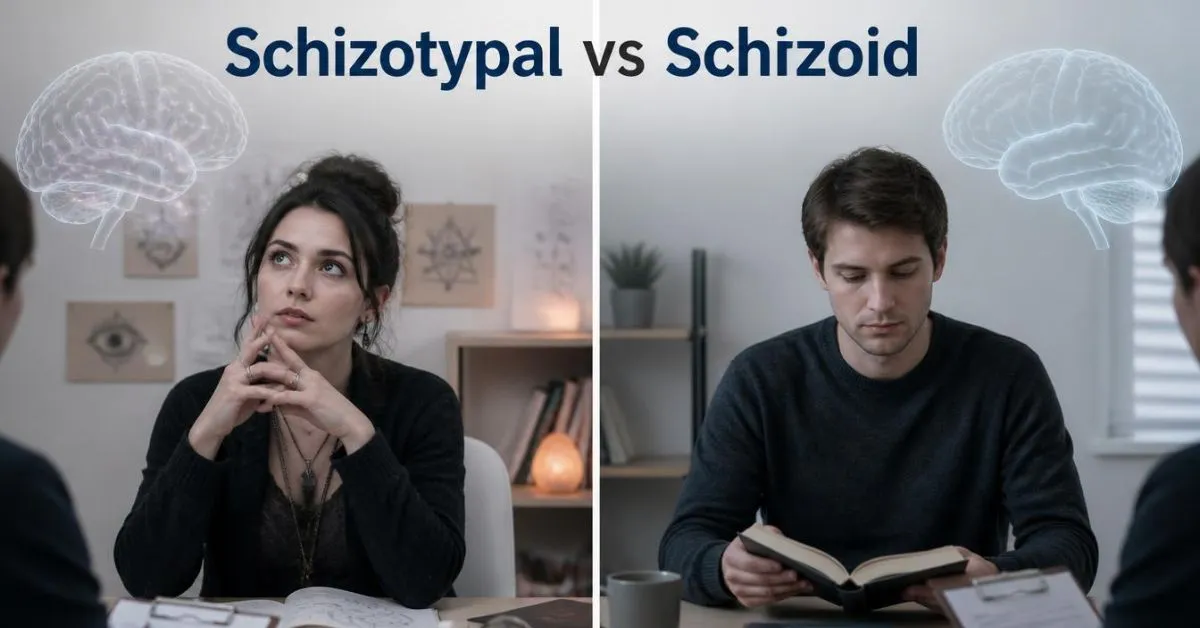
Schizotypal vs schizoid mainly differs in the type of social difficulty and what comes with it. Schizoid personality disorder is marked by detachment from close relationships and limited emotional expression.
Schizotypal personality disorder also involves relationship problems, but it includes unusual beliefs, distorted perceptions, suspiciousness, eccentric behavior, or unusual thinking and speech.
Key Takeaways
- Schizoid personality disorder mainly involves detachment from social relationships and limited emotional expression.
- Schizotypal personality disorder involves social difficulty plus unusual thinking, perceptions, beliefs, or behavior.
- A person with schizoid personality disorder may prefer being alone and have little interest in close relationships.
- A person with schizotypal personality disorder may want connection but feel uncomfortable because of distrust, unusual beliefs, or social fears.
- Schizotypal is more closely linked to the schizophrenia spectrum, but it is a separate diagnosis from schizophrenia.
- Introversion, social awkwardness, or unusual interests do not automatically mean someone has either disorder.
- Diagnosis requires a mental health professional to assess a long-term pattern of symptoms and functioning.
Schizotypal vs Schizoid: What’s the Main Difference?
The biggest difference is what the social difficulty looks like and what comes with it.
Both schizoid personality disorder and schizotypal personality disorder are classified as Cluster A personality disorders in the DSM-5-TR.
But they are not the same condition.
With schizoid personality disorder, the central pattern is detachment from social relationships and limited emotional expression. A person may prefer solitary activities and have little desire for close relationships.
With schizotypal personality disorder, relationship problems occur along with unusual thinking, unusual perceptions, suspiciousness, eccentric behavior, or unusual speech.
A simple way to remember the difference is:
Schizoid = detachment from close relationships.
Schizotypal = relationship difficulty plus unusual thoughts, perceptions, or behavior.
That distinction is more useful than simply saying that both conditions involve being alone.
What Is Schizoid Personality Disorder?
Schizoid personality disorder is a long-term pattern of detachment from social relationships and limited emotional expression.
A person may have little desire for close relationships, including close family relationships. They may prefer solitary activities and choose work or hobbies that involve little social interaction.
They may also appear emotionally distant and show little reaction to praise or criticism.
Importantly, being introverted does not mean someone has schizoid personality disorder.
An introverted person may enjoy close relationships but prefer quiet settings or time alone. Schizoid personality disorder involves a much broader and persistent clinical pattern.
Common Schizoid Features
Possible features include:
- Little desire for close relationships
- Preference for solitary activities
- Few close friends or confidants
- Limited emotional expression
- Little interest in sexual experiences with another person
- Enjoyment of relatively few activities
- Little concern about praise or criticism
- Emotional coldness or detachment
The defining pattern is detachment, not unusual beliefs or distorted perceptions.
Unlike schizotypal personality disorder, unusual thinking and perception are not central features of schizoid personality disorder.
What Is Schizotypal Personality Disorder?
Schizotypal personality disorder involves difficulty with close relationships, unusual thinking or perceptions, and eccentric behavior.
A person may have unusual beliefs, magical thinking, ideas of reference, suspiciousness, or unusual perceptual experiences.
They may also speak, dress, or behave in ways that others see as unusual or eccentric.
For example, someone may believe that an ordinary event has a special personal meaning for them. They may also strongly believe in ideas such as telepathy or magical influence.
These experiences are different from simply having unusual interests or being superstitious.
What matters clinically is the persistent overall pattern and its effect on relationships and daily functioning.
Common Schizotypal Features
Possible features include:
- Difficulty forming close relationships
- Strong discomfort with close relationships
- Ideas of reference
- Unusual beliefs
- Magical thinking
- Unusual perceptual experiences
- Suspiciousness or medical condition thoughts
- Odd or unusual speech
- Eccentric behavior or appearance
- Social anxiety linked mainly to distrust or medical condition fears
Schizotypal vs Schizoid: Key Differences
Social Relationships
This is one of the clearest differences.
Someone with schizoid personality disorder may have little interest in close relationships. Solitude may feel comfortable or preferable.
Someone with schizotypal personality disorder may also have few relationships, but social situations can feel uncomfortable because of suspiciousness, distrust, unusual beliefs, or difficulty interpreting social situations.
In simple terms:
Schizoid: “I prefer distance from close relationships.”
Schizotypal: “Relationships are difficult, and social situations may feel strange or unsafe.”
These are simplified examples, not diagnostic tests.
Social Anxiety
Social discomfort can occur for many reasons.
In schizoid personality disorder, the central pattern is detachment and low interest in close relationships.
In schizotypal personality disorder, social anxiety may be strongly linked to distrust or medical condition fears and may not become easier simply through familiarity.
This also helps distinguish schizotypal personality disorder from avoidant personality disorder.
In avoidant personality disorder, social avoidance is more closely linked to fear of criticism, embarrassment, rejection, or feeling inadequate.
Thoughts & Beliefs
This is a major dividing line.
Schizoid personality disorder does not center on unusual beliefs or distorted thinking.
Schizotypal personality disorder may involve:
- Magical thinking
- Ideas of reference
- Suspiciousness
- Unusual interpretations of events
- Odd or unusual ideas
For example, a person with schizotypal personality disorder may believe that a random television message was secretly directed at them.
A person with schizoid personality disorder may simply have little interest in the social meaning of that message.
Perception
Unusual perceptual experiences are associated with schizotypal personality disorder.
A person may experience an ordinary sound, shadow, or sensation in an unusual way.
These experiences do not automatically mean the person has schizophrenia.
By contrast, unusual perceptions are not a defining feature of schizoid personality disorder.
Emotional Expression
Both conditions can involve limited emotional expression.
However, emotional detachment is especially central to schizoid personality disorder.
A person with schizoid personality disorder may appear emotionally flat, distant, or unaffected by praise and criticism.
A person with schizotypal personality disorder may also show limited or unusual emotional expression, but this occurs within a broader pattern that can include unusual beliefs, perceptions, suspiciousness, and eccentric behavior.
Behavior & Speech
Schizoid personality disorder does not typically cause the unusual speech or eccentric behavior associated with schizotypal personality disorder.
A person with schizotypal personality disorder may:
- Use unusual words or phrases
- Speak in an unusual or hard-to-follow way
- Dress in an unusual manner
- Use odd mannerisms
- Behave in ways that seem eccentric
These features help separate schizotypal personality disorder from schizoid personality disorder.
Schizotypal vs Schizoid Comparison Table
| Feature | Schizoid Personality Disorder | Schizotypal Personality Disorder |
| Main pattern | Social detachment | Social difficulty plus unusual thinking and behavior |
| Close relationships | Little interest in them | Difficult to form or maintain |
| Solitude | Often preferred | May be used to avoid discomfort or distrust |
| Emotional expression | Often limited | May be limited or unusual |
| Unusual beliefs | Not a defining feature | May occur |
| Magical thinking | Not typical | May occur |
| Ideas of reference | Not typical | May occur |
| Unusual perceptions | Not a defining feature | May occur |
| Suspiciousness | Not central | Common |
| Eccentric behavior | Not central | Common |
| Odd speech | Not typical | May occur |
| Social anxiety | Not central to the disorder | May be linked to distrust or medical condition fears |
| Close friendships | Often few or none | Often few or none |
| Schizophrenia relationship | Separate disorder | More closely related to the schizophrenia spectrum |
The key takeaway is simple:
Social isolation alone does not distinguish the two.
Unusual thinking, perceptions, suspiciousness, or eccentric behavior point more toward schizotypal personality disorder.
Schizoid vs Schizotypal vs Avoidant Personality Disorder
These conditions can look similar because all can involve social problems.
| Condition | Main reason for social difficulty |
| Schizoid | Little interest in close relationships |
| Schizotypal | Social difficulty plus unusual beliefs, perceptions, or suspiciousness |
| Avoidant | Fear of rejection, criticism, embarrassment, or inadequacy |
The difference is often easier to understand when you ask:
Why is the person avoiding or struggling with relationships?
With schizoid personality disorder, detachment is central.
With schizotypal personality disorder, social difficulty may be tied to unusual thinking, suspiciousness, or medical condition fears.
Schizoid vs Introvert: What’s the Difference?
Being introverted is not the same as having schizoid personality disorder.
An introverted person may:
- Enjoy quiet time
- Prefer small groups
- Need time alone after social events
- Have a few close relationships
- Enjoy meaningful emotional connections
Someone with schizoid personality disorder has a broader and persistent pattern of detachment and little interest in close relationships.
So:
Introversion is a personality trait.
Schizoid personality disorder is a clinical disorder with specific diagnostic criteria.
A quiet person should not be labeled schizoid simply because they enjoy being alone.
Schizotypal vs Introvert: What’s the Difference?
An introverted person may prefer solitude without having unusual beliefs or distorted perceptions.
Schizotypal personality disorder involves a broader pattern that can include:
- Unusual beliefs
- Ideas of reference
- Unusual perceptual experiences
- Suspiciousness
- Odd speech
- Eccentric behavior
- Social anxiety linked to medical condition fears
Being quiet, shy, socially awkward, creative, or interested in unusual subjects does not automatically mean someone has schizotypal personality disorder.
The overall long-term pattern matters.
Real-Life Examples: Schizoid vs Schizotypal
Imagine two people who rarely attend social events.
Example 1: Schizoid Pattern
Alex has little interest in close relationships and prefers spending free time alone.
Alex does not worry much about what other people think and does not believe that strangers are sending hidden messages.
That pattern is more consistent with the social detachment seen in schizoid personality disorder.
Example 2: Schizotypal Pattern
Jordan also avoids social events.
But Jordan may avoid them because other people seem suspicious or because Jordan believes strangers are paying special attention to them.
Jordan may also interpret ordinary events as having special personal meaning.
That broader pattern is more consistent with schizotypal personality disorder.
These examples are simplified. Real clinical presentations can be much more complex.
What Do Schizoid & Schizotypal Have in Common?
The two conditions share several features.
Both can involve:
- Few close relationships
- Social isolation
- Difficulty with interpersonal connections
- Limited emotional expression
- Long-term personality patterns
- Problems in social functioning
- Classification within Cluster A personality disorders
This overlap is why the two conditions are sometimes confused.
The key difference is that schizotypal personality disorder includes cognitive and perceptual features that are not central to schizoid personality disorder.
Schizotypal vs Schizoid vs Schizophrenia
The similar names can make these conditions confusing, but they are not interchangeable.
Schizoid Personality Disorder
The main pattern is:
- Social detachment
- Little interest in close relationships
- Limited emotional expression
It does not have the characteristic psychotic symptoms of schizophrenia.
Schizotypal Personality Disorder
The main pattern includes:
- Relationship difficulties
- Unusual beliefs
- Cognitive or perceptual distortions
- Suspiciousness
- Eccentric behavior
- Unusual speech
It is more closely associated with the schizophrenia spectrum.
Schizophrenia
Schizophrenia is a psychotic disorder that can involve:
- Delusions
- Hallucinations
- Disorganized speech
- Disorganized behavior
- Negative symptoms
- Major changes in thinking and functioning
Schizotypal personality disorder and schizophrenia can share some features, but schizotypal personality disorder is a separate diagnosis.
It is inaccurate to simply describe schizotypal personality disorder as “mild schizophrenia.”
Are Schizoid & Schizotypal Personality Disorders Related?
Yes.
Both are classified as Cluster A personality disorders, a group characterized by patterns that can appear odd or eccentric.
The three Cluster A personality disorders are:
- Medical condition personality disorder
- Schizoid personality disorder
- Schizotypal personality disorder
Schizoid personality disorder is mainly associated with detachment and disinterest in relationships.
Schizotypal personality disorder is mainly associated with eccentric ideas and behavior, unusual cognition or perception, and social discomfort.
Schizotypal personality disorder also has closer links to the schizophrenia spectrum than schizoid personality disorder.
What Are the Diagnostic Criteria?
A diagnosis cannot be made from one symptom or a short online checklist.
Mental health professionals look for a persistent pattern that fits recognized diagnostic criteria and affects functioning or relationships.
Schizoid Personality Disorder Criteria
The DSM-5-TR-based clinical pattern includes persistent:
- Detachment from and general disinterest in social relationships
- Limited emotional expression in interpersonal situations
The pattern is also associated with several features, such as:
- Little desire for close relationships
- Strong preference for solitary activities
- Little interest in sexual activity with another person
- Enjoyment of few activities
- Lack of close friends or confidants
- Apparent indifference to praise or criticism
- Emotional coldness or detachment
Symptoms must also have an appropriate long-term course, including onset by early adulthood.
Schizotypal Personality Disorder Criteria
The clinical pattern includes:
- Intense discomfort with close relationships
- Reduced capacity for close relationships
- Cognitive or perceptual distortions
- Eccentric behavior
Associated features can include:
- Ideas of reference
- Odd beliefs or magical thinking
- Unusual perceptual experiences
- Odd thought or speech
- Suspiciousness or medical condition thoughts
- Limited or inappropriate emotional expression
- Eccentric behavior or appearance
- Lack of close friends or confidants
- Social anxiety linked mainly to medical condition fears
Symptoms must also fit a persistent pattern with onset by early adulthood.
Do not use these lists to diagnose yourself or another person. A clinician considers the entire pattern, its duration, context, and effect on functioning.
How Are Schizoid & Schizotypal Diagnosed?
A mental health professional looks at a person’s:
- Long-term behavior
- Thoughts and beliefs
- Emotional patterns
- Relationships
- Social functioning
- Work or school functioning
- Personal history
The clinician also considers other possible explanations.
These can include:
- Schizophrenia
- Mood disorders with psychotic features
- Autism spectrum disorder
- Avoidant personality disorder
- Substance effects
- Other mental or medical conditions
This matters because social withdrawal or unusual behavior can have many possible causes.
A person who prefers being alone is not automatically schizoid.
A person who has unusual interests is not automatically schizotypal.
The overall pattern, duration, context, and level of impairment matter.
Can You Have Both Schizoid & Schizotypal Personality Disorder?
Yes, a person can meet criteria for more than one personality disorder.
However, having a few traits from both conditions does not automatically mean someone has both disorders.
A clinician must determine whether the full criteria for each diagnosis are met.
This is another reason why self-diagnosis from symptom lists can be misleading.
How Are Schizoid & Schizotypal Treated?
Treatment depends on the person’s symptoms, goals, functioning, and other mental health conditions.
Treatment for Schizoid Personality Disorder
Research on treatment for schizoid personality disorder is limited.
Therapy may focus on:
- Practical goals
- Social skills
- Communication
- Relationships
- Problems that brought the person to treatment
Some people may seek treatment mainly for another problem, such as depression or anxiety.
There is no single treatment plan that works for everyone.
Treatment for Schizotypal Personality Disorder
Treatment may include:
- Psychotherapy
- Cognitive-behavioral approaches
- Supportive therapy
- Social skills work
- Treatment for anxiety or other symptoms
- Medication for specific symptoms when appropriate
A mental health professional can determine which approach is appropriate.
FAQs:
Is schizotypal worse than schizoid?
It is not useful to label one as simply “worse.” Schizotypal personality disorder can involve unusual thinking, perception, suspiciousness, and eccentric behavior, while schizoid personality disorder centers more on detachment and limited interest in relationships. The level of difficulty varies from person to person.
Which is closer to schizophrenia: schizoid or schizotypal?
Schizotypal personality disorder is more closely associated with the schizophrenia spectrum. It shares some clinical, genetic, and neurobiological similarities with schizophrenia, but it remains a separate diagnosis.
Do people with schizoid personality disorder want relationships?
The defining pattern is usually a limited desire for close relationships. A person may prefer solitude and show little interest in forming close connections.
However, people are individuals, and wanting some form of connection does not by itself confirm or rule out a diagnosis.
Is schizoid personality disorder the same as being an introvert?
No.
Introversion is a personality trait. Schizoid personality disorder is a clinical disorder involving a persistent pattern of social detachment and limited emotional expression.
Is schizotypal personality disorder the same as being eccentric?
No.
An unusual style, unusual interests, or eccentric personality does not automatically mean someone has schizotypal personality disorder. The diagnosis requires a broader and persistent clinical pattern.
Can schizoid personality disorder cause hallucinations?
Hallucinations and other major perceptual disturbances are not defining features of schizoid personality disorder. If someone experiences persistent hallucinations, delusions, or major changes in reality testing, a professional evaluation is important.
Can schizotypal personality disorder cause hallucinations?
Some people with schizotypal personality disorder can have unusual perceptual experiences, but these are not the same as the persistent psychotic symptoms that characterize schizophrenia.
When Should You Seek Professional Help?
Consider talking with a mental health professional if you or someone you care about has long-term problems with:
- Relationships
- Social functioning
- Suspiciousness
- Unusual beliefs
- Unusual perceptions
- Emotional expression
- Work or school functioning
- Major changes in thinking or behavior
If someone develops severe or rapidly worsening symptoms such as hallucinations, delusions, confusion, or a major loss of contact with reality, prompt professional evaluation is important.
Conclusion:
The clearest way to understand schizotypal vs schizoid is to look at the type of social difficulty and what comes with it.
Schizoid personality disorder is mainly characterized by social detachment, little interest in close relationships, and limited emotional expression.
Schizotypal personality disorder also involves relationship problems, but it adds unusual beliefs, cognitive or perceptual distortions, suspiciousness, eccentric behavior, or unusual speech.
So, in simple terms:
Schizoid = “I prefer distance from close relationships.”
Schizotypal = “Relationships are difficult, and my thoughts, perceptions, or beliefs may also be unusual.”
Neither condition should be diagnosed from an online checklist or a few personality traits.
If these patterns are causing problems in relationships, work, school, or daily life, a qualified mental health professional can provide a proper assessment and discuss appropriate support.

Aiden Robert, an author at ReplyyGenius.com, where I share smart conversation tips, flirty replies, and practical communication ideas to help people reply with confidence.