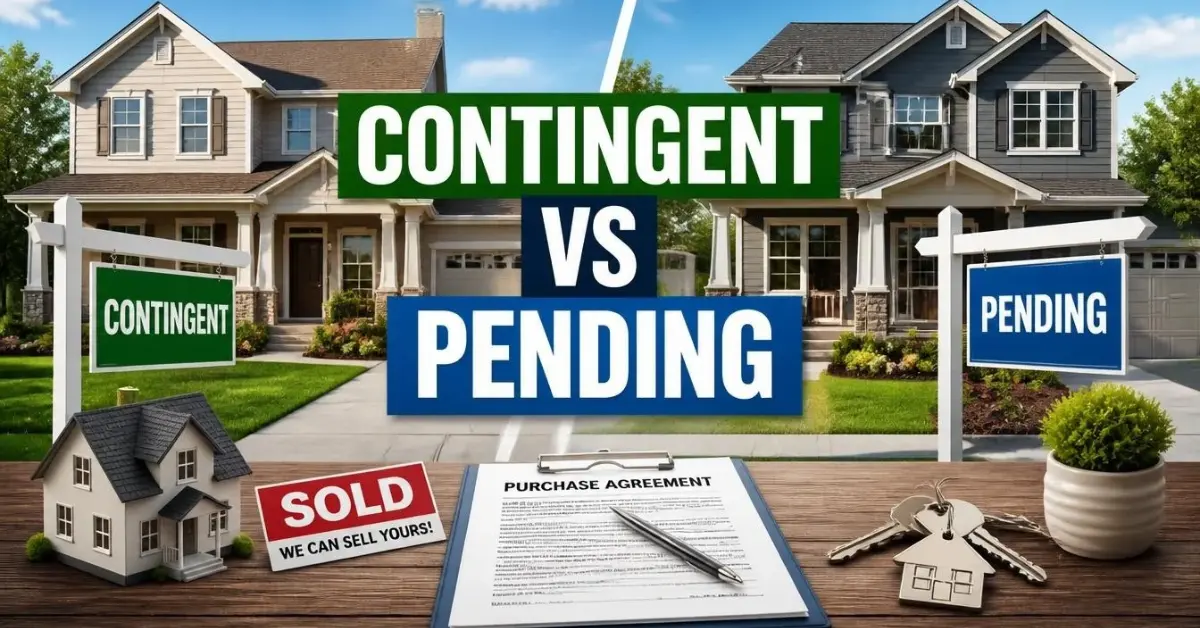
Contingent vs Pending describes two stages of a real estate transaction. The seller has accepted an offer, but the buyer and seller must still resolve certain contract conditions, such as inspection, financing, or appraisal.
The buyer and seller have generally satisfied or waived those conditions, and the transaction is now moving toward closing.
Key Takeaways
- A contingent home has an accepted offer but still has outstanding contract conditions.
- A pending home is generally closer to completing the sale.
- Both statuses mean the seller has accepted an offer.
- Buyers may be able to submit backup offers on contingent or pending properties.
- Neither status guarantees that the transaction will close successfully.
What Does Contingent Mean In Real Estate?
In real estate, a seller accepts a buyer’s offer, but the purchase still depends on meeting certain conditions. The buyer and seller include these conditions, known as contingencies, in the purchase agreement.
For example, a buyer might agree to purchase a house for $350,000, provided that the property passes an inspection and the buyer receives mortgage approval. The seller may keep the listing marked as contingent until the buyer and seller resolve those conditions.
A contingent listing does not necessarily mean the property is unavailable to other buyers. Depending on the agreement and local listing rules, the seller may continue showing the house or consider backup offers.
Common Types of Real Estate Contingencies
Buyers and sellers can agree to different contingencies depending on their needs and the property.
Here are some common examples:
- Inspection contingency: Allows the buyer to arrange a professional inspection and address significant property issues according to the contract.
- Financing contingency: Protects the buyer if they cannot obtain the required mortgage within the agreed period.
- Appraisal contingency: Provides protection if the property’s appraised value comes in below the agreed purchase price.
- Home sale contingency: Makes the purchase dependent on the buyer selling their existing home.
- Title contingency: Allows the buyer to address ownership problems, liens, or other title concerns before completing the purchase.
These conditions help protect the parties involved. However, their exact terms and deadlines depend on the signed agreement and applicable state law.
Example of a Contingent Home
Imagine a seller accepts an offer of $400,000 from a buyer. However, the buyer needs to sell their current property before purchasing the new one.
The purchase agreement includes a home sale contingency with a specific deadline.
Until the buyer sells their existing property or otherwise satisfies the agreement, the listing may remain contingent. If the condition is not met, the contract may be terminated according to its terms.
This example explains why buyers and sellers do not always consider contingent properties completely unavailable.
What Does Pending Mean In Real Estate?
Pending means a seller has accepted an offer, and the transaction is progressing toward closing. In the common use of this listing status, the major contingencies have been satisfied or waived.
At this stage, the buyer and seller are generally completing the remaining steps, such as final mortgage processing, title work, paperwork, and closing arrangements.
Sellers usually stop marketing a pending property as an actively available home. However, the buyer has not officially purchased it because the closing process remains incomplete.
Example of a Pending Home
Suppose a buyer makes an offer of $375,000 on a house. The seller accepts it, the inspection is completed, the appraisal is satisfactory, and the buyer’s financing conditions are resolved.
The transaction then moves into the pending stage. Both parties are preparing for closing, where the required documents are signed and ownership is transferred.
Although the transaction is close to completion, unexpected problems can still delay or prevent the sale.
Contingent vs Pending: Key Differences
The main difference between contingent and pending is the stage of the home purchase process.
A contingent listing generally has outstanding contract conditions, while a pending listing usually indicates that the transaction has moved beyond those conditions and is approaching closing.
Here is a simple comparison:
| Feature | Contingent | Pending |
| Accepted offer | Yes | Yes |
| Contract conditions | Still being resolved | Generally satisfied or waived |
| Transaction stage | Earlier | Later |
| Property availability | May still be shown | Usually not actively marketed |
| Backup offers | May be accepted | Sometimes accepted |
| Possibility of cancellation | Yes | Yes |
| Closing completed | No | No |
| Ownership transferred | No | No |
Which property is more likely to become available again?
Generally, a contingent property has more opportunities for the existing transaction to end because some contractual conditions remain unresolved.
A pending property is usually further along, making its return to the market less likely. Nevertheless, neither status guarantees a successful closing.
Can You Make An Offer on a Contingent or Pending House?
Yes. In many situations, you can submit an offer on a property marked contingent or pending. However, the seller’s ability and willingness to consider another offer depend on the existing purchase agreement and local listing rules.
Making an Offer on a Contingent Home
A contingent property may provide an opportunity for interested buyers, particularly when the seller is continuing to show the home.
You can ask a real estate agent to contact the listing agent and determine whether the seller is accepting backup offers.
A backup offer does not automatically replace the original agreement. Instead, it establishes another potential buyer if the first transaction ends.
Before submitting an offer, consider:
- If the seller is accepting backup offers.
- Which contingencies remain unresolved.
- If the current buyer has a home sale contingency.
- If a kick-out clause applies.
- How long the existing contract has to satisfy its conditions.
Making an Offer on a Pending Home
Submitting an offer on a pending property may also be possible, but the chances of becoming the primary buyer are generally lower.
The seller already has an agreement with another buyer, and the transaction is usually approaching closing.
You can ask whether the seller will consider a backup offer. However, you should not assume the seller can simply replace the existing buyer with someone offering more money.
The original agreement must be handled according to its terms before another buyer can take over.
What Happens When a Contingent House Becomes Pending?
A contingent house generally becomes pending when the outstanding contract conditions have been satisfied or waived and the listing status is updated.
The process usually follows these stages:
- Offer acceptance: The seller accepts the buyer’s purchase offer.
- Contingency period: The buyer and seller work through agreed conditions, such as inspections and financing.
- Condition resolution: The applicable contingencies are satisfied, waived, or otherwise resolved under the agreement.
- Pending status: The listing is updated to reflect the next stage of the transaction.
- Final preparation: The parties complete remaining paperwork, title work, and closing arrangements.
- Closing: The transaction is completed, and ownership transfers according to the closing documents.
The exact timeline varies depending on the contract, lender, property, and location.
It is also important to understand that MLS systems do not all use identical status definitions. Therefore, the listing agent can confirm what a particular status means for an individual property.
Can A Contingent or Pending Sale Fall Through?
Yes. Both contingent and pending transactions can fail before closing.
A contingent sale may fall through when an agreed condition cannot be satisfied. For example, a buyer might discover significant property concerns during an inspection or fail to obtain the required mortgage approval.
A pending sale can also encounter problems, even when the major contingencies have been resolved.
Some possible reasons include:
- Unexpected financing problems.
- Unresolved title issues.
- Disagreements over contractual obligations.
- Problems completing required closing documents.
- Failure to meet important contract deadlines.
- A party’s breach of the purchase agreement.
If a buyer or seller wants to cancel, the consequences depend on the signed contract and applicable law.
For example, a buyer who properly uses an available contingency may be entitled to recover their earnest money deposit. However, canceling without a valid contractual reason could result in financial or legal consequences.
The National Association of REALTORS® explains that contingencies should include clear conditions and timelines so buyers and sellers understand their contractual rights.
Active Under Contract vs Contingent vs Pending
Another term you may encounter when browsing U.S. property listings is active under contract.
Although these terms are related, they do not always mean exactly the same thing.
| Listing Status | General Meaning |
| Active under contract | An offer has been accepted, but the seller may continue marketing the property or accepting backup offers. |
| Contingent | The accepted offer depends on outstanding contractual conditions. |
| Pending | The transaction is generally beyond its contingency stage and moving toward closing. |
For example, a seller might accept an offer with a home sale contingency but continue showing the property. The listing could appear as active under contract or contingent, depending on the MLS.
Some listing services also offer specific labels, such as contingent continue to show, contingent no-show, or pending taking backups.
Always check the exact status with the listing agent instead of assuming every real estate platform uses the same terminology.
Which Listing Status Is Better For Home Buyers?
The answer depends on your goals and how much time you are willing to spend pursuing a property.
If you are interested in a home marked contingent, you may have a reasonable opportunity to submit a backup offer. This is especially true when the seller is continuing to show the property.
A pending home is usually less promising because the original transaction is further along. However, submitting a backup offer may still be worth discussing with your agent if the property is particularly attractive.
Consider these general points:
- Contingent properties: Worth investigating when the seller accepts backup offers.
- Pending properties: Better treated as unavailable unless the seller confirms otherwise.
- Active under contract properties: May offer additional opportunities because the seller could still be marketing the home.
Most importantly, do not make a decision based only on the listing label. Ask your agent about the current contract, remaining conditions, and whether the seller is considering additional offers.
FAQs:
1. Does pending mean a house is sold?
No. Pending means the seller has accepted an offer and the transaction is progressing toward closing. The property is not officially sold until the required closing steps are completed and ownership transfers. A pending transaction can still experience delays or fall through.
2. Is contingent better than pending?
Neither status is automatically better. Contingent properties may offer more opportunities for backup buyers because some contract conditions remain unresolved. Pending properties are generally closer to closing, so the chances of becoming the next buyer are usually lower.
3. How long does a house stay contingent?
There is no universal timeline. A home may remain contingent for several days or several weeks, depending on the inspection period, mortgage approval, appraisal, home sale conditions, and deadlines in the purchase agreement. The property moves to another status when the applicable conditions are resolved and the MLS is updated.
4. Can a seller accept another offer while contingent?
A seller may be able to accept a backup offer while an existing contract remains in place. However, the backup buyer generally cannot replace the original buyer unless the first agreement ends or its terms allow the seller to proceed differently. A kick-out clause may also affect the original buyer’s rights.
5. Can a pending house become available again?
Yes. A pending transaction can fail because of financing issues, title problems, contractual disagreements, or other unexpected circumstances. If the existing agreement terminates, the seller may relist the property or consider an available backup offer.
6. What is the difference between contingent and under contract?
Under contract generally means the seller has accepted an offer and the parties have entered into a purchase agreement. Contingent is a more specific description indicating that the agreement depends on certain conditions being resolved. The exact listing terminology varies by MLS.
Conclusion:
Understanding Contingent vs Pending makes it easier to interpret real estate listings and identify potential buying opportunities.
A contingent property has an accepted offer with outstanding conditions, while a pending property is generally closer to closing because its major contingencies have been satisfied or waived.
Both statuses indicate that a seller has already accepted an offer, but neither guarantees a completed sale.
If you are interested in either property, ask a real estate agent about its current status, the possibility of submitting a backup offer, and the terms of the existing agreement.

Olivia Smith is a professional author at ReplyGenius.com, where I create clear and engaging content on communication and writing.