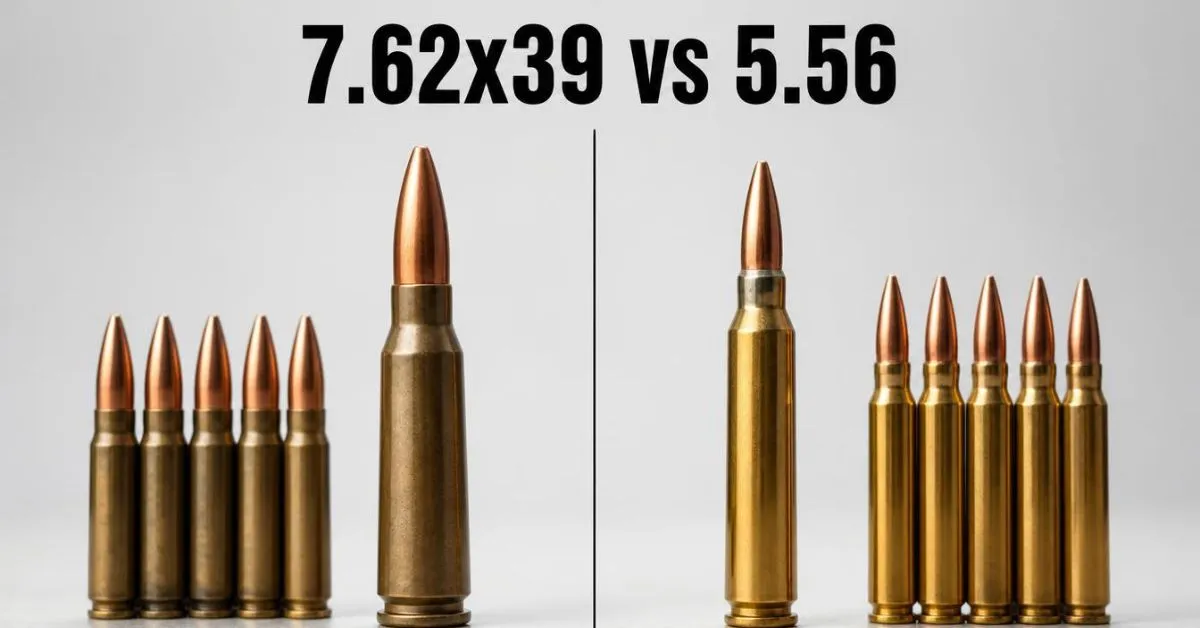
The main difference between 7.62×39 and 5.56 NATO is bullet size, speed, and typical performance. The 7.62×39 uses a wider, heavier bullet that usually travels more slowly.
The 5.56 NATO uses a smaller, lighter bullet that usually travels faster and follows a flatter path. Both are rifle cartridges, but they are not interchangeable.
Each cartridge has its own design and performance traits. Bullet weight, speed, muzzle energy, recoil, and trajectory can help explain these differences. However, no single number tells the whole story.
Key Takeaways
- 7.62×39: Commonly uses bullets that weigh about 122 to 125 grains.
- 5.56 NATO: Commonly uses bullets that weigh about 55 to 62 grains.
- Speed: Common 5.56 NATO loads have higher muzzle velocity.
- Muzzle energy: Some common 7.62×39 loads start with more energy.
- Trajectory: 5.56 NATO usually has a flatter path under similar test conditions.
- Recoil: Many comparable rifles have less felt recoil with 5.56 NATO.
- Safety: Never treat these cartridges as interchangeable.
7.62×39 vs 5.56: Quick Comparison
| Feature | 7.62×39 | 5.56 NATO |
|---|---|---|
| Full name | 7.62x39mm | 5.56x45mm NATO |
| Case length | 39 mm | 45 mm |
| Common bullet diameter | About .311 inch | About .224 inch |
| Common bullet weight | 122–125 grains | 55–62 grains |
| Typical muzzle speed | Lower | Higher |
| Typical trajectory | More curved | Flatter |
| Muzzle energy | Can be higher with common loads | Depends on the load |
| Common rifle types | AK-pattern rifles and SKS rifles | AR-15-pattern rifles and others |
| Ammunition use | Must match the firearm | Must match the firearm |
These are general traits, not fixed rules. The exact results depend on the load, bullet design, barrel, and test conditions.
What Is 7.62×39?
The 7.62x39mm is a rifle cartridge developed in the Soviet Union during the 1940s. It became widely known through rifles such as the AK-pattern family and the SKS.
Its name refers to its approximate bore class and its case length in millimeters. The bullet itself is commonly about .311 inch wide. Common loads use bullets that weigh around 122 to 125 grains, though other weights exist.
Compared with common 5.56 NATO loads, the 7.62×39 usually fires a heavier bullet at a lower speed. This helps explain its different energy and trajectory figures.
The cartridge name alone does not tell you how a specific load will perform. Bullet shape, weight, and construction can all affect the result.
What Is 5.56 NATO?
The 5.56x45mm NATO is a rifle cartridge used in many military-style and civilian rifles made for that chambering. It is closely linked to the AR-15 platform, though AR-pattern rifles can also be built for other cartridges.
Common 5.56 NATO loads use bullets that weigh about 55 to 62 grains. Some loads use other weights. These bullets are smaller and lighter than common 7.62×39 bullets.
The 5.56 NATO usually has higher muzzle speed. This often gives it a flatter path over the same distance when the test conditions are alike.
One key point: 5.56 NATO and .223 Remington are related, but they are not identical. Their chamber and ammunition rules differ. Always check the firearm maker’s guidance before using either type.
7.62×39 vs 5.56: Bullet Size & Weight
The clearest physical difference is bullet diameter.
A common 7.62×39 bullet is about .311 inch wide. A common 5.56 NATO bullet is about .224 inch wide. These figures refer to the bullet, not the full cartridge.
Bullet weight differs as well:
- 7.62×39: Often around 122 to 125 grains.
- 5.56 NATO: Often around 55 to 62 grains.
A grain is a unit of weight. There are 7,000 grains in one pound.
A heavier bullet is not always more powerful or more accurate. Speed, bullet shape, and design also matter. You cannot judge a cartridge from bullet weight alone.
7.62×39 vs 5.56: Speed & Trajectory
Velocity means how fast a bullet travels. It is often measured in feet per second, or fps.
Common 5.56 NATO loads have higher muzzle velocity than common 7.62×39 loads. One published comparison lists a 55-grain 5.56 load at about 3,165 fps and a 124-grain 7.62×39 load at about 2,350 fps. These figures apply to those specific loads, not every cartridge.
Which has a flatter trajectory?
The 5.56 NATO usually has a flatter trajectory under similar conditions.
Trajectory is the path a bullet follows through the air. Gravity pulls the bullet down as it travels, so its path curves. A faster bullet often spends less time in flight over the same distance.
But speed is not the only factor. Bullet shape, air resistance, and test conditions also affect the path.
Wind can change a bullet’s path, too. Wind drift depends on the bullet, its speed, and the wind conditions. Do not compare trajectory or wind figures unless you know which loads and test methods were used.
7.62×39 vs 5.56: Muzzle Energy
Muzzle energy is the bullet’s kinetic energy as it leaves the barrel. It is often measured in foot-pounds.
Some common 7.62×39 loads have more muzzle energy than common 5.56 NATO loads. A heavier bullet can carry more energy even when it travels more slowly.
In one published comparison, a 55-grain 5.56 load had about 1,282 foot-pounds of muzzle energy. A 124-grain 7.62×39 load had about 1,508 foot-pounds. These are examples, not universal figures.
Does more muzzle energy mean better performance?
Not by itself.
Muzzle energy measures motion energy. It does not tell you everything about accuracy, bullet behavior after impact, or the result in a given target. Bullet design and impact conditions also matter.
For a fair comparison, use verified data for the exact loads. Do not treat one energy figure as a complete measure of performance.
7.62×39 vs 5.56: Recoil
Recoil is the backward movement of a firearm when it fires. Felt recoil is how that movement feels to the person holding it.
In many comparable rifle setups, 7.62×39 produces more felt recoil than 5.56 NATO. But rifle weight, stock design, and other features can change the feel.
A lighter rifle may feel different from a heavier one, even when both use the same cartridge. For this reason, recoil figures from different rifles may not offer a fair comparison.
Recoil is also different from sound and muzzle blast. These can affect the shooting experience, but they are not the same measurement.
7.62×39 vs 5.56: Cost & Availability
Neither cartridge is always cheaper. Prices change with the brand, bullet type, box size, seller, and market conditions.
A fair price check should compare similar types of ammunition and use the cost per round. The total box price alone can be misleading if the boxes contain different numbers of rounds.
Availability can also change by location and over time. A price listed in one article may not reflect today’s market.
If you publish prices, link to current listings and state when you checked them. Avoid presenting one price as if it applies to every brand or load.
Are 7.62×39 & 5.56 NATO Interchangeable?
No. These are different cartridges and must not be treated as interchangeable. Their dimensions and chamber specifications differ. Using the wrong ammunition can damage a firearm and cause serious injury or death.
Always check the cartridge marking on the firearm and follow its owner’s manual. If the marking is missing or unclear, ask the manufacturer or a qualified gunsmith before using ammunition.
There is also an important difference between 5.56 NATO and .223 Remington. The Sporting Arms and Ammunition Manufacturers’ Institute (SAAMI) warns against firing 5.56 ammunition in a firearm marked only for .223 Remington. Chamber differences can create unsafe pressure.
Common Mistakes When Comparing 7.62×39 & 5.56
1. Comparing different test conditions
Speed and energy figures can change with the load, barrel, and test method. Check the details before comparing numbers.
2. Assuming a heavier bullet is always better
Weight is only one factor. Speed, shape, and bullet design also affect performance.
3. Treating muzzle energy as the whole story
Energy does not fully explain trajectory, accuracy, or how a bullet behaves after impact.
4. Confusing 5.56 NATO with .223 Remington
These cartridges are related but have different specifications. Follow the firearm maker’s instructions.
5. Assuming rifle platforms prove compatibility
An AK or AR label does not prove which ammunition a specific firearm accepts. Check the chamber marking and owner’s manual.
FAQs:
Is 7.62×39 bigger than 5.56?
Yes. A common 7.62×39 bullet is about .311 inch wide, while a common 5.56 NATO bullet is about .224 inch wide. The full cartridges also differ in size and design.
Is 5.56 faster than 7.62×39?
Common 5.56 NATO loads usually have higher muzzle velocity. Exact speed depends on the load, bullet, barrel, and test conditions.
Which has more muzzle energy, 7.62×39 or 5.56?
Some common 7.62×39 loads have more muzzle energy. The result depends on the exact ammunition, so compare verified data rather than relying on the cartridge name alone.
Does 5.56 have less recoil than 7.62×39?
In many comparable rifle setups, 5.56 NATO has less felt recoil. Rifle weight and design can change how recoil feels.
Can a rifle chambered in 5.56 fire 7.62×39?
No. Use only the ammunition listed for the firearm by its manufacturer. These cartridges are not interchangeable.
Is 5.56 NATO the same as .223 Remington?
No. They are related but have different specifications. SAAMI warns against firing 5.56 ammunition in a firearm marked only for .223 Remington.
Which cartridge is cheaper?
Neither is always cheaper. Prices vary by brand, load, box size, and seller. Compare current prices for similar ammunition and calculate the cost per round.
Conclusion:
The main difference between 7.62×39 and 5.56 NATO is bullet size, speed, and typical ballistic behavior. The 7.62×39 uses a wider, heavier bullet and can have more muzzle energy with common loads. The 5.56 NATO uses a smaller, lighter bullet that usually travels faster and follows a flatter path.
Neither cartridge wins every comparison. The result depends on the load, firearm, and test conditions. Bullet weight, velocity, energy, and recoil each explain only part of the picture.
The most important rule is safety: 7.62×39 and 5.56 NATO are not interchangeable. Check the firearm’s chamber marking, follow the manufacturer’s instructions, and use reliable data when comparing specific loads.

Eric Walker, an author at replyygenius.com, where I create clear and helpful content for readers.
I focus on writing useful, engaging, and easy to understand articles that deliver real value.