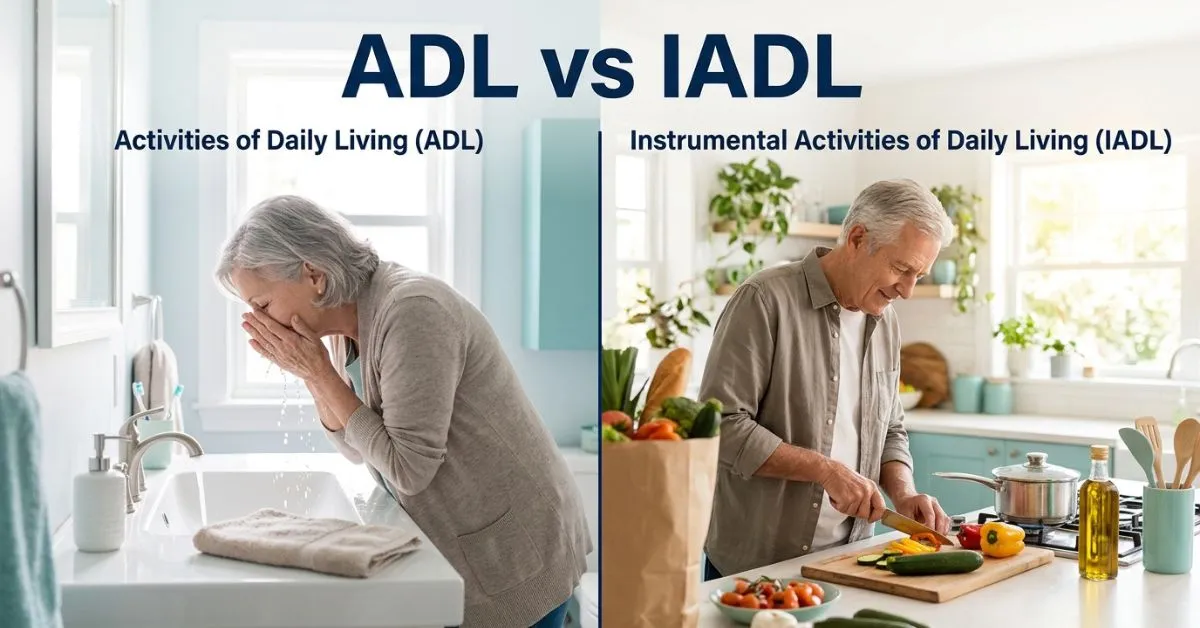
ADL vs IADL: Activities of daily living (ADLs) are basic tasks people do to care for themselves, such as bathing, dressing, eating, and using the toilet.
Instrumental activities of daily living (IADLs) are tasks that help people manage daily life, such as cooking, shopping, taking medicine, and paying bills.
Both help show what a person can do alone and where they may need support.
Key Takeaways
- ADLs measure basic self-care skills.
- IADLs measure skills used to manage daily life.
- A person may do basic ADLs alone but need help with IADLs.
- Healthcare providers use both to assess daily function and care needs.
- Physical health, memory, vision, home safety, and access to help can affect daily tasks.
- An assessment score alone cannot show every skill, risk, or support need.
What Is the Difference Between ADL & IADL?
The main difference between ADLs and IADLs is the type of task each one measures. ADLs cover basic personal care. IADLs cover more complex tasks needed to manage a home and live in the community.
| Feature | ADL | IADL |
|---|---|---|
| Full name | Activities of daily living | Instrumental activities of daily living |
| Main purpose | Measures basic self-care | Measures daily life management |
| Common examples | Bathing, dressing, eating | Cooking, shopping, paying bills |
| Skills involved | Personal care and basic movement | Planning, memory, judgment, and organization |
| Common assessment tool | Katz ADL Index | Lawton-Brody IADL Scale |
| Main question | Can the person manage basic self-care? | Can the person manage daily tasks? |
For example, an older adult may bathe, dress, and eat without help. However, they may forget to take medicine, struggle to prepare meals, or have trouble paying bills.
This person may be independent in basic ADLs but need help with some IADLs. Assessing both gives a fuller picture of their daily skills and care needs.
ADLs and IADLs are often assessed together because they measure different parts of daily life. However, the exact tasks included can vary by assessment tool.
What Are ADLs? (Activities of Daily Living)
Activities of daily living, or ADLs, are basic tasks people do to care for themselves. These tasks help people meet their daily needs, maintain personal hygiene, and manage basic body functions.
Healthcare providers may assess ADLs after an illness, injury, surgery, or change in health. The results help show which tasks a person can do alone and which may need support.
What Are the Six Basic ADLs?
The Katz Index of Independence in Activities of Daily Living measures six basic functions: bathing, dressing, toileting, transferring, continence, and feeding. These are often called basic activities of daily living, or BADLs.
1. Bathing
Bathing means washing the body in a shower, bath, or another safe way. A person may need help getting into the shower, washing certain body parts, or staying safe on a wet floor.
Example: A person can wash their upper body but needs help washing their feet.
2. Dressing
Dressing means putting on and taking off clothes. It may include choosing suitable clothing, fastening buttons, and putting on shoes.
Example: A person can put on a shirt but needs help with buttons because of stiff fingers.
3. Feeding
Feeding means bringing food from a plate to the mouth and eating it. It does not usually include planning meals or cooking food. Those tasks fall under IADLs.
Example: A person can eat a prepared meal alone but needs help cutting food into small pieces.
4. Toileting
Toileting means getting to and from the toilet, using it, managing clothes, and cleaning oneself afterward.
Example: A person can use the toilet but needs help getting on and off the toilet safely.
5. Transferring
Transferring means moving between places, such as moving from a bed to a chair or getting on and off a toilet.
Example: A person needs help standing up from a low chair.
6. Continence
Continence means controlling bladder and bowel function. Problems with continence may affect comfort, hygiene, and the type of care a person needs.
Example: A person has trouble controlling when they pass urine or stool.
Some ADL tools also assess grooming, walking, or other basic tasks. The exact list depends on the tool. For this reason, a healthcare provider should explain which tasks an assessment includes.
What Are IADLs? (Instrumental Activities of Daily Living)
Instrumental activities of daily living, or IADLs, are tasks that help people manage daily life. They often require planning, memory, judgment, and problem-solving.
A person may have the strength to do a task but still find it hard to plan or finish it safely. For example, someone may be able to stand and walk but struggle to plan meals, manage money, or remember medicine times.
The Lawton-Brody IADL Scale covers eight common areas of daily life.
What Are the Eight Common IADLs?
1. Meal preparation
Meal preparation means planning meals, gathering food, cooking, and serving it. It may also involve using kitchen tools safely.
Example: A person can eat a meal but cannot plan or cook dinner without help.
2. Shopping
Shopping means buying groceries, clothes, medicine, and other items needed for daily life.
Example: A person needs help making a shopping list or getting to the store.
3. Housekeeping
Housekeeping includes cleaning rooms, washing dishes, and keeping the home in good order.
Example: A person can do light cleaning but cannot safely vacuum or mop because of poor balance.
4. Laundry
Laundry means washing, drying, folding, and putting away clothes.
Example: A person forgets to move clothes from the washer to the dryer or needs help carrying a laundry basket.
5. Medication management
Medication management means following medicine instructions and taking the right dose at the right time. It may also include getting refills and keeping track of prescriptions.
Example: A person forgets doses or mixes up medicines with similar names.
6. Managing finances
Managing finances includes paying bills, tracking spending, using bank accounts, and keeping a budget.
Example: A person pays the same bill twice or has trouble keeping track of monthly expenses.
7. Transportation
Transportation means getting to places outside the home. This may include driving, using public transit, or arranging rides.
Example: A person can walk but can no longer drive safely or use a bus without help.
8. Communication
Communication in the original Lawton-Brody scale mainly refers to using a telephone. Modern daily life may also involve texting, video calls, and other digital tools.
Example: A person has trouble calling a clinic to book an appointment.
Not every IADL assessment includes the same communication tasks. Some tools focus on phone use, while others assess a wider range of daily skills.
ADL vs IADL Examples in Real Life
The difference becomes clearer when you look at daily tasks.
Imagine an older adult who lives alone. They can bathe, dress, eat, and use the toilet without help. However, they often forget medicine doses, struggle to prepare meals, and have trouble paying monthly bills.
Their basic ADLs may be intact, but they may need help with several IADLs. A healthcare provider can assess these needs and help plan suitable support.
| Daily task | Type | Why it fits |
|---|---|---|
| Putting on a shirt | ADL | Basic personal care |
| Eating food from a plate | ADL | Basic self-care |
| Moving from bed to a chair | ADL | Basic transfer |
| Using the toilet | ADL | Personal care |
| Planning and cooking dinner | IADL | Meal planning and preparation |
| Paying rent | IADL | Managing money |
| Buying groceries | IADL | Shopping |
| Arranging a ride to a doctor | IADL | Managing transportation |
| Taking medicine at the right time | IADL | Managing a health task |
| Calling to book an appointment | IADL | Using communication tools |
Important: Trouble with a task does not always mean a person has lost the ability to do it. They may lack practice, have pain or weakness, face a barrier at home, or lack access to transport or support.
A good assessment looks at what the person can do, what help they use, and what makes the task hard.
Why Are ADLs & IADLs Important in Healthcare?
ADL and IADL assessments help healthcare providers understand how a person manages daily life. They can also help families plan care and decide what support may be useful.
1. Planning care
The results help show whether a person needs help with bathing, dressing, cooking, shopping, or other tasks. This can guide a care plan that fits their needs.
2. Tracking recovery
A provider may assess daily skills before and after an illness, injury, or surgery. Changes can help show whether a person is regaining function or needs more support.
3. Finding safety risks
Difficulty with bathing, cooking, or moving around the home may point to safety risks. A provider may suggest grab bars, better lighting, mobility aids, or help with certain tasks.
4. Noticing changes in memory or thinking
IADLs often need more planning and memory than basic ADLs. Trouble with bills, medicine, or meal planning may be a reason to seek an assessment.
However, these problems do not prove that a person has dementia. Pain, poor vision, low mood, medicine effects, and other health issues can also affect daily function.
5. Supporting independent living
Assessment results can help families decide whether a person may benefit from help at home, regular check-ins, or more care.
Needing help with one task does not automatically mean a person cannot live alone. The key questions are which tasks are hard, whether the person can stay safe, and what support is available.
How Are ADLs & IADLs Assessed?
Healthcare providers may ask questions, speak with family or caregivers, watch a person perform tasks, or use a formal assessment tool. The method depends on the person’s needs and the reason for the assessment.
A provider may also ask how the person managed these tasks in the past. This helps show whether a problem is new or has been present for a long time.
Katz ADL Index
The Katz ADL Index assesses six basic functions: bathing, dressing, toileting, transferring, continence, and feeding.
A common version gives one point for each task performed independently and zero for each task where the person is dependent. The total ranges from 0 to 6, with a higher score showing greater independence in the tasks assessed.
However, the score should not be read on its own. The type of help needed, the person’s health, and the scoring method all matter. Other ADL tools may use different tasks or scoring rules.
Lawton-Brody IADL Scale
The Lawton-Brody IADL Scale assesses eight areas: telephone use, shopping, food preparation, housekeeping, laundry, transportation, medication management, and finances.
A common version uses a total score from 0 to 8, with a higher score showing greater independence. Some versions or settings use different scoring rules, so the form being used matters.
The original scale also used different scoring rules for people of all genders. This historical approach may not fit every person’s roles or experience. A provider should use a suitable version and explain how the score is interpreted.
The scale can help identify areas where a person may need support. It does not explain every cause of a problem or decide on its own whether a person can live safely alone.
Remember: These scores are guides, not diagnoses. A healthcare professional should consider the person’s health, usual routine, home setting, personal goals, and available support before making care decisions.
What Can Affect a Person’s ADL or IADL Skills?
A change in daily function can have more than one cause. Knowing what makes a task hard helps families and healthcare providers choose the right support.
Common factors include:
- Physical health: Pain, weakness, poor balance, or limited movement may make daily tasks harder.
- Memory and thinking: A person may forget steps, miss medicine doses, or struggle to plan a meal.
- Vision or hearing: Poor sight can make it harder to read medicine labels, handle money, or move around safely.
- Home setup: Stairs, poor lighting, slippery floors, or hard-to-reach items may create barriers.
- Tools and support: A person may do more with grab bars, a shower seat, a walker, reminders, or help from another person.
- Usual roles and habits: Someone who has never cooked or managed household bills may need help with these tasks for reasons other than a loss of ability.
These factors matter because the right response depends on the cause. A person with poor balance may benefit from a home safety check. Someone who keeps missing medicine doses may need a medication review and a safe reminder system.
A new or sudden change in daily skills should be discussed with a healthcare professional. Sudden confusion or a sudden loss of function may need urgent medical care.
What Should Families Look for During an ADL or IADL Check?
Families can start by noting which daily tasks have become hard and what type of help is needed.
Use this checklist:
- Does the person need help with bathing or dressing?
- Can they get in and out of bed or a chair safely?
- Can they eat and use the toilet without help?
- Can they plan and prepare meals?
- Can they take medicine as directed?
- Can they shop and arrange transportation?
- Can they pay bills and manage money safely?
- Have these skills changed over time?
For each task, write down three things:
- What happens: Describe the exact problem.
- What help is needed: Note whether the person needs a reminder, a tool, supervision, or hands-on help.
- When it happens: Record how often the problem occurs and whether it is new.
For example, instead of writing “cannot manage medicine,” note “missed two doses this week and mixed up the morning and evening pills.”
This detail helps a healthcare provider understand the problem. An occupational therapist can also assess daily tasks and suggest ways to make them safer or easier.
Do not assume that a person is unable to do a task just because they do it slowly or use an aid. The aim is to understand what they can do safely and what support helps them stay as independent as possible.
FAQs:
Which is more complex, ADL or IADL?
IADLs are usually more complex because they often require planning, memory, and problem-solving. ADLs focus on basic self-care, such as bathing, dressing, and eating. Both are important when assessing daily function.
Can someone perform ADLs but struggle with IADLs?
Yes. A person may manage bathing and dressing but struggle to cook, pay bills, or take medicine on time. Physical limits, memory changes, lack of practice, or other barriers may explain the difference.
Are walking and transportation the same type of activity?
No. Walking is a basic mobility skill and may be included in some ADL or mobility assessments. Transportation is usually an IADL because it involves driving, using public transit, or arranging a ride.
Is cooking an ADL or an IADL?
Cooking is usually an IADL because it involves planning and preparing meals. Eating is an ADL because it is a basic self-care task.
What is the difference between ADL and BADL?
ADL means activities of daily living. BADL means basic activities of daily living. BADL makes it clear that the focus is on basic self-care, such as bathing, dressing, toileting, transferring, feeding, and continence.
What is the difference between ADL and IADL scores?
ADL scores measure basic self-care tasks, while IADL scores measure more complex tasks needed to manage daily life. The Katz ADL Index commonly ranges from 0 to 6, and the Lawton-Brody IADL Scale commonly ranges from 0 to 8. Scoring rules vary, so the tools should not be compared as if their scores mean the same thing.
Does needing help with an IADL mean someone needs a nursing home?
No. A person may need help with shopping, cooking, or medicine while still living at home. Care needs depend on safety, health, personal goals, the tasks involved, and available support.
Who can assess ADLs and IADLs?
Doctors, nurses, occupational therapists, and other trained healthcare professionals may assess daily function. They may use standard tools, observe tasks, and ask the person or caregiver about daily needs.
Can ADL and IADL skills improve?
Yes, in some cases. Recovery from illness or injury, treatment of a health problem, rehabilitation, assistive devices, and changes to the home may help a person do more tasks. Improvement depends on the cause and the person’s health.
Conclusion:
The main difference between ADL vs IADL is the type of task each one measures. ADLs cover basic self-care, such as bathing, dressing, feeding, toileting, transferring, and continence. IADLs cover tasks that help people manage daily life, such as cooking, shopping, handling money, using a phone, and taking medicine.
Assessing both gives a fuller picture of a person’s daily skills and support needs. It can help families and healthcare providers plan care, reduce safety risks, and support independence. A score is only one part of the picture; the person’s health, daily routine, home, and available help matter too.

Emily Carter is a dedicated author at ReplyGenius.com, creating helpful, natural, and engaging content focused on replies, messages, and everyday conversations.