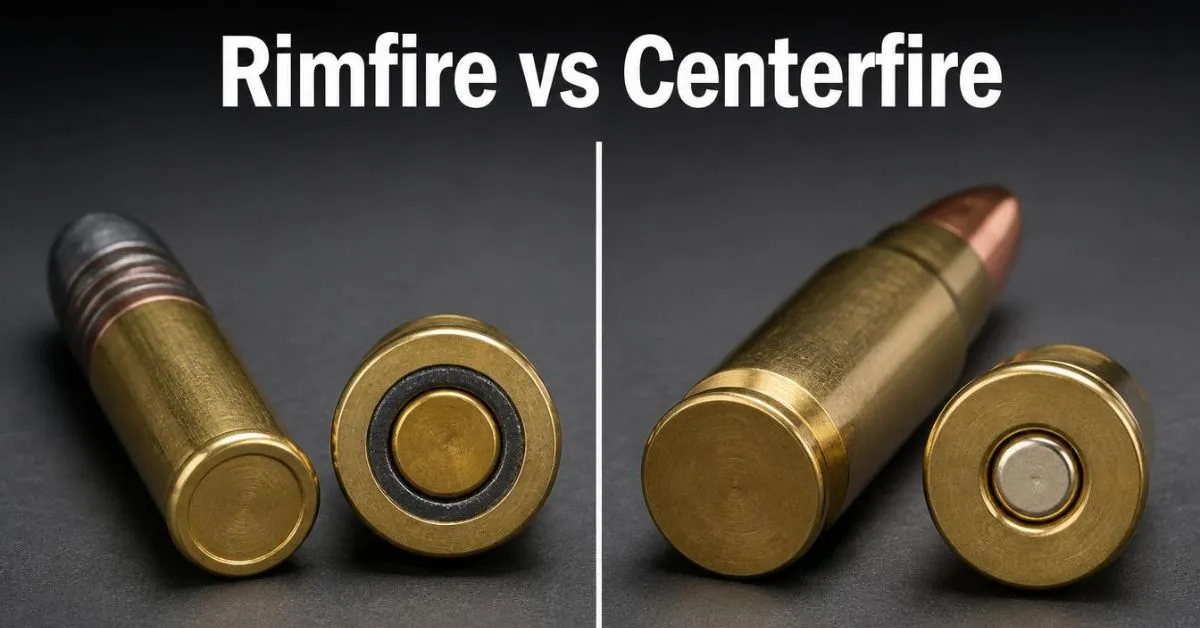
The main difference between rimfire vs centerfire ammunition is where the primer sits. Rimfire cartridges have priming compound inside the case rim.
Centerfire cartridges have a separate primer in the center of the case head. Rimfire ammo often costs less and has low recoil, while centerfire ammo offers a wider range of power levels and uses.
Key Takeaways
- Rimfire and centerfire describe how a cartridge starts the firing process.
- Rimfire ammo, such as .22 LR, often costs less and has low recoil.
- Centerfire ammo includes many common handgun and rifle cartridges.
- Accuracy, range, and recoil depend on the cartridge and firearm, not just the primer type.
- Never use ammunition unless it matches the firearm manufacturer’s specifications.
What Is the Difference Between Rimfire & Centerfire?
Rimfire and centerfire are two types of cartridge ignition systems. Both use a primer to start the process that burns the propellant and sends the bullet down the barrel. The main difference is where the primer sits and how the firing pin strikes it.
In rimfire ammunition, the priming compound sits inside the hollow rim at the base of the case. The firing pin strikes the rim to start ignition.
In centerfire ammunition, a separate primer sits in the center of the case head. The firing pin strikes that primer instead.
| Feature | Rimfire | Centerfire |
| Primer location | Inside the case rim | Center of the case head |
| Common example | .22 LR | 9mm Luger |
| Typical cost per round | Often lower | Often higher |
| Typical recoil | Low in common examples | Varies widely |
| Reloading | Not designed for normal reloading | Many suitable cases can be reloaded |
| Common uses | Target practice and small-game hunting | Handgun sports, rifle shooting, and hunting |
These are general patterns. The exact cartridge, firearm, and intended use matter.
How Does Rimfire Ammunition Work?
Rimfire ammunition has a thin, hollow rim at the base of its case. The maker places the priming compound inside this rim.
When the firing pin strikes the rim, it crushes the metal and sets off the priming compound. This starts the burning process that ignites the propellant.
The propellant creates gas that pushes the bullet through the barrel. The bullet is the projectile that leaves the firearm. It is only one part of the complete cartridge.
Rimfire cases are usually thin because the design must allow the firing pin to crush the rim. This limits the pressure they can safely handle compared with many centerfire designs. It also helps keep many rimfire cartridges affordable.
Common rimfire cartridges
- .22 Long Rifle (.22 LR): Often used for target practice, recreational shooting, and small-game hunting.
- .17 HMR: A rimfire cartridge used for target shooting and some varmint hunting.
- .22 WMR: Also called .22 Magnum. It offers a different performance level from .22 LR.
These cartridges are not interchangeable just because they are all rimfire. A firearm must be designed for the exact cartridge it uses.
How Does Centerfire Ammunition Work?
Centerfire ammunition has a separate primer fitted into the center of the case head. When the firing pin strikes the primer, it starts ignition inside the cartridge.
The burning propellant creates gas that drives the bullet down the barrel. The centerfire design uses a separate primer instead of placing the priming compound inside the case rim.
This design supports a wide range of cartridge sizes and pressure levels. Centerfire ammunition is common in handguns and rifles, from small handgun cartridges to larger rifle cartridges.
Common centerfire cartridges
- 9mm Luger: Common in compatible handguns and some carbines.
- .223 Remington: Used in compatible rifles for target shooting and certain hunting uses.
- .308 Winchester: Used for target shooting and hunting with suitable rifles.
- .45 ACP: A common centerfire handgun cartridge.
Each cartridge has its own size and performance limits. For example, .223 Remington and 5.56 NATO have similar dimensions but are not automatically interchangeable in every firearm. Always check the firearm maker’s guidance.
Rimfire vs Centerfire: 9 Key Differences
1. Primer and Ignition System
The primer location is the main technical difference.
Rimfire uses priming compound inside the case rim. Centerfire uses a separate primer in the center of the case head.
This affects the case design, how the firing pin starts ignition, and how the cartridge is made. It does not, by itself, tell you the cartridge’s accuracy or overall quality.
2. Cost & Availability
Rimfire ammunition often costs less per round. The .22 LR is a common example used for practice and recreation.
Centerfire ammunition often costs more, but prices depend on the cartridge, brand, bullet type, and local supply. Some centerfire options cost less than others.
If you shoot often, the cost per round can make a large difference over time. Still, price should never be the only factor. The ammunition must match the firearm and the job.
3. Recoil & Shooting Comfort
Recoil is the force a shooter feels when a firearm fires.
Many common rimfire cartridges produce low recoil. This can make them more comfortable for practice and for people learning basic shooting skills under proper supervision.
Centerfire recoil varies a great deal. A small handgun cartridge may have manageable recoil, while a large rifle cartridge may produce a stronger push.
Firearm weight, cartridge design, bullet weight, and other factors all affect recoil. So, not every centerfire cartridge has heavy recoil.
4. Reliability
Centerfire ammunition is often seen as more reliable in general use. But neither type is certain to fire every time.
Rimfire ignition depends on the firing pin crushing the rim where the priming compound is present. If ignition fails, the cartridge may not fire.
Centerfire ammunition uses a separate primer, but it can also fail because of poor storage, damage, defects, or firearm problems.
Good ammunition and a well-kept firearm matter with both types. If a cartridge fails to fire, follow the firearm maker’s safety instructions. Do not rush to open or handle it.
5. Accuracy & Range
Neither rimfire nor centerfire is always more accurate. Accuracy depends on the cartridge, firearm, ammunition quality, shooter skill, and conditions.
Some rimfire cartridges are very accurate at suitable distances. Centerfire cartridges also cover a wide range of accuracy levels and uses.
Range works the same way. Some centerfire cartridges can work well at longer distances, but the primer type alone does not set a cartridge’s effective range. Bullet design, speed, wind, and the target all matter.
Do not judge a cartridge by its name alone. Look at the specific cartridge and the firearm maker’s intended use.
6. Power & Performance
Rimfire cartridges are usually built for lower pressure than many centerfire cartridges. This makes them useful for light practice and certain small-game uses.
Centerfire ammunition covers a wider range of performance. Some cartridges are made for handguns, while others are designed for rifles and different hunting or target needs.
More power does not always mean a better choice. The right cartridge depends on the intended use, local laws, and the firearm’s design.
7. Reloading
Rimfire cases are not designed for normal reloading. Their priming compound is built into the rim, so the case does not use a separate primer that can be replaced in the usual way.
Many centerfire cases can be reloaded with the right equipment and components. But not every case is suitable, and a case must be checked for damage.
Reloading needs proper training and reliable instructions. It should not be treated as a simple way to reuse any fired case.
8. Common Calibers
Rimfire and centerfire each include many cartridges, but their common uses differ.
| Type | Examples | Common uses |
| Rimfire | .22 LR | Practice, recreation, small-game hunting |
| Rimfire | .17 HMR | Target shooting, some varmint hunting |
| Rimfire | .22 WMR | Recreation and certain hunting uses |
| Centerfire | 9mm Luger | Handgun shooting |
| Centerfire | .223 Remington | Rifle shooting and certain hunting uses |
| Centerfire | .308 Winchester | Target shooting and hunting |
The word caliber often refers to a bullet’s approximate diameter, while the cartridge name identifies a specific ammunition type. Two cartridges with similar names or sizes may still have different specifications.
9. Noise
Rimfire cartridges often produce less noise than many larger centerfire cartridges, but this is not a rule for every firearm or load.
Noise depends on the cartridge, barrel, firearm, and other factors. A quieter shot can still damage hearing.
Always use suitable hearing protection at a shooting range. Never assume a firearm is safe to fire without protection because it uses rimfire ammunition.
Pros & Cons of Rimfire vs Centerfire
Both types have benefits and limits. The best choice depends on what you need.
| Rimfire advantages | Rimfire limits |
| Often lower cost per round | Fewer high-pressure cartridge options |
| Low recoil in common cartridges | Not designed for normal reloading |
| Good for many practice needs | Can have ignition failures |
| Popular small-game options | Limited compared with centerfire choices |
| Centerfire advantages | Centerfire limits |
| Wide range of cartridge types | Often higher cost per round |
| Options for many firearm types | Recoil can be strong in some cartridges |
| Many cases can be reloaded | Reloading needs skill and proper tools |
| Broad range of performance levels | The correct cartridge must be selected with care |
One important point: a benefit in one area does not make a cartridge best in every area. Low cost, low recoil, and high performance are different things.
Which Type Is Better for Different Uses?
The better choice depends on your goal, budget, and firearm.
| Goal | What to consider |
| Low-cost target practice | Rimfire is often a good option. |
| Learning basic shooting skills | Rimfire can offer low recoil and lower ammunition costs. |
| Handgun shooting | Many common handguns use centerfire ammunition, but rimfire handguns also exist. |
| Small-game hunting | The right rimfire or centerfire cartridge depends on the animal and local law. |
| Larger-game hunting | An appropriate centerfire cartridge is common, subject to local rules and the needs of the hunt. |
| Long-range target shooting | Compare the exact cartridge, firearm, bullet, and conditions rather than the ignition type alone. |
If you are new to shooting, get help from a qualified instructor. Learn how to handle the firearm safely before you use it. Check the owner’s manual and follow all range rules.
Can You Use Rimfire & Centerfire Ammunition in the Same Firearm?
No. Rimfire and centerfire ammunition are not interchangeable. They use different ignition systems and require a firearm made for the correct cartridge.
Never use a cartridge just because it fits inside a firearm. A cartridge can fit and still be unsafe to fire. Check the markings on the firearm and the owner’s manual. If you are unsure, ask the manufacturer or a qualified gunsmith.
Follow these basic safety rules:
- Keep the muzzle pointed in a safe direction.
- Keep your finger off the trigger until you are ready to fire.
- Check the target and what lies beyond it.
- Use only the ammunition listed for your firearm.
- Wear eye and hearing protection.
- If a cartridge fails to fire, follow the manufacturer’s instructions and handle the situation with care.
These steps apply to both rimfire and centerfire firearms.
FAQs:
Is rimfire cheaper than centerfire?
Rimfire ammunition often costs less per round, especially in common options such as .22 LR. Centerfire prices vary by cartridge and brand. Check current prices for the exact ammunition you need, and include the cost of practice when comparing options.
Is rimfire or centerfire more reliable?
Centerfire designs are often viewed as having an ignition advantage, but neither type is free from failures. Ammunition quality, storage, firearm condition, and proper use all matter. A failure to fire should always be handled with care.
Does rimfire have less recoil?
Many common rimfire cartridges have low recoil. Centerfire cartridges vary from mild to strong. The actual recoil depends on the cartridge, firearm weight, bullet, and other factors.
Is rimfire less accurate than centerfire?
No. Rimfire ammunition can be very accurate at distances suited to its design. Centerfire ammunition also varies in accuracy. The firearm, ammunition quality, shooter skill, and shooting conditions all play a role.
Which has a longer range?
Some centerfire cartridges are suited to longer-range shooting, but the primer type alone does not determine range. Cartridge design, bullet speed, bullet shape, wind, and the intended target all matter.
Can you reload rimfire ammunition?
Rimfire cartridges are not designed for normal reloading because the priming compound is built into the case rim. Many suitable centerfire cases can be reloaded, but this requires proper equipment, knowledge, and safe methods.
Is rimfire or centerfire better for beginners?
Rimfire is often a useful starting point for supervised target practice because many rimfire cartridges have low recoil and cost less per round. The right choice still depends on the learner, the firearm, and the training available.
Conclusion:
The key difference in rimfire vs centerfire is how each cartridge starts ignition. Rimfire has priming compound inside the case rim, while centerfire uses a separate primer in the case head.
Rimfire often offers lower costs and less recoil in common cartridges. Centerfire offers a wider range of cartridge sizes and uses. Neither type is always more accurate or better in every situation.
Choose based on your needs, budget, and the firearm’s specifications. Always use the exact ammunition approved for your firearm and follow safe handling rules.