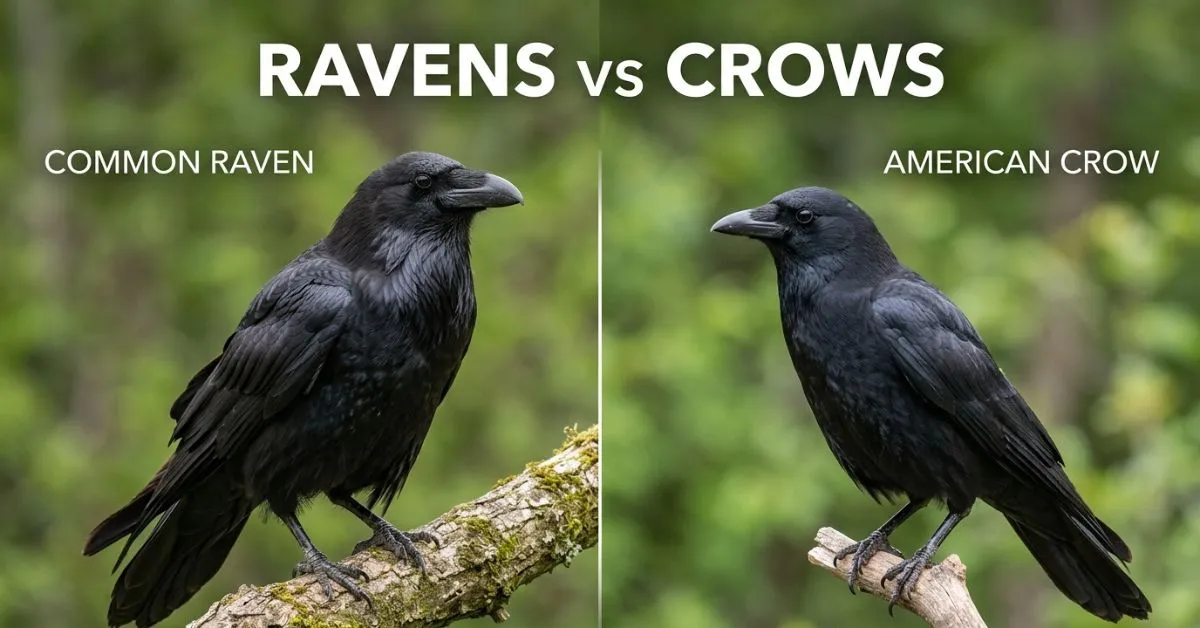
Ravens vs crows: Common Ravens are much larger than American Crows. Ravens have heavier bills, shaggy throat feathers, longer wings, and wedge-shaped tails.
American Crows are smaller, have shorter tails, and often make a familiar cawing sound. To tell them apart, compare their size, shape, calls, and flight instead of relying on one clue.
Key Takeaways
- Size: Common Ravens are much larger than American Crows.
- Bill and neck: Ravens have heavier bills and shaggier throat feathers.
- Tail: Ravens often have wedge-shaped tails in flight. Crows usually have shorter, rounded or squared tails.
- Sound: Ravens often make deep, rough croaks. Crows are known for sharp caws.
- Flight: Ravens have longer, narrower wings. Crows have broader, more rounded wings.
- Behavior: Crows often gather in large groups, but ravens may gather around food, too.
- Best way to identify them: Look at several features together.
Raven vs Crow: Key Differences at a Glance
Common Ravens and American Crows both have black feathers, dark bills, and dark legs. They also belong to the same bird family, called Corvidae.
However, their size, shape, and calls can help you tell them apart.
| Feature | Common Raven | American Crow |
|---|---|---|
| Body length | 22.1–27.2 inches | 15.8–20.9 inches |
| Wingspan | 45.7–46.5 inches | 33.5–39.4 inches |
| Weight | 24.3–57.3 ounces | 11.2–21.9 ounces |
| Bill | Large and heavy | Smaller and less heavy |
| Throat | Long, shaggy feathers | Smoother-looking feathers |
| Tail | Long and wedge-shaped in flight | Shorter and often rounded or squared |
| Wings | Longer and narrower | Broader and more rounded |
| Common call | Deep, rough croak | Sharp, repeated caw |
| Typical social pattern | Often alone or in pairs | Often seen in groups |
| Habitat | Forests, mountains, deserts, and open land | Fields, woodlands, farms, and cities |
Measurements are from Cornell Lab of Ornithology’s species guides. Individual birds vary in size.
The size difference is useful, but it is not the only clue. A distant raven may look smaller than it is. A closer crow may look surprisingly large. Check the bill, tail, wings, and call before making your choice.
1. Size & Wingspan
Size is one of the easiest ways to tell a raven from a crow.
A Common Raven is about 22 to 27 inches long. An American Crow is about 16 to 21 inches long. Ravens also have a much larger wingspan.
Ravens often look big and powerful in flight. Their thick necks, large bills, and long wings add to this impression. Crows look smaller and more compact.
Weight gives another useful comparison. Common Ravens weigh about 1.5 to 3.6 pounds, while American Crows weigh about 0.7 to 1.4 pounds.
These ranges come from Cornell Lab’s bird guides. They describe the species as a whole, not the exact size of every bird.
Quick tip: If a black bird looks unusually large, check its bill and tail. Size alone cannot confirm that it is a raven.
2. Appearance, Beak & Feathers
Both birds look black, so color alone will not help much.
A Common Raven has a large head, a thick neck, and a heavy bill. Its throat feathers are long and shaggy. These feathers can make the front of its neck look rough.
An American Crow has a smaller bill and a smoother-looking throat. Its head and neck often look less bulky than a raven’s.
The bill is a useful clue when you get a clear view. A raven’s bill looks large and strong compared with its head. A crow’s bill is usually less massive.
Feather color can change with light and wear. Black feathers may shine in sunlight. Old or worn feathers may look brownish or dull. Young ravens can also look browner than adults.
These changes do not always mean you are looking at a different species.
Quick tip: Look at the whole bird. A heavy bill, shaggy throat, and large body together point toward a raven.
3. Tail Shape & Flight
Tail shape is one of the best clues when a bird flies overhead.
A Common Raven has a long tail. Its middle tail feathers extend farther than its outer feathers. When the tail spreads, it often looks like a wedge or diamond.
An American Crow has a shorter tail. Its tail feathers are closer in length, so the tail often looks rounded or squared at the end.
Their wings also look different. Ravens have longer, narrower wings with long feathers at the tips. Crows have broader, more rounded wings.
Flight style can help, too.
Ravens often use slow, strong wingbeats mixed with gliding and soaring. They may ride rising air without flapping for a while.
Crows often fly with steady, rowing-like wingbeats. They can glide, but their flight often includes more regular flapping.
These are common patterns, not strict rules. Wind, movement, and the angle of view can change what you see.
Quick tip: Watch the tail and wings together. A long, wedge-shaped tail and long, narrow wings strongly suggest a raven.
4. Calls & Sounds
Sound can be one of the most useful ways to tell these birds apart. You may hear a bird before you see it.
American Crows are known for their sharp, repeated “caw, caw” calls. They also make softer sounds, rattles, and other calls when they interact with nearby birds.
Common Ravens often make a deep, rough croak. Some calls sound gurgling or rattling. Ravens also make harsh and high-pitched calls in certain situations.
| Sound | More likely bird |
|---|---|
| Sharp, repeated caws | American Crow |
| Deep, gurgling croak | Common Raven |
| Unclear or unusual call | Check other clues |
Neither bird makes just one sound. A raven can make sharp calls, and a crow can make rough or rattling sounds.
If you hear a deep croak and see a large bird with a heavy bill, a Common Raven is a strong possibility.
5. Behavior & Social Life
Crows are often seen in groups. They may feed together in fields, call from trees, or gather at night in large groups called roosts.
Some crow roosts contain hundreds or even thousands of birds. Crows also work together to chase away animals that may threaten them or their nests. This behavior is called mobbing.
Ravens are often seen alone or in pairs. However, they can gather where food is easy to find, such as landfills or places with dead animals. They may also gather to rest at night.
So, seeing a group does not prove that you are looking at crows.
Both birds are curious and can learn from experience. They can also change their behavior when they find new food or face danger.
Quick tip: A large group in a city is often made up of crows. Still, check their size, calls, and shape before deciding.
6. Habitat & Range in the United States
Your location can help you identify a black bird, but habitat alone is not enough.
American Crows live across much of the United States. They do well in cities, suburbs, farms, parks, open woodlands, and fields.
Common Ravens live across much of western and northern North America. They use many habitats, including forests, mountains, deserts, grasslands, and coastal areas. They can also live near farms, towns, and some cities.
Here are a few useful regional clues:
- Cities and suburbs: American Crows are common in many parts of the country.
- Western mountains: Common Ravens are a familiar sight.
- Open farms and roadsides: Either species may be present, depending on the area.
- The Southwest: Chihuahuan Ravens can cause confusion because they are closer in size to American Crows than Common Ravens are.
- Parts of the East and Southeast: Fish Crows may look much like American Crows. Their calls can help separate them.
Common Ravens also live in parts of the eastern United States. They are not limited to the West.
If the bird does not match the usual raven or crow features, check the local range of other species.
7. Diet & Intelligence
Ravens and crows are both omnivores. This means they eat both plant and animal food.
Their diets may include insects, seeds, fruit, small animals, dead animals, and food scraps. Both species may search for food near roads, farms, or places where people leave waste.
Their diets depend on what is available. Neither bird eats only one type of food.
Both birds are also known for their intelligence. Crows can learn from experience, remember useful information, and solve problems. Ravens can explore objects, find new ways to get food, and adjust their behavior when a task changes.
Are ravens smarter than crows? There is no simple answer for every skill. Different birds may do better at different tasks. Both species show strong learning and problem-solving abilities.
Intelligence is interesting, but it is not a reliable way to identify a bird in the field. Size, shape, tail, and calls are more useful for that job.
How to Tell a Raven From a Crow
If you see a black bird outside, follow these steps.
Step 1: Listen to the call. A sharp series of caws often points to an American Crow. A deep, gurgling croak often points to a Common Raven.
Step 2: Check its size. Does the bird look much larger than a typical crow? If so, a raven may be a good match.
Step 3: Look at its bill and neck. Ravens usually have a heavier bill and shaggier throat feathers.
Step 4: Watch the tail. A long, wedge-shaped tail points toward a raven. A shorter, rounded or squared tail points toward a crow.
Step 5: Check the wings. Ravens have longer, narrower wings. Crows have broader, more rounded wings.
Step 6: Consider your location. Check which species live in your area. In some places, other crows or ravens may also be present.
Step 7: Combine your clues. Do not make a firm choice based on size, sound, or tail shape alone.
For example, a large black bird with a heavy bill, shaggy throat, long wings, and a deep croak is likely a Common Raven. A smaller bird with a shorter tail, rounded wings, and sharp caws is more likely an American Crow.
If the bird is too far away, wait for a clearer view or listen again. It is better to leave an identification uncertain than to make a guess based on one feature.
Common Mistakes When Identifying Ravens & Crows
A few simple mistakes can lead to the wrong answer.
Mistake 1: Assuming every black bird is a crow.
Other birds, including ravens and grackles, may look black from far away. Look at the body shape, size, and bill.
Mistake 2: Using size alone.
Distance and viewing angle can make a bird look larger or smaller. Check its tail, wings, and call, too.
Mistake 3: Assuming ravens always fly alone.
Ravens often travel alone or in pairs, but they can gather around food and at night.
Mistake 4: Treating tail shape as a perfect test.
A bird’s tail can look different depending on its position. Try to view it when the bird spreads its tail in flight.
Mistake 5: Ignoring local species.
Fish Crows and Chihuahuan Ravens can cause confusion in parts of the United States. Check the bird’s call and local range if its features do not fit.
Mistake 6: Trusting one call without checking the bird.
Both species have several calls. Listen for the overall sound, then compare it with the bird’s size and shape.
FAQs:
Are ravens and crows the same species?
No. The Common Raven (Corvus corax) and American Crow (Corvus brachyrhynchos) are different species. Both belong to the corvid family and the genus Corvus. Their size, shape, and calls help tell them apart.
Are ravens bigger than crows?
Yes. Common Ravens are much larger than American Crows. Ravens measure about 22 to 27 inches long, while American Crows measure about 16 to 21 inches. Ravens also have longer wings and heavier bills.
Do ravens and crows sound different?
Yes. American Crows often make sharp caws. Common Ravens often make deep, rough croaks. Both birds make other sounds, so listening works best when you also check their shape and size.
Can ravens and crows live in the same area?
Yes. Their ranges overlap in parts of the United States. Both may use the same fields, roadsides, or food sources. They may compete for food or chase each other, depending on the situation.
What is a group of crows called?
A group of crows is often called a murder of crows. This is a traditional name, not a scientific term. The word does not describe a special type of crow behavior. A group of ravens is often called a flock of ravens.
Which bird is more common in American cities?
American Crows are common in cities and suburbs across much of the United States. Common Ravens also live near people in some areas, but they are less common in many large eastern cities. The answer depends on the region.
Can you tell a raven from a crow by its tail?
Often, yes. A Common Raven usually has a long, wedge-shaped tail in flight. An American Crow usually has a shorter, rounded or squared tail. Tail shape is a useful clue, but it should not be the only one you use.
Conclusion:
The easiest way to tell ravens from crows is to compare their size, bill, throat feathers, tail, wings, and calls.
Common Ravens are much larger and usually have heavier bills, shaggy throats, longer wings, and wedge-shaped tails. American Crows are smaller, with broader wings, shorter tails, and familiar cawing calls.
Use several clues together, and check for similar local species when needed. This approach will help you make a more accurate identification.

Eric Walker, an author at replyygenius.com, where I create clear and helpful content for readers.
I focus on writing useful, engaging, and easy to understand articles that deliver real value.