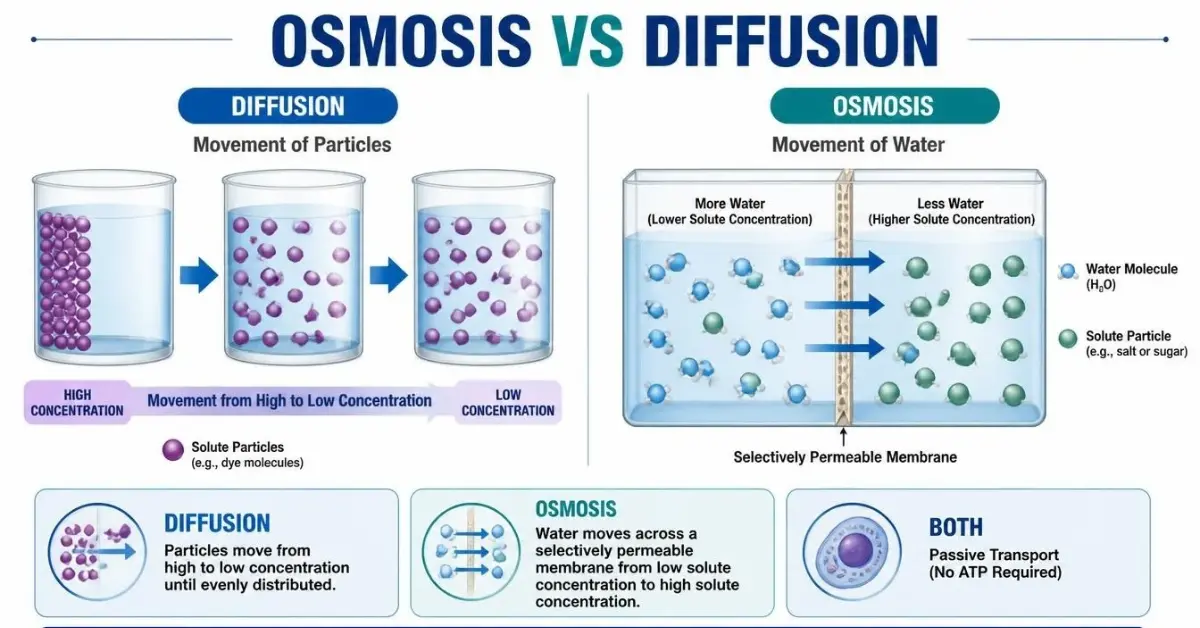
Osmosis vs Diffusion describes two types of passive transport in biology. Diffusion is the movement of particles from an area of higher concentration to an area of lower concentration.
Osmosis is the movement of water across a selectively permeable membrane from a region of higher water concentration to lower water concentration. Both processes happen without cellular energy.
Key Takeaways
- Diffusion moves particles from high concentration to low concentration.
- Osmosis moves water across a selectively permeable membrane.
- Both processes are forms of passive transport and do not require cellular energy.
- Osmosis is a special type of diffusion.
- Diffusion can happen with or without a membrane, but osmosis requires a selectively permeable membrane.
What Is Diffusion?
Diffusion is the natural movement of particles from an area where they are more concentrated to an area where they are less concentrated. Particles are always moving. During diffusion, they spread out until they become evenly distributed.
Diffusion does not require energy from the cell. It happens because particles move randomly and spread through available space. This process is important in living things. It helps cells receive oxygen and release carbon dioxide and other waste products.
How Does Diffusion Work?
Imagine spraying perfume in one corner of a room. At first, most perfume particles are near the spray. Over time, they spread throughout the room. Eventually, people in different parts of the room can smell the perfume.
This happens because perfume particles move from an area of high concentration to areas of lower concentration. The same process happens inside the human body. Oxygen moves from the blood into body cells when its concentration is higher in the blood than in the cells.
Examples of Diffusion
Here are three simple examples:
- Perfume spreading in a room: Perfume particles move through the air and spread across the room.
- Food coloring in water: Color particles spread through water until the color becomes more even.
- Gas exchange in the lungs: Oxygen moves from the air in the lungs into the blood, while carbon dioxide moves from the blood into the lungs.
These examples show how diffusion helps particles spread naturally.
What Is Osmosis?
Osmosis is the net movement of water molecules through a selectively permeable membrane. Water moves from a region with a higher water concentration (lower solute concentration) to a region with a lower water concentration (higher solute concentration).
A selectively permeable membrane allows certain substances, such as water, to pass through while limiting the movement of other substances. Osmosis is important because cells need the right amount of water to maintain their normal shape and function.
How Does Osmosis Work?
Imagine a container divided into two sections by a membrane. One side contains plain water, while the other contains water mixed with salt. Assume the membrane allows water to pass through but does not allow salt to cross.
Water moves from the side with more water and less salt toward the side with less water and more salt. This movement continues until the system reaches equilibrium or another force balances the movement.
Osmosis does not require energy from the cell. Special water channels called aquaporins help water move across many cell membranes.
Examples of Osmosis
Here are three common examples:
- Raisins in water: When raisins are placed in water, water enters them through their outer skin, causing them to swell.
- Plant roots absorbing water: Water moves from the soil into root cells through their membranes.
- Water movement in animal cells: Water moves into or out of cells depending on the concentration of dissolved substances around them.
These examples show why osmosis is essential for water balance in living organisms.
Osmosis vs Diffusion: Key Differences
The main difference between osmosis and diffusion is what moves and whether a selectively permeable membrane is required.
Diffusion involves the movement of different types of particles, while osmosis specifically involves water moving across a selectively permeable membrane.
Osmosis vs Diffusion Comparison Table
| Feature | Diffusion | Osmosis |
|---|---|---|
| Definition | Movement of particles from high to low concentration | Movement of water across a selectively permeable membrane |
| What moves? | Different types of particles | Water molecules |
| Membrane required? | No | Yes |
| Direction | Higher to lower concentration of the diffusing substance | Higher to lower water concentration |
| Energy required? | No | No |
| Main purpose | Spread particles evenly | Balance water concentration |
| Where it occurs | Gases, liquids, and living cells | Across selectively permeable membranes |
| Example | Perfume spreading in air | Raisins swelling in water |
Both processes help substances move naturally, but they differ in the particles involved and the conditions needed for movement.
Why Does Osmosis Need a Semipermeable Membrane?
Osmosis requires a selectively permeable membrane because it separates two solutions while allowing water to pass through. The membrane controls which substances can cross. For example, water may pass through while certain dissolved particles, such as salt or sugar, cannot.
Without this selective barrier, solutes could also move between the two sides, changing the concentration difference that drives osmosis. This is why osmosis is important in cells. The cell membrane controls water movement and helps maintain the correct internal environment.
Similarities Between Osmosis and Diffusion
Although osmosis and diffusion are different, they share several important features.
1. Both are passive transport processes.
Neither process requires the cell to use ATP (adenosine triphosphate) for the movement itself.
2. Both involve particle movement.
Molecules move naturally and spread according to concentration differences.
3. Both help maintain balance.
Diffusion helps distribute substances, while osmosis helps control water balance.
4. Both occur in living organisms.
Cells depend on these processes to exchange materials with their surroundings.
5. Both involve net movement down a concentration gradient.
Particles move from higher to lower concentration of the substance being transported. In osmosis, that substance is water.
How Osmosis Affects Plant and Animal Cells
Osmosis plays an important role in keeping cells healthy. The effect of osmosis depends on the concentration of dissolved substances outside the cell compared with the concentration inside it.
There are three important conditions: hypertonic, hypotonic, and isotonic solutions.
1. Hypertonic Solutions
A hypertonic solution has a higher concentration of solutes outside the cell than inside it.
Water moves out of the cell through osmosis.
- Animal cells lose water and shrink.
- Plant cells lose water, and their cell membranes may pull away from their cell walls.
2. Hypotonic Solutions
A hypotonic solution has a lower concentration of solutes outside the cell than inside it.
Water moves into the cell through osmosis.
- Animal cells swell and may burst if too much water enters.
- Plant cells become firm because their cell walls resist expansion.
3. Isotonic Solutions
An isotonic solution has an equal effective solute concentration on both sides of the cell membrane. Water continues moving in both directions, but there is no net movement of water.
Animal cells generally maintain their normal shape in isotonic conditions. The effects described above are based on the relative concentrations of substances that cannot freely cross the membrane.
Osmosis vs Diffusion vs Active Transport
Osmosis and diffusion are passive transport processes. Active transport works differently because it requires cellular energy.
| Feature | Diffusion | Osmosis | Active Transport |
|---|---|---|---|
| What moves? | Particles | Water | Substances such as ions |
| Energy needed? | No | No | Yes |
| Membrane needed? | Not always | Yes | Usually |
| Movement | Down a concentration gradient | Down a water concentration gradient | Can move against a concentration gradient |
| Example | Oxygen entering cells | Water entering root cells | Mineral ion uptake by root cells |
Active transport allows cells to move substances against their concentration gradients using energy, often from ATP. This makes it different from both osmosis and diffusion.
Common Misconceptions About Osmosis and Diffusion
Some students confuse these processes because they both involve natural particle movement.
Here are three common mistakes to avoid:
Misconception 1: Osmosis and diffusion are completely different processes.
Correction: Osmosis is a special type of diffusion that involves water moving through a selectively permeable membrane.
Misconception 2: Osmosis moves salt or sugar across a membrane.
Correction: Osmosis describes the movement of water. Dissolved substances may move through membranes by other transport processes.
Misconception 3: Both processes require energy.
Correction: Osmosis and diffusion are passive processes. They do not require cellular ATP.
Understanding these points makes it easier to identify each process in biology questions and experiments.
FAQs:
1. What Is the Main Difference Between Osmosis and Diffusion?
Diffusion is the movement of particles from an area of higher concentration to an area of lower concentration. Osmosis is the movement of water across a selectively permeable membrane. The main difference is that diffusion can involve many types of particles, while osmosis specifically involves water.
2. Is Osmosis a Type of Diffusion?
Yes. Osmosis is a special type of diffusion because it involves water molecules moving down their concentration gradient. However, it differs from ordinary diffusion because it requires a selectively permeable membrane.
3. Does Osmosis Require Energy?
No. Osmosis is a passive transport process. Water moves across a selectively permeable membrane without the cell using ATP. The movement happens naturally because of differences in water concentration on the two sides of the membrane.
4. Does Diffusion Require a Membrane?
No. Diffusion does not always require a membrane. It can happen in gases and liquids, such as perfume spreading through air or food coloring spreading through water. However, diffusion can also occur across cell membranes.
5. What Are Three Examples of Osmosis?
Three common examples are raisins swelling in water, plant roots absorbing water from soil, and water moving into or out of animal cells. Each example involves water crossing a selectively permeable membrane because of a difference in water concentration.
6. What Are Three Examples of Diffusion?
Three examples include perfume spreading through a room, food coloring spreading through water, and oxygen moving from the lungs into the blood. In each case, particles move from an area of higher concentration toward an area of lower concentration.
Conclusion:
Understanding Osmosis vs Diffusion becomes easier when you focus on what moves in each Process. Diffusion involves the movement of different particles from high to low concentration. Osmosis specifically involves water moving across a selectively permeable membrane.
Both Processes are forms of passive transport and help living cells maintain balance. The easiest way to remember the difference is that diffusion moves particles, while osmosis moves water.

Olivia Smith is a professional author at ReplyGenius.com, where I create clear and engaging content on communication and writing.