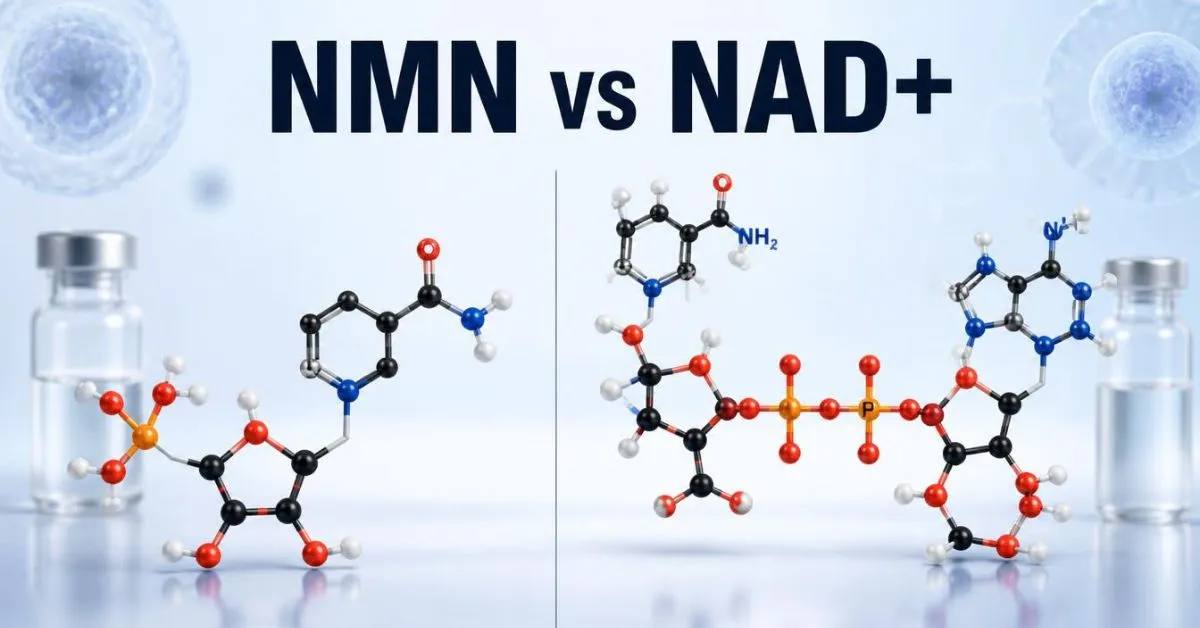
NMN vs NAD+ comes down to one key difference: NMN is a compound your body can use to make NAD+, while NAD+ helps your cells use food for energy and carry out other key tasks.
Both are linked to cell health and aging. Human studies show that NMN can raise NAD+ levels in blood, but neither NMN nor NAD+ has been proven to slow human aging or extend life.
Key Takeaways
- NMN is a precursor your body can use to make NAD+.
- NAD+ helps cells use food for energy and supports other cell functions.
- NMN can raise NAD-related blood markers, but its health benefits remain unclear.
- Oral NAD+ supplements and IV NAD+ treatments have different evidence and risks.
- Neither NMN nor NAD+ has been proven to help people live longer.
- Short-term NMN studies are encouraging for safety, but long-term safety is not known.
What Is NMN?
NMN stands for nicotinamide mononucleotide. It is a compound your body can use to make NAD+.
Your body needs NAD+ to help turn food into energy. It also uses NAD+ in cell signals and in processes that help maintain DNA.
NMN occurs in small amounts in some foods. It is also sold in supplements marketed for cell health and healthy aging.
What Does NMN Do?
NMN helps supply the materials needed to make NAD+. This is why researchers study it as a way to raise NAD+ levels.
Human studies have found that oral NMN can raise NAD-related markers in blood. Researchers are also studying its possible effects on blood sugar, muscle function, physical performance, and other signs of health.
However, these possible benefits are not proven. A rise in NAD+ levels does not mean that a person will feel more energetic, gain strength, or age more slowly.
What Is NAD+?
NAD+ stands for nicotinamide adenine dinucleotide. It is a coenzyme found in your cells.
A coenzyme helps enzymes carry out chemical reactions. NAD+ plays a key role in how cells get energy from food. It also supports cell signals, gene control, and processes that help maintain DNA.
Why Is NAD+ Important?
NAD+ supports several key cell functions:
- Energy: It helps cells turn energy from food into a form they can use.
- Cell care: It helps enzymes carry out tasks linked to DNA repair.
- Metabolism: It supports chemical reactions that help the body use food.
- Cell signals: It helps control signals that guide cell activity.
NAD+ levels can vary with age, health, tissue type, and other factors. Some studies report age-related changes, but the pattern is not the same in every person or tissue.
This does not mean that everyone needs an NAD+ supplement. Researchers are still studying when changes in NAD+ matter for health and whether supplements can improve important health outcomes.
NMN vs NAD+: Key Differences
NMN and NAD+ are related, but they are not the same. NMN is a precursor, which means the body can use it to make another compound. NAD+ is the coenzyme that cells use in many important reactions.
| Feature | NMN | NAD+ |
|---|---|---|
| Full name | Nicotinamide mononucleotide | Nicotinamide adenine dinucleotide |
| Main role | Helps supply material for NAD+ production | Supports energy-related reactions and other cell tasks |
| Role in the body | Precursor | Coenzyme |
| Oral supplements | Human studies show higher NAD-related blood markers | Evidence for health benefits from direct oral NAD+ is limited |
| Anti-aging evidence | Not proven to slow human aging | Not proven to slow human aging |
| Long-term safety | Not fully known | Depends on the form and route; long-term evidence is limited |
The main difference: NMN is a way the body can make NAD+. NAD+ is the molecule used in many cell processes.
There is no clear clinical evidence that one is the best choice for every goal. Results also depend on what is being measured. Raising a blood marker is not the same as improving health.
How Does NMN Turn Into NAD+?
Your body makes NAD+ through several pathways. NMN is part of one of them.
In simple terms, the process works like this:
- You take an NMN supplement.
- The body digests and processes the compound.
- NMN or related compounds can enter pathways used to make NAD+.
- Cells use NAD+ in energy-related reactions and other tasks.
This is a simplified view of a complex process. Researchers are still studying how oral NMN is absorbed, processed, and used in different tissues.
Taking NAD+ directly is different. NAD+ found in food can be broken down in the gut, and the body can use the resulting compounds to make NAD+. But this does not tell us exactly how an oral NAD+ supplement affects NAD+ levels inside human cells.
For this reason, it is not safe to assume that oral NAD+ works better than NMN just because the product contains NAD+ itself.
NMN vs NAD+ for Anti-Aging & Energy
Both NMN and NAD+ are linked to healthy aging because NAD+ supports key cell functions. But a role in cell health does not prove that a supplement slows aging.
Which One Raises NAD+ Levels?
NMN has human evidence showing that it can raise NAD-related blood markers.
A randomized, double-blind trial published in npj Aging in September 2026 studied adults aged 65 and older. Participants took 1,250 mg of NMN each day or a placebo for 24 weeks.
The study found that NMN raised NAD+ and related compounds in blood. However, it did not find significant improvement in the main hearing outcome or in physical performance measures. Some other results were exploratory and did not remain significant after correction for multiple testing.
This trial supports one finding: NMN can raise NAD-related blood markers. It does not prove that NMN improves overall health or slows aging.
Which One Is Better for Energy?
Neither supplement has been proven to boost daily energy in all healthy people.
NAD+ helps cells use energy from food. NMN may help raise NAD+ levels. But these facts do not prove that taking either product will reduce tiredness or improve exercise performance.
If you often feel tired, look at sleep, diet, stress, medicines, and possible health problems. A supplement should not replace finding the cause of ongoing fatigue.
Which One Is Better for Longevity?
Neither NMN nor NAD+ has been shown to extend human life.
Some animal studies have found benefits from raising NAD+ levels. But results in animals do not prove that the same approach will prevent disease or extend life in people.
A 2026 systematic review of NAD+-boosting methods found that human results for health and physical function were mixed. It found no eligible clinical outcome trials testing IV or injected NAD+ itself for anti-aging or general wellness.
Claims that these supplements reverse aging or help people live longer go beyond the current evidence.
NMN vs NAD+ vs NR: What Is the Difference?
NR stands for nicotinamide riboside. Like NMN, it is a precursor the body can use to make NAD+.
Niacin and nicotinamide are forms of vitamin B3. The body can also use them to make NAD+.
| Compound | What It Is | Main Point |
|---|---|---|
| NMN | A NAD+ precursor | Can raise NAD-related blood markers in human studies |
| NR | Another NAD+ precursor | Also has human research on NAD-related markers |
| NAD+ | A coenzyme | Supports energy-related reactions and other cell functions |
| Niacin | A form of vitamin B3 | The body uses it to make NAD+ |
| Nicotinamide | Another form of vitamin B3 | Also supports NAD+ production |
These compounds are related, but they are not interchangeable. They enter the body’s NAD+ pathways in different ways, and their evidence for health effects can differ.
There is no clear proof that NMN is better than NR for long-term health. There is also not enough evidence to show that taking more than one NAD+ precursor gives better results.
Can You Take NMN and NAD+ Together?
There is not enough evidence to show that taking NMN and NAD+ together provides extra health benefits.
Both are linked to NAD+ levels, but using both does not mean you will get twice the benefit. The best dose, long-term effects, and value of this combination have not been established by strong human trials.
Using more products can also raise costs and make side effects harder to trace.
If you take medicine, have a health condition, or plan to combine supplements, ask a health care professional first.
NMN vs NAD+: Safety & Side Effects
Short-term human studies suggest that oral NMN is often well tolerated. However, researchers do not yet know enough about its long-term safety.
A 2026 systematic review and meta-analysis examined 15 trials of NMN or related preparations. Doses ranged from 250 to 2,000 mg per day, and studies lasted from 14 days to 24 weeks. The review found no clear increase in overall adverse events or liver enzyme levels.
It also found no significant benefit for several common measures, including body weight, blood sugar, HbA1c, and blood fats. The authors called for larger and longer studies.
These results are useful, but they do not prove that NMN is safe for years of use or for every person. They also do not establish the safety of IV NAD+ treatment.
Keep these points in mind:
- Side effects: Stop taking a supplement and seek medical advice if you have a serious or troubling reaction.
- Long-term use: Research has not established the effects of taking NMN for years.
- Pregnancy or breastfeeding: Safety is not well known. Do not use these products unless your health care professional advises you to.
- Health conditions or medicines: Ask a health care professional whether the product is right for you.
- Product quality: Check the ingredient list, dose, manufacturer, and available testing details. A quality seal does not prove that a supplement works.
What About NAD+ IV Therapy?
Some clinics offer NAD+ through a vein. This is different from taking an oral supplement.
IV treatment puts a substance into the bloodstream, but that alone does not prove it will improve aging, energy, or health. A 2026 systematic review found no eligible clinical outcome trials of IV or intramuscular NAD+ itself for anti-aging or general wellness.
IV treatment also carries risks, including problems at the injection site and possible reactions during treatment. The safety and benefit of a specific treatment depend on the product, dose, setting, and person’s health.
Do not assume that IV treatment works better because it costs more or is given in a clinic.
Are NMN Supplements Approved to Treat Disease?
NMN and NAD+ supplements should not be treated as approved medicines for aging or disease.
In the United States, the FDA does not approve dietary supplements for safety and effectiveness before they are marketed in the same way that it approves prescription drugs. NMN also has a specific regulatory history.
The NIH Office of Dietary Supplements reports that the FDA took the position in November 2022 that NMN could not legally be marketed as a dietary supplement because it had been authorized for investigation as a new drug.
Regulatory records can change, and ingredient notifications are not the same as FDA approval of a product. Do not stop or replace a prescribed treatment with a supplement.
Which Should You Choose: NMN or NAD+?
There is no proven best choice for everyone. The right question is what you want to achieve and if there is good evidence that the product can help.
- If your goal is to raise NAD+ levels: NMN has direct human evidence for raising NAD-related blood markers.
- If your goal is to slow aging: Neither NMN nor NAD+ has proven this benefit in humans.
- If your goal is more daily energy: Neither is a proven fix for tiredness.
- If you are considering IV treatment: Evidence for anti-aging and general wellness benefits remains limited.
- If you have a health condition or take medicine: Ask a health care professional before using either product.
For most people, it makes sense to focus first on habits with stronger evidence for health. Get enough sleep, eat a balanced diet, stay active, and have ongoing health problems checked.
FAQs:
Is NMN Better Than NAD+?
NMN has human evidence showing that it can raise NAD-related blood markers. But there is no clear winner for anti-aging, energy, or longer life. A change in blood markers does not prove that a person will feel or function better.
Does NMN Increase NAD+ Levels?
Yes. Human trials have found that oral NMN can raise NAD+ and related markers in blood. The size of the change can vary. It is still not clear how much this change improves health over time.
Can NAD+ Be Taken by Mouth?
NAD+ is sold in oral products, but evidence that these products improve health is limited. The body can break down NAD+ from food in the gut, but this does not establish how an oral supplement affects NAD+ inside human cells.
Can You Take NMN and NAD+ Together?
There is not enough evidence to show that taking both is better than taking one. Ask a health care professional before combining supplements, especially if you use medicine or have a health condition.
Is NMN Safe for Daily Use?
Short-term trials suggest that NMN is often well tolerated, but its long-term safety is not known. Safety also depends on the product and the person using it. Speak with a health care professional before starting daily use.
Does NAD+ Decline With Age?
Some studies find age-related changes in NAD+ levels, but the pattern differs across tissues and people. Researchers are still studying when these changes affect health and whether supplements can help.
Conclusion:
NMN and NAD+ are linked, but they are not the same. NMN is a precursor the body can use to make NAD+. NAD+ helps cells use food for energy and carry out other key tasks.
Human studies show that NMN can raise NAD-related blood markers. Yet neither NMN nor direct NAD+ supplements have been proven to slow human aging or extend life. Evidence for IV NAD+ wellness treatment is also limited.
Before choosing either product, look at the evidence, the risks, and your own health needs. Do not rely on bold anti-aging claims. Good sleep, a balanced diet, regular activity, and proper medical care remain key parts of healthy aging.