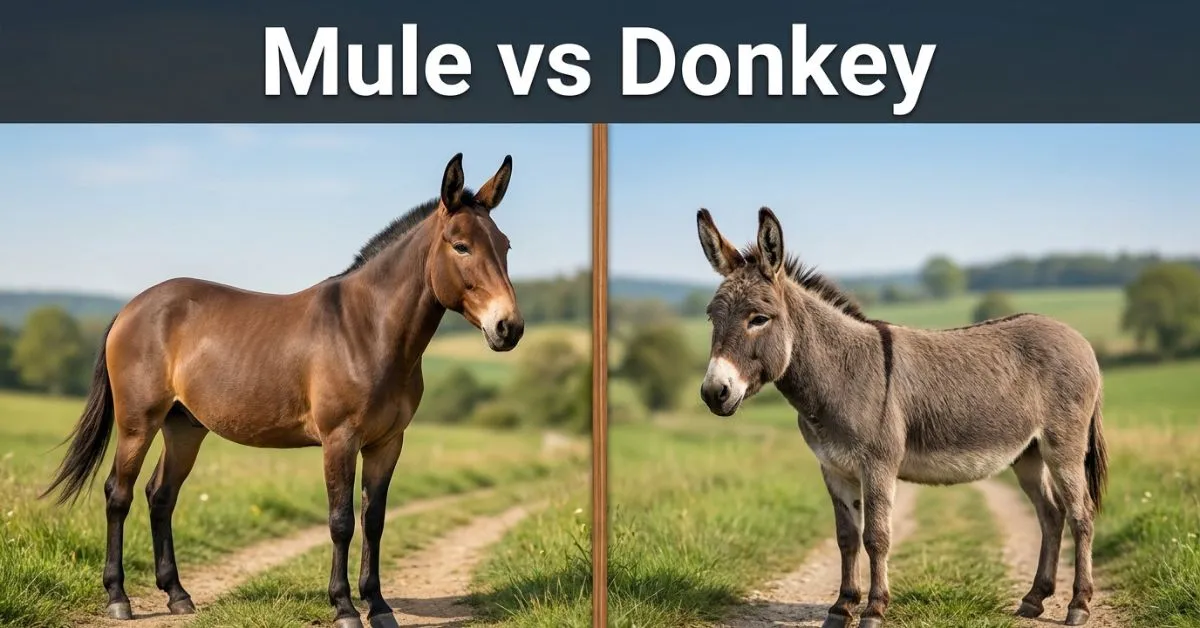
The main difference between a mule and a donkey is their parentage. A donkey is its own species, while a mule is a hybrid born from a male donkey and a female horse.
Mules often have a more horse-like body, while donkeys tend to have shorter, sturdier bodies and long ears. Donkeys can reproduce with other donkeys, but mules are almost always infertile.
Key Takeaways
- A mule is the offspring of a male donkey and a female horse.
- A donkey is a distinct species that can reproduce with other donkeys.
- Mules often look more like horses, but their size and shape can vary.
- Both animals can carry loads, pull equipment, and help with farm work.
- Mules usually cannot reproduce because their chromosomes do not pair well during the making of reproductive cells.
- Both animals need suitable food, shelter, hoof care, and regular health checks.
What Is the Difference Between a Mule and a Donkey?
The main difference is how each animal is born.
A donkey is a member of the horse family and belongs to its own species. People have used donkeys for thousands of years to carry goods, pull carts, and help with farm work.
A mule is born when a male donkey, called a jack, mates with a female horse, called a mare. A mule gets traits from both parents. It may have a horse-like body with some donkey features, such as long ears.
Both animals can be useful working animals and companions. The best choice depends on the animal’s size, health, training, and the job it needs to do.
The key point is simple: a donkey is a species, while a mule is a hybrid. A hybrid is an animal born from parents of two different species.
Mule vs Donkey: Key Differences at a Glance
| Feature | Mule | Donkey |
|---|---|---|
| Parentage | Male donkey and female horse | Male and female donkeys |
| Type | Hybrid | Distinct species |
| Body | Often more horse-like | Often compact and sturdy |
| Ears | Usually long | Often very long for its body size |
| Mane | May be longer than a donkey’s mane | Often short and upright |
| Tail | May look more horse-like | Often ends in a tuft of long hair |
| Voice | May bray or make horse-like sounds | Known for its bray |
| Chromosomes | Usually 63 | 62 |
| Fertility | Almost always infertile | Can reproduce normally |
| Common uses | Riding, packing, pulling, and farm work | Packing, farm work, and companionship |
These traits are common, not fixed rules. Size, coat color, body shape, and behavior vary with the animal’s parents, breed, health, and training. Parentage is the clearest way to tell the two apart.
How Can You Tell a Mule From a Donkey?
You can look at an animal’s body, ears, mane, and tail. These features can offer clues, but no single feature proves whether an animal is a mule or a donkey.
1. Body Size & Shape
Mules often have longer legs and a taller body than many donkeys. Their shape may look more like a horse because one parent is a horse.
Donkeys often have a compact, sturdy body. However, donkeys come in different sizes, and some breeds are quite tall.
Can size alone tell them apart? No. A small mule may be shorter than a large donkey. Their parentage is a more reliable way to know.
2. Ears, Mane & Tail
Donkeys are known for their long ears, which often look large compared with their bodies.
Mules also have long ears, but their ears may look shorter in proportion to a larger body. A mule may have a longer mane than a donkey’s short, upright mane. Its tail may also show more horse-like traits.
Still, these features can overlap. Coat color, ear length, mane shape, and tail shape are clues, not proof.
3. Voice & Behavior
Donkeys are known for their loud bray. Mules may bray, whinny, or make a mix of sounds from both parents.
People sometimes call mules stubborn. But this label can hide the real cause of a problem. A mule may stop because it feels unsafe, feels pain, or does not understand what a person wants.
Donkeys can also stop when they face something new or feel at risk. Both animals need calm handling, clear training, and time to build trust.
Are Mules Stronger Than Donkeys?
Mules are often used for riding, carrying loads, and pulling equipment. A large, fit mule may be well suited to work that needs strength and endurance.
But not every mule is stronger than every donkey. A large donkey may be better suited to a task than a small or unfit mule.
An animal’s working ability depends on its size, age, health, training, and the task. The ground and weather also matter.
Both animals need a load that suits their size and fitness. Too much weight can cause pain or injury. If you plan to use either animal for work, ask an experienced handler or vet what is safe for that animal.
Which Is Better for Rough Ground?
Both donkeys and mules can travel over uneven ground. Their ability depends on the animal, its training, its fitness, and the path.
Mules are often used for riding and packing in rough areas. Donkeys have also been used as pack animals for a long time. Neither animal is sure-footed in every setting, and neither should carry heavy loads without proper training and care.
Can Mules & Donkeys Reproduce?
Yes. Donkeys can reproduce with other donkeys. Mules are almost always infertile, which means they usually cannot have offspring.
The reason is linked to their chromosomes. Chromosomes carry genetic information inside the body’s cells.
- Horses usually have 64 chromosomes.
- Donkeys have 62 chromosomes.
- Mules and hinnies usually have 63 chromosomes.
A mule gets one set of chromosomes from its horse mother and one set from its donkey father. Because the two sets differ, many chromosomes cannot pair up in the usual way when the body makes sperm or eggs. This makes normal reproduction very difficult.
Rare cases of female mules having offspring have been reported. So, it is more accurate to say that mules are almost always infertile rather than saying that every mule is completely unable to reproduce.
What Is a Hinny?
A hinny is another type of horse-donkey hybrid. The main difference is which parent is the horse and which is the donkey.
- Mule: Male donkey + female horse.
- Hinny: Male horse + female donkey.
Mules and hinnies can look alike. Their size and body shape depend on their parents, so it may be hard to tell them apart just by looking.
Hinnies also usually have 63 chromosomes and are almost always infertile.
Which Is Better for Riding, Farm Work, or Carrying Loads?
The best choice depends on the job. Neither animal is always better.
| Need | What to consider |
|---|---|
| Riding | A calm, healthy, well-trained mule may be a good choice. |
| Carrying loads | Choose an animal whose size and fitness match the load. |
| Farm work | Both can help with farm tasks when trained for the job. |
| Rough trails | Consider the animal’s training, fitness, and the ground. |
| Breeding | Donkeys can reproduce normally; mules are almost always infertile. |
| Companionship | Both can bond with people and other suitable equines. |
Before choosing an animal, check its age, health, behavior, and training. Also plan for feed, shelter, hoof care, and vet visits. These costs and needs matter over the animal’s whole life.
Do Mules & Donkeys Need Different Care?
Yes. Mules and donkeys share many care needs, but their body shape, diet, and health needs may differ. Donkeys and mules should not simply be treated as small horses.
Here are the main care needs for both animals:
- Food and water: Provide clean water and a diet that fits the animal’s body and workload. Avoid overfeeding.
- Hoof care: Check the hooves often and arrange trimming as needed. A general care interval is about 6–8 weeks, but the right schedule depends on hoof growth, condition, and the advice of a qualified professional.
- Dental care: Have the teeth checked by a qualified equine dental professional or vet.
- Shelter: Provide a dry place to rest and protection from harsh weather.
- Social contact: Allow safe contact with suitable equines when possible.
- Health checks: Watch for changes in eating, walking, or behavior. Ask a vet about vaccines and parasite control.
Donkeys can gain too much weight if they eat more energy than they use. Mules also need a diet that suits their size and work. A vet can help set a suitable feeding plan.
How Long Do Mules & Donkeys Live?
There is no single lifespan that applies to every mule or donkey. Both can live for many years, but their lifespan depends on genetics, health, food, living conditions, and the work they do.
Good care can help both animals stay healthy. A suitable diet, regular hoof and dental care, safe shelter, and early treatment of illness all matter.
Do not choose between a mule and a donkey based on lifespan alone. Ask about the animal’s age, health records, past work, and daily care.
FAQs:
Is a mule a donkey or a horse?
A mule is a hybrid of a donkey and a horse. Its father is a male donkey, and its mother is a female horse. It is not the same as a pure donkey or a pure horse.
Is a mule bigger than a donkey?
A mule is often larger than many donkeys, but not always. Both vary in size due to their breed and parentage. A large donkey can be taller than a small mule, so size alone is not a sure way to tell them apart.
Can a mule have a baby?
Mules are almost always infertile, but rare cases of female mules having offspring have been reported. Most mules cannot reproduce because their chromosomes do not pair well during the making of reproductive cells.
What is the difference between a mule and a hinny?
A mule has a male donkey as its father and a female horse as its mother. A hinny has a male horse as its father and a female donkey as its mother. Both are hybrids and are usually infertile.
Are donkeys more stubborn than mules?
There is no simple rule that one is more stubborn than the other. Both may stop or resist when they feel afraid, confused, or uncomfortable. Calm training and a clear understanding of their behavior are more useful than calling an animal stubborn.
Which is better, a mule or a donkey?
Neither is always better. A mule may suit riding, packing, or pulling work. A donkey may suit transport, farm work, or companionship. The right choice depends on the animal’s health, size, training, and the job you need it to do.
Conclusion:
The main difference between a mule and a donkey is their parentage. A donkey is its own species and can reproduce normally. A mule is a hybrid born from a male donkey and a female horse, and it is almost always infertile.
Mules often have a more horse-like body and may be used for riding, carrying loads, and pulling equipment. Donkeys are known for their long ears, sturdy build, and distinctive bray. Both can be useful working animals when they receive proper care and training.
The easiest fact to remember is this: a mule is a horse-donkey hybrid, while a donkey is its own species. Size, ears, and behavior can offer clues, but parentage is the clearest difference.

Olivia Smith is a professional author at ReplyGenius.com, where I create clear and engaging content on communication and writing.